PRIME Minister Rick Houenipwela’s government appears to be defying a High Court Order that it pays Lever Solomons Ltd $50 million in compensation for the Hell’s Point land in east Honiara.
Judge Rex Faukona made the initial Order on November 2 last year after Lever Solomons Ltd successfully sought the High Court Order.
In it, Justice Faukona ordered that “all persons occupying the lands subject of these proceedings be removed permanently”.
The High Court also ordered that the Defendant (government) pay LSL “a sum of $50,000,000 (fifty million Solomon Islands dollars) together with any sum not already paid to the Claimant by or on behalf of the Defendant in respect of the parcels of land known as Bloody Ridge and more specifically mentioned in the Schedule attached hereto; and
“Upon payment in full of the sums referred to in the foregoing order, the Claimant is to transfer the said lands to the Defendants forthwith,” it says.
The High Court has also ordered that the government pays the claimant’s costs in the proceedings.
Justice Faukona has since issued an enforcement order as well as a Certificate of Orders after delays by the government in making the payment.
Sources told Island Sun in the Chinese capital, Beijing, on the weekend that LSL has again successfully sought a High Court for the payment after the government reneged on its commitment to make the payment by April this year.
The new Order issued on May 23 this year gave the government 12 months to pay up.
To date, the government has only paid LSL $10 million for the Bloody Ridge land nearby.
When contacted, businessman Patrick Wong who is handling the matter, declined to comment except to say he is talking to the government about it.
A background piece on the Hell’s Point saga is on page 6 today.
THE Provincial Police Commander Western Province, Chief Superintendent Mathias Lenialu appeals to the people in Gizo to celebrate the 40th anniversary of independence responsibly.
Celebrations began yesterday and will continue until tomorrow.
Police in Gizo are mounting an operation to ensure the celebration goes on peacefully.
“I want to appeal to the people residing in Gizo and also to those visiting from our islands to celebrate this anniversary responsibly,” says PPC Lenialu.
“Let us celebrate peacefully with pride and make these celebrations free of crime.
“Police from Gizo, Noro and Munda will also be mounting a parade on July 6 at the JFK Stadium in Gizo and it is open to the public to come along and join in our Nation’s 40th anniversary of independence.”
POLICE at Auki in the Malaita province have arrested three suspects for allegedly stealing money during a boat trip from Honiara to Auki on June 30, 2018.
Supervising Provincial Police Commander (PPC) for Malaita province Superintendent Timothy Apaesi says, “The victim was travelling from Honiara to Auki on one of the local inter-island boats with more than $17,000 cash in her bag. During the trip she put her bag as her pillow and went to sleep.
“It was when she was asleep that the alleged suspect came and unzipped the bag and removed all the money without her realising it.
“On Monday June 2, 2018, the matter was reported to the police and following investigations police apprehended the suspect.
“He was arrested after which he revealed that there were two others with him when he alleged stole the money. Police was able to recover some of the stolen money.
“The three suspects, all about 25 years old, have been placed in police custody awaiting a remand application within the next 14 days. Investigations are continuing into the matter and still yet to recover rest of the money,” says PPC Apaesi.
Students performing at the opening ceremony of the 6th MACFest on Sunday 1st July at Lawson Tama.
By Gary Hatigeva
STUDENTS who took part in the opening ceremony of the Melanesian Arts and Culture Festival (MACFest) on Sunday, have questioned the nature in which payments for their performances were made.
The students expressed their disappointment over the fact that payments for their participation in the event, were paid to schools and not them.
With so much anticipation to get small incentives in the form of allowances for their participation, students were only told on Monday that the funds were paid to their respective schools.
The displeased students told Island Sun that they were disappointed as they were not told about the payment arrangement.
They claimed that based on what they were told by the organisers, their performance allowances will be paid to schools represented.
However, with dismay, one of the students who asked not to be named expressed that their schools should never be given the allowances because the MACFest is done during the holiday period, and that they are the ones doing all the hardwork, not the schools.
“Even during our practice sessions prior to the opening, our schools never cared to help out in terms of transportation and food or drinks.
“Knowing that they will be paid the allowances, which we deserved, they should at least showed the courtesy to help us out, in that way, it would have been common sense to realise that we also owe it to our schools, but that was never the case,” the student alleged.
Students performing at the opening ceremony of the 6th MACFest on Sunday 1st July at Lawson Tama.
Other students also agreed and added that in their case, they were only transported three times by their school vehicle, but the rest of the sessions, the costs of traveling to and fro, water and other necessary items, were met at their own expense.
But when questioned on the claims, Festival Director, Denis Marita explained that regarding the students’ issue, the respinsible sub-committe dealt directly with the school administrations on things.
“Any form of ‘token of appreciation’ to the students will go directly to the school administrations and they will sort out this with their students.”
The event’s director, who is also the Director for Culture under the Ministry of Culture and Tourism, further explained that any decision whether to give individuals cash or host a picnic for the students, is up to school administrations to decide on.
“Note that the National Organising Committee does not have the necessary funds to pay huge lump sums to individual performer/ student, as such, we deal directly with school administrations on this matter and negotiate on just a package for the school on behalf of their students,” the MACFest Director added.
However, on a more positive note, Marita revealed that schools whose students took part in the ceremony, were also given the opportunity to put up stalls at the festival venues, “for their contributions in this regard”.
Over 300 students from three schools in Honiara took part in the performances that were done during the colourful opening programme over the weekend.
Solomon Islands without national security policy, gov’t scrambles for one
BY JENNIFER KUSAPA
DESPITE being 40 years old, Solomon Islands still does not have a national security policy (NSP), says Minister of Justice and Legal Affairs, Mr Derrick Manuari.
National security policy is the overall strategy a government takes to advance national security and the course of action it pursues to accomplish the strategy. It is one of the elements which enables a government to ‘ensure domestic tranquillity’ and ‘promote the general welfare’.
Opening a national security consultation workshop on Wednesday, Manuari says the lack of such policy has rendered Solomon Islands’ government handicapped to address its security challenges ‘in a coherent, consistent and coordinated manner’.
Manuari says therefore the government of the day has made it one of its priorities to ensure Solomon Islands has one such policy.
“Government in valuing and recognising the importance of NSP and sovereignty of Solomon Islands, affirm its commitment to establish a long term vision for a safe, peaceful and prosperous Solomon Islands.
“In doing so the Government has placed priority in its policy framework to establish a NSP that encompasses the whole of SIG approach of all stakeholders to cooperate in addressing security threats of country.
“The absence of an effective NSP and strategy in place gives rise to all sorts of security challenges confronting us internally and externally, and the ineffectiveness for Solomon Islands as a country to effectively address these challenges.
“The Government’s primary responsibility is the safety and well-being of its people. To achieve this, it is important to have a strategic framework that provides security to Solomon Islands and our people.”
He says in a world of uncertainties where threats are real, it is imperative that government reviews its security apparatus and establish a cohesive system which would enable it to respond to any security challenges.
“This proposed policy represents a major milestone, it fulfils the government’s commitment to provide enhanced security for its entire people.”
And, while addressing the country’s security challenges, government believes that everyone needs to work together ‘to ensure a secured, safe environment and ultimately prosperity in Solomon Islands’.
“Therefore important that we must all collectively work together to develop a NSP that is home grown and is relevant to our needs and aspirations for a safe, secured, peaceful and prosperous Solomon Islands.
“I believe that our new National Security Policy that is currently being developed will identify the security challenges facing Solomon Islands and will also identify the strategies in dealing with the threats.”
Some of the archers who will leave for New Caledonia on Thursday
BY ROMULUS HUTA
Some of the archers who will leave for New Caledonia on Thursday
SIX archers destined for New Caledonia will leave the country on Thursday.
The archers will travel to participate in the Oceania Archery Championship due to place in Noumea from July 9 to 13.
Archers selected to participate in the Oceania event includes three male and three female namely Andrew Lano, Piper Soper, Kelly Baedonga, Janet Siru, Nancy Pize and Doris Laula.
The six archers were selected from last month’s national archery championship sponsored by C & I Distributors.
The national championship was held at the Town Ground Rugby Stadium and attracted up to 20 competitors.
The Oceania Archery Championship is expected to bring together archers from 12 Oceania countries namely Australia, Fiji, Kiribati, New Caledonia, New Zealand, Norfolk Island, Palau, Papua New Guinea, Samoa, Tahiti, Tonga and Vanuatu.
Following the completion of the championship, the Oceania Archery Congress will also be convened for top officials as well as a Level Two Olympic Solidarity Coaching Course from July 16 to 24 to be conducted by Pascal Colmaire of World Archery.
Solomon Islands will be represented in the coaching course by Lano and Laula while Archery Federation President Nihal Seneviratne will represent the country in the Oceania Congress.
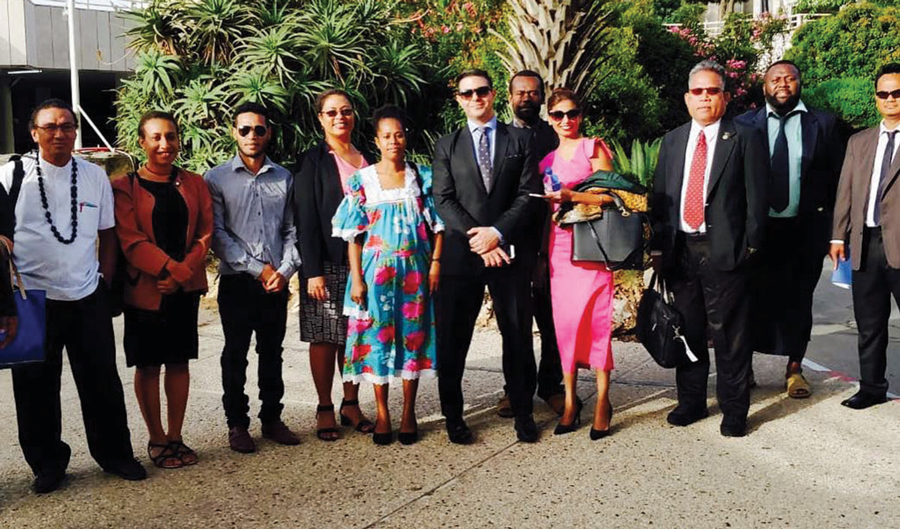
Members for the Pacific Media team team in Israel.
BY MIKE PUIA
Members for the Pacific Media team team in Israel.
IN a word, the State of Israel is simply “amazing”. This is why I decided to use this word for this series. This series is intended to share my experience whilst in Israel.
My travel to Israel started on 11th June 2018. I arrived back in Honiara on 26th June 2018. I spend eight days in Israel while the other eight days were for traveling to Israel and back.
Before I start, let me thank the Israeli Ministry of Foreign Affairs for giving me, and my pacific colleagues, the opportunity of a lifetime to visit and learn about Israel.
Israel is well known to Solomon Islanders. Most learn about this place through the bible. This is where the story of Jesus, the son of God who saves human kind, took place.
Jesus was born in Bethlehem, raised in Nazareth, does most of his work around Galilee and was crucified in Calvary. All the places and sites recorded in the story of Jesus are found in Israel. This is why Israel is called the holy land.
Others learn about Israel through secondary school history studies. The famous six days war was fought by Israel. Maybe others learn about Israel through the news. News seems to tell more about bombing between Israel and its neighbouring Arab nations. I learn about Israel probably through everything above- bible, school text books and news.
So, my travel started four days early. I arrive in Nadi, Fiji, on 11th June and spend four days there before I continue to Seoul, South Korea, on board a Korean Air flight. It was a 10 hour flight.
On arrival in Seoul, I was told I have been arranged to accommodate in a hotel outside Seoul’s terminal. My other colleagues from Vanuatu and Papua New Guinea were not allowed to go out of the terminal. That means I don’t need a visa to enter Seoul. I prefer an accommodation inside the terminal and that was arranged.
The next day, we boarded another Korean Air flight to Tel Aviv, the second most populous city in Israel after Jerusalem.
After 12 hour in the air, we were above the Mediterranean Sea through Turkey on the north. Looking across the horizon, eastward, are Tel Aviv’s city lights. We landed at Ben Gurion International Airport in the evening on Saturday 16th June 2018.
Tel Aviv is located on Israel’s Mediterranean coastline. The young but fast growing city is the financial and technological center of Israel. It has the third-largest economy in the Middle East after Abu Dhabi and Kuwait City.
The city has the 31st highest cost of living in the world and it receives over 2.5 million international visitors annually.
The city was founded in 1909 by Jews as a modern housing estate on the outskirts of the ancient port city of Jaffa.
Tel Aviv was at first called “Ahuzat Bayit”. The name changes to Tel Aviv, meaning “ancient hill of spring”.
There is a saying in Israel that goes “Jerusalem pray, Tel Aviv parties and Jaffa works”. Indeed, Tel Aviv is a party capital in the Middle East with a lively nightlife.
The team of 12 pacific media practitioners were given a VIP treat on arrival at Ben Gurion International Airport.
Two black private mini buses were there waiting to pick us. We had to skip the long queues to the last gate where our passports are checked before we collected our luggage.
We were introduced to a new guy who then led us to a white private mini bus that was parking outside the terminal waiting for us. The bus has a Wi-Fi so we had to access the internet after long hours.
We were transferred to Leonardo Plaza hotel in Jerusalem. Tel Aviv to Jerusalem is about 54 kilometers. At about 10pm we checked-in in our hotel rooms. By that time it was about 6am in Honiara.
We woke on Sunday morning to the start of an exciting journey. Sundays are like Mondays here in Honiara being the first day of the week. Every offices and businesses opened for business.
For the next couple of days I spend in different parts of Israel, everything I thought about Israel changes- most opposite to what I imagine.
I often wonder how people cope with having to live with fear every day and how restricted movements in the country must have been. The Israel I visited is so peaceful and free. The people coming from different tribes enjoy so much freedom. They practice their faith even in public places without fear.
Israel is a shining example of how people of different backgrounds can live in harmony with each other.
In the second part of this series, I will share my experience while visiting the Israeli Ministry of Foreign Affairs and the Yad Vashem, the world holocaust remembrance center, on Sunday 17th June.
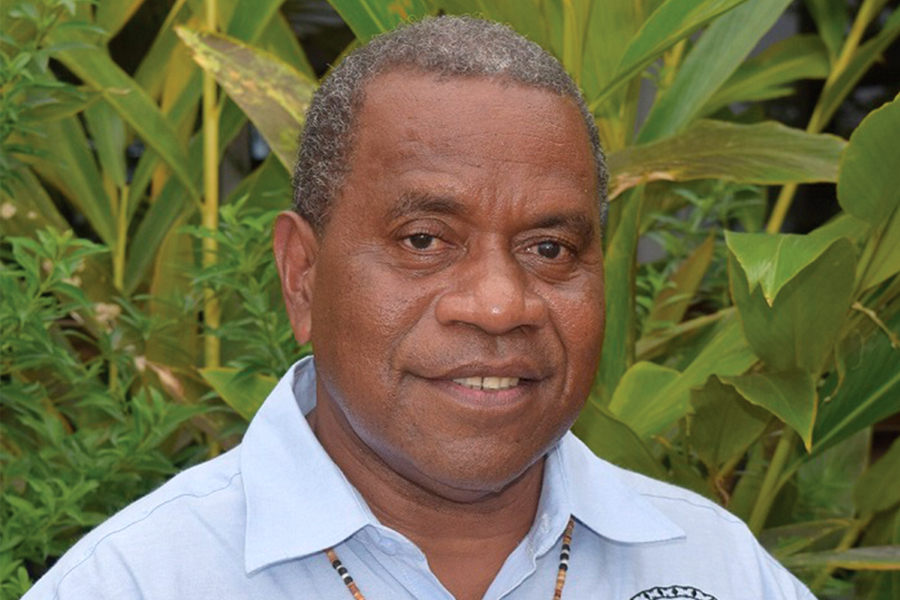
HIS Holiness Pope Francis has appointed Rev Father Peter Houhou to be the new Bishop of Auki Diocese of the Catholic Church.
Fr Houhou is the first Solomon Islander to hold the post of Bishop; his appointment was made yesterday.
He is currently the Vicar General of the Archdiocese of Honiara and Administrator of Holy Cross Cathedral.
He was born in Marau on October 10, 1966 and is from Makira, Our Lady of Fatima Parish. Even though he is from Marau he has ethnic roots in Ulawa and in West Are’are.
His beloved parents the late Mr Luke Iawai from Ulawa and late Mrs Salome Sautareia from West Are’are.
They have six children, late Peter Marau Houhou, Abraham Taroainimae, Saniela Atohui, Fr Peter Houhou (Bishop elect) and Elizabeth Nunuhia.
Peter was ordained priest on July 3, 1999 by His Grace Emeritus Archbishop Adrian Thomas Smith SM after he completed his studies at Holy Spirit Seminary in Bomana Port Moresby. His ordination theme was “Take up your Cross and follow me” (Lk 9:23).
The Catholic Diocese of Auki has an estimated population of 50,000 people who live in more than 270 Catholic communities which comprise the 11 parish regions of the Diocese.
The 34 priests and 21 religious sisters of the Diocese along with the more than 500 lay catechists will be happy to welcome the first local catholic bishop.
Fr Houhou is the 3rd Bishop of Auki; current Archbishop Chris Cardone, OP is his predecessor.
The Diocese of Auki began in 1984; long serving New Zealand Marist Missionary: late Bishop Gerald Francis LOFT, SM founded the Diocese.
Details of Bishop-elect Peter Houhou’s ordination will be decided by the Auki Diocesan Administrator and the leaders of Auki Cathedral Parish of St Augustine.
Ministries and offices held
July 1999 to April 2000: Assistant Parish Priest of Ruavatu Parish, Honiara
April 2000 to May 2006: Parish Priest – Makina Parish in Marau, Honiara
May 2006 to Feb. 2015: Parish Priest – Visale Parish, Honiara
May 2011 – present: Vicar General of the Archdiocese of Honiara
Feb 2015 – present: Administrator of Holy Cross Cathedral, Honiara
DEAR EDITOR, my recent letters in the local SI media about hydroponic growing methods generated quite a number of enquiries asking about the techniques and the basic equipment needed for growing vegetables, salad crops and tomatoes to be used for home consumption and for sale.
The aim of my letters was to promote the idea of hydroponic cultivation in simple systems using water and a rich nutrient solution and without the need for soil.
The World Bank sees the potential for simplified hydroponic systems to enhance climate resilience while helping to create local jobs and fostering regional investment.
In the context of creating regional investment I would pose the question of the SIG what measures are being considered to improve the production of different farming methods in view of the need for food security and job creation, especially given the advance of climate change and salt water incursion in parts of the country?
Simplified hydroponics can be taught to farmers and individuals with no prior knowledge. Those farmers could generate income from small plots of land with vertical farm tools, even in urban areas. New jobs and farms supported by hydroponics contribute to a green economy and job security.
The methodology also creates opportunities for additional income in developing regions, including from personal experience in Swaziland, Kenya. In Kenya, in particular, there has been developed a world wide export market for the flowers it cultivates.
Given what I have said about the impact of climate change and the reduction in food crops in some parts of the country, I would urge the government to consider asking for help from countries that have extensive experience in hydroponic cultivation methods, including Singapore, Thailand, Taiwan, Japan, Israel and Kenya.
The UN recently gave a small grant to a resident of Kiribati most recently and he has successfully created a business from the units he made.
In the Solomon Islands get help with grass roots training and, if at all possible, provide subsidies for the basic equipment and inputs.
One commercial company that I know of in Singapore teaches the techniques of simple hydroponic cultivation using basic systems growing hygienic and high quality leafy vegetables and culinary herbs all year round for local consumption and exports.
I know that modern hydroponics on a commercial scale is likely to be outside the scope of affordability for many potential growers in the Solomons but much scope exists for smaller scale hydroponic cultivation.
I advocate looking at U-Tube to see the many simple hydroponics systems people use to successfully grow their produce, including black plastic bags, off-cut lengths of PVC tubing, plastic containers, plastic water bottles and even Styrofoam boxes with lids.
My partner charity, “Takes My Hands” (TMH) in New Zealand is exploring the possibility of acquiring some of the basic needs to commence hydroponics on a small scale and I hope to learn more soon.
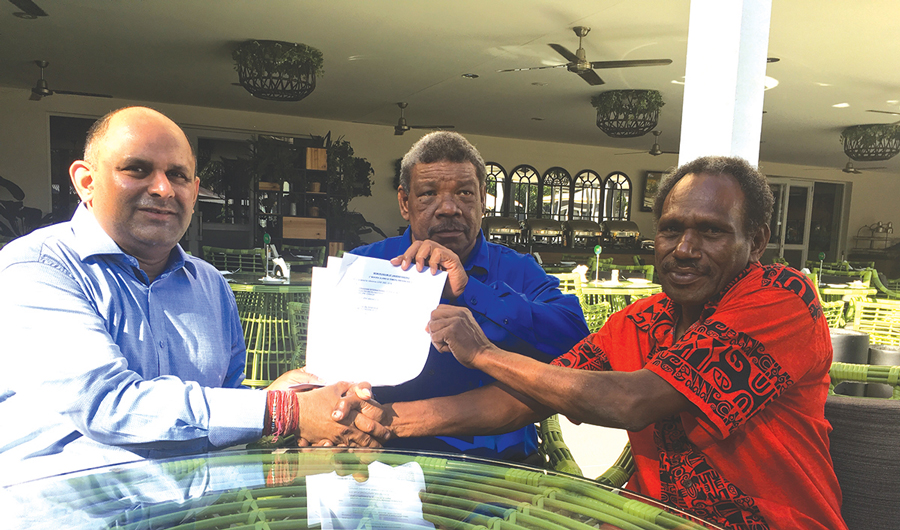
CITREC Chairman Ashwant Dwivedi [L] with Makira-Ulawa Province Premier Hon. Stanley Siapu and Temotu Premier Hon. David Maina
BY LYNTON AARON FILIA
CITREC Chairman Ashwant Dwivedi [L] with Makira-Ulawa Province Premier Hon. Stanley Siapu and Temotu Premier Hon. David Maina last monthGUADALCANAL and Canadian governments have extended their employment mobility to the Makira-Ulawa province recently.
CITREC initiative under the Guadalcanal provincial government and Canadian Government brings opportunities to the people of Makira-Ulawa province.
CITREC Chairman Ashwant Dwivedi confirmed this in his meeting with the Guadalcanal provincial assembly which also included the premier of Makira Ulawa province, Stanley Siapu.
Mr Dwivedi confirmed that Makira-Ulawa province has been included in its new stream of employment opportunities.
“I can confirm that apart from tourism, hospitality and agriculture labour opportunities, Makira-Ulawa province also has the opportunity to be part of the food processing sector,” said Dwivedi.
Dwivedi said the employment opportunities encourage inclusive participation – both women and men to have equal opportunities.
“I want women from the provinces of Guadalcanal and Makira-Ulawa to be part of the pool of workers that would be bound for Canadian employment opportunities,” Dwivedi said.
He adds, currently his academic team is working closely with the education authority of Makira-Ulawa province and its government, with plans to implement the programme by mid-August.
The successful inclusion of Makira-Ulawa province was made possible after Premier Siapu successful held bi-lateral talks with Dwivedi during his recent visit to Guadalcanal.
Siapu said it is his dream of seeing his people and province being included in the CITREC.
He thanked the province of Guadalcanal through its Premier Anthony Veke and executives for providing the much-needed guidance to be able to join the CITREC programme.