WESTERN province Gizo Bio-security Division has stepped up the fight to stop the spread of the coconut rhinoceros beetle in the province.
This comes after the Division of the Ministry of Agriculture and Livestock spotted few sites within Gizo town last month.
Mr Ataban Zama said the Bio-Security Division have tried to quickly address the spreading of the beetle.
“Most farmers are worried over their coconut plantains and copra production will drop as the deadly Rhinoceros beetle found its way in Gizo.
“We are currently monitoring the situation and we encourage the general public to look after all our traps that we locate within Gizo.
“I would like to call on those of you spot any symptoms or signs of Coconut must quickly come forward to our office or contact any officers so that we can quickly monitor the situation.”
The Division strongly warns passenger ships, landing crafts and foreign vessels to be closely monitored.
A man between his 30s and 40s has been found safe and alive at the Betikama area on Wednesday morning.
Supervising Police Commissioner Juanita Matanga revealed yesterday that on July 10, White river Police Post received a report saying that a male person has been missing since July 5.
The missing person was with others who went hunting at the Kongulai area; relatives became worried when he failed to return.
However at 10am on Wednesday morning the missing hunter was found safe and alive at the Betikama area, Ms Matanga said.
“Police are again called on people to inform relatives of their whereabouts and must ensure to communicate with families of where you go to avoid panic and stress of relatives,” Matanga said.
Teachers representing schools in the central region of Malaita province to a one week counselling training in Auki.
BY SAMIE WAIKORI
Auki
Teachers representing schools in the central region of Malaita province to a one week counselling training in Auki.
SCHOOLS in the central region of Malaita province will soon introduce counselling programme for its students.
Teachers are currently undergoing a counselling training in Auki.
National Adolescent Health Programme Coordinator, Ms Nancy Pego said during the training earlier this week that the training is a follow-up to a family life education training MHMS and MEHRD had previously held.
The first training was to find out possible options on how to teach reproductive health in schools due to its sensitivity.
Pego said the topic of reproductive health was within the syllabus, but due to cultural barriers it would not be implemented as yet.
She said the possibility reached was for the two ministries to work together especially health workers to assist teachers in schools when it comes to the topic.
She said it was reported by teachers that there are lots of problems affecting students in schools, and one important area identified was to provide counselling for problems the students face.
“Sometimes students are absenting from schools and teachers continue to punish them or even expel them without knowing there’re problems within them.
“Teachers sometimes send students to clinics for medical attention and to their parents and guardians to sort out their problems.
“Without knowing some of the problems there are very simple that teachers if having counselling skills they can talk to students and solve the problems,” Pego said.
She said those are the areas they see important for teachers to equip with counselling skills so they can deal with the students’ problem.
Pego said the MHMS and MEHRD are working together on the programme by assisting each other to ensure students to benefit out of the programme.
She said as the training will complete, they hope teachers will go back and serve their various schools with the counselling knowledge and skills they’ve learnt.
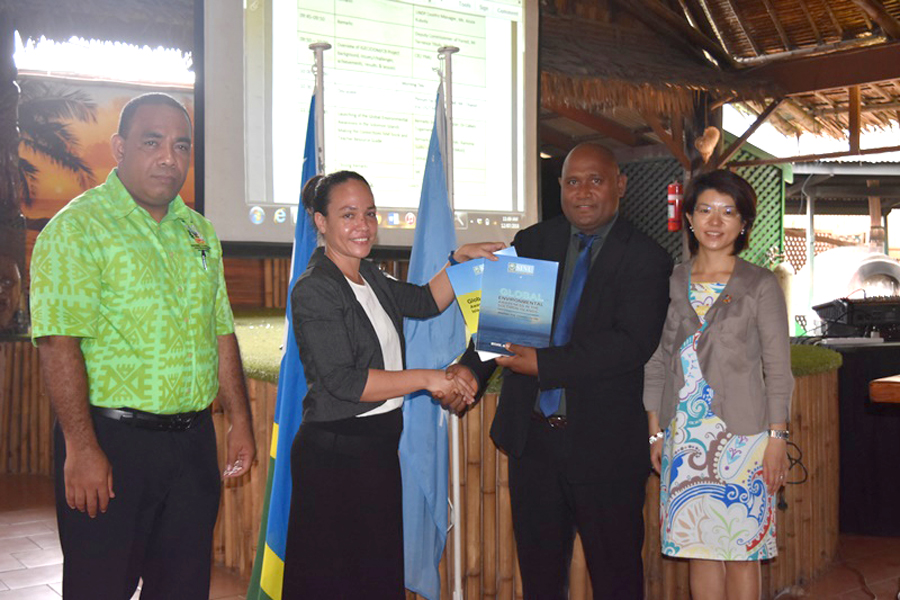
Minister Dr Culwick Togamana handing over the text book and teacher’s guide to the SINU’s Acting Dean for School of Natural Resources and Applied Science Dr Ramona Sulifo’oa along with PS Melchior Mataki and UNDP Country Manager Ms Azusa Kubota.
BY LYNTON AARON FILIA
GLOBAL Environment issues can now be taught at the Solomon Islands National University and secondary sectors across the country as additional materials.
Minister for Environment, Climate Change, Disaster Management and Meteorology Dr Culwick Togamana officially launched and handed over the books to SINU’s Acting Dean on Thursday.
The textbook and Teacher Resource Guide entitled ‘Global Environment Awareness in Solomon Islands-Making the Connections’ is an outcome from the Integrating Global Environment Commitments in Investment and Development Decision Making (IGECIDDM) Project.
Ministry of Education and the SINU senate have endorsed the book materials to be used in the university and high schools throughout the country.
Officers signed up to collect the book materials
Togamana said they are useful materials and SINU lecturers and high school teachers should take ownership of it.
“I believe materials will enable students to think critically and understand how and why global environmental issues are affecting Solomon Islanders’ welfare socially, economically and environmentally,” he said.
He adds, the materials will better equip high school teachers to teach their pupils more effectively and enable the transfer of knowledge on environmental issues.
Togamana said environment taught at schools is necessary background knowledge to make informed decisions about use of the environment and the effect of human activities on the environment.
SINU’s Acting Dean for School of Natural Resources and Applied Science Dr Ramona Sulifo’oa said development of the materials is applicable to current and future generations.
She said the text book and teachers guide is important for SINU particularly the SNRAS and secondary sectors across the country.
“We thanked UNDP for organizing to give SINU 100 copies of the text book and the teachers resource guide and we look forward to future collaboration with the government and UNDP,” she said.
Minister Dr Culwick Togamana handing over the text book and teacher’s guide to the SINU’s Acting Dean for School of Natural Resources and Applied Science Dr Ramona Sulifo’oa along with PS Melchior Mataki and UNDP Country Manager Ms Azusa Kubota.
UNDP Country Manager Ms Azusa Kubota said, “Information in the text books will enable students to think critically about why global environmental issues (for instance global warming) should be a concern, how they affect our lives and what we can do as global citizens to mitigate the impact.
“The teacher’s resource guide will equip high school teachers to disseminate and transfer knowledge effectively, especially in the rural communities without access to resource materials.
“For citizens of a country that is vulnerable to climate-induced disasters, it is important to know that actions at the community level have direct impact on a global scale,” she said.
“Everything in today’s ever shrinking world is inter-connected, and attaining sustainable development requires citizens who think global, act local,” Kubota said.
Development of the materials is a result from the consultation of the REDD+/Rio Conventions awareness workshop conducted with teachers and student of Temotu in 2015.
Students shared environment topics are not taught much due to lack of resources such text books and internet catchment but with the books it ease the challenges.
GP-Minister of Education Lazarus Rina (L) and Finance Minister Keith Robu jointly hand over travel documents to Canada-bound workers. Photo by Macfaddean
Aoraunisaka
GP-Minister of Education Lazarus Rina (L) and Finance Minister Keith Robu jointly hand over travel documents to Canada-bound workers. Photo by Macfaddean Aoraunisaka
CANADA’s labour mobility partnership through Canadian International Training & Education (CITREC) is bringing more Solomon Islanders into Canada.
CITREC Chairman Ashwant Dwivedi believes that by the end of next year the numbers are expected to significantly grow as more Solomon Islands provinces are joining the programme.
He also said that Solomon Islanders dedication, good nature and work ethic are very well credited for by the Guadalcanal workers who are presently in Canada under GP-CITREC partnership which is resulting in more employers seeking workers from Solomon Islands.
On Thursday two more graduates of the GP-CITREC programme were handed their travel documents at the Guadalcanal provincial government headquarters for their travel into Canada to be employed in the dairy sector.
Mr Paul Labukode and Mr Peter Sagaru will be joining group of workers already working in the Agriculture section in Canada and were presented their immigration and travel documents before Guadalcanal ministers.
In a statement Guadalcanal province’s minister for education, Lazarus Rina, presented the travel documents to the graduates yesterday and reminded the two Canada-bound workers that when they arrive in Canada Guadalcanal province only expects the best from them and that they must uphold their commitment to their Canadian employer.
“I want to remind you that you both represent your families, community, province and Solomon Islands as a whole. I only expect the best from both of you. Remain committed and dedicated and make Guadalcanal and Solomon Islands proud,” Rina said.
Rina also reminded the two Canada-bound workers to be good ambassadors and display their identity as responsible Guadalcanal people.
“Also let me remind you that when you touch down on Canadian soil you must be willing and ready to be follow the Canadian law. You must always uphold the laws of Canada to your benefit and interest,” Rina said.
Guadalcanal Finance Minister Amaziah Keith Rubo said the GP-CITREC partnership is growing and that he wants to see the programme grow further.
“Therefore, you all act as important persons towards our partnership with Canada. As our partnership has already started to yield financial benefit we at the Guadalcanal government remain committed to see the human resources aspect of the program grow as well,” Rubo said.
“Be proud of yourself and of the opportunity and we only expect best of your performance.”
Guadalcanal’s Minister of Infrastructure Andrew Rayboy said that with the number of workers to Canada set to grow he is confident that with remittances that would be sent to the benefit of Guadalcanal province by the GP-CITREC workers, the province in future can improve its infrastructure.
“Therefore, it is very important that you all work hard and help build opportunity for others. The remittances we will receive will help our provincial government provide essential services to your people,” Rayboy said.
Member of Provincial Assembly (MPA) Godfrey Raubola who was also present at the handover ceremony said that the labour mobility partnership is the strong result of CITREC-Guadalcanal partnership and in future the province is only going to strengthen its partnership.
CITREC Chairman Dwivedi said that Canadian employers are hiring more GP-CITREC graduates and Canada’s foreign worker policy is also becoming an attractive part of the partnership.
“Canada’s foreign worker benefit is one of the best that is enjoyed by Guadalcanal workers. We in Canada treat our workers as families. And so far, our Guadalcanal workers have continued to show their dedication and commitment to their Canadian employers.”
Canada has started to issue Guadalcanal workers with 24-month work permits. Canada’s employment opportunity comes with Canadian standard wages, medical and housing, where a significant cost housing is paid for by the Canadian employer. Employees under the contract only pay $30 a week in rental cost.
Also, employers pay for return air fare for the workers as part of their arrangement under Canada’s employment regulation. The airline ticket cost is not deducted from employee salaries.
Last week it was announced that Solomon Islands nationals who are job-ready graduates of the CITREC programme from Guadalcanal have been included in a new stream of employment which includes employment in Canada’s food processing sector.
Also included in the pilot project will be the province of Makira-Ulawa, which has recently been added to list of eligible provinces alongside Guadalcanal as part of the labour mobility partnership with Canada.
Furthermore, this opportunity will also be extended to any province that will partner with CITREC.
Speaking on the achievement, Dwivedi said that “Solomon Islands and the people of Guadalcanal have created a very strong trust among Canadian employers through their performance that is helping to create more opportunity among many sectors across Canada. Guadalcanal people and province must be congratulated for their leadership in area of creating partnership with Canadian employers”.
Dwivedi also confirmed that Makira-Ulawa has also been included in the new stream of employment opportunity.
“I can confirm that apart from tourism, hospitality and agriculture labour opportunities that Makira-Ulawa province will be participating in it also has the opportunity to be part of the food processing sector.”
Dwivedi further added that his office is working closely with the food processing sector and food service retail industry to identify candidates that it would be immediately seeking for its industry across Canada.
“My intention is to make sure that women are equally represented. I want women from the provinces of Guadalcanal and Makira-Ulawa to be part of the pool of workers that would be bound for Canadian employment opportunities.”
Dwivedi also confirmed that presently his academic team is working closely with the Education authority of Makira-Ulawa province and its government to implement the programme in the province by mid-August.
“This partnership between CITREC and the Makira-Ulawa provincial government (MUPG) is for the benefit of the province and its people. What makes this partnership unique is that the province of Guadalcanal has extended its support and its assistance through its education department to help MUPG deliver the CITREC programme to its province and to the people of MUPG.
“We are aiming for implementation of the programme by August. Since the announcement a few weeks ago of MUPG partnership with CITREC we have received many inquiries from interested candidates. We ask all of the candidates from MUPG to contact the provincial government for further details.
“This partnership between CITREC and the Makira-Ulawa provincial government is for the benefit of the province and its people. What makes this partnership unique is that the province of Guadalcanal has extended its support and its assistance through its education department to help MUPG deliver the CITREC programme to its province and to the people of MUPG.
“This is what partnership is all about. For Guadalcanal to lead will help facilitate this programme.”
Meanwhile, Dwivedi confirmed that MUPG will also be a beneficiary of the Remittances Accord.
“I can confirm that MUPG will receive the same benefit that Guadalcanal province is entitled to under the Remittances Accord. We have as a matter of fact amended some of the contents of the Accord and have referred it to the legal counsel’s office and relevant government office in Canada for the final reading. Once this has been received we will be sending this document across to the MUPG government for its consideration.”
THE Parliamentary Bills and Legislation Committee (BLC) will commence enquiries into four new Bills, starting with the Goods Tax (Amendment) Bill 2018 today.
The Good Tax (Amendment) Bill 2018 is an Act enacted by the National Parliament to amend the Good Tax Act (Cap.122) in relation to the way the sale value of certain goods is calculated, and for other related purposes.
As stated in the Bill’s objects and reasons, there are strong concerns that persons registered for goods tax purposes are undervaluing goods at the wholesale level to pay less goods tax.
As a tax compliance measure, for goods imported into Solomon Islands, the sale value on which goods tax is applied will be set at an uplifted value to represent the mark-up at the wholesale level.
The uplifted value is the customs value of the goods plus the amount of customs duty payable, all uplifted by 130 percent.
Currently the same uplifted value is used to charge goods tax on goods that are imported for home consumption by an unregistered person or a registered person who does not quote his certificate in respect of the entry.
The Commissioner of Taxation will still be responsible for the collection of Goods Tax from those registered for goods tax.
Despite the proposed amendments to the sale value used to determine the goods tax payable on imported goods, the Commissioner will retain the power to determine and where necessary alter the sale value of the goods.
The Bill has 12 clauses and witnesses that will appear before the BLC include: the Permanent Secretary of the Ministry of Finance, the Commissioner of Inland Revenue, the Comptroller of Customs, the Legal Draftsperson, Solomon Islands Chamber of Commerce, Association of Clearance Agents, Chinese Association and Wholesalers Association.
BLC will also conduct hearings for another three new Bills in the coming weeks. These include the Development Bank of Solomon Islands (DBSI) Bill 2018, Payment System Bill 2018 and the Constitution (Amendment) (Dual Citizenship) Bill 2018.
Meanwhile Parliament meeting will resume on Wednesday next week, after its last adjournment on Monday, April 9, 2018.
VERENAUE Community High School is an education institution to be established within Gao District in Isabel province.
According to the IPYF, on commenting, the Community High School interim committee chairman and Secretary to the people of Huali, Hageulu, Vara, Takutu, Hukamoto, Rasa and Tataba wish to make an appeal for contributions for the school capital.
The committee chairman and Secretary said that while letters will be disseminated to business houses, ministries and stakeholders for contributions, people responsible, (Mr Duddley Uata and Marshel Hiro) will be coming over to Honiara by the end of this month.
Verenaue Community High School was built by elders, chiefs and members of the communities around Glogu area.
The IPYF urges nearby communities to help and support, including community members of Hageulu and Huali who are based in Honiara.
In the meantime, bush clearing for the new school site will take place as of this month and onward.
INVESTIGATION into the case of a 23-year-old man alleged of raping a 20-year-old-girl on July 9 at Lungga area is ongoing.
Supervising Commissioner Juanita Matanga said the girl was on her way home from work when the alleged incident occurred.
She said from information gathered by police the man threatened the girl with a bush knife; from that threat the girl was frightened and she was raped by the accused.
Ms Matanga said the matter was reported on July 10 and the accused was arrested charged and placed in court to face the rule of law.
The girl worked as a shop assistance in one of Chinese shops in East Honiara.
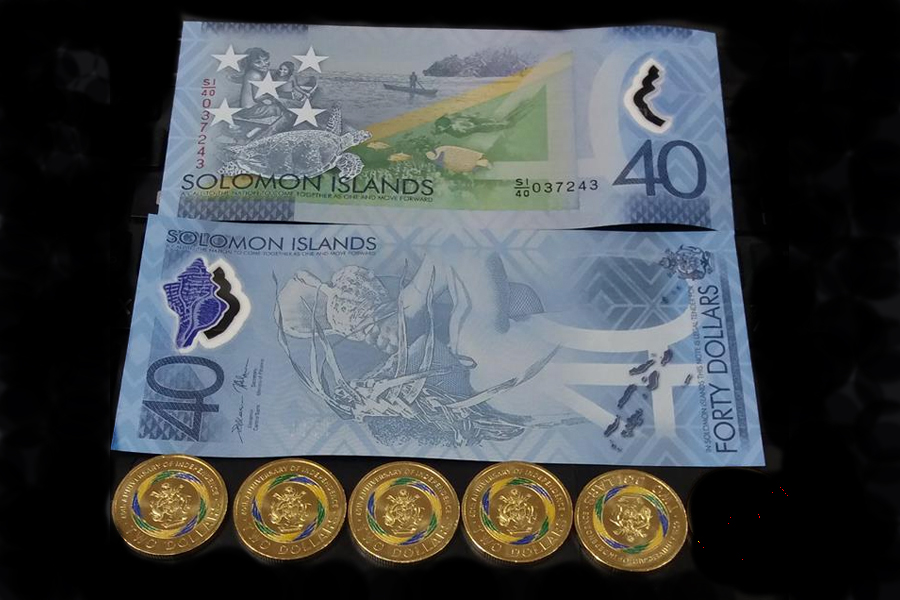
IT is revealed that though short term, the new $40 note is a dedicatory bill, produced in dedication to the country’s 40 years in existence as a nation.
Following its official launching, a question was posed, which goes to question whether it was necessary to have a $40 note that is understandably produced to mark Solomon Islands’ 40th Independence Anniversary.
Many, who gave views on that and expressed disappointments over the decision to come up with the note, suggested that Solomon Islands wanted a stronger currency, “not new notes”.
“40 years already gone, yet the country’s economic status is still the same (slow), with so many challenges, of course that includes cash flaw crisis, and therefore does not deserve to be given any special treatment,” one expressed.
Others thought that instead of creating an odd note, the bank should have created higher valued notes, giving examples of a potential $200 or $300 bill (note).
Another also suggested that the country does not necessarily need to increase any note value, but rather increase the value in the country’s dollar.
Some reiterated that the Value of Solomon’s currency needs to be increase, and because of its weakness, they thought it was unnecessary to produce the independence note.
But following what they revealed as misreporting and misleading reports from the mainstream media over the launched notes and coin, the Central Bank of Solomon Islands (CBSI) came out with an official statement for retraction and correction.
The explanation has however shed strong lights to what many have highlighted and discussed in relation to the raised question, both on face book and in person.
Based on the reason as to why the new note, the statement explained that the $40 is a circulating commemorative note.
“As a circulating note people can use the note in their daily transactions like the existing circulating notes ($100, $50, $20, $10 and $5.)
“The commemorative nature of the note however, makes this denomination a collectible note or a memorabilia where individuals/firms etc. can use the note as a gift to their friends or visitors or retiring colleagues and so forth.
“People must note that there is also an element of rarity in this banknote issue as the Bank had only ordered a limited number of notes.
“This means that once the stock of $40 is all issued into circulation then that would be it – it is a one off production meant to celebrate the country’s 40 years of independence.
“The other issue that the report highlighted was that of a higher value denomination, particularly, why CBSI did not consider issuing a $150 or $200 denomination instead.
“In that connection, people need to be informed that the Central Bank continues to monitor the banknote structure and will introduce a higher value denomination as and when it is appropriate to do so. Currently there are five banknote denominations (i.e. $100, $50, $20, $10 and $5) and five coin denominations ($2, $1, 50c, 20c and 10c) in the country’s currency structure,” the statement explained.
The statement added that for Solomon Islands, this currency structure is considered ideal given the demand for cash in the economy and, for banknotes, their use pattern as payment and market notes.
“That said, the CBSI continues to monitor the value/volume of currency in circulation, the number of payment instruments used in the country, cash distribution issues to name a few issues,” the statement adds.
It is also revealed that CBSI will introduce a higher denomination as and when absolutely necessary. The public will be informed when this happens.
CBSI’s Acting Chief Manager for Currency Department, Joe Vasuni. PHOTO BY MANEBONA BARNABAS
BY BARNABAS MANEBONA
CBSI’s Acting Chief Manager for Currency Department, Joe Vasuni. PHOTO BY MANEBONA BARNABAS
CENTRAL Bank of Solomon Islands (CBSI) clarifies that the new $40 banknote and $2 coin launched is part of the country’s circulation currency.
This means that the public can exchange goods and services with this special commemorative currency as it has been officially declared as legal tender.
CBSI corrects an article published by Island Sun under the headline, ‘Commemorative $40 note produced is not part of circulation currency’.
According to CBSI, the article title has misled the general public.
From brief explanation given by CBSI, the $40 is a circulating commemorative note, which people can use in their daily transactions like the existing circulating notes of $100, $50, $20, $10 and $5.
The commemorative nature of the note however makes the denomination a collectible note or a memorabilia where individuals/firms can use the note as a gift to their friends or visitors or retiring colleagues and so forth.
People must note that there is also an element of rarity in this banknote issue as the Bank had only ordered a limited number of notes meaning that once the stock of $40 is all issued into circulation then that would be it.
It is a one off production meant to celebrate the country’s 40 years of independence.
Another issue the report highlighted was that of a higher value denomination, particularly, why CBSI did not consider issuing a $150 or $200 denomination instead.
“In that connection, people need to be informed that the Central Bank continues to monitor the banknote structure and will introduce a higher value denomination as and when it is appropriate to do so.
“Currently there are five banknote denominations (i.e. $100, $50, $20, $10 and $5) and five coin denominations ($2, $1, 50c, 20c and 10c) in the country’s currency structure,” CBSI explains.
For Solomon Islands, this currency structure is considered ideal given the demand for cash in the economy, for banknotes, their use pattern as payment and market notes.
With these said, CBSI continues to monitor the value/volume of currency in circulation, the number of payment instruments used in the country and cash distribution issues to name a few issues.
CBSI will introduce a higher denomination as and when absolutely necessary as the public will be informed when this happens.