Home Blog Page 1239

Law of demand and supply currently affects market venders

0
Goreti Vathagi originally from Monga village in East Central Guadalcanal, now resides in Honiara.

BY GEORGINA KEKEA

Goreti Vathagi originally from Monga village in East Central Guadalcanal, now resides in Honiara.

THE price of produce at the Honiara’s Central Market is said to slightly drop.

Speaking to vendors on Tuesday it was found that currently there is a low demand of market produce and that the supply of produce are also high.

The slippery cabbages that usually costs $10 are now selling for $5 per parcel.

The same goes for a parcel of shallot that usually costs $10 to $15 are now selling at $5 per parcel.

Pumpkins go as low as $2 for the smallest ones and $15 for a big pumpkin.

All the way from Malaita, a ball cabbage ranges from $15 to $30 while a $10 heap potato has a fair amount of potatoes in it.

Resellers at the market says currently there is minimal profit while a seller from the Guadalcanal plains say for her, it will be good.

“This is because I get to sell the produce myself, instead of having middle market people, buying my produce. I do not earn much profit when I do that. But if I sell the produce myself, I will be able to get good profit.”

Another reseller who reside at Tuvaruhu says for her, this is the only income generating activity for her.

“So whether it is good or bad time, I have to do this. I have no option.”

Asked why she didn’t do what other resellers usually do, that is to go back to their area of residence to sell, she said she doesn’t want to do that because it is better for her to sell at the market where no one knows her then to sell from her place of residence.

Ball cabbages from Malaita province arrives yesterday.

“Because I want to avoid people getting my produce on credit. This is the only income generating activity for me and sometimes people do not repay what they owe,” she said.

For these vendors, this is their livelihood and they often smile when there are events happening in the city.

“Because this is when we have caterers coming to the market and some buy most of our produce. We also have people from the hotels but most times we are shy to approach them with our produce,” the venders say.

For those from Tathiboko in North East Guadalcanal when asked what will happen to them if they have leftover market produce they pointed to the walkway in front of the Bulk shop and say, “that is our bedroom. We sleep there at night”.

They say it is quite safe and they rather stay close to the market so that they can get there early in the morning before someone take up their space.

“They should build a proper dormitory for us here,” they jokingly say.

National Youth Policy launch today sets new beginning

0

BY LYNTON AARON FILIA

NATIONAL leaders and Youth in Honiara will witness the launching of a new National Youth Policy at the Mendana Hotel today.

The National Youth Policy lists three sectors that the country will work upon so that youths will have a better future—Strategic Framework for Youth Development and Empowerment in Solomon Islands and the National Youth Employment and Entrepreneurship strategy.

The document points out that it is essential that every policy that is implemented considers youths’ needs and it also envisages a youth policy for the next 14 years.

In Solomon Islands, Youth are a significant segment of the population with seven out of 10 Solomon Islanders under 30 years old.

However, obstacles prevent this demographic from fully participating in employment, politics and decision-making.

Now, the Ministry of Women, Youth, Children and Family Affairs will launch the Solomon Islands National Youth Policy 2017-2030 which will guide the government in efforts to develop and empower the country’s youth.

According to the MWYCFA, the National Youth Policy2017-2030 is the first of the documents from the new 3- tier policy framework for youth development in Solomon Islands.

MWYCFA said such new 3 tier policy framework for youth exemplifies the government’s commitment to transform Solomon Islands youths and adolescents into effective and positive force for nation building.

The document also ensures every young person is given the opportunity to contribute to the social, cultural and economic, political and spiritual development of the country, it said.

The event today will convened PM Rick Houenipwela, Minister for MWYCFA Freda Tuki and his Permanent Secretary Dr Cedrick Alependava and former UNDP Administrator and former New Zealand Prime Minister Helen Clark.

UNDP representative, Youth stakeholders, Civil Society Organizations and young people in Honiara will also part of the launching today.

School plant-tree programme to begin soon

0
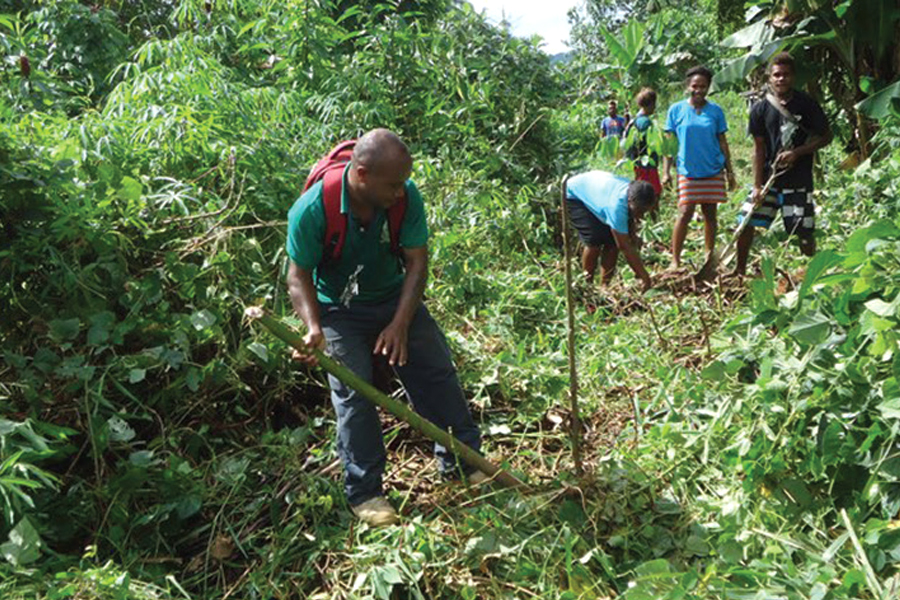
Officer In-charge of the Reforestation Unit of Auki Forestry, Mr Rony Aiwewe helping students of Gwaigeo CHS during one of the School Tree Planting programmes in 2018.

BY SAMIE WAIKORI

AUKI

Officer In-charge of the Reforestation Unit of Auki Forestry, Mr Rony Aiwewe helping students of Gwaigeo CHS during one of the School Tree Planting programmes this year.

THE continuation of the School Plant Tree programme for schools in Malaita Province will begin soon.

Officer In-charge of the Reforestation Unit of Auki Forestry, Mr Rony Aiwewe recently told this paper on the programme.

He said his office currently preparing for the programme as they will go out to secondary schools within it.

Aiwewe said during the first half of the year, schools in Central Kwara’ae and West Kwaio were visited with the programme.

He said for this continuation programme, they looked at going to schools in West Kwara’ae and as far as West Fataleka area.

Aiwewe explained that the aim of the programme was to deliver awareness in schools on the importance of reforestation.

He said the programme was targeted at secondary students with an intention to equip them with the knowledge of tree planting.

Adding not only that as it will also help to do proper decisions and management on their forest as they grow-up in the future.

Aiwewe said the programme also involved tree planting in schools where students and teachers planted trees along their schools.

He said the tree planted was to show the students how to plant the trees and it will also useful for the school uses in future.

FAO set framework to battle social and ecological issues in SI

0

BY LYNTON AARON FILIA

THE Food and Agriculture Organisation (FAO) in its national and regional priorities are setting benchmark to battle social and ecological issues in Solomon Islands from 2018 to 2022.

Solomon Islands are facing vulnerabilities of social and ecological issues relating to climate change, food security and nutrition and Non-Communicable Disease (NCD) which described as burden to agriculture development.

However, the time has come with FAO are setting the scene to implement its programme in Solomon Islands which already started this year and runs to 2022.

In the long in terms of agricultural sector, it will benefit the farmers and country to minimize issues relevant to agriculture and health particularly the NCD crisis.

Mrs Rosemary Kafa from the FAO said according to the 2018—2022 PICs’ national and regional priorities one, its focus aimed at linking agriculture and health.

She said these are part of PICs national and regional priorities one to build social and ecological resilience to the impact of climate change, strengthen food security and nutrition and the NCD crisis.

“FAO aims to play a catalyst role in linking agriculture and health, strengthening inter-agency linkage and development partnerships to foster a sustainable increase in production, trade and marketing of domestic agriculture products, and healthy consumption of diverse, safe and nutritious food,” she adds.

Kafa said FAO assistance will be focused on three common areas of intervention which set as bench mark to achieve its overall priority area or outcome across the PICs document.

She said three areas of intervention are;

  1. Evidence-based recommendations developed and promoted to incentivize the production and consumption of safe and healthy food
  2. Sustainable and climate-smart practices promoted to help build resilient agriculture, fisheries and forestry production system
  3. Food control and business practices identified and promoted to facilitate efficient agri-food value chains that provide safe, nutritious and affordable food

Kafa revealed FAO’s framework to the Senior Extension Officer of the Ministry of Agriculture and Livestock yesterday during their five-day conference which currently underway.

She also outlines there are new projects on the pipeline set for 2018—2020.

Meanwhile, the FAO’s assistance to Solomon Islands balances regional-level initiatives with demand-driven country-specific plans for 14 Pacific Island Countries.

Across the region, assistance is focused on: Improved policy plans and legislation; Enhancement of ecologically sustainable agricultural production, including forestry and fisheries.

Also to improved food quality and safety, improved production, processing and marketing of agricultural produce, Protection and sustainable use of biodiversity.

Redirecting MAL is top priority for new PS

0
MAL’s Permanent Secretary Mrs Ethel Francis

NEWLY appointed Permanent Secretary of the Ministry of Agriculture and Livestock (MAL) Ethel Tebengi Frances has called for refocusing and re-strategizing in approaching agriculture development in the Solomon Islands.

Ms Frances made the call in her maiden speech to officially open the 2018 annual agriculture extension senior staff conference now underway in Honiara.

“Agriculture needs to step up, refocus and re-strategize in its approaches going forward.

“The nation’s economy base is still weak and vulnerable after emerging from the ethnic tension and number of natural disasters in the recent past.

“Logging will soon scale down operations in the country and that will further weaken the economy and increase unemployment.”

The agriculture sector however has the potential to fill in the gaps if the Ministry is wholly resourced

The Permanent Secretary told the conference it is therefore timely that we must work together to draw up an Agriculture Sector Growth Road Map to direct and guide our development ambitions going into the future.

“It is good to export and earn revenue but we also need to feed ourselves, create employment opportunities by entering into commercial agriculture thereby reducing our dependency on imported food.”

She challenged the participants not to treat the meeting just like any other sessions where they come to report on activities but urged them to constructively discuss and find ways to chat a new chapter for the agriculture sector.

The conference this week brings together all the agriculture extension heads from the provinces including Honiara city.

It is an opportunity for them to be updated on Ministerial matters and directives.

Effectively the conference is a forum where issues are raised and discussed and possible solutions found in order for the department to effectively deliver agriculture services in the rural areas.

More importantly it is also time where important stakeholders, i.e. donor partners, Private sector and NGO’s have the opportunity in giving awareness of possible partnerships that can be forged and harnessed for the betterment of our farmers in the rural areas.

Director of Agriculture Extension Services Michael Ho’ota highlighted that Agriculture continues to face challenges due to the ever changing global economy, social issues and climate change and that the extensions services requires the resources and manpower to overcome these challenges.

Ho’ota said despite the huge contribution of the agriculture sector towards the national economy the extension services and MAL for that matter continues to lag behind the other Government agencies with regards to its annual budget allocations.

He highlighted insufficient staff numbers, Lack of staff housing and office spaces, staff capacity, resources and logistic support continues to hinder effective delivery of agriculture services to our rural population.

The theme of this year’s conference is ‘Farmers for Better Future’. It is relevant seeing that farmers are the most important stakeholders and would be fitting to see more emphasis given to them, to enable them develop sustainably and profitably to ensure food security and livelihoods are improved in the rural areas.

The Director thanks the Solomon Islands Government for funding the conference. It ends Friday, August 24.

–MAL PRESS

The Santa Cruz ground dove worthy of protection

0

DEAR EDITOR, the Santa Cruz ground dove is a beautiful bird with its pink frontal feathers but very sadly it’s already becoming an endangered species in the Solomon Islands because invasive rats eat their eggs and ash fromTinakulu volcanic activity has further threatened their traditional breeding sites.

Because of a reported lack of breeding facilities to help re-populate the doves, the Solomon Islands Government has sent 60 doves to Singapore where they will be kept at the largest bird park in the world – the Jurong Bird Park.

Situated on Jurong Hill the wildlife park contains more than 8,000 birds of more than 600 species, some very rare and previously endangered species.

The Solomon Islands Government, through the Ministry of Environment, Climate Change and Meteorology (MECDM) is congratulated for having signed an agreement with the Jurong Bird Park which, hopefully, will result in re-populating the doves and thereby re-introducing them back to their native, original, Santa Cruze environment.

The Solomon Islands, apart from its pristine beauty as a tourist destination has some unique flora and fauna and protection of such valuable assets must never be allowed to be neglected.

Yours sincerely

Frank Short

Aiding fairness and justice through Solomons accountability institutions

0

DEAR EDITOR, an article in the Island Sun newspaper, today, Tuesday 21 August, 2018, told of a new partnership arrangement which will soon see the Australian Government, through the Office of the Australian Commonwealth Ombusdman, provide support to the Office of the Ombudsman in the Solomon Islands and to the Leadership Code Commission of the Solomon Islands.

It is my understanding from reading the published article that the proposed arrangement will support both local accountability Institutions, through specific activities such as in leadership mentoring, organization reform and staff capability development.

Coming days after the historic passing of enabling legislation to tackle the fight against corruption, the envisaged support arrangement offered by the Australian Government is welcome news and I extend my thanks in anticipation of the technical aid to allow the Office of the Ombudsman and the Leadership Code Commission to better serve the people of the Solomon Islands with fairness and justice.

Yours sincerely

Frank Short

SICCI reaffirms support towards airport projects

0

THE Solomon Islands Chamber of Commerce and Industry (SICCI) reaffirms its support towards the Government’s proposed plans to develop existing airports including supporting infrastructure around the country.

At the same time SICCI urges the Solomon Islands Government to remain committed in seeing these projects come to fruition as it will link people and markets, create more economic activities and eventually lead to growth in outer parts of the country.

Prime Minister Hon Rick Hou officially re-opened the Parasi airport in the Southern region of Malaita Province last week accompanied by the Acting Minister for Communication and Aviation, Hon Jeremiah Manele who used the occasion to outline some of the airport development projects the ministry plans to implement in the next couple of years.

Once successfully completed, SICCI is of the view that these projects will open the door for investment and businesses not only in the capital Honiara, but throughout our provinces. It will also link us to our people in the rural communities.

Chief Executive Officer (CEO), Dennis Meone said improved infrastructure and reliable means of transportation creates a good environment for businesses to prosper and welcomes the proposed airport development projects.

“The transport sector is an important element of the economy and a conduit for development. Our islands are geographically spread and remote and it will always be an issue to reach outer parts of the country but the airport projects will provide alternative means of travel. This is great news for the country and we acknowledge the government for taking lead and our donor community in making it a reality.

“I fully concur with the statement made by the Prime Minister last week that there is a need to enhance infrastructure development to connect other sectors such as tourism, medical, commerce, education and maritime,” Mr Meone said.

The CEO further applaud the work of the Airport Taskforce setup under the Ministry for Communication and Aviation for their tireless efforts in leading negotiations and the landowning groups for having foresight to visualize and look beyond today and opening up their land for airport operations to resume.

Under the Provincial Airport Upgrade, the New Zealand and the Solomon Islands Governments will design new airports for Lata, Temotu Province; Seghe, Western Province; Suavanao, Isabel Province; and Taro, Choiseul Province.

There is also the Honiara International Airport Improvement Project, funded by JICA and co-financed by SIG which will deliver, a new Departure Terminal, an additional new taxi-way, a new Control Tower, the expansion of Apron to the east and refurbishment to the International Terminal.

–SICCI PRESS

Vying candidates for SINU Vice Chancellor position deliver presentations

0
(Left to Right) Dr David W Gegeo, Dr Morgan Wairiu and Mr John T Usuramo

BY LORETTA BRIGIDIA MANELE

(Left to Right) Dr David W Gegeo, Dr Morgan Wairiu and Mr John T Usuramo

SOLOMON Islands National University (SINU) on Tuesday hosted presentations from vying candidates for the position of SINU Vice Chancellor.

According to SINU’s Senior Marketing and Promotions officer of the Vice Chancellor’s office, Estee Baffet Lonamei, the presentation by the candidates not only represents an important part of the process but signifies a critical component of the selection criteria approved by SINU Council.

The topic identified by the selection panel which three candidates; Dr David Welchman Gegeo, Dr Morgan Wairiu and Mr John Teddy Usuramo spoke on was “Your Vision for SINU as Academic Institution and as an Agent for Socio-economic Growth”.

Mr Usuramo in his presentation voiced that should he be selected for the position of Vice Chancellor for SINU, he plans to work on 10 commitments for the socio-economic growth of the university.

He said that one of the commitments is to ensure flexibility in the choice of subjects for students.

Usuramo stressed that currently this is restrictive at SINU and there is a need to revise the subject combination by working with the dean and heads of departments.

He furthered that if students have more choices, particularly if they can enroll a course or class from another department, it would provide them more prospect after university.

IMF stands ready to support government

0
IMF team leader Mrs Alison Stuart

BY GEORGINA KEKEA

IMF team leader Mrs Alison Stuart

“SOLOMON Islands has made significant gains over the past fourteen years, in restoring law and order, re-establishing public institutions, and improving human development indicators. Macroeconomic and financial stability has been achieved and important structural reforms have been implemented.

This was said by Alison Stuart from International Monetary Fund (IMF) who had led a team to Solomon Islands towards the end of July.

In a report issued by IMF, Stuart said nevertheless, Solomon Islands still confronts large economic and governance challenges.

“Challenges stem from weak management of the logging and mining sectors, a lack of transparency in the Constituency Development Funds (CDFs), and the need to strengthen public financial management.

“Growth held up well in 2017, estimated at 3.5 percent, and is projected to remain at 3.4 percent in 2018 buoyed by strong performance in logging, infrastructure spending, fisheries, agriculture, and manufacturing. Growth is expected to moderate to 2.9 percent in 2019, due to a slowdown in logging. Inflation has picked up somewhat to 2.4 percent in June 2018, following increases in domestic and global prices.

“The government budget position deteriorated further in 2017 and IMF staff project a sizeable deficit in 2018. The overall deficit widened to 3.8 percent of GDP in 2017 as revenues fell short of expectations, and spending on tertiary scholarships, shipping grants and CDFs remained high. Fiscal buffers are low with the cash balance at merely 1.5 months of spending, below the two-month target. Payment arrears have reemerged”.

Stuart said that against this backdrop, IMF staff team and the authorities had discussed policies to restore fiscal buffers as well as to strengthen financial management, improve governance and invest in new sources of growth. She said IMF staff also emphasised the need to clear the backlog of financial sector regulatory reform.

“Actions are needed to rebuild the cash balance as well as to clear domestic expenditure arrears. Strengthening revenue administration and compliance, and efforts to reduce tax arrears should continue. Reducing the scope for transfer pricing by the logging and mining sectors is also important”.

She said new sources of growth are also needed to replace logging and to sustain incomes for a growing population.

“Mining is likely to be an important growth sector but other countries’ experience shows that transparency, a strong regulatory and policy environment, and a robust tax regime are needed to fully reap the benefits”.

The government’s focus on anti-corruption and the passage of the Anti-Corruption bill is a positive step, Stuart said.

The IMF staff strongly supported the authorities’ intent to move forward with resolute and effective implementation of the bill and the whistleblower bill.

IMF say they stand ready to support the government’s reform efforts through policy advice and the development of better capacity for economic analysis and policy formulation, including on monetary and fiscal policies, tax reform and revenue administration, financial sector supervision and regulation, and macroeconomic statistics.