Home Blog Page 1225

Win-win for Mala and NPF

NPF Chairman Mr Peter Boyers and Malaita Premier Peter Ramohia exchanging entitlement on Friday 23

National provident fund pays $3.5M for Auki plaza

BY LYNTON AARON FILIA

NPF Chairman Mr Peter Boyers and Malaita Premier Peter Ramohia exchanging entitlement on Friday 23 August

THE Auki Plaza is now property of the national provident fund (NPF), after it paid the Malaita province $3.5million last Friday.

NPF handed over $3.5million in cheque to Malaita’s premier Peter Ramohia and his executive, who then handed NPF the property rights to the plaza.

NPF’s board chairman, Peter Boyers, received the rights on behalf of NPF.

Handing over the property rights, Premier Ramohia said Malaita province recognises the importance of property, and NPF is a big investor which they are looking forward to working closely with after it has renovated the plaza and operates it.

Ramohia explains that the proceeds from business opportunities in the plaza will be invested back to Malaita province.

“For the purpose of our people might think that this funding province receives, I am assuring people of Malaita that it will be used for good investment.

“If we did not invest now, it will hand over to the new government but people have the rights to make any comments.

“Part of it will be invested in the CITREC programme which the Guadalcanal one provincial already beneficiary including Makira province now joining.”

He said importance about the programme is it will give more opportunities to Malaita province in terms of training and labour mobility.

“I hope following our handover of the payment we will see first block of Malaitan entering the labour mobility in Canada December this year,” Ramohia said.

He said trainings and application forms will be released in weeks ahead so that young people in Malaita can apply for the scholarship and get trained.

Ramohia thanked the Solomon Islands government, saying Prime Minister Rick Houenipwela truly supports labour mobility.

“As a premier for Malaita province, I am excited to realise such opportunity and I appreciated and acknowledged the NPF,” he adds.

Chairman Boyers said NPF is delighted that they have come to an end and beginning of a new journey with the payment of the Auki plaza.

“I think today marks a win-win situation for people of Malaita specifically development aspect of funds and also NPF is joining a new partnership in development of Malaita province.

“We hope to use this as stepping stone and partnership with other provinces interest in such development.”

Science and fiction

0

DEAR EDITOR, I read with keen interest an article by Mathias N. Sao. Waifo from Patutiva entitle “The Creation of Rennel-Bellona” in Solomon Star Newspaper on August 21, 2018.

In his article Mr Waifo talked about the founding fathers of Bellona Island but more interestingly was his account regarding the formation of Owaraha- Santa Ana Island.

I believe all provinces in the Solomons with varied cultures would have their own stories vis-à-vis the formation of islands. We aptly called this as ‘custom stories’. They may differ slightly from each other but the content would be very much the same.

It is something of the past that is kept in narration and passed verbally that mesmerize consecutive generations throughout ages. Some of these ‘custom stories’ are remarkably important which entails chiefly ownership or bigmanship in our various cultures or related to ownership of land or islands by settlers for that matter.

To our forefathers (ancestors), the formation of islands could be linked to supernatural powers related to god worshipping during heathenism or it could be related to spells, because their world is full of mystery and enchantments.

Nevertheless, I personally love the way they create such accounts of fictions that depict reality of what happen in nature. The story of the two brothers that pull the island of Santa-Ana to surface interest me much. It may be fiction in a sense, but it factually portrays science at work.

With science, we can resolve mysteries that are happening in the physical environment as experienced by our ancestors in the olden days. This article will briefly explain how our islands are formed and to give a fair idea of the reality that lies behind the mystery of island formation that was experienced by our ancestors.

In practical, we are living along a Convergence Plate boundary – the convergence between two Crustal Plates, the Pacific Plate and the Australian Plate. The Pacific Plate being denser of the two, sinks under the Australian Plate (which is lighter) creating a subduction zone. This is a zone where tremor and volcanic activities occur – particularly known in science as the “Pacific Rim of Fire”.

Volcanic activities in this subduction zone can form oceanic/volcanic islands. Specifically, our islands in the Solomons archipelago belong to a volcanic arc caused by the subduction of the oceanic crust of the small Solomon Plate under the Pacific Plate.

However, this is quite complex to understand but simply put, the theory is the Pacific Plate slides beneath the Australian Plate, it creates a weak zone along the subduction zone which allows molten magma or magma plume from the earth’s mantle to easily escape reaching the surface creating what is known as volcanic arc; and it is in this way that our islands are formed.

Another good example of such island formation is the Aleutian Arc formed where Pacific Plate is sliding under the North American Plate.

The Lesser Antilles (islands in the Eastern Caribbean) also formed in the same manner as the Caribbean Plate is sliding under the North American Plate.

On the other hand, some islands in the Pacific formed at “Hot Spot”.

This is an area where the Pacific Plate is thin and magma plume from the mantle can push up through the plate, forming chain of islands.

An example of this is the Hawaiian Islands, Samoa, Pitcairn and Tahiti.

The “hot spot” remains stationary while the sea floor (Pacific Plate) moves. The Pacific Plate is moving to the northwest at a speed of between 7 and 11 centimetres (cm) or ~3-4 inches per year.

The successive cycles of volcanic activity at the site of the “hot spot” leave a trail of volcanic peaks (which is the Hawaiian Islands).

These volcanic peaks or islands become older and more eroded in the direction of the Plate movement.

Therefore the largest island in the archipelago which is Hawaii is also the youngest, while Kahoolawe, the smallest island, is also the oldest and the farthest from the hotspot.

In theory, the Plates are moving while you read this article and it is with such movements that drive our islands to form through volcanic activities along subduction zones.

Therefore, this wonderful custom story about the two brothers that pull Santa Ana to surface is a great example of a science fiction related to a mysterious world of our ancestors in the olden days.

However, the “science” in this science fiction isn’t about tales or mystery, but in reality it is about tectonic activities and the formation of islands by volcanic activities.

Therefore, embrace your culture and don’t let loss of any of your science fiction, for they are your identity.

I have the conviction that science fictions from our various cultures need to be recorded and preserved.

I think the science fiction will encourage us to explore, helps us think about possibilities and look at our society from a different perspective.

And with the “science” in the science fiction as the backdrop, we can understand our world better.

Steve S Kapivio

Honiara

Solomon Islands

Grim implications for SI coastals

0

DEAR EDITOR, late evening news relayed by Radio New Zealand last night, Thursday, 23 August 2018, gave a grim report of the reported loss of Fiji’s coastal fisheries resources.

My mind was immediately focused on the food security needs of those communities in the Solomons dependent on coastal fishing.

I repeat the text of the news broadcast. (quote) “Fiji’s coastal fishery resources have been depleted due to years of over-exploitation, an agriculture official says.

“Naipote Katonitabua, the acting permanent secretary for the Ministry of Agriculture, said food security for Fijians living in coastal communities was at risk.

“The FBC reported him saying coastal fisheries provided extensive benefits for Fijian communities, including employment and nutrition.

“But communities involved with fisheries needed to work with government to better manage coastal resources, Mr Katonitabua said.

“Over-exploitation of coastal fisheries was a Pacific-wide pattern and the focus of various regional commitments aimed at countering the problem, he said.

“One example was the Melanesian Spearhead Group roadmap for inshore fisheries management and sustainable development, the official said.” Copyright @ 2018, Radio New Zealand.

Yours sincerely

Frank Short

Land dispute in Malaita

0

DEAR EDITOR, I disagree with the statement made by the Prime minister in public media on land issue in Malaita province.

The land dispute issue should be treated as part and partial of the policy and strategy of development for Malaita province because development cannot happen without land.

And so for any Malaitian leaders to isolate land dispute away from the development in that province only reflect poorly on the mindset that are ignorance and reluctant to address economic development in that province.

It is not right to compare Malaita with other sister provinces in the nation because of the huge population and patrilineal customary land ownership that has been practice and experience in that province that create favourable environment for more land dispute issues.

It is childish for our national leaders to blame the people in the provinces for land dispute issue because as elected leaders people are entrusted us to play our roles in addressing issues of concern that affect livelihood.

It is sad to say that for the last 35 years none of the effort and commitment from the provincial and national MPs from Malaita has been shown towards the land dispute related issues mounted to development in the province through establishment of right policies and financial assistance in addressing the issue.

While the billions of dollars of development funds as CDF has been poured into the province through the discretions of the 14 MPs, nothing tangible had seen happening, not single tiny percentage of those funding has been gears towards the land related issues within the province.

The customary chiefs and land owners are left alone struggling without funding and directive policies from the government dealing with the land dispute issue with lengthy and costly land court system practice currently in the nation.

There has been a poor working relationship with the national MPs and the provincial leaders when sharing ideas and priorities for the future welfare and development aspiration of the Malaita province is concern.

The people of Malaita have the legal right to ask and take into court their 14 MPs as where are the development funds such as CDF that provide purposely to develop Malaita province for the last 10 to 20 years has been used?

Our national leaders must be mindful when making public statement on the development related issues or else we are barking on the issue that we failed to address.

If the elected leaders failed to uphold their roles and obligations what are leaders for?

God bless the struggling people of Malaita province.

Jacob Ofasia

Talise market

Third female PS

0

DEAR EDITOR, as a person who has great concern for development aspiration to heart, I wish to share my concern on the recent media releases both from Island Sun newspaper No 2985 on Friday 17th and media release from Government Communication Unit, of the Office of the Prime Minister and Cabinet dated 16.08.2018.

This is regarding the recent appointment of the third female Permanent Secretary to lead the Ministry of Agriculture and Livestock.

The concern is in the light of the process involved in the processes undertaken in the appointment.

Whilst the general public appreciates the appointment, both media releases failed to highlight the fundamental issues required for a suitable candidate to fill such an important post.

The important issues are the relevant qualifications required for this technical post.

This is a technical ministry (MAL) an incumbent of this post requires the followings as the bench mark.

  • A pre-requisite qualification requires for the candidate must be a BSC degree and Master Degree in Agriculture and rural development from a metro-polythene University.
  • A required minimum of 10 years or more working in the field of Agriculture, which special emphasis in either, extension, research, livestock or quarantine with colossal experiences with local, regional and international connections.
  • Other management qualifications example, human resources management and other extra areas of interventions.

These qualification requirements are essential for the candidate to provide a sound and appropriate advice to the Hon. Minister Agriculture and Livestock.

This is important when the Hon. Minister is due to make contributions to important issues raised during Parliament debate from time to time and more importantly, during budget sessions.

I am of the view that the process involved in the recruitment is doubtful and the process is being influenced by politics.

This will result in under performance and will somewhat create low productivity in the agriculture sector for the next five years down the road.

And when it happens, responsible authorities must be answerable for such a stake of affairs in the agriculture sector.

John Harunari

Prioritising youths

0

IT is good to hear that a ‘Policy’ for youths was launched recently.

Also hearing government speak highly of labor mobilisation as a mean for youths to be employed is good.

However is this really the best way for our youths?

To encourage them to go overseas?

In Solomon Islands only 15 percent of our land has been used for economic activities.

85 percent is customary land ownership.

Why do we need to go overseas to find money?

Hearing the former Prime Minister of New Zealand and a former UN Administrator Helen Clark speaks of agriculture as the backbone of economy sure hits home.

The food chain that we have.

Why do we not work on strengthening the food chain here so that everyone will benefit.

Incentives should be given to farmers to plant more.

Exempt tax on agricultural equipment, invest more in infrastructure.

Why do we always have to focus in Honiara and overseas?

Are we not proud of our country?

Before we start going outside, why don’t we start with our own country first?

We go to the hotels we eat food bought from Australia or New Zealand.

Supermarkets buy produce from overseas.

We have an abundance of human resources and land, yet we cannot utilise our resources well.

We focus so much on logging and timber that we tend to forget about the backbone of our country’s economy, Agriculture!

If government should come up with policies again, why not come up with a good policy for farmers and rural people so that they can be able to earn good money for what is worth.

Provide them the incentive they need in order to sustain themselves.

Forget labour mobility for now.

We are only creating more avenues for youths from the rural areas to come to Honiara with the hope to go overseas to work in farms when they can toil on their own land and earn more if government sets it priorities right.

SICCI, Private Sector and the Sustainable Development Goals

0
Ms Helen Clark delivering her remarks on the Sustainable Development Goals (SDGs) and how the private sector can help achieve these goals for the country.
Ms Helen Clark delivering her remarks on the Sustainable Development Goals (SDGs) and how the private sector can help achieve these goals for the country.

ACHIEVING an ambitious agenda like the Sustainable Development Goals (SDGs) cannot be achieved without full engagement with the Private Sector and the business community.

Former UNDP Administrator and New Zealand Prime Minister, Ms Helen Clark made this statement during a Business After Five (BA5) event organised by the Solomon Islands Chamber of Commerce and Industry (SICCI) this week in Honiara.

The Sustainable Development Goals (SDGs) are a collection of 17 global goals set by the United Nations Development Programme (UNDP).

The SDGs set global development priorities for a generation, and without doubt our world will be more peaceful, prosperous, and sustainable if the Goals are achieved.

All UN Member States have signed up to the SDGs.

More than one hundred SICCI members, private sector representatives and members of the business community turned up for what was the biggest SICCI BA5 event to date, in terms of participation.

Clark highlighted at the event that Government and public money alone cannot help the country achieve the SDGs.

“It is quite clear that an ambitious agenda like this can’t remotely come near to being achieved, without full engagement with the world’s private sector.

Ms Helen Clark in deep discussion with the SICCI Chair, Jay Bartlett and CEO Dennis Meone during the BA5 on Wednesday this week.

“The public money isn’t there to do it, this agenda has to inspire both businesses to do business differently but also it has to inspire investment in things that are inclusion and sustainable,” Clark, who was Prime Minister from 1999-2008, said.

She said Governments have to make their luck for their countries and the way in which governments design their policy frameworks will also have an impact on how investment is attracted.

“Businesses like certainty, likes to know where the Government is taking the country, what steps it’s taking and businesses like predictability for investment security.

“What Governments want to achieve with the development of their country and the achievement of the SDGs can’t be done with public money,” Clark said.

During her presentation, Clark highlighted some interesting examples around the world on how the private sector has come in to make a difference.

“The role of private sector in achieving the SDGs is absolutely essential.

“How business does business, and where it does business, will have a significant impact on whether the SDGs are achieved,” she said.

“Through commitment to inclusive business models and eco-sensitive ways of operating, the impact will be very positive,” Clark added.

SICCI Chief Executive Officer (CEO), Dennis Meone said in the Solomon Islands the challenges are quite complex in getting businesses in tune with the SDGs and the National Development Strategy which is something the private sector can work together with government to get the information from the top and down to all layers of society.

But by hosting Ms Clark at its popular networking event the BA5, SICCI has provided the opportunity for businesses and the private sector to get deep insight on how they can engage and participate in helping the country achieve the SDGs.

“I think one of the challenges for us is how do we really engage the private sector. Yes, the SDGs are there and nationally we have the National Development Strategy (NDS), but how does the private sector get involved.

“Most businesses in the country are already undertaking SDGs and NDS initiatives except they don’t know it’s part of the SDGs. We just need to stocktake and align what’s been happening on the ground to the SDGs and get people informed about it,” Meone said.

Meone said businesses in Solomon Islands can take encouragement from some examples from overseas where companies use those SDGs as branding for them in securing investment opportunities.

“The SDGs and NDS are long term goals but can be achievable and it comes back to collective efforts.

“Government has the leading role in ensuring we achieve the SDGs but also the civil society and the private sector can really make it happen,” the SICCI CEO said.

–SICCI PRESS

Empower Pacific SI supports RSIPF reduce psychological harm

0

BY MAVIS NISHIMURA PODOKOLO

EMPOWER Pacific in Solomon Islands has stepped in to improve the Royal Solomon Islands Police Force duty of care to its officers and reduce the risk of psychological harm.

This was done on Thursday through an agreement signing to conduct counseling intervention for police officers in Honiara

Counselling is an important process for a robust organisation like RSIPF. Officers most times go through traumatic cases especially the police response team which and will be very distressing for them.

For instance they encounter situations like injury or threats to employee’s life on duty, victim/body recovery, homicides, suicides, death or serious injury to baby and high attendants at postmortems

Empower Pacific country manager Mrs Lavinia Dakei said they will only provide counselling in terms of stress management for traumatic cases to help support the wellbeing of Police officers on how they can support their work.

“With that I am very humbled and pleased RSIPF has chosen Empower pacific to carry out this essential service for the police officers. Through my experience of work I’ve worked with military/police officers and I see counseling is a need in this domain.

“They need it to support their work and wellbeing so that they can be productive and active in their demanding work,” Dakei said.

Dakei expressed Empower pacific has singed this particular service with other organisations and this one of them especially to empower and ensure psychological approach towards employees is taken into consideration.

The agreement witnessed on Thursday is a one year contract and is of Empower Pacific’s Employment Assistance Programme in Solomon Islands and was held yesterday at the Empower Pacific office in Honiara.

We are pumped, ready for show: Big Mountain

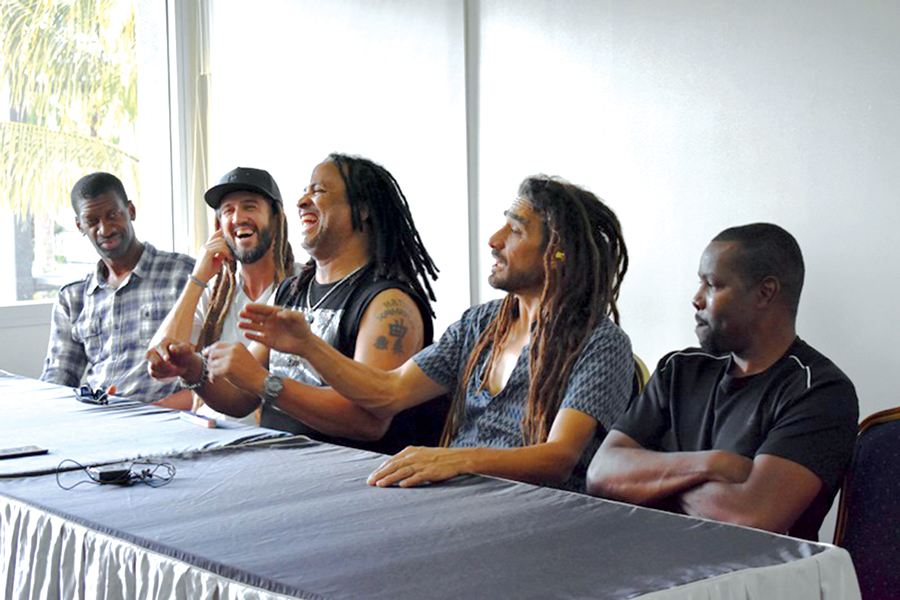
Big Mountain at the press conference.

BY LORETTA BRIGIDIA MANELE

BIG Mountain has arrived in the country and will again bring relaxing, uplifting and mesmerising reggae vibes to the Solomon Islands when they perform live at Heritage carpark area this Saturday.

Speaking to the press on Thursday, the American reggae band’s lead vocalist, Joaquin McWhinney, also known as “Quino” expressed that they will perform for at least two hours but if people want more they will play more.

He said this is their second time to come over to Solomon Islands to perform.

Quino said during their first time here, they didn’t know what to expect but were really surprised at how receptive the crowd was.

Heritage Park Hotel’s Event Manager, Bradford Hepponstall welcomes Big Mountain at Henderson airport.

“The crowd was very receptive, the energy was very strong. It is relaxing and a reception like that inspires us,” he said.

Quino mentioned that they feel comfortable to perform with no boundaries and that is what they want to do.

“We try to give people a full performance so we can walk away feeling better about ourselves, our culture,” he said.

Quino also voiced that their songs are not just love songs but songs with positive reggae vibes to uplift people, encourage and inspire them.

He mentioned that in a way, the music and songs they make is like medicine for the people, giving the positivity amidst challenges or situations they are facing.

When asked if the band was ready for the show, drummer, Paul Kastick excitedly said they are pumped and ready for the show.

“We are pumped, we are pumped, we are ready. It’s gonna be hype,” he said.


Bill brings hope for clean election

National Parliament of Solomon Islands

By Gary Hatigeva

PARLIAMENT has on Thursday completed all debates into the Electoral Bill 2018 and has voted for it to be committed down to the Committee of the Whole House for thorough scrutiny.

With over 100 pages and around 12 Parts, the Bill accompanies the Constitutional Amendment Electoral Reform Bill (Act), which was passed on Wednesday, and was in doubt after opposition and independent groups vowed to vote against because of certain amendments it initially proposed.

Disagreements came from the group over certain sections within the proposals, which most members from the other side of the house thought were irrelevant and have no local contexts, making the bill to appear premature in almost all its aspects.

Others thought the changes proposed will weaken the intentions of establishing institutions like the Political Parties Commission that was established with hopes, to bring political stability and good governance.

Disagreements on that was in relation to intentions noted in the bill for the merger of the Political Parties Commission and the Solomon Islands Electoral Commission, and the creation of a new Commissioner’s post, Commissioner of Elections, that was designed to manage all affairs of elections in the country.

All these turmoil had forced a number of suspensions and adjournments to the proceedings and deliberations into the bill, where several meetings were held based on suggestions and recommendations for thorough discussions amongst the three groups, over both the Constitutional Amendment Electoral Reform Bill and the Electoral Bill.

The meetings have actually worked and the dust settled as all parties agreed to include recommendations and support both bills.

Today, parliament is expected to resolve into the committee of the whole house to thoroughly begin its proceedings into bill, and the collaborative approach taken have received positive feedbacks from all benches of the house, which gives hope for its passage.

The Electoral Bill according to its objectives aims to, repeal and replace the National Parliament Electoral Provision Act (Cap 87), at same time improve the registration system of electors through regular reviews of the register, out of constituency registration and registration of persons between the ages of 17 and 18, in preparations for an election.

The bill also looks to further regulate nomination process of candidates, with proposals to increase the nomination fees for candidates, to clarify the nomination process and other related areas, including processes into voting and importantly, ensuring arrangements are in place to help people with special needs express their rights to vote.

It also aims to ensure there is a comprehensive range of electoral offences with appropriate penalties, which according to many who contributed during the debate session on its general principles, gives hope for fairness, transparent and clean elections, which many are confident, will lead to good governance and sustainable development for the country.

Many supported the bill indicating excitements over what they have described to be timely and acceptable changes especially, to the changing nature of the country’s political arena.

The MP for Gizo-Kolombangara, Lanelle Tanaganda who was the last to debate the bill, pointed out in her speech that the amendments in the highlighted in the bill gives a new face to the electoral laws, with its inclusive nature as it will also display a whole new dimension in the political culture of Solomon Islands.

The MP for East Guadalcanal and Minister of Mines, Bradley Tovosia in his intervention statement also pointed out that the bill contains the fairness of what is needed to be done in the election system of the country.

Many from both the government and opposition groups including the independent bench however stressed that while the bill may not be the solution to all the problems continued to be highlighted before, during and after elections, but at least it gives hope for the beginning of clear indications and direction towards better election future for the country.