Joses Nawo goes past John Aeta of Marist during their mid week clash on Wednesday.
Four TSL matches confirmed for weekend
By Taromane Martin
Joses Nawo goes past John Aeta of Marist during their mid week clash on Wednesday.
HENDERSON Eels FC climbed a spot up the 2018-2019 Telekom Soccer League table after claiming their fourth win in round one.
H/Eels defeated Marist FC 3-1 in their TSL mid week clash yesterday at the Lawson Tama Stadium to see them move into second place with 13 points.
Surprisingly it was the youthful Marist who looked more threatening in the first half against the experienced Eels side but saw their final touches letting them down.
Eels had to wait until the second half to score their first goal after a sloppy performance in the opening 45 minutes saw the scores tied nil-all at half time.
Joses Nawo opened the scoring for Eels 56 minutes into the second half. Tuti Zama added their second before Obed Ofea sealed the win despite a late Patrick Taroga consolation goal for Marist.
Eels Head Coach Eddie Marahare said he was pleased with the way his players responded after their half time talk and a sloppy first half performance.
“I think the first half we controlled the game but I think the players were a bit rush in the final third,” Marahare said.
“The message for the second half was we need to be patient. Whilst we are controlling the game we need to be precise and make good decisions.
“The players responded positively and got three goals for us even though it should be more than that.
“But overall I’m happy with the way the players responded after out half time talk,” he said.
Meanwhile four matches are set for this weekend at the Lawson Tama, Competitions Manager Mr Gabriel Riotarau said.
Matches for this weekend will see Real Kakamora FC taking on Western United FC, Saturday at 2pm followed by KOSSA FC and Henderson Eels at 4pm.
“I’m sure it will be a tough game. While I respect them (KOSSA) we are also desperate for the three points come this Saturday,” Coach Eddie Marahare said.
Sunday’s matches will see FC Guadalcanal taking on Marist FC at 2pm followed by Solomon Warriors FC and Malaita Kingz FC at 4pm.
Ms Corina Dettke competiting durint eh 10th National Body Building Championship in Honiara last month.
Local Body builders leave Monday
By Taromane Martin
Ms Corina Dettke competiting durint eh 10th National Body Building Championship in Honiara last month.
SOLOMON Islands Body Building Federation (SIBBF) first ever Miss Solomon, 24 year old Corina Dettke says she is happy, excited and honored to represent the country at the 24th South Pacific Body Building Championship in Suva.
Ms Dettke will join 14 other local male body builders to compete against other regional body builders for the SPBBC in Suva which starts October 26-28 this month.
The 24 year old who was crowned the first ever SIBBF Miss Solomon during the 10th national body building championship at the Multipurpose Hall last month said training for the regional championship as a figure competitor has been intense after competing as a bikini and fitness competitor early this year.
Despite the challenges faced she said she is happy doing what she loves and will concentrate on staying focused until they leave next week.
“Training has been very intense because the girls I will be competing against in Fiji have been in the sport and training for some years now,” she told SunSPORTS yesterday at the SweatBox gym.
“I train two to three times a day. My work outs usually takes five hours, this involves posing, learning the quarter turns and walking.
“I’ve only been competing for a month. My first competition was only three weeks ago. I took part in a bikini category in Australia then fitness at the national championships last month but for Fiji I have to go under the figure category which requires more muscle and physique.
“This requires me to have more muscle, build my strength and learn all the posing, walking and the quarter turn moves.
“It’s challenging as everything is different from the bikini and fitness competitions I did the past month. I had to learn all of this in a matter of three weeks so that was a lot of pressure on me.
“But it is a good challenge; I enjoy it that is why I’m doing this. Every day I’m learning new things such as about dieting, what to eat and not to eat, how to gain muscle, strength and overall just how to stay positive every day.
“I have to be happy every day, which I am. I love doing this because I know I’m doing it for a purpose. If there wasn’t any purpose then I wouldn’t be willing to put my heart and soul into this,” she adds.
She said she looks forward to meeting the other body builders during the championship and hopes other girls can also take up the sport in the near future.
“I’m looking forward for the championship, to meeting the other competitors, learn from their experiences and gain inspirations from them which I hope the boys are also looking forward to.
“I just need to stay positive, maintain have good people around me supporting me every day because this is not an easy sport where you can just come and do it. Every day you have to be prepared both mentally and physically for it.
“For the future yes I look forward to competing again next year at the next national championship because it be good to show other girls that girls can also be in the sport of body building.
“I hope to see some girls taking up the sport in the near future as well. Give it a try, if you don’t like it then it’s not for you. At the end of the day there is always a sport for everyone,” she said.
Meanwhile, SIBBF athletes for the 24th South Pacific Body Building Championship in Suva will leave the country on October 22, President Pius Mamae confirmed.
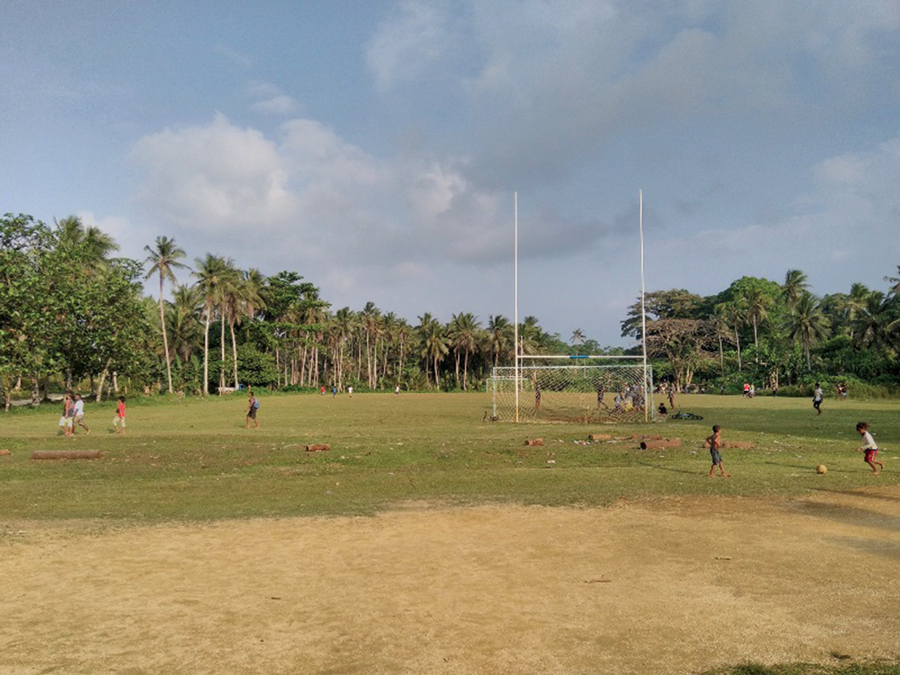
Gongona rugby field will host the rugby competition of the upcoming Solomon Games
By Taromane Martin
THAT is the message echoed by Chief Executive Officer for the 2018 Renbel Solomon Games Mr Golden Kiloko yesterday.
Mr Kiloko along with a delegation from the National Olympic of Solomon Islands (NOCSI) and the Ministry of Home Affairs was in the province last weekend to assess preparations on the grounds for the games.
The CEO in a statement yesterday said he is confident Rennell and Bellona Province is ready to host the games next month despite so many doubts and negative perspective regarding groundwork.
“We are ready to host the games. Initially there were so many doubts and negative perspective over the past months regarding Renbel hosting the game especially on its ground preparation, but I can confidently said that Renbel is ready to host the game,” Kiloko said.
“We have had the opportunity to carrying out inspection and final assessment on the ground work preparation of sports facilities and game support services in Rennell this week especially on accommodation, catering, transportation, water, sanitation, ceremonies logistics etc along with the Under Secretary of the Ministry of Home Affairs and President of NOCSI, and from the assessment.
“I can say that 95% of work on both the sports facilities and support services are done, Just need final touches on some of the facilities and our LOC is working around the clock to complete them within the next two weeks ahead of the game dates 26th November to 7th December, 2018.
“We have also arranged and engaged communities in Rennell to be responsible and cater for the games supports services as we want them to get advantage and take ownership and be part of the game, especially pride of bringing the game to our homeland.
“During the assessment, and considering the short time period, our LOC had decided to reduce the initial number of sports from 17 to 10 with an estimated number of 1,900 athletes and officials, and this will assist us to host a more efficient and manageable game.
“The individual sports selected were based on avail of its sports facilities at the host province; athletics, basketball, football, netball, rugby 7s, touch rugby, futsal, swimming, table tennis and beach volley and indoor volley,”
“All in all, I would say that RENBEL is ready to host the game in style comes November and we are looking forward to welcome our athletes and officials to our beautiful shores,” he said.
Kiloko on behalf of their taskforce thanked the Under Secretary of the Ministry of Home affairs and President of NOCSI who did their final assessment on the ground work preparation of the game as part of the process of hosting the game.
Meanwhile sports facilities that are ready and confirmed by the CEO for the 7th Solomon Games in Renbel are:
Two soccer field (Lavaghu & Kagua), two basketball courts (Lavaghu & Tahanuku), netball court (Tupuaki), volley court (Lavaghu & Tupuaki), beach Volley (Lavaghu), Futsal court (Tahanuku), rugby 7s field (Ngongona), touch rugby (Ngongona) table tennis (Tupuaki) and swimming (Lake).
INDIGENOUS Peoples and their traditional knowledge and practices are essential to reaching the United Nations 2030 Sustainable Development Goals and to climate change mitigation.
This was in relation to the International Labour Organization (ILO), as the United Nations specialized agency dedicates to the rights of workers, employment opportunities, and social justice.
In accordance to the 2016 report, it shows that 370 million peoples all over the world have been identified as Indigenous or Tribal Peoples.
This 5 percent of the world’s population is estimated to care for 22 percent of the world’s surface and protect 80 percent of the world’s remaining biodiversity.
It shows that, despite their invaluable role in sustainable development and protecting the environment, Indigenous and Tribal Peoples remain widely disadvantaged, making up 15 percent of the world’s poor.
Indigenous and Tribal Peoples are commonly denied access to a full education, employment, and social mobility due to discrimination and unequal resource distribution.
Social, cultural, economic, and political differences have also drawn a line between Indigenous Peoples and governments, leaving Indigenous Peoples out of important decision making processes.
Additionally, Indigenous and communities in states of poverty are excessively affected by climate change.
According to the United Nations Permanent Forum on Indigenous Issues in July 2018, it shows that Indigenous Peoples are among the first to experience the direct consequences of climate change, due to their dependence on and relationship to the environment and its resources.
This occurs even though Indigenous communities are some of the most involved in the mitigation of climate change and in protecting the environment.
It also shows that deforestation on land managed by Indigenous Peoples with protective rights over their lands was low while deforestation on unprotected land has more percentage.
In relation to, some recent examples of natural disasters has highlight the drastic effects of climate change on Indigenous communities, such as landslides, droughts, tsunamis, cyclone and earthquakes that hamper the traditional driving practices of Indigenous Tribes.
Yet, Indigenous Peoples who advocate for environmental conservation and against extractive projects that contribute to climate change also face threats, criminalization, violent attacks, and even death.
These has let the ILO to echoed the importance of Indigenous in environmental conservation and in reaching the United Nations Sustainable Development Goals, echoing a discussion panel of Indigenous representatives at a High Level Political Forum on Indigenous Issues.
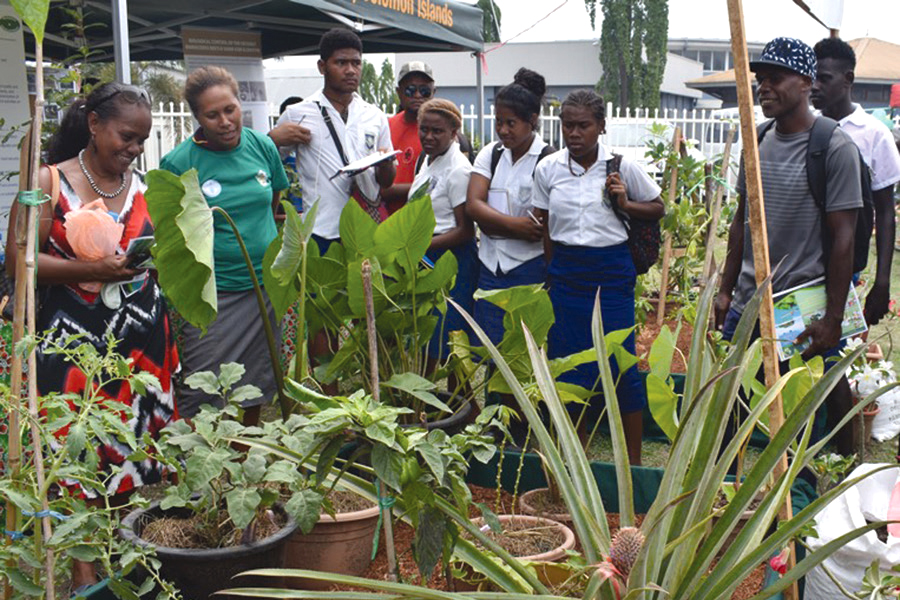
Students being made aware about the importance of our local foods
BY ELLISON VAHI
THE country’s agriculture, farming and food culture did not have a widespread beginning.
According to reports from the ‘solomonislandsculture- resource’, very few plants and animals are indigenous to the land.
Through the years the country’s agriculture and farming has expanded due to settlers, oceanic agriculture and world influences.
Therefore, due to our resources and impacts the islands have adopted a European influence in foods and culture.
While the history of the country starts about 30,000 years ago, over the years, settlers brought a variety of foods, aside from what the surrounding waters had to offer.
Coconut is one of the staple foods of the islands and is believed to have been grown prior to the settler’s arrival. Coconut has made its way to the islands by water current and has become part of the eatable goods.
Students being made aware about the importance of our local foods
The coconut is used for its water, milk and flesh; becoming one of the most essential foods of the island diet.
The diet on the islands has been constantly changing with the waves of people that welcome the land.
This creates an increasingly diverse selection of plants and animals, including taro, sugar cane, rice, yams, pork, sea food and more.
The European influence is extremely specious, however old diet traditions are still noticeable among our locals.
Despite natural traditions, new restaurants with different ethnic backgrounds are constantly opening up and gaining popularity, both by foreigners and locals alike.
The European tradition of coffee, tea, bread, fruit or sometimes fish or rice for breakfast is prominent among the inhabitants of the Solomon Islands.
Lunch is traditionally the biggest meal of the day, which is an experience that can last up to a couple of hours and is typically enjoyed at home.
However, this is not a practice that is followed by all. In addition, most of the traditional foods are served with rice as a base and taro is used to prepare the food in a variety of ways.
Taro and yams are staples of the South Pacific diet. Also, Tapioca is commonly included into the diet.
Drinks are usually made with kava root. Kava root is known for its relaxing effect however it is not considered a drug.
Avoidance of tap water and drinks made out of tap water are obvious due to potential contamination.
Dining custom on the Solomon Islands is usually much unplanned; slowness is common and understood.
No main custom roles are followed, but you should eat what is offered to you and no more than another guest. Meals are a social practice.
In the meanwhile, although the country did not start with a broad range of resources and traditions, those aspects have grown over time due to settlers and worldly influences.
In regards to the food culture, Solomon Islands have adopted a significant similarity to European values.
Now, the Solomon Islands are a place of variety and collaborations. If travellers would like to enjoy the unique relationship between Native and European culture, then the Solomon Islands is the place visit.
FOR one Solomon Islands student studying in Taiwan, the country will always be his home away from home.
In June this year, Kuei Mi-Li, who comes from Taiwan and has been teaching Mandarin at the Solomon Islands National University (SINU) travelled back to her country for her holiday.
During her stay, she got the chance to meet 24 Solomon Islands students studying at various universities who had just graduated.
Among them, Li met Michael Siwainao Jnr, President of the Solomon Islands Student Association in Taiwan (SISAT) which was established back in 2004, the same year Taiwan began its award of scholarships to Solomon Islands students.
She said that Siwainao who is doing his Bachelor of Diplomacy and International Relation at Tamkang University told her about his experience of studying in Taiwan.
According to Li, Siwainao chose to study in the country because of its uniqueness.
More to that, he had three reasons as to why he wanted to study in the country popular for its Taipei 101 building in Xinyi District, night markets and friendly people.
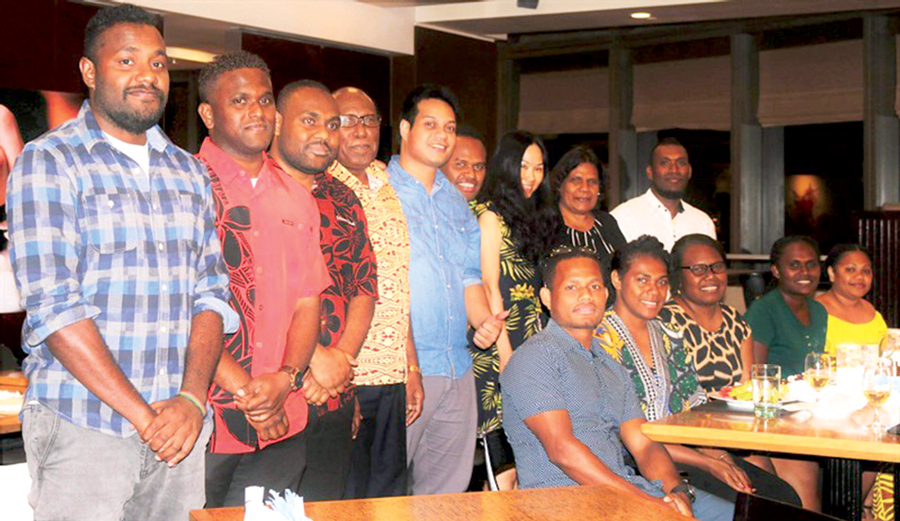
Ms. Kuei Mi with 2018 SI Graduates in Taiwan.
Siwainao said he picked Taiwan to pursue tertiary studies because he not only wanted to learn the most commonly spoken language in the world, Mandarin, but also wanted to experience being educated in an Asian country and lastly because Taiwan is a great friend of Solomon Islands as the two countries share and exchange similar interests in politics, economic sector and so on.
He rated learning the language as “very important” and not only if you’re studying in Taiwan because it will be a gateway for opportunities in the future.
She stated that after spending four years in Taiwan, Siwainao now refers to Taiwan as his second home and is very grateful to have taken up the scholarship to study there.
Li said he finds that the universities in Taiwan provide a very high quality learning environment for students.
Siwainao also expressed that the country is safe with high quality living standards and an education system that has provided qualified human resources.
He sees Taiwan as a country paving its way forward in in innovation, technology, science and much more.
Siwainao mentioned that although Taiwan may or may not be recognized as part of some major international organization, it has the status of being called a “state”, adding that recent innovations have proven that if Taiwan is to be included in the international organization, the country will play a major key role.
“All these innovations and improved way of living all come down to human resources. The education system in Taiwan has provided the best platform to educate students. Lastly, Taiwan is a democratic state and provides freedom around you”, he said.
It was not just about living and studying in a foreign country for Siwainao but also about experiencing something that made him feel closer to home despite the distance of being thousands of miles away.
Li stated that he spoke of his experience about being chosen to join other international students in a workshop and conference in 2017 hosted by the Indigenous organization in Taiwan.
During the four days’ workshop Siwainao got the opportunity to work with the Amis Tribe in Dulan community located in Taitung County in the east coast of Taiwan.
His first impression when he got there was similar to the feeling of returning home during his school holidays.
“The aboriginal culture and way of living is very similar to ours (Solomon Islands). The traditional methods of hunting, fishing, farming, clothing and cooking are very similar”, said Siwainao.
He told her that he remembered that in Dulan community they have the “big man” system where there is a council of chiefs that deals with community issues or other tribes.
“The decision making body system is very much alike to where I am from (West Are’ are) and that is why I can relate”, said Siwainao.
Li said he is affirmative that the various experiences that he has gained in Taiwan will definitely help him in the future and for the betterment of Solomon Islands.
“From the moment that Taiwan welcomed me to when I had lost my belongings and retrieved them to the achievements I received while in Taiwan, I am so thankful for the Government of Taiwan (MOFA) and the good citizens. I will always call Taiwan my second home from Solomon Islands”, said Siwainao.
PROMOTION of handwashing with soap is estimated to reduce diarrheal diseases by between 27 and 48 percent, it is reported.
This was reported by Erick Hale Senior WASH officer of the Live and Learn.
WASH officer Hale said according to the Demographic and Health Survey 2015 (DHS) which is the latest statics conducted by the National Statistics Office (NSO) it stated that washing hands with soap and the use of clean drinking water is likely reduce diarrhoea.
“Handwashing with soap and the use of clean drinking water could reduce the loss of nutrients diarrhea and reduce stunting in children under 5 by up to 15 percent,” said the DHS report.
He said according to the DHS reported it spelled out that chronic environmental enteric dysfunction (EED) has been the mina cause of the contamination of food items with fecal matter
Hale said the statistic specified that EED diminishes the intestines, capacity to absorb nutrients.
Also there is also a research proposing that a body facing EED cannot absorb nutrients because it is too busy fighting off disease.
He said children with diarrhoea not only eat less but able to absorb nutrients from food.
Hala uttered this makes future diarrhoea more likely, since undernourished children are more likely to develop diarrhoea.
DPM Manasseh Sogavare on behalf of the government said that hand has are strategically placed as a very important member of our body that do the biddings of our brains.
“So in reality, it is our brains that we need to properly develop and inform in this matter. That is why the Global Hand wash programme is established.
“It is designed to help us appreciate that the little things we do and are sometimes considered unimportant immensely to our health to a point where you could lose your life by neglecting it,” said Sogavare.
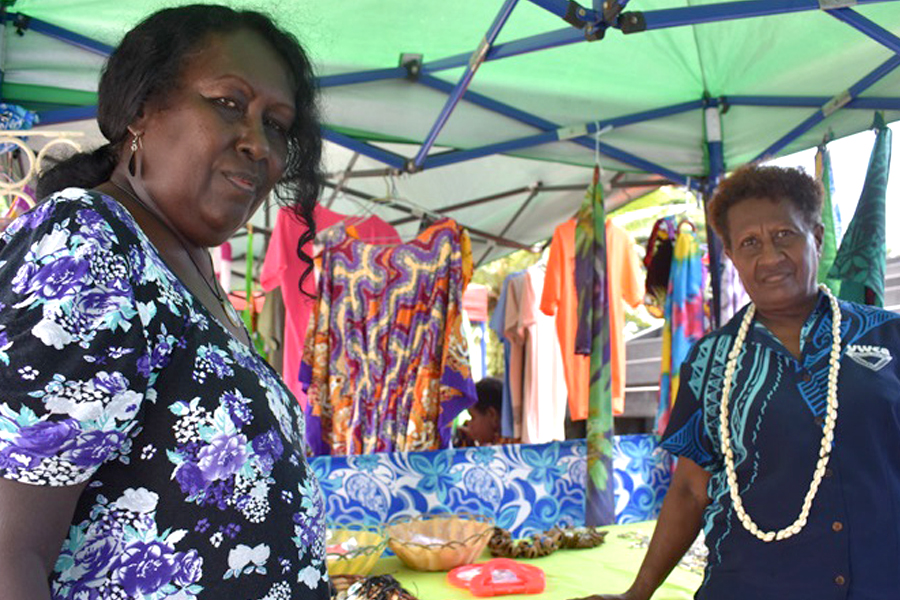
(Left to right), Sarah Ben and YWCA’s Jocelyn Lai at their stall.
BY MAVIS NISHIMURA PODOKOLO
THE celebration of the International Rural Women’s Day held in Honiara has wrapped up yesterday with women participants having discovered issues affecting them and also learnt new life skills.
Speaking on behalf of all the participated women Janet Oge chairperson of the Solomon Islands Women’s Celebration said the event is essential especially to the rural women as it’s an avenue where they can discover issues affecting them as well an opportunity where they can look and learn.
A woman is surrounded by colorful garments at her stall.
“This event is an essential platform where women can able to discover concerns that they have faced ,look and learn from other women stalls , they gather to sell their own hand made products and a space where rural women can able to interact with other working women,” said Oge.
Oge adds so far the three days gathering it has been enjoyable for the participated women who avail themselves.
She said with regards to the activities women do marketing in terms of selling of both uncooked and cooked foods and displayed the livelihood things, leaned how to cook, sew, printing of lava-lava’s, floral arts and took part during entertainment intervals.
Oge said for this year the programme only runs for three days but they’ll try to make it a weeklong next year in a venue where it can attract the general public to go and participate.
With that, the day yesterday was concluded with a long and exciting parade in the morning starting from the Honiara City Council (HCC) down to the National Museum Grounds in Honiara where the officially closing was held.
(Left to right), Sarah Ben and YWCA’s Jocelyn Lai at their stall.
Elenoa Diani, Geographic Information System (GIS) Consultant - Pacific:
Food Security Analysis (Vulnerability Analysis and Mapping) Unit: United
Nations World Food Programme (WIP) presented the copy of the Atlas to
the Government Statistician, Douglas Kimi at the National Statistics Office. Photos from SINSO Media
Elenoa Diani, Geographic Information System (GIS) Consultant – Pacific: Food Security Analysis (Vulnerability Analysis and Mapping) Unit: United Nations World Food Programme (WIP) presented the copy of the Atlas to the Government Statistician, Douglas Kimi at the National Statistics Office. Photos from SINSO Media
THE Solomon Islands national statistics office has received a copy of the Regional Food Security Atlas, which is said will go a long way in helping the country in its efforts towards improving food security and nutritional status.
The National Statistics Office (NSO) has thanked the Secretariat of the Pacific Community (SPC) and the work of the United Nations World Food Programme (WIP) for the mutual relationship and sharing of information.
Government Statistician, Douglas Kimi highlighted this when handed a copy of the 2018 Regional Food Security Atlas of the Pacific by the SPC.
Elenoa Diani, Geographic Information System (GIS) Consultant – Pacific: Food Security Analysis (Vulnerability Analysis and Mapping) Unit: United Nations World Food Programme (WIP) presented the Atlas to Mr Kimi last week at the NSO.
Acknowledging the SPC, Kimi said the Atlas will helpful to the NSO to ensure it guide its effort to collect natural disaster and food security related statistics in the country that can help legislators improve food security and nutritional status of all Solomon Islanders.
The 2018 Atlas provides a spatial overview of the core issues that affect food security across the Pacific Island Countries (PICs).
Divided into nine topical sections, the Atlas provides the reader with information and knowledge on the causes and outcomes of food security and nutrition in the region.
The Pacific is prone to natural disaster. To be able to respond quickly and effectively after the occurrence of a disaster, accurate and up to date data is essential.
The Regional Food Security Atlas of the Pacific is intended to provide a baseline of statistical information that can be helpful to decision makers to improve food security and the nutritional status of vulnerable people across the Pacific Island Countries.
It is hoped that the 2018 Food Security Atlas for the Pacific will contribute to attaining the Sustainable Development Goal 2: end hunger, achieve food security and improved nutrition and promote sustainable agriculture.
The Regional Food Security Atlas of the Pacific is a joint publication by the Pacific Community (SPC) and the World Food Programme (WFP). It is generously funded by the Australian Government’s Department of Foreign Affairs & Trade.
Governor Gary Juffa of Oro Province in Papua New Guinea who is in Honiara
for environment talks as guest speaker.
By Gary Hatigeva
Governor Gary Juffa of Oro Province in Papua New Guinea who is in Honiara for environment talks as guest speaker.
THE Melanesian Spearhead Group (MSG) has lost its purpose of existence to fight for the rights of Melanesians, says Gary Juffa, the Governor of Oro Province in Papua New Guinea.
The PNG Governor who is in the country for an Environment summit, made this strong statement at an interview yesterday, when questioned on his take regarding the MSG, which many thought had principally been sold out.
Mr Juffa from time to time, in various occasion advocates on the West Papuan issue, a course he has been championing in both his home country and around the region.
Meanwhile, during yesterday’s interview, the outspoken politician who is also known for his strong stand on rights of indigenous people of lands, reflected on the initial establishment of the MSG, which he thought was right in its approach from the start until it got compromised.
“See, the whole intent of that organisation was to fight for the rights of Melanesians, for a greater Melanesia, for a free Melanesia, but unfortunately, they have completely abandoned all that, and they are now looking more and more at trade.
“When you hear trade and trade agreements, you know, these are issues pushed by the wealthy, and usually, it will come at the expense of the poor, and so it is not a game we oath to be thinking about playing, unless we do it in a degree whereby we benefit and there’s inter-trade between the islands.
“But MSG was not set up for that purpose, and that may be part of its agenda, down the line, but its original agenda was the well-being and freedom for Melanesians and a greater Melanesia, and they have completely lost the plot.
“It has to disband itself as it has been infiltrated and compromised, and it is no longer useful vehicle for anything,” Governor Juffa stressed.
He then pointed out that the Pacific can’t be free until West Papua is free, and added that the people of the pacific have to realise that West Papuans are pacific islanders, “they are Melanesians who deserve to have their own freedom and determine their destiny, and they don’t have that now”.
The PNG Governor came in on Monday to hold talks at this summit on environment, regarding his experiences within his provincial jurisdiction, on how he dealt with logging as a leader and what measures he’s taken to help his people.