BY NED GAGAHE
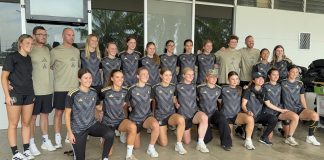
A team of lecturers from the Solomon Islands National University (SINU) visited the Tetere Species Recovery Centre (TSRC) on the Guadalcanal Plains to observe ongoing conservation efforts for the endangered Santa Cruz Ground Dove.
The visit on Tuesday, February 10, involved staff from SINU’s Faculty of Agriculture, Fisheries and Forestry (FAFF) and the Department of Environmental Studies.
According to a statement from SINU, the team was led by FAFF Dean Dr Vaeno Vigulu and focused on TSRC’s captive breeding programme for the Santa Cruz Ground Dove, which is listed as endangered by the International Union for Conservation of Nature (IUCN).
TSRC was established by Guadalcanal Plains Palm Oil Ltd (GPPOL) in partnership with the Ministry of Environment, Climate Change, Disaster Management and Meteorology (MECDM) and Toledo Zoo in the United States. The centre’s main goal is to conserve the Santa Cruz Ground Dove.
SINU said the visit provided an opportunity to explore how TSRC can serve as a platform for research, training and capacity building in conservation breeding, animal husbandry and biosecurity.
The collaboration is expected to involve local and international students and researchers, supporting scientific studies to guide future translocations, habitat restoration, preservation of genetic diversity and long-term management of endangered species.
The visit was coordinated by Narelle Wilson, Conservation Advisor with Toledo Zoo and in-country advisor for TSRC. TSRC staff were led by Martin Prescott, Senior Aviary Keeper at GPPOL, who oversees the daily husbandry and welfare of the dove population.
TSRC maintains a healthy and genetically diverse captive population, serving as an insurance population and a resource for future reintroductions and genetic rescue.
The Santa Cruz Ground Dove, endemic to the Santa Cruz Islands and northern Vanuatu, was once common across the region but has declined sharply due to introduced mammals such as rats, cats and pigs. In Solomon Islands, the remaining population is now confined to Tinakula, an island historically free from rats and cats.
However, the species continues to face threats from illegal capture, volcanic eruptions and habitat disturbance caused by introduced pigs.
Both TSRC and SINU say building local capacity and academic expertise in managing captive breeding programmes is vital to strengthen conservation efforts in Solomon Islands.
TSRC welcomes and values SINU’s collaboration in these critical efforts.
Photo: SINU
For feedback, contact: [email protected]
Editor: [email protected]