
Home Blog Page 317

Minerals bill to boost SI’s macroeconomic: CBSI

0

BY SAMIE WAIKORI

The Central Bank of Solomon Islands (CBSI) has projected that the Minerals and Resources Bill 2025 will have significant impact on the macroeconomic of the country.

Speaking before the Bills & Legislative Committee (BLC) on the Minerals and Resources Bill 2025 this week, Advisor Policy at CBSI Michael Fifiolo said the bill is important in terms of potentials it has on export proceeds.

Fifiolo said the bill will also boost balance of payment position of the country, trade position even the strength of local exchange rate.

“We need a lot of export proceeds back to the country, build-up of external reserves and fiscal revenues.

“The cap that export proceeds may not be repatriated back because of some factors have been understated by the industry, the country stands to lose because of deficiencies in our processes or inadequate capacity,” he said.

He stated that CBSI also acknowledges the need to look at its own exchange control processes by collaborating with responsible and appropriate government stakeholders.

“This is to ensure potential benefits which will be derived from mining industry are fully realized,” Fifiolo said.

On the same note, he said his team has looked through the bill and did not seem to see any mentioned of a Sovereign Well Fund except a mention of a Mineral Resources Special Fund.

“Given the fact that mineral is a non-renewable resource, its presence and opportunities for us to look outside of the box and come up with a facility that could generate inter-generational benefits is crucial.

“This is to ensure that income that flows from this resource can benefit our future generations.

“I’m not sure whether it can be accommodated in the bill or mentioned somewhere in the bill,” Fifiolo noted.

He said CBSI is not only looking at contributions from the mineral resources, but also from other resources the country has.

Fifiolo said nothing is too late and he hopes the idea to create facility that will benefit future generations will be looked into.

For feedback, contact:[email protected]

Mineral bill to establish basis for sustainable development of resources

0

BY SAMIE WAIKORI

The Minerals and Resources Bill 2025 is projected to establish a basis for sustainable development of the country’s resources.

Speaking before the Bills & Legislative Committee (BLC) this week, Deputy Secretary for Economics at the Ministry of Finance and Treasury, Mr Selwyn Takana said the bill has the potential to determine which resources can be managed and to ensure how resources are used without compromising the need of future generation.

“I believe that the mining sector is heading towards a much-needed sustainable path with the mineral resources bill.

“We want to see a sector moving forward from an outdated ad hoc system to a modern transparent and a competitive framework that sets to maximise national revenue, job creation, ensures environmental and social sustainability and most importantly supports the resource owners,” he said.

Takana also stated that the economic difficulty registered by logging and the slow recovery of service sector after the pandemic reminds us of the necessity to diversify our economy.

He added that this should be an economy that does not only take place in Honiara but creates jobs and opportunities all across the country.

“Also, an economy that represents resource owners, values the environment and is committed to a development process that does not leave anyone behind,” said Takana.

He mentioned that the new bill will allow us to shift the paradigm towards a mining sector that benefits many.

Moreover, Takana stressed that country needs to learn from its past and from the experiences of its neighbours to create a modern framework that sensifies investment job creation and growth.

At the same time, he said the country must also not give up its role as stewards of the land it inherited for future generations.

“Thanks to this bill, we will have stronger safeguard against mismanagement, stricter fiscal management of mining resources and more severe punishment against rule breakers.

“The public sector will have better tools to monitor mining activities to ensure transparency to reap their benefits.

“Also, investors will receive a stable framework, allowing them to plan ahead and contribute to reinvigorate our country’s private sector,” he said.

Takana said his team at the ministry has examined the new bill and have come up with list of suggestions, considerations and recommendations for BLC and parliament to take it into consideration.

“And with these modifications, I believe the bill will be more complete from the fiscal point of view, strengthening our ability to identify and avoid irregularities.

“Ultimately, our goal is to transform the resources that sit below our feet into healthcare, education and infrastructure improvement for all Solomon Islanders,” he said.

For feedback, contact:[email protected]

Last push for SARA

0

BY BEN BILUA

Far East Mining Company has injected more than SBD$40,000 in a final bid to convince landowners of San Jorge Island to sign the long-pending Surface Access Right Agreement (SARA).

The company met with members of the San Jorge Landowners Association yesterday with one key objective – to secure signatures for the SARA before the scheduled signing date on September 18.

Following the meeting, each Land Trustee reportedly received SBD$3,000 to facilitate consultations with their respective groups. The consultations are expected to take place next week in preparation for the official signing.

However, questions remain as to whether the SARA signing will proceed as planned, as tension continues to grow among landowners.

Some have expressed dissatisfaction with the level of support provided by Far East, claiming the funds fall short of what is needed to effectively conduct consultations.

“To facilitate consultation, we need to bring all our members to a designated meeting venue.

“This requires fuel, boats, engines, and meals to cater for participants. Our members are scattered across different areas, so bringing them together is very expensive.

“The amount given is simply not enough,” one landowner said.

Another landowner criticized the company’s handling of previous financial requests, accusing Far East of undermining landowner proposals and ignoring legitimate concerns.

“Our people have been fooled by this company, yet they fail to see the truth. It is sad to see that landowners are acting cheaply while the mining company enjoys the ride,” he said.

He also raised doubts about the company’s financial and technical capacity to carry out mining operations on San Jorge Island.

With just weeks before the proposed signing, uncertainty lingers over whether the agreement will materialize or collapse under mounting mistrust and division among resource owners.

Island Sun understands that Far East have been trying to sign the SARA since it set foot on San Jorge Islands in 2024.

For feedback, contact:[email protected]
‘Geopolitics brings benefits and challenges’

0

BY JOHN HOUANIHAU

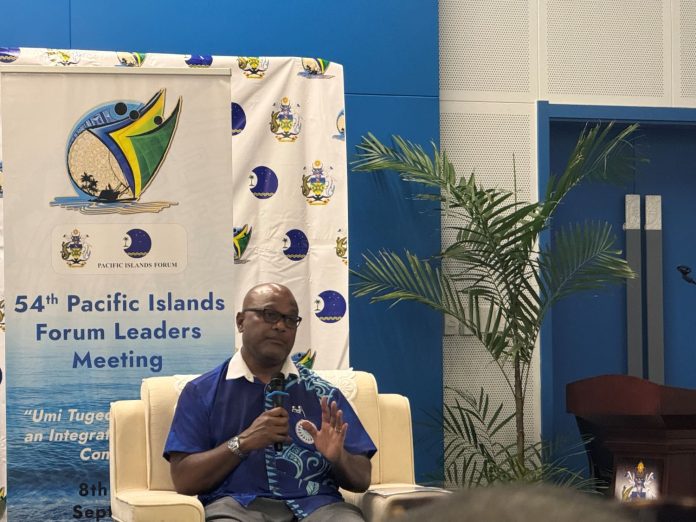
Geopolitical influence is an ongoing topic of discussion for Pacific Islands Forum Leaders going forward.

Prime Minister Jeremiah Manele told local media on Wednesday this week that geopolitical influence is at play everywhere.

“In terms of geopolitics, geopolitical influence or competition is everywhere in the world, in all regions, it’s in Africa, in Europe, in the Pacific, and we are well aware of this; it’s not only this time around, it’s been there,” said PM Manele.

He said that there are both opportunities and challenges relating to geopolitics.

“Of course, as a region, we try our best. There are both opportunities and challenges relating to geopolitical competition for influence in the region, so as a region, we’ll navigate as leaders, the region will navigate to maximise the benefits that we can draw for the region and of course minimise or address the challenges,” he said.

He said that the issue of geopolitics is not an easy undertaking and needs a proper approach in terms of regional and national interests.

“It’s not that easy. It’s not that easy because sometimes we have to navigate and balance between regional interests and national interests, but as leaders within the region, we continue to discuss those issues and see where the region can benefit and see where the region can work together to minimise the risks going forward,” he said.

For feedback, contact:[email protected]
Minerals contribute $1.5 billion to economy

0

BY SAMIE WAIKORI

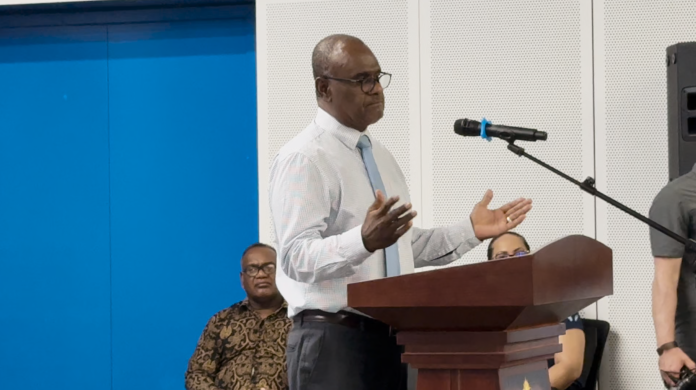
The Central Bank of Solomon Islands (CBSI) has reported $1.5 billion in proceeds from Minerals export from January to July 2025.

In terms of the country’s overall export, minerals scooped almost a quarter of the country’s export for this year.

Speaking before the Bills & Legislative Committee (BLC) on the Minerals and Resources Bill 2025 this week, Advisor Policy at CBSI, Mr Michael Fifiolo highlighted the critical situation faced by the country in terms of economic growth.

“Ideally, I would like to see economic growth sustain above the country’s population growth rate of around 2.4% to ensure sustain improvement in people’s living standard.

“With the anticipated decline in the forestry sector activities, the country is in the position where it has to look for alternative sources of growth,” Fifiolo said.

He noted that faced with the situation, the Minerals and Resources Bill 2025 is very important, as the mineral sector is considered to be one of the alternative industries to support and drive the country’s economy.

Fifiolo mentioned that over recent years, the mineral sector has offered numerous benefits like creation of job opportunities and increase of mineral export.

He added that this also includes taxes and royalties to landowners and provincial governments and spill of benefits to other sectors of the economy.

“Also, record up to July this year shows mineral export stands at 1.5 billion – an increase of 1.36 billion from last year.

“In terms of the overall export of the country, mineral export stands at almost a quarter of total export for the country.

“That comes mainly from gold, bauxite and nickel. Unfortunately, there’s also associate minerals we are not able to capture,” Fifiolo said.

Moreover, he highlighted some of the areas CBSI plays in terms of exports and why they see the bill as important.

Fifiolo said CBSI has close collaborations with the Mines Division and Customs & Exercise in terms of assessment of export applications.

However, he revealed that the challenges CBSI faced was their inability to verify the type and volume of mineral resources that been declared for export.

“From our stand point, we solely relied on Mines Division to do the verification to which they have the appropriate technical capacity.

“CBSI doesn’t do verification and that leaves us in a position that we can only accept what has been declared as the real export value.

“And on our side, the export will proceed and expect what will come back into the country under the exchange control act.

“Given the challenges, we hope the Minerals and Resource Bill 2025 would fill-in the gaps and address the issue,” he said.

For feedback, contact:[email protected]

‘PIF members need to align efforts’

0

BY LORETTA B MANELE

The Pacific Island Forum (PIF) has hinted at the need for member countries to align their efforts towards achieving collective goals.

If PIF members do not see alignment in their efforts at different levels, be it at the community, national, regional or global level, then it will always be difficult to work together more so, to achieve a common goal as a region.

PIF Deputy Secretary General, Esala Nayasi raised this when he spoke to regional and local media representatives at the three-day PIF Workshop which commenced on Friday, September 5, 2025 at the Forum Media Centre, Sports Stadium.

“If we do not see alignment in all our efforts at different levels, at community, at sub-national, to national, to sub-regional, to regional, to global, if these efforts are not aligned, it is always difficult to not only work together, but achieve a common goal as a region,” he said.

In relation, Nayasi said that in the last two years, they have gone through a review of the regional architecture in which leaders have set four pillars.

He explained that they are also looking at all the institutions in the region.

“So, we have regional organizations, we have international organizations, we have national initiatives, programs in the region, and also different stakeholders with different priorities. And you’ll understand how complicated it can be to align all these different efforts,” Nayasi said.

He added that it is obvious that in this case, you need to manage interest and expectations of each stakeholder.

Nayasi said there are four pillars that have guided their work in the review of the regional architecture.

He explained that the first one is the “political mandate of our leaders”.

“Political mandate of our leaders in relation to membership of regional organizations, membership of all different stakeholders that we have,” said Nayasi.

He mentioned that this also speaks to the importance of political governing bodies that govern each organisation.

“Likewise, multilateral organizations like the UN. Likewise, all the different organizations which were even part of the sub-national, national, sub-regional to regional level. And obviously, the global level,” said Nayasi.

He stated that the second pillar is to do with regional governance and pointed out that in terms of regional organisations, there are different governance mechanisms.

“There are different governing bodies that govern each organization,” said Nayasi.

The third pillar as stated is “institutional arrangements”.

Nayasi went on to say that the final pillar is “partnerships” and raised that PIF member countries cannot achieve goals, aspirations, national development plans and regional plans without effective and sustainable partnerships.

For feedback, contact:[email protected]
PM Manele encourages journalists to tell Pacific’s story

0

BY CHRIS ALEX

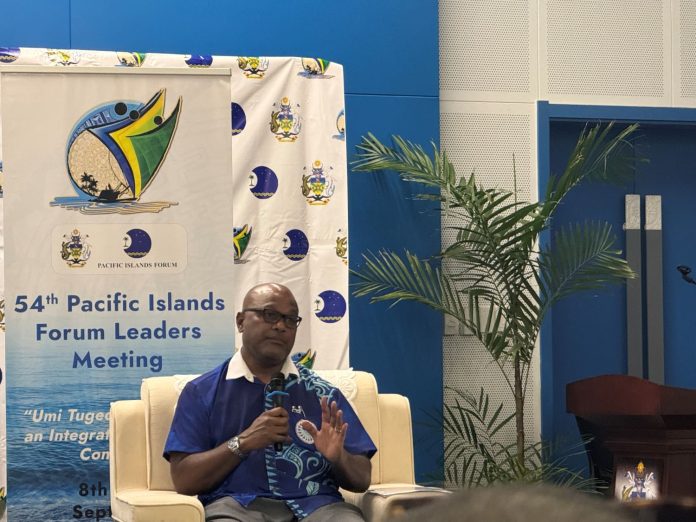
Prime Minister Jeremiah Manele has called on Pacific journalists to amplify the voices of the region, encouraging them to make regional decisions meaningful and accessible to all Pacific peoples.

Speaking at the official opening of the Regional Media Workshop Yesterday in Honiara, Mr Manele highlighted the vital role of media in shaping the shared journey of the Blue Pacific.

The event is jointly convened by the Pacific Islands Forum Secretariat (PIFS), the Pacific Islands News Association (PINA), and the Media Association of Solomon Islands (MASI).

With the 54th Pacific Islands Forum Leaders Meeting approaching, the Prime Minister stressed the importance of communicating regional strategies in ways that resonate with everyday Pacific Islanders.

He urged media professionals to go beyond official communiqués and reflect the lived experiences, challenges, and aspirations of Pacific communities.

“You will tell the stories and make these regional decisions meaningful for everyday Pacific Islanders. Through your reporting, the messages of our leaders will reach communities, helping people understand the decisions and discussions that affect their lives,” Prime Minister Manele said.

He also acknowledges the work of journalists operating in often under-resourced newsrooms, praising their resilience and commitment to public service.

The Prime Minister encouraged them to maintain ethical standards while championing the values and unity of the Pacific region.

“The canoe of the Blue Pacific has already set sail.

“If we paddle together, guided by our shared values and united in purpose, we will reach our destination,” he said.

The Regional Media Workshop serves as a critical lead-up to the Forum Leaders Meeting, where the media is expected to play a key role in bridging policy decisions with public understanding under the Forum theme, “Iumi Tugeda: Act Now for an Integrated Blue Pacific Continent”.

For feedback, contact:[email protected]
Premier orders immediate removal of vessels from old NFD Wharf in Tulagi

0

BY NED GAGAHE

Premier of Central Province, Kenneth Sagupari, has issued an urgent directive to all shipping managements with vessels currently docked at the old NFD Wharf in Tulagi, to immediately remove or relocate their ships.

The directive, released from the Office of the Premier yesterday, stated that land and sea title ownership of the old Solomon Taiyo wharf area has officially reverted to the provincial government, with development plans already in motion for the strategic site.

“We urge you to remove or relocate your ships to a safer harbour immediately,” Premier Sagupari warned, highlighting that some vessels have been abandoned, neglected, and have not paid harbour charges to the province.

The situation has already escalated, with one vessel reportedly sinking at the site.

Premier Sagupari said that without immediate action, remaining ships risk a similar fate.

“We cannot stress enough the importance of prompt action.

“The continued abandonment of ships is not only a sign of disrespect to this province but a direct threat to our environment, marine life, and public safety,” Sagupari said.

Sagupari expressed grave concern over the growing number of sunken or derelict vessels in Central Province waters, saying they threaten both the future development of the region and the sustainability of marine resources.

“We will not allow Central Province to become a ship graveyard. The presence of these vessels poses a serious risk to our marine environment and the well-being of our people,” he said.

The Office of the Premier calls on relevant maritime and enforcement authorities to intervene if shipowners fail to act swiftly.

With control of the site now returned to the provincial government, plans are being developed for the revitalization of the old NFD wharf area, a move seen as critical to Central Province’s long-term growth and infrastructure strategy.

Premier Sagupari also firmly calls for cooperation from all shipping stakeholders.

“We expect responsible authorities and shipowners to treat this matter, and Central Province with the respect it deserves,” Premier Sagupari said.

For feedback, contact:[email protected]

PIF in third phase in review of regional architecture

0

BY LORETTA B MANELE

The Pacific Islands Forum (PIF) is now in the third phase of the Review of the Regional Architecture (RRA).

Esala Nayasi, PIF Deputy Secretary General spoke about this yesterday at a PIF Workshop for regional and local media representatives who will attend and cover the week long 54th PIF Meeting next week.

He explained that they have been able to go through the RRA which consists of three phases and they are now in the third phase.

Speaking on the first phase, “understanding the status quo”, Nayasi said they have come to understand that there are many organisations in the Pacific region which means competing interests, duplications and overlapping interests for PIF members.

“It also means wishes of resources, particularly if there are duplication,” he said.

Henceforth, Nayasi mentioned that they had to look at the way we are set up as a region, particularly as it refers to governments and institutional arrangements.

The second phase as stated was more towards regional organisations.

Nayasi voiced that this was about how PIF members will reset in regards to different regional organisations, different governing bodies and different priorities.

He said this involves issues like how PIF members will align national development plans to the regional vision and goals that is set for all PIF members.

Nayasi stressed that this is also about how PIF member countries can do things better and more effectively and be able to ensure that they are serving their people in a way that is efficient, effective, meaningful and in a manner that meets the expectations of everyone.

He furthered that they are now in the third phase of the review which is in relation to the personalisation of regional organisations.

“This is what the leaders will be discussing next week,” he said.

For feedback, contact:[email protected]

PM Manele welcomes Pacific media to Honiara

0

BY CHRIS ALEX

Prime Minister Jeremiah Manele officially welcomed media representatives from across the Pacific to Honiara at the opening of the Regional Media Workshop, on Friday, September 5, 2025 setting the stage for the upcoming 54th Pacific Islands Forum Leaders Meeting next week.

The workshop, hosted by the Pacific Islands Forum Secretariat (PIFS) in collaboration with the Pacific Islands News Association (PINA) and the Media Association of Solomon Islands (MASI), aims to strengthen the role of media in promoting Pacific regionalism and informing communities on key issues.

Delivering the keynote address, Prime Minister Manele expressed gratitude to PIFS and PINA for their continued commitment to empowering Pacific voices through journalism.

“Hosting the Forum for the third time, after 1979 and 1992, reflects our commitment to Pacific solidarity and to the values of unity and cooperation that lie at the heart of the Pacific Way,” he said.

Reflecting on this year’s Forum theme, “Iumi Tugeda: Act Now for an Integrated Blue Pacific Continent”, the Prime Minister described it as both a celebration of Pacific identity and a call to urgent action.

“‘Iumi Tugeda’ – we are together – speaks to our identity as Pacific peoples. ‘Act Now’ – our challenges demand urgent actions. An Integrated Blue Pacific Continent – this is our shared vision of a peaceful, resilient, and future-ready Pacific,” he added.

Manele underscored the crucial role of media not just as observers but as partners in regional development, saying journalists help translate regional discussions into relatable stories for Pacific communities.

“Our people will ask: ‘What does this mean for me? For my family? For my community?’ It is through your work that those answers will be found,” he said.

He also acknowledges the challenges many Pacific journalists face, including working in under-resourced environments, and thanked them for their dedication to connecting and empowering people.

In light of the ongoing implementation of the 2050 Strategy for the Blue Pacific Continent, the Prime Minister calls on the media to uphold ethical and balanced reporting, emphasizing that trust and visible impact will be the true measures of regional success.

“Success will not be measured by communiqués alone. It will be measured by the trust of our people and the real changes they can see and feel in their daily lives,” he said.

Closing his remarks with a metaphor of unity, Manele likened the region to a canoe navigating uncertain waters.

“The canoe of the Blue Pacific has already set sail. The waters may be uncertain, but if we paddle together, guided by our shared values and united in purpose, we will reach our destination,” he said.

The Regional Media Workshop continues in the lead-up to the 54th Pacific Islands Forum Leaders Meeting, where journalists will play a central role in ensuring regional priorities are communicated effectively to Pacific communities.

For feedback, contact:[email protected]