
Home Blog Page 304

Pacific Island countries working on treaty to protect Kava

0

BY SAMIE WAIKORI

The Pacific Island Forum through its Pacific Island Forum Trade Department is working with Kava groups in the region to establish a treaty that could protect Kava – as a biocultural heritage of the Pacific Islands.

The treaty comes from Pacific Islands Development Strategy Declaration on Kava, which was endorsed by Pacific Island Forum Leaders in 2024. The objective of the treaty is to protect kava from being commercialized and to recognize the cultural importance of kava to Pacific islanders.

The Technical Chair of Working Kava Group, who is also the Chair of Kava Committee Tonga and Advisor Palace Officer Tonga, Mr Feiloakitau Tevi said during the Pacific Trade Ministers’ meeting this year, they were asked to work around geographical indicators for Kava – to look further at the Kava declaration.

“So, in order to get to the treaty on Kava, we needed to have the first step, which is the Kava declaration.

“And so, the Kava declaration is formed in such a way that the declaration more or less talks about the cultural, traditional importance of Kava.

“So, for all of this to say, basically, Kava for us is of cultural importance. And we cannot just let Kava be commercialised and traded like we have gifted bananas and sugarcane to the world,” he said.

Mr Tevi added both products are from South Pacific and were taken by colonial master been commercialized.

Kava is one of those products that if we do not protect it, and if not safeguard against mass commercialisation, we will not reap benefits and our people will not reap the benefits of it.

“And the Kava declaration is one step in the process of trying to protect the name and trying to protect the product and the plant.

“But the declaration is not restrictive. It’s not an obligation right now. It’s just an aspiration.

“This is what we would like to do. It strengthens the base product’s integrity because it covers the Pacific role and Pacific process. It also gives us a strategic advantage in terms of market.

“Kava should come from the Pacific. That’s what we’re trying to say through this declaration. The team is working with PIF on the undertaking,” he affirmed.

Moreover, Tevi said in May, the inaugural Pacific Regional Kava festival was held in Tonga at the Pacific Week of Agriculture. This is one of the outcomes of the Regional Kava Strategy.

He added that during the event, it was twisted to Solomon Islands Minister of Agriculture, and that means Solomon Islands would host next year’s Pacific Regional 

“So, we hope to have a Pacific Regional Kava Festival hosted in the Solomon Islands at some point in time before the next Pacific Islands Forum in Palau.

“So that gives us one more excuse to come back to the Solomon Islands, to come and enjoy the islands.

“I think Malaita is holding its hand up to host the Regional Kava Festival. So we look forward to going there” Tevi said.

For feedback, contact:[email protected]

54th Pacific Islands Forum Leaders Meeting ends successfully

0

BY BEN BILUA

THE 54th Pacific Islands Forum Leaders Meeting has ended successfully in Honiara on Friday, September 12, 2025.

The weeklong event brought together regional leaders to discuss pressing issues and opportunities on bringing peace, security and economic development in the pacific region.

Under the theme “Iumi Tugeda: Act Now for an Integrated Blue Pacific Continent”, leaders engaged in series of dialogue with Civil Society Organisations, Private Sector and Head of Civil Society Organisation in the Pacific.

Leaders also took time to strengthen cooperations between countries by signing security and trade arrangements.

Key events that took place during the meeting were; the implementation of 2050 Strategy, Review of the Regional Artitechture, the signing of the Pacific Resilience Facility and the endorsement of the Ocean of Peace Declaration.

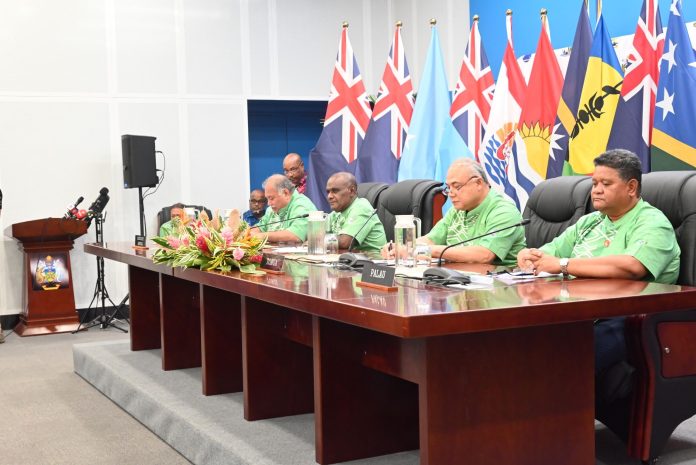
On Thursday this week, leaders flew to Munda, Western Province for the Forum Leaders Retreat and returned to Honiara on Friday, September 12, 2025 for the Troika press conference.

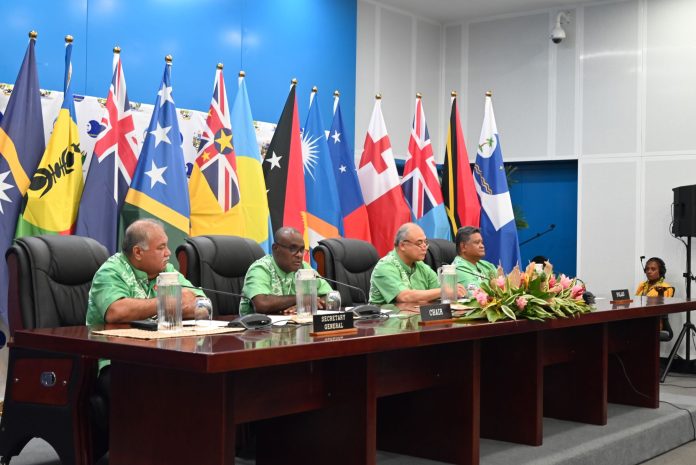
Opening the Troika press conference, Pacific Islands Forum Secretariat, General Secretary Baron Divavesi Waqa acknowledges the government and people of Solomon Islands for hosting the regional event.

He also acknowledges regional leaders for their contribution in series of meetings which took place during the week.

In his speech Forum Chair, Prime Minister Jeremiah Manele said the forum reflected deeply on regional priorities, reaffirmed regional unity and agreed on clear actions that will help guide the Blue Pacific Continent through increasing complex and challenging strategic environment.

He said leaders had the opportunity to meet with numbers of key stakeholders in the pacific including the representatives from the private sector, civil society organisation, head of CROP agencies and Associate members.

Manele said forum leaders have agreed to a communique which outlines important agendas and recommendations for respective countries in the region to implement.

For feedback, contact:[email protected]

54th PIF leaders call on states and non-states to adhere to six key actions

0

BY LORETTA B MANELE

Leaders from the 54th Pacific Islands Forum (PIF) in the 2025 PIF Communique have called on states and non-states to take on six key actions.

This is according to the 54th PIF Leaders Communique which was shared during a press conference on Friday, September 12, 2025.

At the press conference was the PIF Secretary General, Baron Waqa and the Troika members which refers to the former Chair of PIF, the current Chair and the incoming Chair.

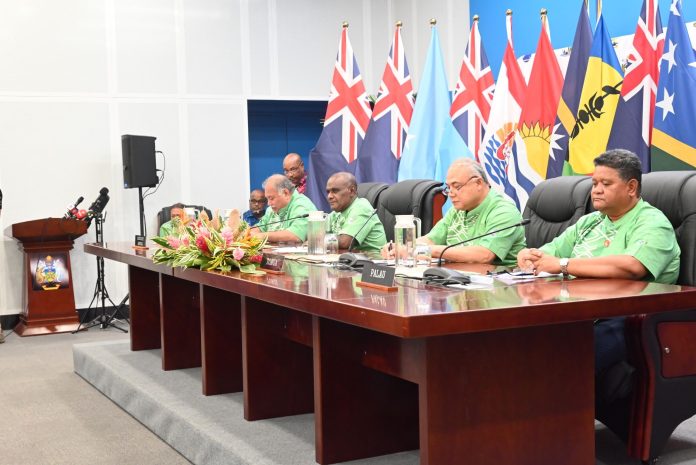
The former PIF Chair is Tongan PM, Aisake Eke, current Chair is Solomon Islands PM, Jeremiah Manele and on behalf of incoming Chair, Palau was their Foreign Minister Gustav Aitaro.

Moreover, in the 2025 PIF Communique, the first of six key actions PIF leaders call on states and non-states to take on is to engage with the Blue Pacific Continent in a manner that honours the Pacific way, respects national sovereignty of all PIF members and supports national and Pacific-led approaches including through Forum-endorsed mechanisms to safeguard Pacific peace and security.

Secondly, states and non-states are called to support the integration and advancement of the Blue Pacific Ocean of Peace by respecting its principles and aligning all engagement with the Pacific’s vision for peace.

Third in line is the call for support for Blue Pacific Continent in strengthening the conditions for peace to thrive.

“Through long-term investment in inclusive and resilient development that upholds national ownership, fosters stable governance and builds Pacific capacity and capability to sustain lasting peace for all Pacific peoples, including the role of women in peace building”, said the statement.

In fourth place, PIF leaders call on states and non-states to recognise the special needs and circumstances of Small Islands Developing States and their vulnerabilities.

In addition is the call for states and non-states to promote the responsible use of technology and innovation.

Lastly, the PIF leaders call for states and non-states to join the Blue Pacific Continent in taking bold, decisive and transformative action through the Paris Agreement and other relevant mechanisms to limit global warming to 1.5C above pre-industrial levels.

On this note, the leaders state that recognising this is crucial to the peace and security of the Blue Pacific Continent.

For feedback, contact:[email protected]
Leadership in the region is crucial: Rabuka

0

BY SAMIE WAIKORI

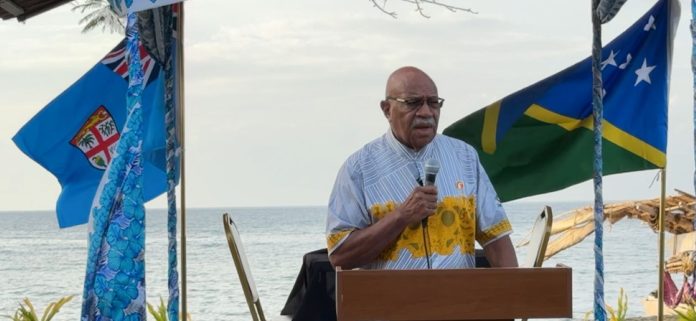
The Prime Minister of Fiji, Sitiveni Rabuka has urged colleague leaders in the Pacific to serve the region by learning and carrying on from good work done by past leaders to mentoring the new generation of leaders.

The legacies of dedication and selfishness they had invested in leading the region are the very spirit to which upon the 2050 Strategy for Blue Pacific Continent was formulated.

Speaking at the ceremony to formally endorse the Ocean of Peace declaration during the PIF meeting that concluded in Honiara yesterday, Hon Sitiveni Rabuka shared some of common challenges faced by leadership in the region.  

“I’ve had the privilege of serving in the political leadership arena on various occasions over the last three decades.

“As I look around, I am very aware of my place in the age calculus. For many of us, our journey went through the lowest of places where we saw the darkest side of the human heart (conflicts and battlefields) to the brightest and highest offices of the land.

“We have heard the best of melodies, for which our region is renowned, and the pain that inspired our words and songs.

“On the way, we had tried to avoid fires, but they ended up the very instrument that shaped and defined us,” he said.

Rabuka emphasized that lessons leaders had learned were not just for them, but meant to be shared as they carry the weight of these experiences with a profound sense of duty.

“We’re here to offer a steady hand and a guiding voice, drawn from years of shaping and re-shaping by “the One in whom we live and move and have our being.

“Those before us had fulfilled their duties. We, the present generation, stand on their shoulders.

“They had the luxury of trial and error, of testing and piloting ideas, they had the benefit of doubt as they transitioned our region.

“Today, our societies are less forgiving in the best of times, as their demands for rights, transparency, accountability are ruthlessly pursued,” he said.

The Prime Minister added that as they navigate the uncertainties before them, they must commit to ensuring that the next generation of leaders is equipped to face the fights of their lives with courage and integrity.

“Honouring the legacies of those who were before us can only be demonstrated by leading with the same dedication and selflessness they themselves invested in their time.

“These are the bases upon which the very spirit and intentions of the 2050 Strategy for our Blue Pacific Continent were formulated,” he said.

For feedback, contact:[email protected]
Different aspects of ‘unpacking resilience’

0

BY LORETTA B MANELE

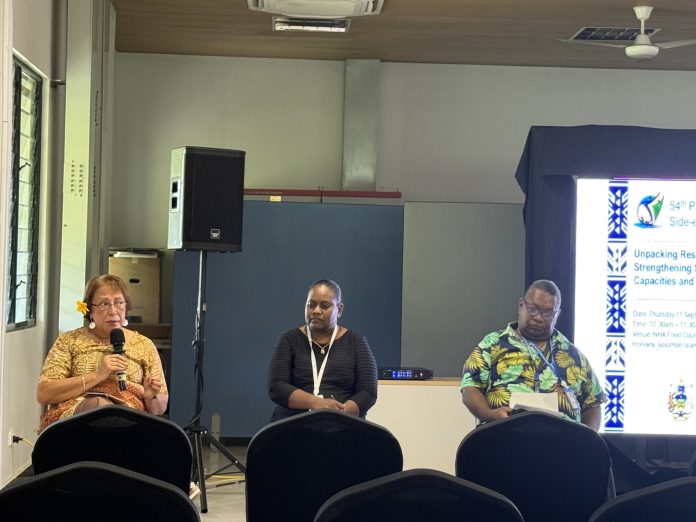
This week, at the 54th Pacific Islands Forum (PIF) Side Event “Unpacking Resilience-Strengthening Systems, Capacities and Practical Solutions”, panelists briefly spoke about different aspects relating to climate resilience.

The session was opened with a few remarks from Rex Ramofafia, Minister for the Ministry of National Planning and Development Coordination (MNPDC).

He expressed that the region must move on from financing resilience in theory to building it in concrete reality, especially in rural areas.

“Mainstream resilience is not a choice, it is a necessity. Our national and sectoral planning and budget cycle are the most critical windows for this integration,” said Ramofafia.

A panel discussion was held with three panelists namely; Amelia Kinahoi Siamomua, Adviser to Tongan PM, Agnetha Vave Karamui, Deputy Secretary Technical, MECDM and Roy Mae, Deputy Secretary, Ministry of Planning.

Siamomua, who is the advisor to the Tongan Prime Minister Aisake Eke, highlighted that it is important to hold governments accountable to ensure that every penny meant for climate resilience is actually spent on climate resilience.

She their government is working on what they call “tracking the money” to ensure that money is allocated to the right tasks in terms of agencies budget.

Agnetha Vave Karamui, Deputy Secretary Technical spoke about community-based disaster tools.

She said they have been working with communities to help them develop their disaster management plans.

Karamui mentioned that this work involves technical training and improving the capacity of rolling out the plans.

The third panelist was Roy Mae, the Deputy Secretary, Ministry of Planning, who spoke about climate budgeting.

He pointed out that the progress of climate budgeting is linked to Solomon Islands national and environmental systems.

Mae also stated that there is ongoing reform on climate budget at country level to strengthen coordination between the Ministry of Environment, Climate Change, the Ministry of National Planning, as well as the Ministry of Finance and Treasury.

The session allowed discussions centered on the importance of tracking funding for climate resilience, the roll out of community-based disaster tools and climate budget reform.

For feedback, contact:[email protected]
Ocean of Peace – aspiration to maintain status quo

0

BY JOHN HOUANIHAU

The Ocean of Peace serves as an acknowledgment for the Pacific region to uphold the existing conditions.

Tingika Elikana, Cook Islands Minister of Foreign Affairs and Immigration made this statement during a side event at the PIFLM focused on regional integration and the Ocean of Peace, which took place at the Aquatic Centre on Thursday.

This side event, aims to foster an ‘Ocean of Peace’ through enhanced regional integration and discussions among government officials, regional representatives, and civil society members.

“From my perspective, as both a Cook Islander and a Pacific Islander, I view this as a recognition of our goals to preserve the current state of affairs and our commitment to tackling the challenges we encounter. Without peace, particularly climate peace, it will be exceedingly challenging to thrive in our region,” he said.

He said that the Pacific Islands are acutely aware of the difficulties faced in this area, especially concerning climate change and geopolitical tensions.

“None of our actions suffice. I have attended all these meetings, and we consistently address the effects or impacts, yet none of our actions are sufficient. Nevertheless, we are the ones who unite to tackle these issues. Consider the PRF we recently signed. It serves as a recognition of the Pacific Islands coming together to confront these challenges,” he said.

He said that the PRF acknowledges the reality that these issues cannot be addressed at the national level by Pacific Island states acting individually.

“As I previously mentioned, the ocean of peace symbolizes our aspirations. Therefore, we cannot achieve it alone. The Cook Islands cannot accomplish it on a national scale. Neither can Fiji or Palau. However, as a region, we may have some influence. Yet, we require the support of our partners to clearly define what the ocean of peace signifies for us to progress,” he said.

For feedback, contact:[email protected]
CLIMATE ACTION

0

54th Pacific Forum leaders summit ends in Honiara with resounding call for all nations to respond to climate change

BY LORETTA B MANELE

Action on climate change is the main highlight of the outcomes of the 54th Pacific Islands Forum leaders’ summit in Honiara.

The 2025 Communique of the 54th Pacific Islands Forum (PIF) Leaders Meeting includes a statement by the leaders which includes six components.

The communique was made available during a press conference on Friday evening, September 12, 2025, the last day of the 54th PIF Meeting.

Present at the press conference were PIF Secretary General, Baron Waqa and Troika group which includes former PIF Chair, Tongan PM, Aisake Eke, current PIF Chair, Solomon Islands PM, Jeremiah Manele and representing incoming chair, Palau, was their Foreign Minister, Gustav Aitaro.

The first is that they now recall the “Boe Declaration on Regional Security and Kainaki II Declaration for Urgent Climate Change Action”.

Secondly, the leaders reaffirm that climate change remains the single greatest threat to the livelihoods, security and wellbeing of the people of the Pacific and is a critical barrier to achieving our leaders’ vision in the 2050 Strategy for the Blue Pacific Continent and the UN Sustainable Development Goals globally.

In third place, is the call from the PIF leaders for all nations to urgently respond to climate change.

This is followed by their reaffirmation of Pacific Islands Forum support for Australia’s bid for COP31 as a Pacific COP and their strong commitment to host this historical international engagement in 2026.

“…to accelerate global action to set us on track to meet the goals of the Paris Agreement and its subsequent,” said the statement.

The 54th PIF leaders also commit to championing the needs of all countries impacted by climate change, particularly the most vulnerable and to refocus on global efforts on accelerating practical action and scaling up support in line with the Paris Agreement and its first global stocktake, reiterating the vital importance of keeping 1.5C within reach.

Finally, the leaders celebrate Pacific leadership in driving regional solutions to global challenges as demonstrated through the establishment of the Pacific Resilience Facility, which will be decisive step forward in securing a resilient future for the Blue Pacific Continent.

For feedback, contact:[email protected]
MP Tei’ifi works closely with chiefs

0

By RODRICK DESURI 

AUKI 

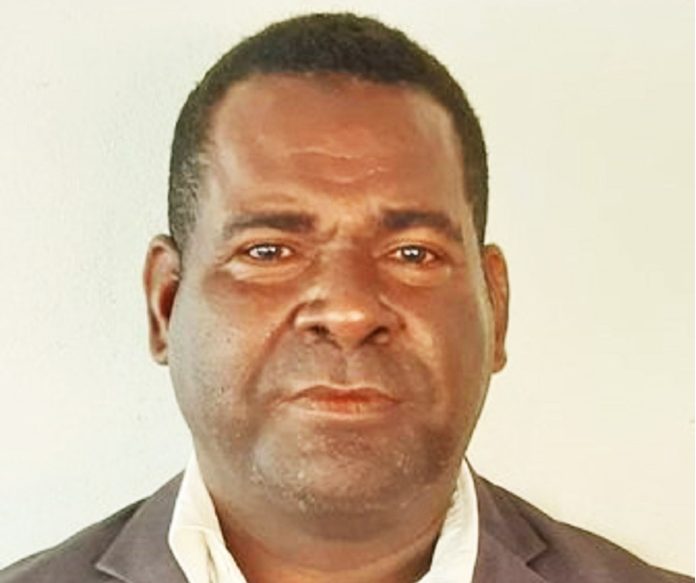
Member of Parliament for West Kwaio Claudius Tei’ifi is reportedly working closely with the three local houses of chiefs in his constituency.

He said the reason his office aims to build the chiefs’ houses is that any development that takes place will happen on the land, and it must be settled first.

The three Houses of Chiefs in West Kwaio are Lafari House of Chiefs in Ward 28, Kwaisie House of Chiefs in Ward 27, and Longa’alata House of Chiefs in Ward 26.

He said that the building of the three houses for the chiefs will provide a comfortable space for the chiefs to discuss very important matters regarding land settlement.

“This is why our constituency office has prioritized building those three chief houses. It will provide a comfortable space for the chiefs to settle land issues in terms of land demarcation,” he said.

He said that as the Bina Harbour tuna processing project is nearing implementation, it is very important for the chiefs to settle land issues first.

“We are the hosts of this Bina Harbour project, so we must get ready and prepare for the development of the project.

“If we don’t prepare and get ready for the development of the Bina Harbour project, we are the ones who will be affected,” he said.

Tei’ifi said that once the houses are complete, he will call on land and criminal chiefs and every landowner to discuss and correct any mistakes they find.

“Once the construction of the houses is complete, we will call all the chiefs and landowners together to discuss the issues like genealogies, land recording, correct the mistakes, and put strong laws in place to protect our lands,” he said.

For feedback, contact:[email protected]
SIART project provides employment opportunities

0

By RODRICK DESURI 

AUKI 

The implementation of the successful applicants’ projects funded by the World Bank under the Solomon Islands Agriculture and Rural Transformation (SIART) programme has created employment opportunities for rural communities. 

Kwasila Association is one of the successful applicants of the SIART programme, which has kicked off with a piggery project and has engaged about 30 people, including women and young people who previously were unemployed. 

Chairman of Kwasila Association, Eddie Otosafi said the project has given them hope and shown an image of achieving goals in the future.

He said his group is now in the implementation phase of their piggery project, and many women and young high school dropouts have been engaged.

“Many women and high school dropouts joined us in the implementation works. This is because they have seen for themselves what the project will provide and what they will achieve from it.

“We work together with the hope that this project will benefit our community in terms of income generation, food, and broadening our knowledge and skills in piggery farming,” he said. 

The report stated that the initiative aims to improve agricultural productivity, commercialisation, and market access for various crops like cocoa and fruit trees, and it is scheduled to end in December 2026. 

The programme is a World Bank-funded initiative mainly to support agricultural producers and rural transformation through training, equipment, and grants for Agribusiness Producer Organizations (ABPOs) in Malaita, Guadalcanal and Makira Ulawa provinces.

For feedback, contact:[email protected]

Live and Learn presents community voices on climate resilience

0

BY BEN BILUA

Live and Learn yesterday presented its findings during a side event of the 54th Pacific Islands Forum Leaders Meeting, highlighting community-led solutions to build climate resilience across the region.

The session, titled “Building Climate Resilient Islands: Community Voices and Partnership for a Blue Pacific Future”, showcased the achievements of the Live and Learn Climate Resilient Islands Program.

It emphasized the importance of amplifying the voices of Pacific Islanders, particularly women, youth, and traditional leaders, in shaping climate resilience and decision-making.

Speaking at the event, Live and Learn representative, Elmah Panisi stressed the need to promote cross-sectoral partnerships involving governments, civil society, donors, and the private sector to support the Blue Pacific Strategy.

She added that the session also aims to facilitate interactive dialogue and knowledge exchange on scaling up resilience efforts across the Pacific.

Supported by the New Zealand Ministry of Foreign Affairs and Trade, the Live and Learn Climate Resilient Islands Program works closely with communities across the Pacific.

The program focuses on developing locally led, nature-based solutions to strengthen climate resilience while safeguarding traditional knowledge, food security, water systems, and local ecosystems.

The side event provided an important platform to amplify Pacific voices, highlight innovative community action, and foster partnerships to accelerate the Blue Pacific Strategy.

For feedback, contact:[email protected]