
Home Blog Page 1317

Konofilia hits back on SIFF

SIFF President Willie Lae
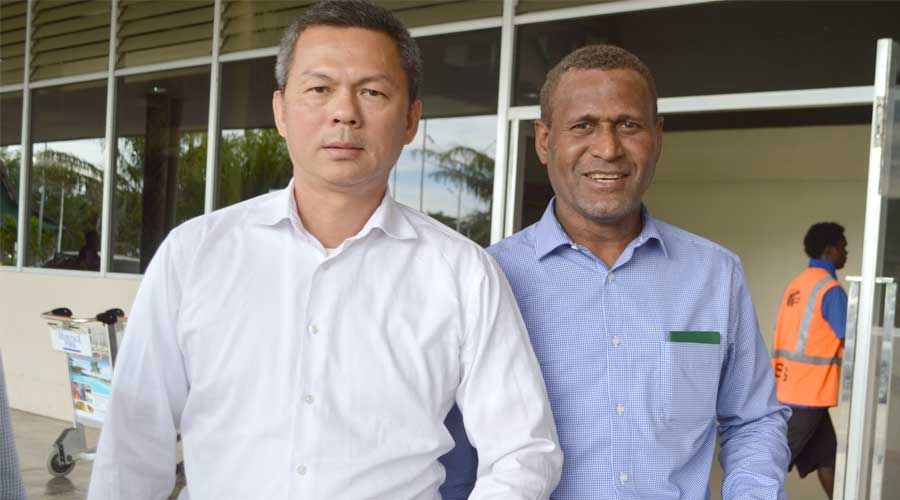
Solomon Islands Football Federation (SIFF) President William Lai and Vice President Eddie Omokirio

OUTSPOKEN football critic Joel Moffat Konofilia has lashed out at the national football governing body stating the statement published last week to condemn his continuous social media ranting as merely ‘all excuses’.

The statement issued by Solomon Islands Football Federation (SIFF) last week termed Konofilia’s continuous scathing attacks on them in the social media as unprofessional.

This follows Konofilia’s recent request to borrow some money from SIFF to cater for him to send some members of his Royals Football Academy to undergo trials with clubs in United Kingdom.

Referring to the statement, SIFF said the manner in which Konofilia behaved whereby he asked to borrow some money from them to aid him send his academy youngsters to attend trial overseas was totally ‘unprofessional’ in a sense that they are not a lending institution.

SIFF asserted that under the FIFA regulations and statutes, SIFF is not obliged to enter into any dealings with Konofilia and Royal academy given they are not affiliated to Honiara Football Association (HFA) nor the Guadalcanal Football Association (GFA) which he claimed to be technically operating under.

“SIFF is entirely responsible for technical, infrastructure and administration of national leagues and only answerable to its member associations.

“However, due to Joel’s continuous visitation at the Allen Boso Complex, SIFF staff have had opened our doors to listen to him.

“Thus, SIFF has warned Joel to stop his misleading ranting against the national body but rather find a way to move the game we all love forward,” the statement explains.

In a response to SIFF, Konofilia said: “These are all excuses.

“The SIFF President William Lai and I already had a reconciliation and that’s why I was only asking for SIFF to help if they could.

“They responded by saying that SIFF has no budget for such activity.

“Then that’s when I asked if we could at least borrow some money and reimburse after our corporate dinner. This was just to meet deadlines.”

Maintaining its stand, SIFF said any project emerging with his (Konofilia) face on it may appear dubious, citing a previous incident last year where the national football governing body paid Australian Visa for two players who were supposed to have trials in Australia through a similar arrangement under Royals which was never carried out.

However, Konofilia lashes out to SIFF by admitting that his previous arrangement for trials in Australia did not eventuate because he was in prison during the whole of February last year.

“Secondly the trip to Aussie didn’t eventuate because I was in prison the whole of February and my partner in Australia thought that I wasn’t interested and cancelled the trip.

“With regards to the payment of the two boys’ visas, the money was never released from SIFF account as we never lodged the visa application in the end.

“However, I would like to stress here that what I’m doing is the best thing that has happen to Solo soccer and SIFF will definitely benefit in the end just like in the case of my nephew, Marcus Chan. Now SIFF needs his service for the upcoming World Cup Qualifiers.

“SIFF never helped his family in the initial stage to send him overseas to train but just look at what’s happening now, they are calling for his service,” Konofila expressed.

SIFF also called on Konofilia to provide them with informative details of the overseas trials but the former national midfielder refused to disclose them.

Details requested by SIFF includes confirmed correspondence from EPL clubs about the trials, contacts and other details which then will be forwarded to the executive members for consideration.

“With details of my agent, I am sorry but I deliberately kept it as secret. However, the trip is definitely on as I’ve already committed funds with the payment of two of our players.

“With regards to not disclosing my partner, it should be understandable because last time I disclosed ROYALS Sponsor, SIFF tried cutting that deal, and fortunately the sponsor was a foreigner and reported SIFF’s attempt to me,” Konofilia affirms.

Furthermore, Konofilia added that SIFF’s plan to send three boys to the Spanish La Liga for trials after the September qualifiers is just a cover up.

“And with regards to the 3 boys going for trials in the La Liga is just a cover up for SIFF’s sleepiness. They are just embarrassed as they are doing nothing for our top elites while Royals are thousand miles

ahead already.

“So while SIFF decides not to help my boys financially attend trials overseas, they still have plans to send players overseas, which only confirms to me that they have money but does not want to help me because it has to be them doing it and not me (Konofilia) for reason only known to themselves.”

Money smart day today

0

BY GEORGINA KEKEA

TODAY marks Money Smart Day in Solomon Islands.

The event is a rebrand of the Central Bank of Solomon Islands (CBSI) to promote financial literacy in the country and to promote child and youth financial education.

On this occasion, commercial banks and financial institutions and NGOs is setting up their booths at the SINPF recreational compound in Town Ground.

The main goal of this day is to educate our young people to learn and develop personal financial management skills and behavior, including good habits related to dealing with money.

At the same time, ANZ Bank with support of the Pacific Financial Inclusion Programme (PFIP) has been promoting its ‘GO MONEY’ platform to the populace of Honiara through various locations since its inception.

ANZ goMoney is a mobile banking service that allows customers to access their ANZ accounts securely from their mobile phone.

The functions of goMoney includes cash withdrawals, or deposits at any ANZ goMoney merchant, transfer money to another ANZ customer, transfer money between linked ANZ accounts but to name a few.

While there are different services available through the goMoney scheme, one of the most recent services provided by ANZ bank is the platform available for parents to pay for their children’s school fees.

Now, with goMoney, parents can pay school fees conveniently and currently this platform is active for a few schools in Honiara.

Future plans are to roll out this platform to the rest of the country.

With this platform, parents do not physically need to go to schools to pay school fees but they can pay their children’s school fees through this goMoney platform.

For the Money Smart Day activity, ANZ bank is also supporting this activity to educate our Youths, children and young people on the need to be money minded and to raise awareness on how to be a good entrepreneur.

In a previous Money Smart Day event, the Governor of CBSI, Denton Rarawa has said that it is time for everyone, “the government, financial institutions, schools teachers, parents and family to empower our children and youth with knowledge and experience to participate in resource saving habits and avoid habits that can incur costs”.

The theme for this year’s Money Smart day is ‘Money Matters Matter’.

The theme was adopted from the Global Money Week 2018. Global Money Week (GMW) is an annual money awareness campaign built to inspire our children and young people to learn more about money matters and entrepreneurship.

Momotu cultural group heads to Honiara  

0

BY ELLISON.T.VAHI

THE Momotu youth cultural panpipe group from Isabel province will be travelling to perform in Honiara from July 1-10.

As one registered youth cultural group under the ministry of culture and Tourism, they will not participate during the Melanesian Arts & Cultural festival but see the importance of the event as they travel to witness it.

Speaking to this paper, the group leader of Momotu, Mr Chris Neo said that organising and bringing in such a group from the province is an expensive exercise in view of transportation, accommodation and meal, however, they see that culture provides important social and economic benefits as well with improved learning and health, increased tolerance, and opportunities to come together with others, culture enhances quality of life and increases overall well-being for both individuals and communities.

He said that since forming the group in 2014, their aim is to bring as well see the youths revive forgotten old traditions, songs and dances being once performed by their forefathers, mothers and grandparents in the past, in a form of panpipe.

Relating their aim with the Melanesian Arts & Cultural festival theme; “Past Recollections; Future Connections” he said that their tour is timely and reinforces the significance of this festival as a time to reminisce on their history and cultures, whilst at the same time connecting themselves as one people in diversity for a brighter connected future.

He also stated that the true spirit of their tour is sharing in unity, whereby through their recollections they are then connected together as they journey forth into the future, hoping that connectedness will contribute towards enabling them to gain new and deeper understanding with appreciation of one another’s cultures.

He adds that together they can face the future with greater courage and confidence to stand side-by-side.

One special thing about the group is that there is a gender balance in the team, compare to other cultural groups from the islands. The groups consist of 12 females and 18 males. Girls also play the instrument.

Neo said their coming to Honiara is to raise funds in aid for any future development plans for the group.

For many members, this will be their first trip to the nation’s capital.

Neo thanks the group for the support and trust they put on him despite the challenges faced to come over to Honiara. He also extends his thanks to those in any way help the Group as well.

All in all, Neo said that despite having the pride to see Honiara the importance of having pride in their identity is they believe the basis of making great decisions for their province, decisions that proves that they care and aware of who they are and the values that makes them who they are.

Koloale primary school hosts gender based violence awareness

0

BY LORETTA BRIGIDIA MANELE

ON June 12, Koloale Primary School got first-hand information on gender based violence and the Family Protection Act (FPA) after an awareness activity was facilitated at the school by RSIPF Community Policing and Red Cardim Violence (RCV) Gender based Violence project.

This is according to Mr Golden Kiloko, the Country Programme Manager for Live and Learn, Red Cardim Violence (RCV) project.

He explained that students and staff were introduced to gender-based violence (GBV), its causes, the negative impacts it has on thousands of women, children in family circles and communities and ways to help reduce it at home and in the communities.

Kiloko added that they were also given a brief lesson about the Family Protection Act (FPA), in which they were enlightened about the act, what it provides and how an individual can be susceptible of facing prosecution with heavy penalties and imprisonment if caught in an act of violence.

“Family Protection Act was also highlighted during the awareness, which is now known and become a law in the country, and anyone caught in act of violence, will be prosecuted with heavy penalties and imprisonment.

“The awareness was on Family Protection Act, it is an act to provide for the protection of families from domestic violence and to promote the safety, health and wellbeing victims of domestic violence and for related purposes,” he said.

Kiloko said that the awareness activity is not only the first of its kind for the school but one that sparked an interest for more information especially from some of the teachers.

“Some of the teachers admitted that they were victims of domestic violence and are eager to learn more,” he said.

Kiloko said that students were also urged to share what they have learned with their parents and communities.

He expressed that lessons learnt from the activity are; teachers and students who experienced violence at home and in school were eager to learn more about issues of violence and the FPA, students were of a good age group to learn about gender based violence given the positive impact it will have on them as they grow into adults and whilst the GBV issue is still widespread in the country, community policing, teachers and students have acknowledged that strong Christian faith will ease the challenges of gender-based violence in Solomon Islands.

“Although the issue of GBV is still rife in Solomon Islands, the Community Policing, Teachers and students have acknowledge that having a strong relationship in Jesus will ease this challenge of GBV in Solomon Islands.

“In overall, the awareness was good as teachers and students have heard and got firsthand information from the facilitators on the violence and its different forms, its causes which have affected women, girls and children in our family and our communities and ways to reduce violence,” Kiloko said.

Culture for growth

0

BY ELLISON.T.VAHI

CULTURE is engrained in the social fabric of our nations where human creativity, traditional skills and practices are the norm. Such practices, both formal and informal, are the basis of income-generation for many traditional and non-traditional artisans, producers and performers.

The Framework for Pacific Regionalism recognises our diversity and heritage and promotes an inclusive future in which cultures, traditions, and religious beliefs are valued, honoured and developed.

This regional recognition of the need to protect and nurture Pacific traditional knowledge has existed for decades.

Meeting in 1965 as members of the South Pacific Conference, Pacific leaders agreed to the creation of a South Pacific Festival of Arts. First hosted by Fiji in 1972, the festival has evolved into a popular event that attracts not only Pacific people but a significant international crowd.

The South Pacific Festival of Arts eventually became the Festival of Pacific Arts and its organising committee evolved into the Council of Pacific Arts and Culture. In 2004, Pacific leaders initiated a process that eventuated in the Pacific Regional Cultural Strategy 2010-2020.

Besides the fundamental role they play in our everyday lives, the growing interest in the cultural and creative economy has given rise to global efforts to profile culture in sustainable development policy to better leverage cultural industrie’s contribution to economic growth.

Cultural dimensions are also incorporated in the Sustainable Development Goals (SDGs) forming part of the wider 2030 Agenda for Sustainable Development, and building on the Millennium Development Goals.

Globally, cultural and creative industries generate about $US2.2 billion ($F4.61b) in annual revenue, equating to 3 per cent of the global GDP, and providing 29.5 million jobs, according to a 2010 UNCTAD report.

Global exports of creative goods and services almost doubled between 2002 and 2011, with annual growth of 8.8 per cent. This places the cultural and creative industries market as the fourth largest in the world, after oil and gas, electric equipment and electronics, and machinery and vehicle markets.

In recognition of the potential of a formalised industry and to comply with international standards, regional and international agencies have taken steps to work towards the development of appropriate policies to support the growth of cultural industries.

Though there is widespread recognition across the region of the economic potential of our own cultural and creative industries, our nations are at different stages of development as far as the sector is concerned, with many still at the infancy stage.

Support for the industry at the regional level is led by the Pacific Community (SPC) with the Pacific Islands Forum Secretariat playing a complementary role in terms of securing political will, supporting policy and legal development alignment with international framework negotiated in the WIPO Intergovernmental Committee on Intellectual Property and Genetic Resources, Traditional Knowledge and Folklore (IGC), and the provision of technical support to foster national and regional policy developments through country consultations and resource mobilisation.

Solomon Islands hosted the 11th Festival of Pacific Arts in 2012 at a time when the nation was just beginning to crawl out of political and socioeconomic trouble. By 2013, Solomon Islands had adopted a national culture policy and by 2016, two major provincial festivals; the Kodili Festival in Isabel Province and the Yam Festival in South Malaita underlined the resurgence of cultural practices and traditional knowledge, which was now also fodder for its infant tourism industry.

A milestone has been the establishment of Certificate III and IV programs in Applied Fashion Design provided by the Australian Pacific Technical College; this will be offered regionally from 2018.

One of the issues highlighted at the Brussels meeting by the Pacific delegation comprising Cook Islands, Fiji, Kiribati, Samoa, Solomon Islands, Tonga, and Vanuatu was the lack of data in the cultural and creative industries sector; it labelled by Mr Ali as “our greatest limitation as an industry”.

“We want to be able to say in confidence that our industry as a whole contributes 5 or even 10 per cent of the total national economic activity and that it is growing. Our industry cannot grow at the pace we would like without direct intervention from our national and regional governments, and this effort is hampered by the lack of data to support our applications for support,” Mr Ali said.

The ACP Secretariat in Brussels hosted 79 members and development stakeholders for its 4th Meeting of ACP Ministers of Culture including the Forum Secretariat and the Pacific Community. The two agencies worked together to secure an EU-ACP grant for the promotion of cultural industries in 2013 which saw a 30-month long collaborative project work between Fiji, Samoa and the Solomon Islands with a range of government and private sector organisations.

The Forum Secretariat supported the project as a financial associate and as a partner in the design and implementation of the project.

With regional policy consultations currently underway, the Forum Secretariat is interested in submissions that can contribute to the development of regional policy responses that protect our culture and heritage while supporting further growth for this valuable industry.

SINU and Our Telekom sign Phase 2 of fibre optic connection

0

BY LORETTA BRIGIDIA MANELE

SOLOMON Islands National University’s (SINU) Acting Vice Chancellor, Mr Donald Malasa and Telekom CEO, Mr Loyley Ngira signed a contract on June 19 that will have the local telecommunications company install a Phase 2 of fibre reticulation system at Kukum Campus.

This is according to SINU’s press release statement, issued yesterday.

The university expressed that the reticulation will link the Vice Chancellor’s office, Institute of Tourism and Hospitality, School of Nursing and Allied Health Sciences, School of Business and Management, Business Investment and Commercial Services Department, Research Department and students’ general computer lab via fibre.

SINU added that the installation will further enhance internet services in these areas to implement internet based services such as voice over IP system, CCTV cameras and so forth.

Additionally, the university stated that the initiative will put SINU in a better position to experience new high speed internet services when the proposed submarine cable lands in the country.

SINU stated that while it is already on fibre connection with Solomon Telekom, Kukum, Ranadi and Panatina (DFL) campuses have also been interconnected via fibre.

Meanwhile, as noted, the School of Education and Humanities at Panatina Campus will be connected to fibre once the new three-storey complex currently under construction at the campus is completed.

“Each party had agreed to work together to support SINU in its endeavor to improve ICT services to enhance teaching and learning at the university,” said SINU.

Woodford students off to Mexico for robotic competition

0

BY LYNTON AARON FILIA

FROM the successful participation last year, three students from the Woodford International School have been selected to represent Solomon Islands in 2018 First Global Robotics Competition in Mexico City.

Three students from Woodford International (WIS) will be among students from more than 175 countries in the world to compete in the 2018 First Global Robotics Competition.

The Challenge will take place from August 15-18, 2018 at the Arena Ciudad de México.

The second time participation of WIS student in the FIRST Global Challenge will boost students’ knowledge in STEM and promote Solomon Islands on the global arena.

The FIRST Global Challenge is a truly international robotics event which will bring together aspiring science engineering from more than 175 nations across the world traveling to Mexico City to participate.

Participating teams are composed of students – aged 14 through 18 years – with the common goal of increasing their knowledge of Science, Technology, Engineering, and Mathematics (STEM).

Team Solomon Islands are mentored and trained by Mr Rakesh Pandey and include three motivated and aspiring Year 9 students namely—William Poznanski, Edward Patternot and Renney Sufiona.

Mr Rakesh explained the competition aimed students become next generation of scientific leaders.

The scientific leaders who will work together to solve some of the world’s most pressing problems, from food security and access to clean water, to finding better medicines and securing cyberspace, he explained.
This year’s theme is: “Energy Impact”.

From commonly used fossil fuels to environmentally friendly resources like solar and wind, energy is a tool that powers the different parts of our world one way or another.

FIRST Global seeks to inspire leadership and innovation in young people in the fields of science and technology to address the most relevant problems globally and improve the quality of life of communities.

In July 2017, four students from WIS part of the first edition of the FIRST Global Challenge held at the Washington DC, where young people competed in a challenge about providing access to clean water.

Where cannabis is legal around the world and where you can only use it for medicinal purposes

0

CANADA has become the second country to legalise the drug cannabis and now the debate on whether it should be declassified has taken over the UK.

In Britain, it is illegal to possess it because it is classified as a Class B drug.

If found in possession with the drug you face a five-year prison sentence, while those dealing it can be punished with a 14-year prison sentence or an unlimited fine.

The government gave police powers in 2008 to issue a warning or an on-the-spot fine of £90 to someone found with cannabis.

However, conviction rates for cannabis possession are still low; in 2016, just 292 out of 16,101 convictions were imprisoned.

Following the case of Billy Caldwell, who was initially denied medical cannabis oil treatment for his epilepsy, the Home Secretary Sajid Javid said it is ‘time to review’ Britain’s laws on cannabis for medicinal purposes.

And he suggested that it could be reclassified from a Class B drug, but decriminalisation still does not mean it would be legally allowed to be consumed for pleasure.

So where is cannabis completely legal to use?

Canada is not the first country to legalise the drug.

In 2013, Uruguay legalised it in a bid to cut crime.

Spain and Portugal have a liberal attitude to its use, too.

In Spain, it has been legal since the 1990s to use cannabis in private places and cultivate plants for personal use. The country also has cannabis clubs, although it remains illegal to sell it for commercial purposes.

Portugal followed Spain in 2001 but went one step further and decriminalised possession of any drug, including heroin and cocaine, so long as the amount does not exceed a ten-day personal supply.

In 2012 Switzerland introduced a fine of 100 Swiss francs if you were found to have the drug on you, but the federal court last year ruled that the law was wrong, so as a consequence police have stopped prosecuting people for keeping a personal possession of the drug.

It’s also legal in the Solomon Islands, and last year Norway announced cannabis would be decriminalised for personal use.

Anywhere else?

It’s not legal everywhere in the Netherlands, but you are allowed to smoke it in coffee shops there.

The government decriminalised up to five grams for public use.

Where is it allowed but only for medicinal purposes?

France’s laws on cannabis are as strict as the UK’s. In 2013 they ruled in favour for limited prescriptions for medical cannabis derivatives but only when no other medications have been shown to work.

Australia, Argentina, Austria, Belgium,Chile, Colombia, Croatia, Cyprus, Czech Republic, Denmark, Finland, Germany, Greece, Israel, Italy, Luxembourg, Malta, Macedonia, Mexico, Netherlands, Norway, Panama, Peru, Poland, Puerto Rico, Romania, San Marino, Slovenia, Solomon Islands, Sri Lanka,Turkey, Uruguay, Zambia and Zimbabwe say it is legal for medicinal purposes in some form.

What is the law in the USA?

There’s been over $1 trillion (£757,845,000,000) spent on curbing drugs since 1969, when the then-US president, Richard Nixon, formally announced a ‘war on drugs’.

With all the money spent some US states are relaxing their cannabis laws.

In 1996 California was the first state to legalise cannabis for medicinal purposes.

And another 29 states have followed suit including Alaska, California, Colorado, Maine, Massachusetts, Minnesota, Maryland, Mississippi, Nevada, New Hampshire, New York, North Carolina, Ohio, Oregon, Rhode Island, Vermont and Washington.

This year, eight US states relaxed drug laws to allow marijuana to be legal for recreational use as well as medicinal. These are Maine, Massachusetts, Colorado, Washington, Oregon, California, Nevada and Alaska.

–METRO NEWS

HCC law enforcement unit commended, but urged not to be selective

0

By Gary Hatigeva

MEMBERS of the Honiara general public have commended the Honiara City Council (HCC) Law Enforcement Unit’s latest demolition exercise currently being carried out to curb the ever growing illegal vendor activities around the city, but are calling for a fair application of ordinances.

This comes after SIBC reported the Unit’s demolishing exercise yesterday of stalls that according to HCC, were carrying out business activities illegally and have been breaching HCC Ordinances.

Further to that, the Head of the Unit said due to additional activities, with the illegal sale of alcohol, they were forced to take immediate actions.

SIBC’s Lowen Sei reported that according to Head of the Law Enforcement Unit, that because of big events also set to be hosted in the capital, the exercise comes as part of cleaning up the city and improving its image.

“We are also clearing up this area to allow road work operations to expand and improve the road here, because this market is also disturbing the flow of traffic,” the Head of the Law Enforcement Unit explained during an interview with SIBC.

Meanwhile, Island Sun took time to interview members of the public both on the street and on social media, where many expressed that while they commend the HCC Law Enforcement Unit for a job well done, the enforcement needs to be done to all who are found breaching relevant ordinances.

Some have questioned the unit’s credibility and integrity, with allegations that the unit seemed to be strongly enforcing the rule of law on vendors who are not close to them but continue to turn a blind eye on people they have strings attached to.

Also highlighting this, members of popular local online forum, Yumi Tok Tok, also expressed similar concerns of unfair application of enforcement to vendors.

Some commentators have shared that if the demolition exercise is being effective, the unit needs to ensure that it is consistently applied to everyone with the same illegal stalls pulled down.

“Leave no stones unturned, and work in line of profession to reflect no wantok business in your exercise,” one Yumi Tok Tok members stated.

Another suggested that while it’s challenging to accept such but if the people are to improve, they need to comply.

They added that true, it is a source of income for many, but pointed out that it also comes with a lot of disadvantages including hygiene issue, practice of bad habit such as unnecessary spending, health related any many others.

The forum also heard that a lot who are betle nut chewers don’t like such scenarios but and are hoping that the authority do something to properly house these activities somewhere safe and are controllable.

Some have suggested for the ban of betle nut bags entering through the gates of the wharfs at point cruiz.

Others are concerned that the unit is seemingly overlooking what’s in their very eyes, at the Central Market, where fish sellers are complaining that betle vendors are dominating spaces and in most cases, created all kinds of health related problems, which includes the issue of hygiene.

But officials within the Honiara City Council Head office said this are things they hear every now and then, but no one has ever stepped up to make official complaints on the highlighted concerns.

They however explained that the Council will closely monitor this exercise and ensure that all those in breach of HCC Ordinance do not get away with things.

This is something the Head of the Unit also strongly emphasized, stressing that the they are now back on the street and the demolition exercise will continue into the coming weeks in other illegal markets around the city.

Airport management reform operations expected to start before year’s end

0

BY BARNABAS MANEBONA

NEW Zealand Prime Minister Jacinda Ardern is said to have announced they will be helping Solomon Islands again in the airport management reforms programme.

Solomon Islands Prime Minister Rick Houenipwela, during his press conference after returning from visits to Australia and New Zealand to reaffirm the countries longstanding relationships and discuss areas of interest, is very happy they covered this sector of issue in their discussions.

“For a number of years we have been trying to work this out as this is again tourism related to make our airports managed properly, efficiently, cleaner and so,” said PM Hou.

He said the previous and current government are continuing work on these reforms and the idea is to commercialise the management of all the country’s airports.

“That is already ongoing which in fact, a company has already been incorporated.

“Only work on it is a bit slow because in terms of human resources as well as on the financial side.

“But I am very happy the New Zealand Prime Minister has announced that they will be helping us again in that sector with NZ$2 Million for the reform programme.”

According to Hou, operations should start before the end of the year.