BARTER system is still practised in Malaita province, it is reported.
Recently, Strongim Binis and Oxfam International Solomon Islands compiled a report on Community Perceptions of Gender Norms and Economic Opportunity in Solomon Islands and found that the barter system is still practised in Malaita province.
In the past, barter system was a strong kastom practice prior to the introduction of the cash economy.
With such type of exchange system commonly known as Barter system, the report said it is still used today in some interior and coastal areas of Malaita.
Men and women across Malaita province still apply the system on daily activities for exchange in goods and today they really value as its economic model, the report said.
“Women, men, young women and young men in all participating communities’ value barter as an economic model to increase inter-community cooperation and networking and enable disadvantaged community members to access the goods they require through exchange, rather than cash,” the report said.
Meanwhile, study carried out in the three provinces identifies and deconstructs key social norms affecting women’s engagement with economic activity in Solomon Islands.
Such include cocoa, coconut and tourism value chains.
The study also considers likelihood of and pathways available to shift restrictive social norms, including those related to the burden of unpaid care work.
This is particularly for women and young women can be supported to engage with economic activity if they desire.
Men and young men can increase their contribution to the wellbeing of families and communities.
A total of $101,000 was raised last Saturday by St Joseph’s Moli Parish at Northwest Choiseul celebrating its annual Harvest Festival with the Theme “Blessing from Giving”.
According to Hon Nerio Ulemiki the Member of Provincial Assembly (MPA) for Varisi Lavata Ward 12 reporting, selling of harvest foods took place after the Holy Mass as a total of forty groups handed in their contributions and donations.
“Also present at the Harvest Festival were the Parish Priest of St Dominic Sirovanga Parish Fr Calistus Tavisibatu and the two MPA’s of Vuru Vachu Ward 6 and Choiseul Bay Ward 7 Hon Paul Telovae and Hon Josiah Vanabachu, giving their support by donating cash money towards the Harvest Festival,” said Hon Ulemiki.
Moli Parish thank everyone who have supported in one way or another towards the Parish annual Harvest Festival over the weekend.
POLICE in Makira Ulawa province continue to roll out the Crime Prevention Strategy as part of its preparations for the National General Election in 2019.
“Our community policing officers continue to hold community awareness in the various communities to train members about the SARA model to deal effectively with different issues arising in their communities,” says Provincial Police Commander, Makira Ulawa province, Superintendent Peter Sitai.
“Many chiefs and elders in our communities today need to understand and have confidence in their mandatory duties. Police believe this SARA model would enhance their skills.” SARA stands for Scanning, Analysis, Response and Assessment.
“During October 2018, the community policing team at the Kirakira Police Station conducted training for Crime Prevention Committee members representing wards 1, 2, 3 and 4 in Ulawa and Ugi constituency.
“On November 9, 2018, the team held another training at Namarango Village for the members in ward 12, in East Makira,” says PPC Sitai.
The Community Policing Team is expected to complete the training programme for the 92 Crime Prevention Committees in Makira Ulawa province by March 2019.
SOLOMON Islands women have played a fundamental role in the economy especially on how best they can earn to sustain their families.
This was revealed to this paper by Honourable Lanelle Tanangada, Minister for Women Youth Children and Family Affairs (MWYCFA), during the launching ceremony of the community perceptions of gender norms and economic opportunities in Solomon Islands report in Honiara.
Tanangada said women’s economic contribution is quite broad which includes 90 percent of the income from tourism which is generated by women.
She said in relation to the matter, 90 percent of the vendors at the central market in Honiara are women, and women make up at least 50 percent of the agriculture workforce.
Tanangada adds that the evidence of this can be seen everywhere, more so in these modern times.
She adds sadly these figures also speak of the increasing resilience on cash, high cost of living and the ever growing need of families and communities.
Tanangada voiced this has placed an even greater burden on women and girls compared to the past.
She said women also faced greater risk in meeting this demands in which it is impaired by strong social norms about gender roles of women in the home and communities which regularly also results in violence posing as one of the key barrier to women accessing economic opportunities.
Tananagada said the evidence of this is also captured by an international; survey in 2012 called women in economic opportunity index where it found that Solomon Islands ranks 124 out of 128 countries in the world when it comes to empowering women economically.
“In other words our women, who are our mothers, sisters, daughters and grandmothers, are in this modern age are some of the most disadvantaged women in the world,” she said.
ONE of the most significant risks of unregulated migration in the Solomon Islands is that it will reduce productivity.
This would affect all population groups whether they were migratory or not, thus Loss of productivity would have a major impact on the economies of the country’s nation states both directly and indirectly.
Also, the capacity of farmers, including subsistence farmers, to produce sufficient food would be hindered, national sources of income to import necessities such as pharmaceuticals, fuel and other essential stocks would also be affected. Industries such as tourism, where the country depend on for generating employment and revenue, would as well be affected.
In addition, unregulated migration also affects living conditions and creates human insecurity for many displaced people as receiving island nations do not have adequate resources or infrastructure to accept or cope with large numbers of displaced and migratory people.
This may result in significant numbers populating refugee camps, urban slums, or makeshift living quarters that are characterised by poor sanitation, inadequate supply of clean water or access to sufficient food, and the lack of public comforts and services.
In relations, these environments may conducive to the spread of disease, the development of epidemics, increased malnutrition, and high mortality levels.
They are also ripe for exploitation by organised crime gangs and sexual predators especially when people are unable to make a living to support themselves or their families.
In the meanwhile, the long term implications may even more severe when those displaced are unable to return to their home environment because their places of origin have been destroyed or in the case of low lying islands, rendered unliveable.
As seen in other parts of the world, deterioration can quickly be exploited by external actors seeking to generate instability for their own purposes.
SOLOMON Islands’ economic base is heavily reliant on and primarily sustained by the exploitation of its natural resources.
Unless this is changed, there will always exist a great potential for its environment to be put under pressure from human activities.
These activities in the country’s forestry, mining, fisheries and agricultural sectors are vital to the country’s economy; without them, Solomon Islands will face economic unproductivity.
However, most of the negative changes to the country’s biodiversity and ecosystem services, state of pollution, as well as land and coastal degradation can be directly linked to these economic activities.
Whilst, Changes caused by these man-made direct and indirect drivers are only further compounded by the country’s rapid population growth, urbanisation and climate change such as sea level rise that poses a serious threats to coastal communities through loss of livelihoods.
Likewise the country’s increasing population creates additional pressures on the environment noticeably through loss of biodiversity and ecosystem services.
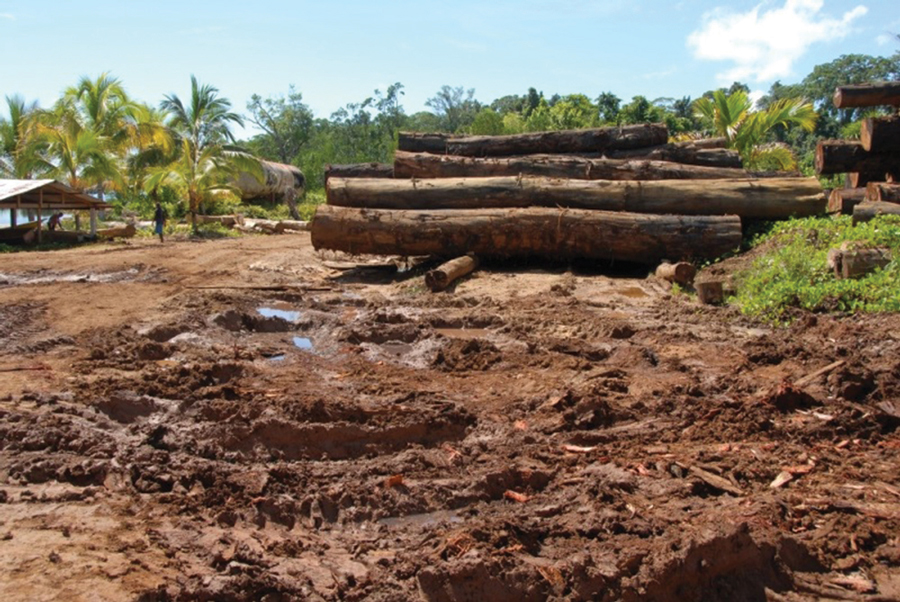
Marovo – logged out and idle.
Thus, is putting pressure on natural resources and land for food and food production, building materials, and other life support systems, as Land is cleared for timber, forestry, oil palm plantations, farming, urban and rural developments and infrastructure, as well, Marine habitats too are damaged from destructive fishing practices, such as dynamite and poisons, pollution and harvesting of rock and coral.
In relation, now a days, Solomon Islanders are moving to a cash economy for school fees, petrol and kerosene and for processed foods. This results in the loss of traditional methods of natural resource management and use.
In addition, the Compounding impacts of human pressure too have contributed to the threat of climate change and sea level rise.
Unfortunately for Small Islands States like Solomon Islands, the developed countries are the main producers of greenhouse gases and other climate changing factors.
However, the effects will severely impact coastal communities, islands and atolls unless there is a serious attempt at national level mitigation and adaptive measures to ensure Solomon Islands is prepared to deal with the changes and impacts.
In the meantime, Ministry of Environment, Climate Change, Disaster Management and Meteorology (MECDM) is leading the fight in Solomon Islands to protect, restore and enhance the country’s natural environment, helping to direct the country towards a path of sustainable development outcomes that are in line with objectives spelled out in the United Nations Sustainable Development Goals as well through the formulation of policies and enforcement of existing environmental legislation, with an extended role towards disaster risk reduction and climate change adaptation and mitigation.
Mangroo resources in the SI.
Additionally, MECDM is the national central point for a number of Multilateral Environmental Agreements (MEAs) including the Convention for Biological Diversity and the United Nations Framework Convention on Climate Change.
The Ministry is also responsible for implementing environmental initiatives and projects such as the Coral Triangle Initiative and other conservation efforts and regulates processes that have a direct impact on the environment as a means of ensuring sustainable development.
These capacity controls also impact on Solomon Islands’ ability to address national environmental issues as well Building the capacity to meet international commitments of the three Rio Conventions that will have significant collaborations with the capacity needed for national actions to address environmental, economic and social issues facing Solomon Islands.
LOCAL farmers are encouraged to dwell more on organic farming method of farming.
Kastom Gaden Agriculture Technician, Mr Jack Kalisto made the statement in an interview saying it’s a simple way of farming that requires almost everything provided by nature.
He said representing a local NGO advocating and promoting organic farming, they’ve been successful in their work with farmers across the country.
Kalisto said for decades, they brought to farmers basic organic farming techniques that help them and continue to help them in their farming.
“Like, currently Kastom Gaden is facilitating the implementation of the food security project which funded by FAO for farmers in three provinces in the country.
“And under the project we are looking at healthy and nutritious crops or sometimes known as color crops.
“Color crops refers to crops or vegetables with color yellow, orange and purple which said to have rich in nutrition and good for health,” he said.
Kalisto stressed that what organic farming is advocating is to ensure people feed on healthy and nutritious food that is free of risks of chemicals.
He said organic farming as Kastom Gaden is advocating is to encourage farmers to make great use of the surrounding vegetation as stimulant for farming.
“This is the natural fertilizer and less consideration should be on develop fertilizer that contains chemicals that harmful for our health.
“A simple way of organic method of farming was when clearing land for farming, don’t burn the bushes clear or throw them away. Keep them in the farm as they will be the fertilizer for the crops you’ll plant.
“There are many more ways of applying farming stimulation by organic activity that requires no harmful materials when consuming products coming out of it,” Kalisto said.
He said nowadays farmers tend to use more on morden fertilizer that is risky if not properly understand how to use it.
Kalisto said sometimes farmers apply fertilizers to crops or vegetables and when it still active on the plant, it harvest for consumption which pose a risk to the body.
He added that other area to consider were on how the soil will use the fertilizer. Sometimes the fertilizer will wash into rivers or sea and can be harmful for uses and sea creatures.
Kalisto stressed that fertilizer was developed for nutrient enrichment of soil, but proper application of it will only avoid harm for the human health.
Thus, he said organic farming method looked at avoiding potential risks of these areas and materials required for its application often richly available at your dispose.
THE United Nations Resident Coordinator is currently here in the country to familiarise himself with some of the burning issues that Solomon Islands is facing.
Mr Sanaka Samarasinha is here for a short visit since he made inclusion and the empowerment of women and girls a high priority when he took on his new role.
In an interview with Samarasinha, he said he is here purposely to familiarise himself with issues affecting Solomon Islands and to identify ways on how UN system can assist to address them (issues).
“I came here purposely to familiarise himself with some of the burning issues that Solomon Islands is facing as country to be able to identify how the UN system can help addressed the priorities of country and your people.
He said in terms of the meeting he had on Thursdays with few women leaders he had gathered information in relation to a lot of good works that have been done in this country – “but need greater collation and coordination”.
Samarasinha said people are doing good work but not necessarily together.
He said this is true for the development partners and structures of the government which is common in other parts of the world.
Samarasinha adds, another thing he came across is there is a must in much more work to be done in terms of connecting provinces and communities with the global, regional and national frame works and plans and so on.
He voiced the above sentiments at the short meeting this week with few women leaders from the existing Non-Governmental Organisations (NGO) in the country.
Samarasinha is UN Coordinator and United Nations Development Programme – UNDP Resident Representative for Fiji and other Pacific Island developing states, including Solomon Islands.
THE former officer manager of People with Disability in Solomon Islands (PWDSI) has taken up a new post in Suva, Fiji.
She is Savina Nongebatu, posted to become the chief deputy executive officer for Pacific disability forum which is based in Suva, Fiji.
In an exclusive interview yesterday Mrs Nongebatu told this paper that her contract is for three years and had already started working in April this year via correspondence (emails and phone calls).
Nongebatu said as a woman with disability, being posted as chief deputy executive officer is such a good feeling – ‘but let’s be clear that women’s work is not only for one particular woman’, she adds.
She said in taking up this new job she pays her respects to all women before her whom have talked and advocated about women empowerment.
“I pay my respects to all women before me who first talked about women empowerment up until now.
“It’s a good feeling to take Solomon Islands to another level of region and as for women with disability I guess this is an example in which it is possible through hard work in terms of doing what you need to do and talking to the right people,” said Nongebatu.
She adds, “creating partnership with the government and other established organisations in the country is another way they will able to realise and recognise your work.
“It’s an exciting emotion but it’s was possible through the hard work of many. I can only take credit from the little things that I do but otherwise big credit will go to the people who behind this , my family, my children and also my PWDSI members and staffs.”
DEAR EDITOR, publishing progressive reports in the media on the developments taking shape in the constituency as done by Hon J Manele is an honourable thing to do and needs acknowledgement.
It shows he is a responsible, transparent, trustworthy and honest leader.
If Hon Manele can do it, why not others?
The constituents and public need to know what’s happening with their money.
Maybe other MPs are not doing it because they don’t have anything at all to report on.
If that is the case then all the millions of dollars taken by MPs in the last 4 years must be investigated.
Anyway some leaders are doing good and Hon Manele is one.