BY NED GAGAHE
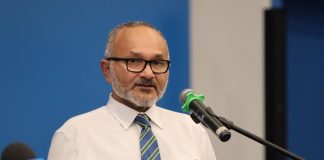
Governor of the Central Bank of Solomon Islands (CBSI), Luke Forau, calls for bold and coordinated action across all sectors to lift the country’s economic growth to at least five per cent.
Speaking at the launch of the CBSI 2025 Annual Report yesterday, Dr Forau outlined what he described as a ‘big-push scenario’ that aims to transform the economy into one that is more inclusive, resilient, and sustainable.
“What would it take to lift growth to at least five per cent? It will require coordinated and deliberate action across all sectors of our economy,” he said.
Dr Forau said that incremental changes will not be enough, calling instead for bold, transformational reforms to achieve meaningful progress.
He said the focus must be on ensuring that growth is not only strong but also shared widely among Solomon Islanders.
“Growth must be inclusive and resilient. These two go together. Without resilience, people remain vulnerable to shocks. Without inclusion, inequality will widen,” he said.
Dr Forau emphasised that the responsibility to drive this transformation lies with everyone, including government, the private sector, and communities.
“This big push requires all of us to play our part—from policymakers to businesses and individuals,” he added.
He identified agriculture as the sector with the greatest potential to drive inclusive growth, noting that it reaches the largest number of people across rural communities.
“Agriculture remains the most powerful engine of inclusive growth. It is where opportunity reaches our provinces, communities, and households,” Dr Forau said.
He highlighted the country’s strong potential in key commodities, including copra and cocoa, particularly in provinces such as Guadalcanal, Malaita, Makira, and Western Province.
However, he questioned whether enough is being done to support farmers to fully realise this potential.
“The real question is whether we can organise and support our farmers to increase production and improve productivity,” he said.
Dr Forau also stressed the need to shift from exporting raw commodities to value-added production, citing cocoa as an example.
“What if instead of exporting raw cocoa, we produce our own chocolate? That is where the real value lies—creating jobs, retaining income locally, and strengthening links across the economy,” he said.
He said strengthening agriculture will also improve food security, noting that the country remains heavily dependent on imported food.
“In 2025, food imports reached around $1.5 billion, compared to agricultural exports of about $1 billion. This gap shows that much of what we consume is coming from abroad,” Dr Forau explained.
He pointed out that rice alone accounted for a significant portion of imports, costing around $400 million.
“That is a gap we must address by boosting local production of staples such as cassava, taro, and potatoes,” he said.
Dr Forau welcomed ongoing efforts by the Ministry of Agriculture and Livestock, including a rice project in Malaita, describing it as a positive step towards reducing import dependence.
He also highlighted tourism as another key sector with strong growth potential, noting a significant increase in government funding.
“The tourism budget has increased from $10 million to $46 million, which shows strong commitment to unlocking this sector,” he said.
With a target of 600,000 visitors by 2035, Dr Forau said tourism could generate jobs, increase foreign exchange earnings, and deliver widespread benefits to communities.
“With the right investment in infrastructure, connectivity, and service quality, tourism can become a powerful engine of inclusive growth,” he said.
He added that digital transformation is also playing a critical role in shaping the future economy, describing it as a “game changer” for improving access, efficiency, and economic participation.
Dr Forau said that achieving the country’s development goals will require a shift from volume-based growth to value-driven growth, supported by strong policies and effective implementation.
“We need growth that is fair, durable, and future-ready,” he said.
Photo credit: Ned Gagahe
For feedback, contact: [email protected]
Editor: [email protected]