Home Blog Page 465

Raising awareness of human rights through Pacific films and talanoa 

0

“We are all connected, parents, babies, oceans and the earth. When we forget that, everything suffers”

As we celebrate Human Rights Day, it is timely to reflect on this message from the documentary Pacific Mother, which premiered at the opening of the 4th Pacific Human Rights Film Festival this year. 

The film explores notions of equality, rights, responsibilities and opportunities for people of all genders, and the importance of community and our indigenous knowledge. 

It is also a reminder of the power of storytelling, through films and other medium, to engage Pacific audiences on issues of human rights with an aim to educate and empower people for positive change.

Films have the power to ignite feelings and emotions.

They open people’s minds to new perspectives and have a profound impact on how people think.

The Festival also creates safe spaces for discussions around the important issues portrayed in the films which can sometimes be considered taboo in some Pacific cultures.

It is important for us as Pacific Islanders to recognise that although human rights are often viewed as a Western concept, the values and principles underpinning them – collective and individual wellbeing – are deeply rooted in Pacific cultures and traditions.

Concepts like fairness, equality, protecting the vulnerable, dignity, respect, and active participation have been embedded in our societies for generations, woven into the social fabric of our communities.

These values are evident, for example, in our spiritual beliefs and sacred relationships, which uphold the dignity and interconnectedness of all members of our communities.  

For instance, the value of respect is upheld across our Pacific cultures in concepts such as Veidokai and Veivakarokorokotaki in Fiji, Fa’aaloalo in Samoa, Faka’apa’apa in Tonga, Wahu in Pohnpei, Ahkfuhlact in Kosrae, Fairo (the way of life that is rooted in respect) in Chuuk, and Asirow in Yap, the Federated States of Micronesia, as well as Kautiej in the Marshall Islands.  

This year, 20 Pacific films were screened around the central theme of ‘Oceans and Land’ to over 2,500 people in Fiji, Hawaii, Kiribati, New Caledonia, Republic of the Marshall Islands, Samoa, Solomon Islands, and Tonga, during at the 4th Pacific Human Rights Film Festival which ran from 30 September to 27 October.

This demonstrates the extending reach of the Festival and its uniqueness as a free, educational and more truly regional initiative.

Audience members reflected that the range of topics covered by the films – from childbirth to the use of technology, to climate change, and the importance of preserving nature – revealed to them that human rights permeate, and can positively enrich, all aspects of our lives and communities.

Despite progress by Pacific Island countries to uphold commitments related to human rights, there still exist socio-economic, political and cultural inequalities and rights violations due to inadequate capacity, lack of human rights institutions, power imbalances, exclusion, and discriminatory norms, attitudes and practices. 

Our region has some of the highest rates of gender-based violence, the lowest rates globally of female parliamentarians and 15 percent of the populations have some form of disability, many of whom are marginalised and often excluded and unable to access essential services such as water and sanitation and health and education services. 

The films screened this year highlighted many of these long-standing issues and also explored emerging trends, such the worsening situation for persons of diverse sexual orientation, gender identity, gender expression, and sex characteristics (SOGIESC) in a year which has seen efforts at the government level to ban LGBTQ advocacy.

This is not only a threat to freedom of expression and our custom of telling stories but also suggests we are failing to heed the message from Pacific Mother – “we are all connected… when we forget that, everything suffers”.

The Pacific is built on a history of oration and storytelling. It helps us share our lived experiences and collectively decide how to chart the best paths for our future happiness and prosperity. It gives voice to those who might otherwise be marginalised.

Without creating space for dialogue and storytelling, we risk further marginalising large sections of our societies, sowing the seeds of division and inequality.

The continued challenges we face, as well as emerging trends, demonstrates the need now, more than ever, for us to draw on our storytelling heritage and the power of films to build a stronger, more resilient Pacific.

The growing talent of Pacific filmmakers to tell important stories that resonate with everyone is evident.

We look forward to next year’s Pacific Human Rights Film Festival reaching an even larger audience across the Pacific with brand new Pacific stories to continue breaking down human rights barriers. 

Let us harness the power of contextual storytelling and talanoa to drive positive action around human rights. 

*Human Rights Day 2024 Op-Ed

By Miles Young,

Director of the Human Rights and Social Development Division

Pacific Community (SPC)

Parametric insurance timely

0

By John Houanihau

The Solomon Islands Meteorological Services (SIMET) has pledged its support for the parametric insurance initiative, emphasizing its readiness to provide data essential for its implementation.

This commitment was highlighted during the SI National Education Workshop: Building Finance Resilience through Parametric Insurance and Disaster Risk Finance, hosted by the United Nations Capital Development Fund (UNCDF) and the Central Bank of Solomon Islands (CBSI) this month.

Speaking at the event, Max Sitai of SIMET affirmed the organization’s readiness to contribute to the initiative by disseminating data and supporting its objectives.

Parametric insurance is a novel solution that provides payouts based on predefined “trigger” events, such as cyclones or excessive rainfall, eliminating the need for lengthy loss assessments. It is part of climate and disaster risk finance and insurance (CDRFI) solutions designed to offer rapid financial responses, minimizing humanitarian and economic losses after disasters.

“SIMET is transitioning to what is called impact-based forecasting, which predicts the expected impacts of specific weather events. This type of information aligns well with the goals of parametric insurance,” Sitai said.

He explained that impact-based forecasting is a new approach being adopted in the Solomon Islands and other Pacific Island countries, providing a critical link between disaster risk reduction and parametric insurance.

Through this methodology, SIMET can utilize climate forecasting on various timescales. “For shorter timescales, we analyze triggers like 72-hour rainfall or wind speeds. On a broader climate scale, we examine early action rainfall outlooks, reviewing up to 12 months of data to inform decisions that could benefit vulnerable populations,” he explained.

The Solomon Islands’ extensive network of synoptic and manned stations collects key weather parameters, including rainfall, temperature, humidity, pressure, wind speed, and direction. This wealth of data is stored in SIMET’s database and is readily available to support parametric insurance programs.

Parametric insurance is also gaining traction in the region, with expansion into Papua New Guinea. A pilot program launched in December 2023 by UNCDF’s Pacific Insurance and Climate Adaptation Programme (PICAP), in collaboration with underwriter Pacific MMI Insurance Limited and Women’s Micro-Bank, highlights the growing importance of such solutions.

CBSI embarks on review of Insurance Act

0

BY JOHN HOUANIHAU

The Central Bank of Solomon Islands (CBSI) is undertaking a review of its Insurance Act to accommodate emerging insurance solutions such as parametric insurance and micro-insurance.

Speaking at the recent Parametric Insurance Workshop for Climate Resilience in Honiara, CBSI’s Steve Awao outlined the bank’s goals for the review. He explained that the initiative aims to clearly define critical components such as parametric triggers and payouts, ensuring these innovative insurance products are explicitly recognised within the legal framework.

“In support of this development, CBSI has also facilitated an exemption from stamp duty for all micro-insurance products, reaffirming our commitment to fostering growth in this sector,” Awao said.

He further highlighted CBSI’s establishment of a regulatory sandbox—a controlled environment where insurers can pilot new and cost-effective parametric products without being subject to full regulatory compliance during testing. This platform is designed to encourage innovation while carefully managing financial risks.

“While parametric insurance offers promising solutions, it also carries inherent risks. As the regulator, CBSI remains committed to ensuring a balance between innovation and risk mitigation. Insurers will be required to maintain strong capitalization, implement reinsurance programs, and provide transparency in policy details to protect consumer trust and confidence,” Awao added.

CBSI’s efforts are closely aligned with the National Financial Inclusion Strategy (NFIS) Three, particularly its fourth objective of enabling economic resilience. The National Financial Inclusion Unit (NFIU) plays a key role in promoting awareness and affordability of parametric insurance.

“The CBSI is working to educate stakeholders and the public to ensure that parametric insurance is accessible, affordable, and well-understood. This education is crucial to making these innovative solutions widely available, contributing to economic resilience across the Solomon Islands,” Awao said.

CBSI has also partnered with key stakeholders to strengthen cross-sector collaboration, emphasizing the importance of partnerships in driving financial inclusion and educating the public about these innovative insurance solutions.

Govt allocates more than $100m for infrastructure

0

By Loretta B Manele

More than $100 million is being allocated for infrastructure from the government budget.

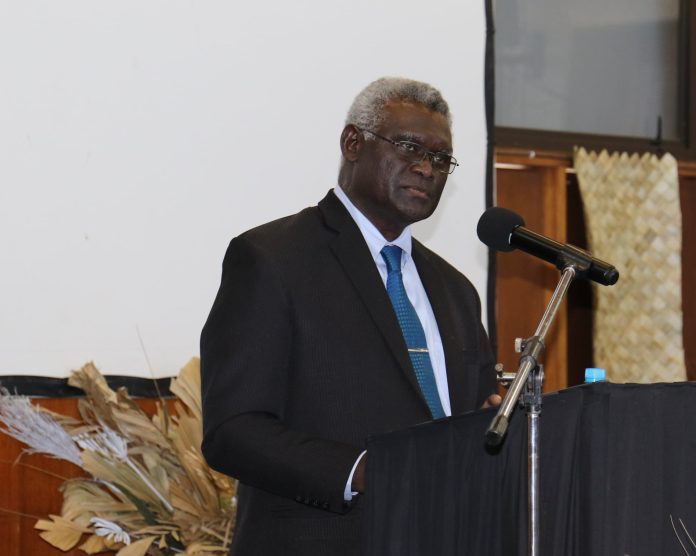
This was said by finance and treasury minister, Manasseh Sogavare when he presented the 2025 Appropriation Bill 2024 on Wednesday last week in parliament.

Her stressed that having proper and quality infrastructure is key to nation-building and socio-economic development.

Sogavare told the honourable house that the government is therefore allocating more than $100 million to build key infrastructures in Honiara and other provinces, and this includes roads, walls, buildings and streetlights.

Sogavare said the government is investing in key infrastructures to improve connectivity within islands and inter-islands of our provinces to improve transportation of goods and services on a time limit.

Moreover, he stated that government is also allocating $45.2 million towards SIWA infrastructure.

“SIWA works are to be completed by March 2025, so the government expects a significant improvement in the overall infrastructure of the Solomon Islands Water Authority.”

He expressed that this is for better sanitation and hygiene for residents resulting in improved public health outcomes, enhanced water management efficiency and benefits for both the environment and local communities.

Sogavare said in government’s ongoing commitment to seal the service critical in our efforts to build our human capital, they are allocating $50 million to support the building of physical infrastructure, technological capacity and human resource capacity in order to create an enabling learning environment and to produce a skilled workforce.

“SINU is expected to increase access to modern facilities and produce a learning environment.

“The grant, provided should be used to fund a specific infrastructure project specified in the SINU 2025 Infrastructure Government Plan.”

To top this off, Sogavare said in support of school infrastructures, the government is allocating $16.7 million to support constructions of classrooms, science laboratories, and ablution blocks.

He stated that the government expects to improve access to quality basic education and plans to build 16 classrooms, two dining halls, five dormitories, one wash, two education provider offices, and four rehabilitation and maintenance projects.

Gov’t allocates $3.7m for second tuna processing plant

0

By Loretta B Manele

The government is allocating $3.7 million towards the ongoing effort to establish a second tuna processing plant in Solomon Islands.

Manasseh Sogavare, finance and treasury minister revealed this when he delivered the 2025 Appropriation Bill 2024 on to parliament on Wednesday, December 4.

He said the project will create more jobs and increase economic benefits for the country once concluded.

Sogavare said in support of freshwater fish hatchery, the government is allocating an additional $12 million to improve food security and income generation.

He also stated that in 2025, the government plans to complete the outstanding on-site infrastructure and equipment importation of the gift species into Solomon Islands and partial operations of the hatchery.

“The government is targeting tilapia farmers throughout the country to benefit from this project.”

Sogavare furthered that government is also allocating $14.7 million to support fisheries operation in provinces.

He mentioned that under this allocation, $1.5 million is to support Tataba fisheries operation $1.5 million is allocated to support Russell Island fisheries operation and $1.7 million is allocated to support Lata’s fisheries operation.

As noted, these allocations are geared towards improving income generations for the respective provincial governments.

Financial sector under reviews

0

By Loretta B Manele

The country’s financial sector is going through various reviews of legislation.

This follows GNUT Policy 8.1.4b that supports the financial sector reforms to promote a modern and resilient financial system that supports economic growth.

Manasseh Sogavare, the minister of Finance and Treasury (MoFT) made the statement when handing down the 2025 Appropriation Bill 2024 in parliament last week.

In relation to the above statement, he said this includes the review of the Financial Institution Act, Insurance Act and developing regulations to create and enable the environment to support the development and expansion of financial services.

Sogavare added that the review of the National Procurement Fund Act is also needed to improve the legislative framework for the operation and prudential regulation of the fund.

He said members should have confidence that their savings are being invested in a prudent manner to ensure that the fund is working in the best interest of its members.

Sogavare stated that progressing the Solomon Islands National Procurement Fund Bill is one of GNUT government’s strategic actions to expand resource access to finance and underpin economic growth in Solomon Islands.

“The government acknowledges that the country also faces many development and growth constraints.”

Sogavare stressed that these constraints range from lack of access to financial services, lack of competition in key areas, shortage of needed skills, access to land, lack of quality infrastructure, weak infrastructure, poor governance, lack of employment opportunities and high costs of doing business in Solomon Islands.

He said the government aims to address the ongoing development constraints through embarking on both structural and institutional reforms across the government.

These structural and institutional reforms include tax reforms, land reforms, foreign investment and tax strategy reforms to address the high cost of utilities, improving good governance and developing robust legislation and policies to drive investment and growth.

Sogavare added that to achieve this objective, the government encourages strong, collaborative and co-ordination amongst all ministries in terms of planning and implementation of the 2025 budget ensuring that key sectors establish working relationships to address cost-cutting needs through cost-sharing and arrangements to fast-track implementation of key government priorities.

“In advancing the better partnership and fruitful relations we continue to enjoy; the government will also work very closely with our development partners during the course of implementing the 2025 investment priorities.”

Call for proper dialogue on Bina Tuna project dispute

0
The Director of the Ministry of Fisheries and Marine Resources Mr Edward Honiwala

By John Houanihau

Director of Fisheries, Edward Honiwala, has called on a group opposing the Bina Tuna Project to address their concerns through appropriate and constructive dialogue.

The call comes after a post featuring a group of men with knives was shared on the West Kwaio Forum Facebook page, drawing widespread attention.

In an interview with Island Sun, an anonymous spokesperson claimed that the group, identified as members of the Ula’ako tribe, has repeatedly attempted to disrupt the project. “From what I understand, they have lost their case in the High Court but continue to create disturbances,” the spokesperson said.

Honiwala highlighted the critical importance of the Bina Harbour Tuna Project for Malaita Province and the Solomon Islands as a whole. He urged all parties to engage in dialogue through established processes.

“The Ministry is not fully informed about the specific grievances, but it is imperative that concerns be raised through the proper channels. This requires collaboration and mutual understanding,” said Honiwala.

He noted that the Ministry, along with its partners, has invested significant time and resources in the project. Any disputes or disruptions, he cautioned, would lead to unnecessary delays and wastage.

“Typically, the consultation process spans two to three years. There are procedures in place for addressing issues, rather than resorting to disruptive actions,” Honiwala explained.

The Bina Harbour Tuna Project, he stressed, is a major economic opportunity for Malaita and the Solomon Islands. “This initiative is something we should take pride in. It enables us to maximize economic benefits and has received strong support from development partners and donors. Ultimately, the decision is ours,” he said.

Honiwala also emphasized that extensive consultations have been conducted with landowners, land trustees, and other stakeholders. However, he acknowledged that the persistence of disputes remains puzzling.

“If these actions continue, the matter may have to be resolved in the High Court. Otherwise, I urge the group to engage in dialogue and consider the long-term benefits for our children and communities,” Honiwala said.

Clayton Wao’s journey in music production

    0

    BY JOHN HOUANIHAU

    Clayton Wao, from Malaita Province, is currently operating a music recording studio in Honiara called Waoton’s Music Production. Wao made his first recording in 2008 when he was in form two, starting his journey into digital music where he produced tracks on the computer. A few years later, in 2014 while he was in form seven, Wao embarked on his first tour to Malaita to record for a gospel group. He began his recordings with speakers, sound cards, and power amps he purchased from local shops in Honiara.

    In 2015, Wao signed a recording contract in Vanuatu for four years, during which he acquired some new recording equipment that significantly boosted his music production, especially in the gospel genre. After returning home in 2018, he enrolled at the Solomon Islands National University (SINU). In 2021, he had the opportunity to participate in the Pacific Seasonal Work Scheme, spending three years in the meat industry in Australia.

    “With my involvement in the scheme, I had the privilege to acquire more updated recording equipment—more quality ones than what I had before,” explained Wao. While in Australia, he also worked on numerous recording projects. “I remember in 2023, one of my mates arranged for me to go work with some gospel groups in Vanuatu. I flew to Santo from Australia and returned to continue working on recordings while still participating in the scheme,” he said.

    After three years in the palm scheme, Wao returned to the Solomon Islands in April 2024 and resumed recording in Honiara. “So far, I’ve had a lot of gospel groups coming in for their recordings, including church groups, youth groups, and more,” he said. Currently, he is working on an album for one of the gospel ministries, their fourth album, which is set to be released next year in 2025.

    One of the challenges Wao faced in his career was the recording environment. “I didn’t have proper or good soundproofing, so I tried to ensure that there was no surrounding noise during the recording process to avoid affecting the final recordings. I’ve already got soundproofing forms, but they are yet to be installed, which also takes time,” he said.

    Another challenge was the high interest among youths in recording and music. “With my passion for singing and recording, I’m still trying to figure out how I can help them, including through vocal coaching or training workshops covering music production, recording, mixing, and mastering,” he said. Wao has also started exploring filming, although he is still learning about that aspect.

    “As a music and recording artist, I also share a bit of advice with young people who are interested in the music industry,” said Wao. “One piece of advice I like to share is that consistency is key in recording. It takes time and effort to put into a project. I’ve had some friends who I’ve helped get into recording, but later they gave up. I just want to encourage those of you who are recording in music: consistency is the main thing.”

    Wao believes that financial constraints can sometimes pose a challenge but there are ways to address them. “The main thing I want to focus on is consistency. I’ve been involved in recording for nearly 15 years, and consistency is what matters. As we continue to do recordings and produce music, we’ll learn from each other—that’s how we build ourselves up,” he said.

    Throughout his recording career, Wao has met many producers with whom he has shared ideas. “I remember at one stage, we did recordings together with our late brother Peter Ofa. I learned a lot from him. That’s how I learn. During our recordings with other studios, I go there and ask questions, and that’s how we learn and grow,” he said.

    Wao believes that listening to constructive criticism from others, even those without experience but who have ideas, is a bonus. “It’s good to accept ideas and look into them because that’s how we learn. So, I just want to re-emphasize the importance of consistency. Don’t give up over the years. Do what you love, and at the end, you will look back and see the difference,” concluded Wao.

    ‘GNUT SOLID, UNITED’

    0
    PM Manele.

    -PM Manele welcomes motion of no confidence, says his government is focused on passing budget

    -Manele downplays report he sought funding support from China in Friday night dinner with ambassador

    BY IRWIN ANGIKI

    Prime Minister Jeremiah Manele is unfazed by the motion of no confidence against him, saying that his government is ‘solid’ and ‘united’.

    Speaking to Island Sun yesterday, Prime Minister Manele said instead his Government for National Unity and Transformation (GNUT) is focused on passing the 2025 budget.

    “GNUT is solid and united to face the motion of no confidence.

    “The Government’s priority now is to pass the 2025 budget, important for the country.

    “GNUT is only just eight months old, its first budget to implement its policies and programmes is before Parliament now,” Mr Manele said.

    PM Manele also emphasised political stability, which the country needs now.

    “Not clear what the grounds for the motion are. Of course any Member of Parliament has the right to move a motion of no confidence, but political stability is critical for the country’s progress and development.”

    Meanwhile, Manele brushed aside reports that he had sought help from the Chinese ambassador during a dinner at the diplomat’s residence Friday night to fund his government’s solidarity.

    “That is not true. Need to check their facts. I did not go to ask help, I was invited by the Ambassador for dinner.

    “We just had dinner. He invited me to his residence to have dinner. I did not ask or seek any help to maintain government solidarity.”

    A notice of Motion of No Confidence was filed by Opposition MP Gordon Darcy Lilo on Thursday last week.

    The motion matures and can be tabled this Friday, December 13.

    Clerk to parliament Jefferson Hallu had told Island Sun on Thursday last week the motion was filed at 4pm that day. He did not elaborate on the reasons attached to the motion.

    However, an Opposition spokesperson told Island Sun over the weekend that reasons for the motion included:

    -Prime Minister Manele’s lack of action over his finance minister’s exposed squandering of tax exemptions costing government hundreds of millions of dollars in revenue

    -PM Manele’s lack of action to address the huge loss of revenue from the mining operation on Rennell island, Renbel province

    -PM Manele’s lack of action regarding exposed offshore account linked to his finance minister and police minister

    -The country’s dwindling economy under the leadership of PM Manele, an example highlighted being the budget currently in parliament reportedly just being on paper with no revenue to back it.

    Mr Lilo is the MP for Central Honiara, and former prime minister (2011-2014).

    Take pride in our environment

    0

    By John Houanihau

    Simon John, Field Supervisor of the Honiara City Council (HCC) Waste Management and Control Division, has urged residents living near the Mataniko River to take responsibility for preserving and caring for the river.

    Speaking to Island Sun, John highlighted the growing challenges posed by increasing waste in the Mataniko River.

    “In the past, this river was cherished by our parents, who appreciated its pristine condition. However, due to population growth and other factors, the river has deteriorated and is now heavily polluted,” he said.

    John called on the public, government ministries, volunteer organizations, community youth, and NGOs to support efforts to restore the river.

    “We urge everyone to join us in this call. Maintaining the cleanliness of our city is a collective responsibility,” he said.

    John emphasized that the HCC alone cannot ensure a clean city and that residents must take an active role in keeping Honiara clean.

    “It is not solely the duty of HCC employees; rather, it is the obligation of all Honiara residents. The beauty of our city is a shared concern,” he added.

    He also appealed to residents living along the riverbanks to properly manage household waste and make use of the waste collection services provided by the HCC.

    “Waste collection vehicles regularly service our neighborhoods, transporting garbage to the designated disposal site at the Ranadi dump. Let us, as residents of this city, take pride in our environment.

    “The condition of our city reflects our actions and attitudes towards it. If there are opportunities for public clean-up campaigns, I encourage everyone to participate wholeheartedly and contribute to the beautification of our community,” he concluded.