Home Blog Page 434

Regional solidarity for sustainable fisheries: Giro

0

BY JOHN HOUANIHAU

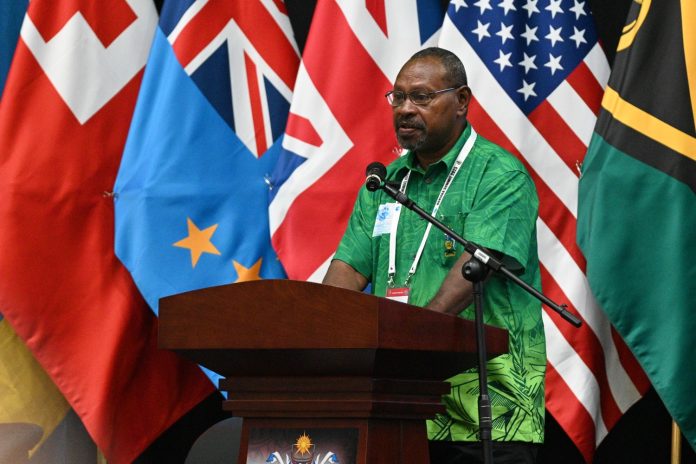
Regional solidarity is fundamental to achieving sustainable fisheries, says Minister for Fisheries and Marine Resources, Nestor Giro.

Speaking yesterday during a session focused on how the Pacific Islands region has responded to SDG 14.4 through the establishment of key fisheries institutions, Giro emphasized the region’s commitment to sustainable fisheries.

He highlighted that regional unity has always been central to addressing the importance of sustainable fisheries.

“The establishment of the regional institutional framework through the Pacific Leaders Forum in the 1970s recognized the sustainable utilisation of marine resources as a matter of common interest among member states,” Giro stated.

He further noted that Pacific leaders were keenly aware of the region’s unique dependence on marine resources and the need to ensure their sustainability.

“The first policy agreement was reached at the Eighth Leaders’ Meeting in Port Moresby in August 1977. During this meeting, leaders adopted the Declaration on the Law of the Sea and established a regional fisheries agency.

Over the years, leaders have adopted several key policies, including the Declaration on Pacific Fisheries (2007), the Regional Roadmap for Sustainable Pacific Fisheries (2015), and the 2050 Strategy for the Blue Pacific Continent.”

Giro emphasised that there is an overarching political framework under the Pacific Islands Forum Secretariat, such as the Pacific Islands Forum Fisheries Agency (FFA), established in 1979, which supports member states in the sustainable management of highly migratory fish stocks.

“In 2004, the Western and Central Pacific Fisheries Commission (WCPFC) was established. This commission is responsible for developing rules and regulations for fishing activities in the high seas areas of the Western and Central Pacific Ocean,” Giro explained.

He acknowledged the significance of the Honiara Summit, as it marked the first occasion where the heads of these regional institutions gathered to discuss their responses to SDG 14.4.

“Comprehensive regional fisheries management arrangements have been in place for over 40 years, and they continue to play a vital role in ensuring the long-term sustainability of fisheries in our region,” he said.

Giro stressed that Small Island Developing States (SIDS) in the region must uphold their sovereignty over national waters and protect their sovereign rights over fishing activities within Exclusive Economic Zones (EEZs).

“With the support of regional institutions, the region continues to emphasise the importance of zone-based fisheries management. Coastal state rights and responsibilities for fishing activities within national jurisdictions must be respected.

Regional approaches include, but are not limited to, the Ecosystem Approach to Fisheries Management, the Precautionary Approach, Biodiversity Protection, and reducing waste in fisheries, he outlined.

Giro underscored that healthy tuna stocks and sustainable fisheries can only be ensured through regional cooperation.

“Without regional unity, we cannot achieve the SDG 14.4 target.

Without the establishment of key institutions by our leaders, we cannot achieve the SDG 14.4 target.

Without leaders endorsing regional policies, treaties, and management tools, we cannot achieve the SDG 14.4 target.

The theme of this Summit, ‘Iumi Tugeda’, is fitting—only by working together can we achieve SDG 14.4 and ensure sustainable fisheries for future generations,” Giro concluded.

For feedback, contact: [email protected]

UN ocean conference turning point for the ocean

0

BY JOHN HOUANIHAU

With the 2030 deadline fast approaching, the UN Ocean Conference in Nice, France, should be seen as a turning point for ocean conservation and sustainability.

These were the words of Charlina Vitcheva, Director-General for Maritime Affairs and Fisheries at the European Union (EU), when she delivered her remarks at the Honiara Summit on Tuesday this week.

Vitcheva emphasized that the Honiara Summit aims to design a European Ocean Pact, which will be presented at the UN Ocean Conference in Nice this June.

She explained that the European Ocean Pact will serve to align all EU ocean-related policies under a comprehensive and coherent framework.

“We all know the state of our ocean. It is time to confirm our political ambition, accelerate action, and deliver real results. We need decisive action, and for that, we need a single reference for the ocean in all our ocean-related policies,” Vitcheva stated.

She added that within this European Ocean Pact, there will be a global agenda and a strong international dimension to support leadership and action for a healthy and productive ocean.

“This must be reflected in the outcome declaration currently being negotiated. I now turn to political leaders, prime ministers, and ministers—please give a bold mandate to your negotiators for this declaration.

This declaration must embody ambition for ocean and climate action, conservation, and the sustainable use of marine resources. It must support the swift ratification of the BBNJ Agreement, the protection of marine biodiversity, and the establishment of a legally binding treaty to combat plastic pollution—everything that concerns the ocean,”* she urged.

Vitcheva reaffirmed the European Union’s commitment to the Pacific, stating that the EU remains a reliable partner with no hidden agenda, dedicated to addressing shared challenges faced by Pacific Island Countries (PICs).

“Our ability to make the UN Ocean Conference in Nice a success depends on us. Partnership is key in this critical time. What we discussed here today is about our lives, well-being, prosperity, and economy. Our security cannot be ensured without a healthy ocean,” she stressed.

She highlighted the Pacific’s vulnerability to climate change, noting that partnerships are at the core of the EU’s action plan.

“We must work together. Strong partnerships will be the key to making SDG 14 a success. And we are walking the talk,” she said.

The Samoa Agreement and Ocean Cooperation

Vitcheva pointed to the Samoa Agreement framework as a clear demonstration of the EU’s commitment to the 2030 Agenda for Sustainable Development Goals (SDGs).

“We represent 1.5 billion people. If we stand united, we will be hard to ignore in multilateral forums. This also applies to ocean protection,” she said.

She further noted that the EU and Pacific states have agreed to join forces on key issues such as ensuring sustainable fisheries, protecting marine biodiversity, and fighting climate change.

“The EU is not just adhering to the Paris Agreement—we have the Green Deal, which ensures that our continent will be carbon neutral by 2050.

Because there was a pledge here to assist you, we remain reliable and committed. In line with this, we are now preparing the second Pacific-European Union Marine Partnership, valued at €20 million, to support the Pacific in achieving its goals under the Pacific Blue Strategy,” she concluded.

For feedback, contact: [email protected]

PM Teo pays historic visit to Solovalu community

0

BY SAMIE WAIKORI

The Prime Minister of Tuvalu, Feleti Penitala Teo, has paid a historic visit to the Tuvaluan community in the Solomon Islands.

The visit took place on Tuesday evening, where he and his delegation visited the Tuvaluan descendants at the Solovalu community near Honiara International Airport in Honiara.

Accompanying PM Teo’s delegation during the visit were Solomon Islands Minister for Culture and Tourism, Ms. Choylin Yim Douglas, who is of Tuvaluan descent, and two of her colleague ministers: Franklyn Wasi, Minister for Agriculture and Livestock, and Paul Bosawai, Minister for Health and Medical Services.

Prime Minister Feleti Penitala Teo, who is in the country for the Pacific Fisheries Summit, paid this sideline visit to reconnect with the cultural heritage between the Solovalu community and the people of Tuvalu.

“The visit is quite significant. We have diaspora in many countries in the Pacific. And it is always a privilege to meet the Tuvaluan diaspora wherever I travel,” he said.

PM Feleti, however, designated the visit as special because of the tie he and his family had with the Solovalu community when they were in Honiara 19 years ago.

“It is good to reconnect with them and see that the community is growing. I thank the elders of the Solovalu community for being proud to be Tuvaluan and representing their home country,” he said.

Feleti also acknowledged a proposal shared by Minister Douglas and a representative from the Solovalu community at the gathering to establish a partnership platform between Solovalu and Tuvalu.

The proposal will focus on cultural exchange, where cultural practices, traditions, and stories would be shared and passed on from one generation to another, both in Solovalu and Tuvalu.

He praised the proposal and the benefits it would bring to both sides, especially the Solovalu community. He noted that living outside of their homeland may lead to the potential for Tuvaluans to practice or interpret their indigenous culture in ways that may not be consistent with traditional values.

Feleti also suggested that the availability of technology, such as social media, could be a platform where Tuvaluans in the Solomon Islands could learn about their culture.

The Prime Minister welcomed the proposal and expressed his happiness to witness that Tuvaluans in the Solomon Islands still have a strong connection to their home country.

For feedback, contact: [email protected]
Governor General knighted by His Majesty King Charles III

0

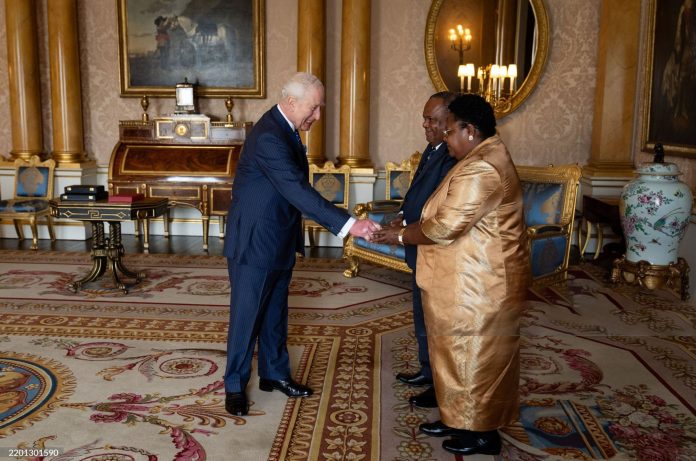
The Governor-General,Sir David Tiva Kapu was conferred his knighthood by His Majesty King Charles III during a ceremony at the Buckingham Palace in London on Wednesday 25th February 2025.

He was awarded the Knight Grand Cross of Saint Michael and Saint George (GCMG), which is customarily conferred on the Governors General of Solomon Islands.

Sir David and Lady Salome Pae Kapu attained their titles immediately after the ceremony followed by an audience with His Majesty and a brief tour of the Palace.

A five-member delegation accompanying Their Excellencies was also given a rare opportunity by His Majesty the King to meet and greet personally with handshakes at the Palace.

Sir David was elected by the National Parliament of Solomon Islands on Monday 17th June 2024.

His Majesty The King appointed him, by an address from Parliament under section 27(1) of the Constitution.

He was duly appointed by His Majesty The King, on a Royal Commission of Appointment on 27th June 2024 which became effective on 7th July 2024 when he was sworn in as the 8th Governor-General of Solomon Islands.

Soon after his knighthood, Sir David said he was humbled and honored by his award by the Head of State His Majesty the King.

“I thank God for his guidance and providence in taking up the responsibility of being His Majesty’s representative as the Head of State of Solomon Islands,” Sir David said.

“I offered all praise and glory to the Almighty God for this historic moment for me and my family and to our country as a whole,” Sir David added.

Solomon Islands High Commissioner to the United Kingdom and Ambassador to the European Union, His Excellency Moses Kouni Mose was in London to congratulate Sir David and Lady Salome after the ceremony.

“Congratulations Sir on the attainment of your knighthood from His Majesty the King. I wish you well in your duty to the Nation as His Majesty’s representative in our country Solomon Islands,” High Commissioner Mose said.

Sir David hails from Buena Vista Islands in Gela, Central Islands Province.

MPG to consult resource owners on Auki greater city

0
Premier of Malaita province, Elijah Asilaua.

BY SAMIE WAIKORI

The Malaita provincial government proposes consultation program with resource owners in and around Auki town, in pursuit of its plan for Auki greater city.

The consultation program aimed to prepare resource owners and other stakeholders to see where and how they can support this historic initiative for the province.

In a recent interview, Malaita Premier, Elijah Asilaua highlighted this as one of the priority objectives of his government.

“Among other priority objectives of my government, we also planned to pursue the initiative for the greater city of Auki this year.

“My government look forward to consult landowners around Auki on the plan. I will take them onboard so that they take ownership of the plan.

“This is also for resource owners to prepare resources for the development, where people and government of Malaita look forward for,” he said.

Asilaua explained that the initiative came under MPG’s policy on urban development strategy, where Auki will become a trading hub for economic activity in the province.

He echoed there are major development projects earmarked for certain spots around the province, and Auki will become their centre.

“My executive is behind the plan and has been consulting national government through its line ministries on it,” Asilaua said.

Asilaua stated his government has been liaising with Ministry of Lands, Housing and Survey especially on land related matters.

“Our mutual cooperation with MLHS has indicated green light to create Auki greater city under the urban development strategy,” he noted.

For feedback, contact: [email protected]
Solomon Islands urged to prioritize preservation of linguistic diversity

0

BY INDY MAEALASIA

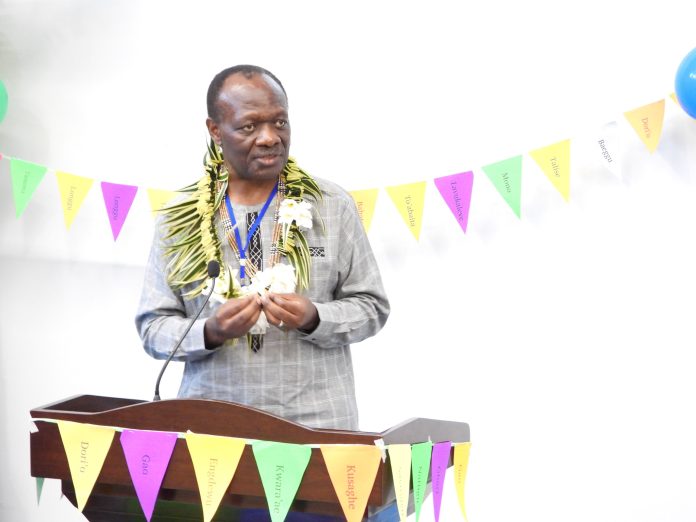
DESPITE the pressing need to preserve local biodiversity, the Solomon Islands should also strive to preserve its rich linguistic diversity, according to the SIL Global Executive Director Dr Michel Kenmogne.

Dr Kenmogne who was in the country recently said preserving linguistic diversity is vital in the age of globalization.

According to the recent 28th edition of Ethnologue, the World’s only credible and comprehensive database for world languages, Solomon Islands has 70 living indigenous languages and 2 indigenous languages that are now extinct.

Commemorating the International Mother Language Day last week at the Solomon Islands National University (SINU), the executive director reflected on the theme “boldly taking our languages into the future”

“When we talk of taking our languages into the future, we are not only taking them into the future. We are taking ourselves into the future into a world in which the dominant languages continue to oppress the minority languages,” he said.

He stressed that the theme is significant for anyone who uses a vernacular language “because it is about our identity, it is about our place, our voice, and our role in the world.”

In 2021, the United Nations recognized the alarming loss of global language diversity and declared the International Decade of Indigenous Languages.

Dr. Kenmogne echoed this call, stressing the political significance of the issue.

“We must do everything we can to raise awareness about the political loss of indigenous languages and the urgent need to preserve, revitalize, and promote them,” he said. “This is why we are here today – to extend that call, “he said.

Dr. Kenmogne further emphasized the connection between language preservation and cultural identity.

“We want to see these languages preserved, revitalized, and promoted, ensuring that the identities of all the people who speak them are protected,” he added.

For feedback, contact: [email protected]
SDG 14.4 targeted at sustainable management of fish stocks

0

By Loretta B Manele

The Sustainable Development Goal (SDG) 14.4 is targeted at ensuring Pacific Island countries are sustainably managing the world’s fish stocks.

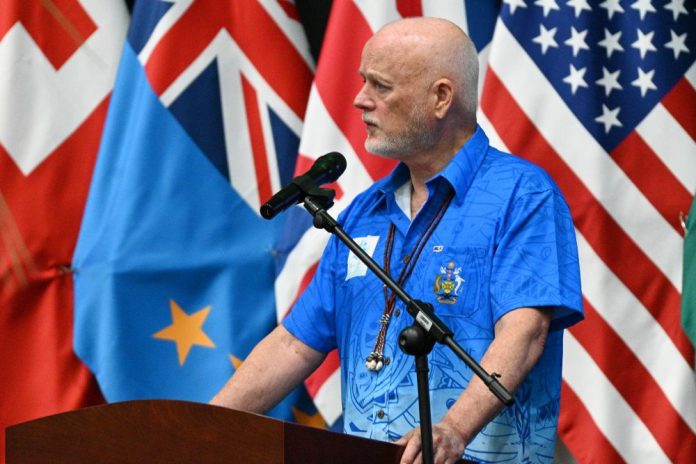
Ambassador Peter Thomson, United Nations Secretary General (UNSG), Special Envoy for the Ocean spoke about this during a high-level discussion at the Honiara Summit- “Umi Tugeda Delivering on SDG 14:4 Achieving Sustainable Fisheries” at the Friendship Hall yesterday.

He said they are gathered at the summit to examine the progress of their implementation of SDG 14.4 of which the target is to ensure that Pacific Island countries are sustainably looking after the world’s fish stocks.

Thomson stated that under the SDG 14.4 goal, they are called to effectively regulate harvesting and end overfishing, illegal, unreported and unregulated fishing and destructive fishing practices.

He highlighted that this goal demands that they implement science-based management plans in order to restore fish stocks to the biologically sustainable levels in the world in the shortest possible time.

Moreover, Thomson said they have seen brave efforts in the establishment and expansion of marine protected areas around the world and have made commendable advances in combating illegal, unreported, and unregulated fishing.

“We’re very close to WTO bans on harmful fisheries subsidies and can demonstrate growing support for small-scale fishes and economic benefits to CIDs and LDCs from marine resources.”

However, he pointed that implementation of the SDG 14.4 goal is not advancing at the speed or scale required to fully meet this goal by 2030.

Thomson emphasized that to meet this goal they have to carefully consider what is going on in the ocean as a whole.

“The ocean is acidifying, it’s warming, resulting in movement of species, in changing ecosystems, and the demise of coral and rising sea levels.

We are continuing to pollute and overexploit the ocean with what seems at times to be scant regard for the tipping points that will make a life on this planet so difficult for coming generations of humans and animals.”

Thomson said at the biennial SOFIA meetings in Rome, the Food and Agriculture Organization (FAO) consistently advised that assessed global fish stocks are being overexploited by a factor of over a third.

He added that for the fish stocks involved and those who depend on them for food security, that statistic does not reflect well on our sustainable use of the ocean’s resources.

Thomson stated that the purpose of this summit must be the why and where of overexploitation and when and how it can be rectified.

For feedback, contact: [email protected]

Sasakawa peace foundation committed to act as catalyst for sustainable fisheries

0

By Loretta B Manele

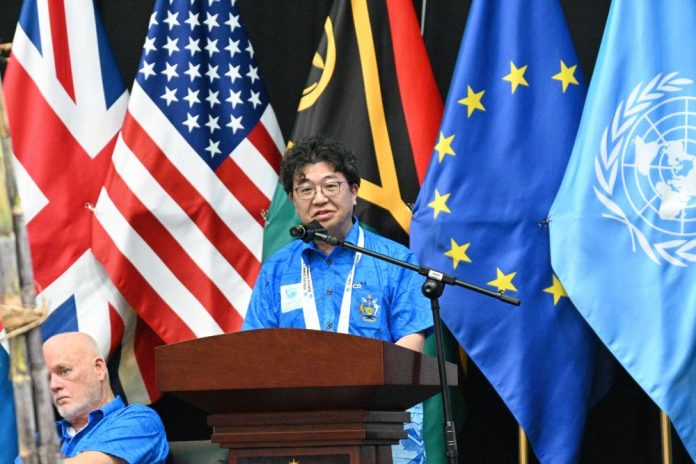
Japan’s Sasakawa Peace foundation is committed to act as catalyst for a number of areas including sustainable fisheries.

Atsushi Sunami, President of Sasakawa Peace Foundation gave the assurance to Pacific Island countries at the Honiara Summit- “Iumi tugeda delivering on SDG 14.4: Achieving Sustainable Fisheries” at the Friendship Hall yesterday.

He said the Sasakawa Peace Foundation is committed to acting as catalyst for developing partners, sharing knowledge, promoting innovation and fostering leadership and entrepreneurship for sustainable fisheries and blue economies.

Sunami also took the opportunity to highlight a number of key points in relation to the Sustainable Development Goal (SDG) 14.4 which is centred on how Pacific Island countries can sustainably manage their fisheries resources.

His first point is that since we all depend on the ocean and its resources but at the same time are increasingly concerned about the impacts of climate change and other related factors it is vital that all Pacific Island countries and their counterparts strengthen collaborative actions to maintain a healthy and protective ocean.

“First, we all depend on the ocean and its resources, yet we are increasingly concerned about the impacts of climate change, sea temperature rise, the increasing frequency of extreme climate events, marine pollution, biodiversity loss and declining fish stocks.

We must strengthen our collaborative collective actions to maintain a healthy and protective ocean and to reduce vulnerability and develop resilience in small island developing states, as underlined by the Antigua and Barbuda Agenda for Small Island Developing States, a Renewal Declaration for Resilient Prosperity.

We explore a way to contribute to the development of vulnerability and resilience country profiles.”

Sunami said the second point is that a key policy challenge lies in finding the optimal balance between conservation and sustainable use of fishery resources.

“A question arises as to how we can increase socio-economic benefits from sustainable fisheries while striving to achieve the 30 by 30 target under the Kunming-Montreal Global Biodiversity Framework. Innovation and strategic partnerships are essential for that.”

The third point he raised is the need to promote equity and justice within the fishery sector.

Sunami expressed that he was particularly impressed by the work of the FAA’s Regional Maritime Surveillance Centre yesterday in monitoring vessels and enforcing marine laws and fishery regulations in the region.

He went on to stress on his fourth key point which is focused on Illegal, Unreported and Unregulated (IUU) fishing.

Sunami stressed that to eliminate IUU fishing they have to engage in all fish nations and seafood importing countries in eliminating IUU fishing by having them as parties to port state measures agreements, PSMA (Port State Measures Agreement).

He added that they must also enhance socio-economic benefits for sustainable fisheries requires cross-sectoral and multi-stakeholder partnerships.

In this regard, Sunami mentioned that they must bridge the fishery sector and serve industries such as restaurants and tourism.

Lastly, he said the Sasakawa Peace Foundation collaborates with the Japanese policymakers and the fishery agency to promote what they call Umigyo.

“A Japanese concept referring to ocean-based livelihoods, and we are producing educational comic books to highlight success stories, challenges, and key drivers for Umigyo, Japan’s version of a sustainable blue economy.”

He emphasized that partnerships are vital and they look forward to participating in candid, inspiring discussions that will enable Pacific Island countries to present forward-looking recommendations at the third UN Ocean Conference in Nice, France this June, advancing SDGs 14.4 and strengthening international collaboration.

For feedback, contact: [email protected]
Fish sustainability has been around for centuries

0

By Loretta B Manele

Pacific Island countries have been managing fish stock for centuries.

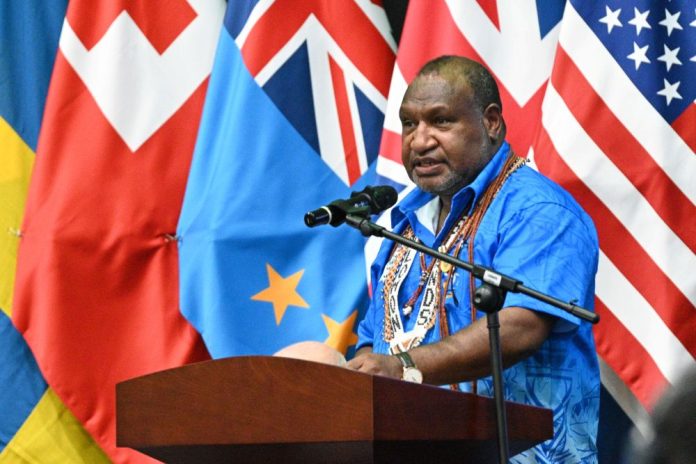
James Marape, Papua New Guinea Prime Minister highlighted the above whilst speaking at the high-level session at the Honiara Summit- “Iumi tugeda delivering on SDG 14.4: Achieving Sustainable Fisheries” at the Friendship Hall yesterday.

In reference to Pacific Island countries, he said they have managed their fish stock for centuries.

“The ocean is our supermarket. The ocean is our garden. The ocean is our life. No one needs to lecture us on fish sustainability. It is our lifestyle.”

In relation, Marape voiced that lectures on fish sustainability should be taken to the big industry polluters or those whose countries are host of illegal fishing.

“Because they are the ones causing non-sustainability of ocean resources in our part of the world.”

Marape highlighted that the Pacific Ocean is the biggest on the face of planet earth and leaders of the Pacific acknowledge this is a global asset and global resource.

“That is why they carved out the blue Pacific continent.

The blue Pacific strategy to ensure we are compliant to SDG number 14.”

Marape mentioned that SDG 14.4 arrived later as Pacific people had practised sustainable fisheries for millennium of years.

“SDG 14 arrived in 2015. As we march to 2030, I wonder how many SDGs all nations on the face of planet, especially the big polluters.”

Marape stressed that the big polluters and big holders of carbon footprint are USA, China, Japan, India and Europe.

“All of your partners sitting here with us. You have caused sea level rise, not my Pacific and if there is any sense of morality left in you, take this message back to your countries.”

Marape said the ocean is a big asset of planet earth that is a carbon sink, a supermarket and a super highway for all the big countries’ ships and submarines and is in need of help.

“In the context of fisheries, please assist us. Assist us with technology to stop illegal fishing that is depleting our fish.”

For feedback, contact: [email protected]
Tripartite MoU signed

0

BY JOHN HOUANIHAU

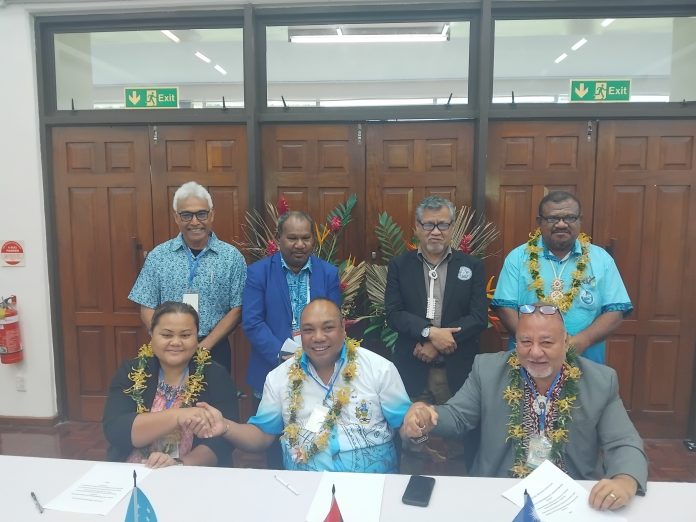
A tripartite Memorandum of Understanding (MoU) was signed between the Federated States of Micronesia (FSM), the Marshall Islands, and Papua New Guinea (PNG) during the East New Britain Initiative (ENBi) event on Monday.

The signing took place at the Forum Fisheries Agency (FFA) headquarters in Honiara as part of a pre-summit event leading up to this week’s Honiara Summit, which was officially opened yesterday.

FSM, the Marshall Islands, and Papua New Guinea are advancing elements of the ENBi framework through this MoU, aiming to accelerate the ENBi concept and invite others interested in collective efforts.

“Our goal is to enhance our participation and engagement in the development of the ENBi concept at a tripartite level and create opportunities for PFA members to benefit from the broader ENBi programme,” said Elina Akinaga of the Federated States of Micronesia.

Delivering her keynote remarks at the event on Monday, Akinaga emphasized that the sustainable development of the region’s fisheries remains a critical objective, ensuring that effective management aligns with broader development goals.

She noted that ENBi is founded on the principle that regional development opportunities must prioritize long-term sustainability.

“Active collaboration and engagement with the industry are vital to ensuring that our tuna products meet both regional and international standards while protecting them from the threats of illegal, unreported, and unregulated fishing.

“This includes pursuing sustainability certifications such as Marine Stewardship Council (MSC) certifications for our tuna fisheries, establishing and enhancing our chain of custody programme, strengthening monitoring, control, and surveillance tools, and integrating emerging technologies in fisheries management, such as electronic reporting and electronic monitoring.”

Hon. Jelta Wong, Papua New Guinea’s Fisheries Minister, told the media during the signing that collaboration is a key pillar of the East New Britain Initiative (ENBi).

“This tripartite MoU keeps us united and ensures that we support one another for a sustainable future. We need to stand together, whether big or small.

“We have a motto: never leave anyone behind. I’m very pleased that both countries have joined us in this effort, working together to strengthen our economies.

“They have strengths that Papua New Guinea may lack, and in turn, we may be able to support them in areas where we have expertise,” said Wong.

For feedback, contact: [email protected]