Home Blog Page 382

Infrastructure remains a strategy priority for GNUT: Manele

0

BY LORETTA B MANELE

Infrastructure will remain a strategy priority for the Government for National Unity and Transformation (GNUT).

Prime Minister Jeremiah Manele stressed on the above whilst speaking at his press conference yesterday.

He went on to express that roads, bridges, airports, wharves, ICT and healthcare facilities are essential not only to deliver vital services but also in driving economic growth and strengthening connections between our communities.

Manele outlined a number of key achievements of the government to date.

One of these achievements is a US $51.2 million additional funding secured for SIRAP2.

Manele added that GNUT also secured an additional US$51.2 million in financing for the Second Solomon Islands Roads and Aviation Project (SIRAP2), bringing total funding to US$140.41 million.

He mentioned that this was approved by the World Bank in February this year and effective as of March 3 and the additional funding will support infrastructure works.

Infrastructure developments under this funding will support construction of four new bridges in Malaita, namely; Kolofe1, Kolofe2, Su’u Harbour and Bira.

Other developments are; road upgrades of 10km in Noro and 33 km in Malaita, provincial airport upgrades in Malaita, Western, Temotu and Makira provinces and air navigation systems in Makira-Ulawa and Temotu to enhance aviation safety and efficiency.

Manel also stated that in 2024, the Australian government funded emergency repairs to 42 km of South Road in Malaita and completed this ahead of schedule in November.

He said the government is focused on restoring the confidence of partners to contribute to the National Transport Fund.

“To this end, Australia has taken the lead in contributing to the National Transport Fund again.”

Manele also noted that in March 2025, the Auki Road Network Rehabilitation Project, funded by the People’s Republic of China, (PRC) was launched to upgrade 5.462 km of roads in Auki, including a vital link to Kilu’ufi Hospital.

For feedback, contact:[email protected]

Gov’t investments focused on services to rural areas

0

BY LORETTA B MANELE

Prime Minister Jeremiah Manele expressed that government investments have focused on extending services and infrastructure to rural areas.

He spoke about this when giving an update to the media about the Government for National Unity and Transformation’s (GNUT) investments and progress while only being in office for just a year.

Initially, Manele said GNUT recognizes that the majority of Solomon Islanders live in rural communities and much of their national development agenda reflects this reality.

He emphasized that government investments have focused on extending essential services and infrastructure to rural areas through rural roads, wharves, airstrips, agricultural support, and fisheries centres to unlock economic opportunities and improve quality of life.

“For example, the road upgrades connecting the South and North of Malaita are helping communities gain better access to markets in Auki and Honiara. The continued rollout of RCDF-funded projects also supports rural livelihoods and helps bridge the development gap.”

Manele highlighted that their goal is to ensure that development is inclusive and balanced; lifting up our most underserved communities while responding to the needs of our growing urban population.

“This approach is not about choosing one over the other, but about building a more connected, equitable and resilient Solomon Islands for all.”

Manele noted that GNUT is actively formulating urban-specific interventions to address these concerns, ensuring balanced and inclusive national development.

For feedback, contact:[email protected]

GNUT reaffirms vision to transform energy sector

0

BY LORETTA B MANELE

Government for National Unity and Transformation (GNUT) has reaffirmed its vision to transform the country’s energy sector.

Prime Minister Jeremiah Manele voiced this at his press conference yesterday.

He said they are doing so through ambitious investments in renewable energy, regulatory reform and sustainable infrastructure.

Manele stated these efforts aim to reduce dependency on fossil fuels, expand energy access, and promote economic resilience. 

He said the Renewable Energy Roadmap targets a full transition of the Honiara electricity grid to 100% renewable energy by 2030, aligning with GNUT’s long-term sustainability goals.

Manele expressed that in partnership with the Asian Development Bank (ADB), the government is accelerating renewable energy generation projects, installing battery storage systems to stabilize supply and expanding renewable infrastructure in both urban and rural areas.

“These measures are critical to building an energy-secure future for Solomon Islands and reducing carbon emissions in line with our global climate commitments.”

In relation, Manele also spoke about the Tina River Hydro project.

He expressed that GNUT remains committed to completing the Tina River Hydro project by 2028. 

Manele said his government has approved the additional financing of US$75 million required for the project and has already secured most of this financing.

“Tina River Hydropower is a cornerstone of our national energy reform.”

Manele furthered that they are implementing programs and activities aligned with goals of; increasing electricity access in both urban and rural areas by 2030, reducing electricity tariffs by 25% by 2028 to alleviate cost burdens on households and businesses, diversifying energy sources to include solar, hydro and other renewables and introducing fiscal policies to lower Solomon Power’s operational costs and incentivize private sector investment in energy infrastructure.

He noted that these measures will boost the energy sector coverage and efficiency, stimulate economic activity and empower local communities.

For feedback, contact:[email protected]

Police say low security threat ahead of motion of no confidence

0

BY JOHN HOUANIHAU

The Royal Solomon Islands Police Force (RSIPF) National Intelligence Unit has indicated no security threat as Parliament is set to debate the Motion of No Confidence against Prime Minister Jeremiah Manele on Tuesday next week.

That was according to Police Commissioner Mostyn Mangau when he updated local media on their preparation towards next week’s Monc during a police press conference held at the Rove Police Headquarters yesterday.

“No threat picked up by our intelligence. For now, we are monitoring the situation. Our intelligence team has been working on that. They are the specialist units of the police force who are assessing incoming information. There is no threat picked up by our intelligence,” said Mangau.

“I would like to thank the People because of the current threat level in the country. Despite this motion, there is no potential threat coming or being picked up by our intelligence. So, I am urging our people. That shows the majority in the country.

“Like with the previous incidents, before the motion was moved, we already felt disturbances based on the commentary on social media,’’ he said.

He said that one of the platforms the Police used to collect information, based on their intelligence assessment, is social media

“That is one of our platforms we are using for collecting information based on our intelligence assessment and, also, raw materials, as well as our source assessment,’’ said Magnau.

For feedback, contact:[email protected]

PM highlights land reform and national security strategy at GNUT anniversary

0

BY NED GAGAHE

Prime Minister Jeremiah Manele says land reform remains one of the key focus areas of the Government for National Unity and Transformation (GNUT).

Speaking during a press conference yesterday to mark the GNUT coalition’s one-year anniversary, PM Manele highlighted the government’s ongoing work through the Ministry of Lands, Housing and Survey, which is currently conducting nationwide consultations on customary land tenure, ownership, and usage.

He said the Customary Land Recording Program—particularly in Rennell and Bellona—is a strong example of the government’s intent to empower local communities and ensure the fair distribution of land-related benefits.

“Our unity and stability have also been institutionalized through the launch of the National Security Strategy 2025,” the Prime Minister stated.

He described the National Security Strategy (NSS) as a reflection of the government’s long-term vision to safeguard peace and sovereignty, while addressing both traditional and emerging threats such as political unrest, corruption, land disputes, economic disparity, and climate change.

“The National Security Strategy is not just a policy document—it is a declaration that our unity and peace are non-negotiable,” Manele said.

He added that national security must be built from the ground up, in close partnership with communities, provinces, institutions, and with the Solomon Islands Government (SIG) firmly in the driver’s seat.

The Prime Minister reaffirmed that the GNUT government will continue to pursue inclusive reforms and adopt a whole-of-society approach to ensure that every citizen has a stake in peace and a voice in shaping the nation’s future.

Yesterday’s press conference formed part of the GNUT’s one-year anniversary celebration, marking 12 months of governance centred on transformation, reconciliation, and national development.

For feedback, contact:[email protected]

PM Manele emphasises unity and stability

0

BY NED GAGAHE

PRIME Minister Jeremiah Manele has reaffirmed his government’s commitment to unity and political stability as key pillars of national development, during a media conference held yesterday to mark the one-year anniversary of the Government for National Unity and Transformation (GNUT).

Speaking at the press conference, PM Manele said the government was founded on the principle that national unity and political stability are prerequisites for lasting progress.

He highlighted that despite political tensions over the past year—including a motion of no confidence—the administration has maintained peace and order.

“As we prepare to face another motion of no confidence next Tuesday, we approach it with calm determination, guided by our unwavering duty to work for the betterment of our people,” PM Manele said.

The Prime Minister used the occasion to reflect on the successes of GNUT over the past year, noting that they serve as evidence of the government’s dedication to building a united, stable, and resilient Solomon Islands.

He cited ongoing efforts to promote national dialogue and reconciliation, as well as initiatives to strengthen traditional governance systems and partnerships with community and faith-based organisations.

These, he said, are part of a broader mission to uphold peace, mutual respect, and inclusive development.

For feedback, contact:[email protected]

‘WE CONTINUE TO SERVE OUR PEOPLE’

0

-Prime Minister Manele shares huge list of development and progress for Solomon Islands brought by GNUT government in its first year in office

-Manele voices respect for political decision of 10 MPs who defected, welcomes motion

BY IRWIN ANGIKI

The Government for National Unity and Transformation (GNUT) is only one year in power but has achieved unprecedented levels of development and progress throughout the country.

This message was voiced by Prime Minister Jeremiah Manele as he fronted media yesterday for the first time since his government lost 10 MPs on Monday and a notice served for a motion of no-confidence against him set to be tabled Tuesday next week.

This week marked the first anniversary of GNUT government. But, before it could celebrate with the country its remarkable achievements, a group of 10 MPs led by Manasseh Sogavare resigned and defected to the Opposition side.

Not allowing this to mar its momentum, GNUT government continued the week with its normal duties providing services, implementing its policies and driving the economy forward.

Prime Minister Manele presented a brief of the achievements of GNUT in its first year. Then he acknowledged before media the political decisions by the 10 MPs who defected, saying he respects their decisions.

Unlike his accusers, PM Manele did not bother to engage in mudslinging and usage of negative adjectives, as he simply said he welcomed Tuesday’s motion of no-confidence.

He shared with media the achievements of the GNUT government in its first year in office.

Noticeably, the achievements of GNUT are huge, and show progress across all social and economic sectors.

“To claim that the government lacks leadership is to ignore the tangible progress we have made,” PM Manele said.

“We remain steadfast in our commitment to deliver on our promises and tackle the challenges facing our people.

“Our leadership is defined by unity, purpose, and service to the people – not by individual demands or disruptions.”

GNUT’s works are guided by four foundational pillars: Unity and stability, Economic transformation, Infrastructure development, Human capital development.

Unity and Stability

GNUT was faced with internal divisions which surfaced when the first motion of no-confidence against PM Manele was staged in early December last year.

However, through it all, PM Manele said GNUT overcame these challenges and managed to keep the grand coalition intact as it moved forward with its policies to improve the economy.

“We have promoted national dialogue, strengthened traditional governance systems, and deepened our partnerships with community and faith-based organisations to uphold peace, reconciliation, and mutual respect,” Manele said.

“Importantly, our foundation of unity and stability was further institutionalized through the launch of the National Security Strategy (NSS) 2025, which reflects our government’s long-term vision to safeguard peace and sovereignty. The NSS aligns closely with our national development priorities—particularly the second pillar of Unity and Stability—and strengthens our commitment to addressing both traditional and emerging security threats, including political unrest, economic disparity, land disputes, corruption, and climate-related risks.”

Economic Transformation

In its first year, GNUT has brought economic transformation to Solomon Islands, creating jobs, empowering rural economies and broadening the country’s national revenue base.

One aspect which has greatly contributed to GNUT’s success in this arena is its successful restoration of trust from donors and partners to be willing to become deeply engaged with GNUT in its programmes and projects to lift up the economy.

“Donor confidence in GNUT’s political stability and policy direction has grown. For example, the Asian Development Bank (ADB) has joined New Zealand and other partners in supporting the education sector through the Education Sector Support Program (ESSP). Australia has once again started to make direct financial contributions to the National Transport Fund. New partnerships are being worked with countries (Saudi Arabia, UAE and others) that have mutual interests with us,” PM Manele said.

GNUT has hosted national dialogues – national economic summit, energy summit, donor roundtable and others which provided a vital platform for reflection and consensus building on what and how to address our economic challenges, strengthen development partnerships and accelerate energy developments.

“The outcomes from the summits are now guiding our development priorities, resource allocation, with a focus on productive and resource sector, infrastructure investment, industry development, and job creation,” PM Manele said.

Furthering GNUT’s work to empower rural communities is the special economic zone bill that is before parliament which will stimulate investment, streamline business processes and generate more jobs.

GNUT is addressing one of the country’s outstanding needs which is a tax system that is fair, simple, and broad-based that ensures everyone pays their appropriate share.

More seasonal work opportunities are being made available for Solomon Islanders as GNUT signs more agreements with other countries, and making progress towards the target of 16,000 seasonal workers by 2028.

“Labour mobility is not just about employment—it is a pathway to skills development, human capital growth, and community empowerment,” Manele said.

Work is underway to enable micro, small and medium enterprises (MSMEs) with a national policy nearing completion with the Ministry of Commerce (MCILI).

One hallmark GNUT initiative is the revolving fund to support cocoa, copra and coconut farmers and buyers.

“As part of this commitment, the Ministry of Agriculture and Livestock has recently launched a $2.26 million revolving fund to support traders engaged in the cocoa and coconut industries,” Manele said.

Ongoing revitalisation of CEMA, with value-added processing plants are underway which will boost the agriculture sector.

Infrastructure development

Solomon Islands is seeing an era of nationwide infrastructure development, with more roads, bridges, wharves and airfields either being built or improved.

Manele briefs GNUT’s main highlights in this sector – additional USD51.2 million for the SIRAP 2 project from the World Bank – which is seeing bridges being built in Malaita, road upgrades in Noro and Malaita, airport upgrades in Malaita, Western, Temotu and Makira provinces.

With Australia and China’s help, road repairs are rolling out in Malaita and Honiara.

28 telecommunication towers are already on-air, with 37 awaiting connection, with support from China as GNUT pushes towards the target of 161 telecommunication towers.

 GNUT is also moving the country towards renewable energy. It aims to have Honiara run on 100 percent renewable energy by 2030.

The Tina Hydro project is on track to complete by 2028, with GNUT recently approving additional financing of $USD75million.

Human Capital Development

“The strength of any nation lies in its people. That is why we have placed human capital development at the centre of our policies,” Manele said.

In the past year, the new Education Act has seen GNUT’s 2025 budget catering for the revised teachers’ salary structure and school grants policy, the tertiary student loan scheme allowing tertiary students access to higher education.

More and more classrooms, dormitories, ablution blocks and school infrastructures are being built across the country.

An unprecedented $125 million has been allocated to the national medical store.

“This reflects our serious commitment to improving access to essential medicines and health supplies. And yes, we have made significant progress to addressing the drugs and medicines shortage,” Manele said.

Upgrades have been done to the national referral hospital and Kiluufi hospital with Japan and China’s help. With Australia’s help, the Naha birthing centre is helping many families in the capital.

For feedback, contact:[email protected]
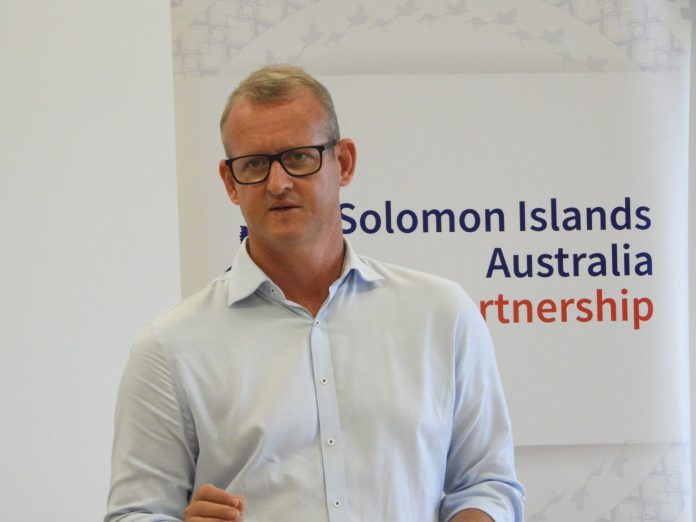
Waneoroa sworn in as new Minister for Rural Development

0
Left-right: PM Manele, GG Sir David Kapu, and new Minister MRD, Daniel Waneoroa

North Malaita MP, Daniel Suilea Waneoroa, was officially sworn in this evening as the Minister for Rural Development at Government House in Honiara.
The ceremony was officiated by the Governor-General, His Excellency Sir Reverend David Tiva Kapu, a statement from the Prime Minister’s Press Secretariat tonight said.
Mr Waneoroa, a member of the Umi for Change (U4C) party – a grassroots movement advocating for rural empowerment and political accountability – joins the Cabinet under the leadership of Prime Minister Jeremiah Manele.
His appointment comes at a critical time, as the Government for National Unity and Transformation (GNUT) prepares to face a Motion of No Confidence in Parliament on Tuesday.
Prime Minister Manele welcomed the appointment, noting that Waneoroa’s inclusion reflects a shared commitment to serving the needs of rural Solomon Islanders and advancing inclusive national development.
As Minister for Rural Development, Waneoroa will lead efforts to improve infrastructure, enhance livelihoods, and strengthen essential services in rural communities across the country.
GNUT has in its first year in power brought unprecedented development and progress in many rural communities across Solomon Islands.

SOLAS beacon of progress for maritime sector

0

BY JOHN HOUANIHAU
The Solomon Islands Maritime College’s state-of-the-art Safety of Life at Sea (SOLAS) centre is a beacon of progress for the country’s maritime sector.
Mr Alan Lilia, the permanent secretary to the Ministry of Infrastructure Development, said that at the official commissioning, opening and handover ceremony held at the SINU Solomon Islands Maritime College at Marine School East, Honiara on Wednesday.
Delivering his keynote address, PS Lilia said that this vision was initially charted by the foresight of the SINU Vice-Chancellor, Dr Transform Agorau, and the Solomon Islands Maritime Authority (SIMA) Director, Thierry Neville.
He said that they initiated a collaborative arrangement that culminated in a right of partnership agreement involving SINU, MID, SIPA, and SIMTA in 2023.
He said that this alliance established a joint oversight committee dedicated to the crucial task of upgrading the country’s maritime college.
He said that together they have diligently developed a comprehensive project proposal and are committed to transformative changes to the institution.
“Our collaborative efforts bore fruit in 2024 when the partnership agreement and the broader development of maritime training received the endorsement of a letter in its integration into the Maritime Labour Mobility and Shipping Registry National Roadmap, which was officially opened, launched in August 2024,’’ he said.
He said that their overarching ambition is to unleash the new horizon of job opportunities and skilled employment for our nation’s needs.
“We firmly believe that the maritime sector, encompassing both shipping within some islands and globally, holds immense potential to fulfil this aspiration. With our solar centre, we will soon provide our student seafarers with internationally recognised qualifications, opening doors to careers on the world stage,’’ said Lilia.
He said that the ambitious endeavour was achieved through the partnerships with National Fisheries Development (NFD) and its General Manager, Russell Dunham, for their invaluable partnership in this critical initiative.
“Our largest shipping and fisheries company and a principal maritime employee, NFD stands not merely as an industry leader but a joint partner in elevating ship safety standards and nurturing our seafarers,’’ said Lilia.

NSO completes R and Rstudio training

0

The National Statistics Office (NSO) is enhancing its data analysis and statistical modelling skills with the recent completion of a four-day training on R and RStudio.

Facilitated by CAPSA Project Statistics Resident Advisor Dr Cengiz Ozkan, 13 statisticians from the different units within the NSO took part in the training.

It presented an opportunity for the statisticians to sharpen their expertise in statistical programming and improve their collective ability to manage and analyse complex datasets using RStudio, a statement by NSO yesterday said.

Director of Methodology and Data Processing Josephat Tako was a participant who is keen to master the RStudio software.

“The RStudio software is new to most of the NSO officers. Very few are familiar with the software, but on the basics. This training is more detailed.

“NSO has been using the Census and Survey Processing System, CSPro for a while now but we are now advancing in technology and we want to switch to using R instead.

“We are lucky to have Dr Ozkan with us and we will continue to utilise his expertise on the software.”’

R is both a programming language and an environment, focused mainly on statistical analysis and graphics, the statement said.

It is quickly becoming the standard for statistical analysis, it is free, and there is a large community of people using it which means there are free resources available online to continue your learning after we finish this course.
RStudio is a graphical user interface for R, it sits “on top” of base R and makes it more user-friendly and easier to learn R, the statement said.
It can write, edit and store code used for data cleaning and analysis, generate, view and store graphs, and manage files.
In two weeks’ time the NSO will convene another training on the application of the software, the statement said.
It will later start using the R and RStudio for the International Visitor Arrivals data and the National Consumer Price Index data.
This will involve importing commonly used data sources at the NSO into RStudio, including data from CSPro, Excel, and Survey Solutions.
The series of trainings are part of the Capacity Building in Statistics and Audit (CAPSA) Project between NSO and OAG in partnership with the World Bank.