Home Blog Page 271

Forum Chair acknowledges CROP heads

0

BY BEN BILUA
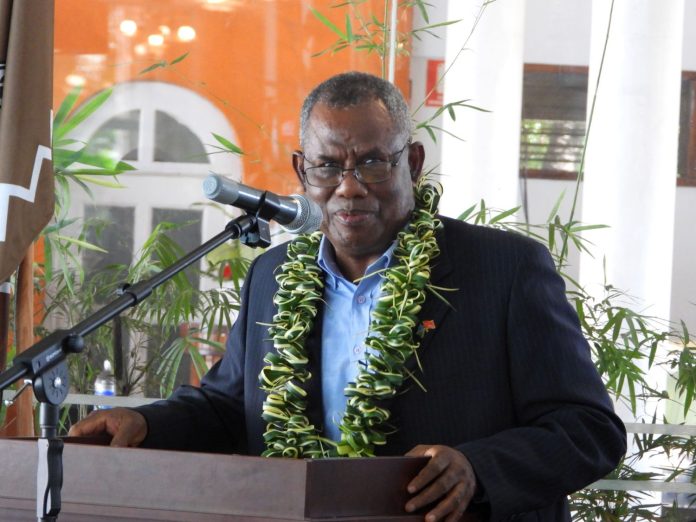
FORUM Chair Jeremiah Manele has acknowledged the presence of Council of Regional Organisation in the Pacific [CROP] at the 54th Pacific Islands Forum Leaders Meeting.
Speaking at the Leaders Dialogue with CROP Manele said, the Council of Regional Organisations in the Pacific play an instrumental role in the implementation of any decisions coming out from forum meetings.
He said CROP agencies have invested in aligning to the region’s collective 2050 Strategy which is not regional leaders’ strategy but a document collectively agreed up by the Blue Pacific Continent.
Manele salutes all CROP Heads, and their respective Teams for working to support the 2050 Strategy Implementation.
“I recognise that we are still in early days of implementation but I remain confident that with the right mechanisms, institutional arrangements and the collective political will of this body, we will advance towards the achievement of our 2050 Vision.
“This is not a mere aspiration – it is an imperative. All of us around this table today, including our CROP Heads, are entrusted with the responsibility of Leadership; to ensure that we can collectively deliver for our people, to drive the collective aspirations of our governments, to advocate for the partnerships and support that we need to ensure our priorities are implemented,” he said.
Manele said the regional system must always be, first and foremost, centered on the people and the membership that it serves.
He said collective decisions as Forum Leaders are for nought, if it is not supported by the implementation machinery such as the Council of Regional Organisations in the Pacific.
“I encourage us to engage with openness, candour, and the spirit of solidarity that defines our Blue Pacific Continent,” Manele said.

CSOs call to expand Pacific family

0

BY BEN BILUA
PACIFIC Civil Society Organisation has called on Pacific leaders to seriously work towards expanding the pacific family.
The organisation made reference to the issues of West Papua, New Caledonia, French Polynesia and Kingdom of Hawaii – calling on regional leaders for greater support.
Joining the call was the General Secretary of the Pacific Conference of Churches Reverend James Bhagwan who is in Honiara for the 54th Pacific Islands Forum Leaders Meeting.
He put forward four recommendations to leaders that would help address the issues in the long term.
The first recommendation is for Pacific Islands Forum Secretariate to institutionalise human rights and self determination as standing agenda items at the 54th Pacific Islands Forum Leaders Meeting – this will ensure the participation of lived experience communities and independent experts and supporting mechanisms for independent reporting, peer review and civil society monitoring across member states.
The second recommendation is to task the PIP Secretariat to co develop a regional strategy on human rights and self determination within the next 12 months with independent experts and our communities.
Third call is that the forum should recognize and elevate ongoing justice claims, including nuclear survivors, the climate displacement challenges facing and economic communities as regional priorities under the Pacific’s commitment to dignity, fairness and accountability.
A final call is for regional leaders to re engage with UN Human Rights processes, including The Office of the UN Human Rights, UN Human Rights Commissioner, the C24 and to support enhanced human rights monitoring in West Papua.
Bhagwan said churches in the region and other civil society organisations stand by the recommendations and would like to see regional leaders to take serious consideration.
“This is a journey, not just for those sitting here, but for each one of us, because that’s what pacific solidarity is,” he said.

Australia PM’s late arrival in PIF leaders summit sparks mixed reactions

0

By BEN BILUA
THE late arrival of Australian Prime Minister Anthony Albanese to the 54th Pacific Islands Forum Leaders Meeting in Honiara has sparked mixed reactions from leaders and ordinary Solomon Islanders alike.
The forum officially opened on Monday this week, with leaders from across the Pacific already engaged in dialogues and side meetings.
Mr Albanese arrived two days later, raising eyebrows and prompting questions about Australia’s priorities in its relationship with the region.
Observers say the late arrival was not just a matter of scheduling but symbolically undermined the spirit of unity and respect that the Forum seeks to foster.
For some, it sent a message that Australia, often described as a “traditional partner” of the Pacific, views the gathering as secondary to its own domestic and foreign policy interests.
“This show is disrespectful not only to the host country but also to Pacific leaders who have been dedicating their time since the official opening,” one regional commentator told this paper.
“It reinforces the perception that Australia comes to the table when it suits them, not when the Pacific needs them.”
Critics argue that Australia’s approach reflects a pattern of pursuing its own strategic goals in the region rather than addressing Pacific-led priorities.
Examples frequently raised include the country’s management of the Pacific Australia Labour Mobility (PALM) Scheme, where reports of exploitative conditions and human rights violations have emerged.
Australia’s broader security posture in the Pacific is also under scrutiny. On Tuesday this week, Vanuatu refused to sign a proposed security and development agreement with Canberra, citing concerns that such a deal could limit its ability to access infrastructure funding and partnerships from other countries, including China.
Media reports suggested that the Vanuatu agreement was one of two major security pacts Australia had hoped to secure this month, as part of a wider strategy to counter Beijing’s growing influence in the Pacific.
With PM Albanese now in Honiara, attention has turned to his closed-door meetings with Solomon Islands Prime Minister Jeremiah Manele.
Analysts expect Australia to quietly lobby for stronger alignment against China’s presence in the region.
This comes against the backdrop of Solomon Islands’ own controversial security agreement with Beijing in 2022, which strained ties with Canberra and prompted Australia to recalibrate its Pacific engagement.
While some view the Australian leader’s visit as an opportunity to reset relations, others remain wary.
For Solomon Islanders, the timing of his arrival and the weight of past grievances raise questions about whether Australia is truly committed to listening to the Pacific or simply using the Forum as a stage for its geopolitical agenda.
As the Forum continues, the test for Australia will be whether it can move beyond power politics and demonstrate genuine respect for Pacific priorities such as climate change, resilience, and sustainable development or whether its actions will continue to feed perceptions of a partner out of step with the region it claims to stand beside.

Pacific leads the world in ocean diplomacy: SPC Director General

0

BY NED GAGAHE
The Pacific region is setting a global benchmark in ocean diplomacy, with 75 percent of shared maritime boundaries concluded through signed treaties significantly above the global average of 60 percent.
Speaking at a sideline event yesterday on “Securing the Blue Pacific Continent: Finalising Maritime Boundaries and Advancing 100% Ocean Management”, Director General of the Pacific Community (SPC) Dr Stuart Minchin reaffirmed the region’s leadership in ocean governance, commending Pacific Island countries for their unwavering commitment to settling maritime boundaries and adopting forward-looking ocean policies.
“The Pacific is leading the world in ocean diplomacy,” Mr Minchin, cited progress made over two decades of sustained technical cooperation, political will, and regional solidarity.
Since the launch of the Solomon Islands’ National Ocean Policy in 2018, the region has witnessed a surge in national efforts to finalise maritime boundaries and secure sovereign rights over vast ocean spaces.
To date, eight Pacific countries have adopted National Ocean Policies, a figure that continues to grow.
The SPC, which serves as the technical custodian of the Pacific Maritime Boundaries Project, has played a key role in facilitating boundary agreements, extended continental shelf submissions, and the development of digital governance tools.
Among recent successes, Tuvalu and Kiribati finalised their maritime boundary treaty earlier this year.
The Cook Islands received a positive recommendation on its Manihiki Plateau submission, an effort 16 years in the making.
Minchin revealed that three new Extended Continental Shelf submissions were advanced to the United Nations in July.
These milestones not only strengthen national sovereignty and resource management but also represent the Pacific’s growing influence in international ocean law.
“Boundaries are not just lines on a map. They are anchors for sustainable development, climate resilience, and food security,” he said.
“Certainty in these spaces gives confidence to investors and protects the livelihoods of our communities,” Minchin said.

Pacific launches first-ever maritime boundaries dashboard

0

BY NED GAGAHE
In a historic step forward for regional ocean governance, the Pacific Community (SPC) has officially launched the Pacific Maritime Boundaries Dashboard, the first regionally-owned digital platform designed to provide real-time tracking of maritime boundaries, extended continental shelf submissions, and national ocean policies.
The Dashboard was launched yesterday at the sideline event on Maritime Boundaries and Ocean Management.

Left to Right – Premier of Temotu Stanley Tehiahua, President Edgar Haward of Torba Province, Vanuatu and Albert Ruddley,Secretary General- Torba.


The platform is already being used by Forum Fisheries Agencies (FFA) to monitor vessel activity against established maritime zones.
The event was attended by Pacific leaders including Prime Minister Jeremiah Manele, SPC Director General Dr. Stuart Minchin, and Deputy Director for the Ocean and Maritime Programme Jens Kruger, Premier of Temotu Province Stanley Tehiahua, and Pacific Ocean Commissioner Dr Filimon Manoni.
The Dashboard is being hailed as a major innovation in the drive for transparency, accountability, and data-driven decision-making in the Pacific’s maritime domain.
“This is more than just a tool, it’s a powerful symbol of regional ownership and cooperation,” said SPC Director General Dr Stuart Minchin.
“It offers governments, negotiators, and partners a shared reference point grounded in science, law, and data.”

Jens Kruger, Deputy Director for the Ocean and Maritime Programme of SPC making his presentation.


Built to respond to the growing need for accurate, accessible maritime data, the Dashboard is already proving its utility.
With over 75 percent of the region’s shared maritime boundaries already settled through signed treaties—and 8 Pacific nations having adopted National Ocean Policies—the Dashboard provides a timely and critical interface to monitor progress, highlight gaps, and coordinate action.
The launch of the Dashboard represents the latest in a series of strategic efforts by SPC and its partners to elevate the Pacific’s role in global ocean diplomacy.
The region is now widely recognised as a leader in boundary finalisation, ocean policy development, and legal advocacy for maritime rights.
The Dashboard complements long-standing initiatives such as the Pacific Maritime Boundaries Project, which SPC has coordinated for more than two decades.
The platform helps ensure that progress is not only made, but measurable, visible, and verifiable.
“Transparency is essential for good governance and when it comes to ocean space, the stakes are too high for guesswork.” Dr Minchin said.
The launch of the Dashboard sets a new international standard for how small island developing states can use digital tools to enhance sovereignty, protect resources, and manage ocean spaces.
As climate pressures mount and geopolitical interest in the Pacific intensifies, such innovations are essential.
The platform will also play a key role in supporting regional efforts toward 100% ocean management, a shared goal that links marine conservation, fisheries governance, and sustainable development.
Backed by enduring support from partners including the European Union, Australia, the United Kingdom, and donors, the Dashboard is expected to evolve over time, incorporating additional data layers and user functionalities.
“This is a living system, not a one-off launch. It will grow as the region’s needs grow.
“The Blue Pacific is not just an identity, it’s an organised, data-driven reality. With tools like this Dashboard, we are demonstrating that Pacific-led solutions are not only possible, they are effective, and they are here.” SPC Director General Dr Stuart Minchin said.

South Choiseul Constituency commends Chinese Embassy

1

BY MORRIS NAFU
The South Choiseul Constituency (SCC) Office, representing the people of Wagina, Selekana, and the wider community, has expressed heartfelt gratitude to the Embassy of the People’s Republic of China in the Solomon Islands for its swift and generous support following recent tsunami-like waves and strong ocean currents that devastated local seaweed farms earlier this year.
China handed over the donated support through the Office of the South Choiseul Constituency on September 2025 with amount of Fifty Thousand Dollars.
SCC development Officer John Ngili Confirm to Island Sun news the support is with the constituency office waiting for distribution according to each Farmers assessed farm damage.
SCC Office added, The Chinese Embassy’s financial assistance provides immediate relief to seaweed farmers whose livelihoods were severely affected by the disaster.
“This crucial aid will help hardworking families recover and rebuild their vital source of income.
This act of kindness highlights the growing friendship and cooperation between the Solomon Islands and China, showcasing the Embassy’s ongoing commitment to supporting vulnerable communities during difficult times,” he said.
The South Choiseul Constituency is deeply thankful for this meaningful support and looks forward to continued partnership with the People’s Republic of China in community development and shared interests.
Wagina’s seaweed farms contribute over 90 percent of the Solomon Islands’ dried seaweed exports and are recognised as the largest seaweed exporter in the South Pacific.
Initial assessments during the disaster reveal nearly every farm was destroyed, with over 510 ropes of seaweed with only three out of around 200 farms were not destroyed.
Reports further added estimate damage farms are around 98 percent of seaweed farms in and around the area.

Fiji and Solomon Islands sign historic security agreement to strengthen regional stability

0

BY CHRIS ALEX
Fiji and the Solomon Islands have officially signed a Bilateral Agreement for the deployment of Fijian security personnel to Solomon Islands.
The signing ceremony, held yesterday in Honiara, marks a significant step forward in the enduring partnership between the two Pacific nations.
The agreement cements a long-standing relationship rooted in shared culture, history and mutual support dating back to the colonial era and even earlier.
The presence of Fijian missionaries and military personnel in Solomon Islands during World War II, and later under regional peacekeeping missions, highlights the longstanding spirit of solidarity between the nations.
“We are connected by the Pacific Ocean, our culture, and our shared history,” Prime Minister Manele said, reflecting the deep personal and historical ties between the two countries.
“Today’s agreement symbolises a modern continuation of that relationship, underpinned by trust, tradition, and a shared vision for peace in the Pacific.”
Fiji’s contributions to Solomon Islands’ stability have spanned decades from deployments under the Commonwealth (2000), RAMSI (2003–2017), and most recently, the Solomon Islands International Assistance Force (2021–2024).
Honouring that legacy, Solomon Islands leaders paid tribute to the Fijians who served and those who sacrificed in the name of peace.
Prime Minister Manele acknowledged Fijian Prime Minister Sitiveni Rabuka’s personal role in peacebuilding efforts, saying, “Tagio tumas, Prime Minister.”
He further praised Fiji’s cultural closeness and operational readiness, emphasizing that the island nation is “well placed to fill our national critical security gaps when called upon”.

Solomon Islands Police Commisioner Mr Mostyn Mangau and Minister of Police Jimson Fiau Tanangada witnessing the signing


While leaders expressed hope that the agreement would never need to be activated, its existence ensures that Fiji remains on what was described as “Solomon Islands’ speed dial” for any future security needs.
The agreement aligns with key regional frameworks, including the Biketawa and Boe Declarations, and reflects Solomon Islands’ broader strategy of strengthening ties with fellow Melanesian states in pursuit of post-conflict resilience and regional stability.
The setting of the signing against the backdrop of traditional ocean voyaging canoes, the Tepuke and Utoni Yalo highlighted the spirit of Pacific unity and the shared “Oceans of Peace” vision championed by Fiji.
As the ceremony concluded, a biblical verse echoed through the gathering:
“Blessed are the peacemakers, for they shall be called the children of God.”
A fitting tribute to the enduring mission of peace both nations have embraced.

STICKING TO PROCESS

0

-Finance minister Manemahaga says he acted to ‘protect national revenue’ by reallowing sufferance wharves
-Minister takes jibe at Ports and Leroy international wharves

BY IRWIN ANGIKI
Finance Minister Trevor Manemahaga has defended his infamous decision to revoke the suspension of sufferance wharves saying he was simply following ‘due process’ and ‘protecting national revenue’.
Mr Manemahaga praised sufferance wharves as ‘critical to the economy’ saying they contribute to lowering prices of goods and services, and supporting competition in the country by ‘preventing monopolistic pricing’.
Ports Authority and Leroy international wharves have gaps in their capacities which sufferance wharves help alleviate with the ‘growing trend of trade that we are undertaking’, Manemahaga told reporters at a press conference yesterday.
He made example of break-bulk cargoes including cement.
Minister Manemahaga, towing the Government for National Unity and Transformation’s (GNUT) zealousness for process and architecture, highlighted that cabinet had resolved on June 3 this year to set up a special committee to review the use of sufferance wharves.
However, the former finance minister suspended sufferance wharves before a committee was formed, thus had not followed due process, Manemahaga implied.
Manemahaga added that sufferance wharves, contrary to widely held beliefs, comply with the government’s regulations.
“One of the issues a lot of people do not fully understand or grasp is on regulatory compliance. I must say that sufferance wharves observe all the compliance processes, including customs and biosecurity processes. Those processes are fully in place.
“For example, before the ship ports the advance cargo manifest arrives ahead and customs receives it. The process is there, being followed. And, when the ship arrives, inspectors board the ship, the customs, the biosecurity and other relevant authorities board the ship and carry out their checks.
“Another important thing is the payment of all applicable taxes and fees and other charges are done before unloading at the sufferance wharves. So due process is being followed there,” Manemahaga said.
Manemahaga reiterated that his action was done in ‘our best national interest, not in the interest of any individual or any businesses’.
“And the policy direction is based and aligned with the cabinet decision on June 3,” Manemahaga said.

Going forward

Minister Manemahaga said he has set up a taskforce to review the issue of sufferance wharves and submit a report to him before the end of October with its findings.
“I’ve instructed my officials to set up the taskforce immediately to look into the issue of sufferance wharves, and the committee’s first meeting occurred at 10am today.
“And the committee members, comprise of a number of different people from various ministries and government authorities. So I expect the committee to do their review and findings and expect them to report back to me before end of October.
“And then I will bring that report to Cabinet to make the final decision on sufferance wharves. And that will also, let me make it clear, not only the sufferance wharves, but also including the Leroy wharf. So the task of the committee will cover both sufferance wharves and Leroy wharf,” Manemahaga said.


Protecting national revenue


Minister Manemahaga reiterates that he is simply following policies of the government of the day.
“My duty is to uphold Cabinet decision, and to also make sure, as a Minister of Finance, to protect national revenue and also ensure our economy continues to function smoothly.
“While long-term policies are being reviewed, this is about continuity, fairness, and responsible governance, not politics. The position I have taken reflects a collective Cabinet decision.
“It’s not a personal directive from me. So as I’ve said, the review is currently underway and my ministry is acting responsibly within that framework,” Manemahaga said.

Background

Sufferance wharves are seen as hotspots for government’s revenue loss due to non-compliance and also the inability of Customs to adequately monitor these wharves’ activities.
On August 21, 2025 former finance minister Harry Kuma ordered the suspension of use of all sufferance wharves for unloading of imported goods.
Nine days later Mr Kuma was kicked out of the finance portfolio and reshuffled to the ministry of Commerce, Labour and Immigration (MCILI).
Manemahaga, MP for Gao-Bugotu, became the new finance minister. And, on September 4 Manemahaga revoked the suspension order.
The former finance minister’s reasons for suspending the sufferance wharves as stated in the August-21 letter include:
“Serious concerns by the Ministry’s management and relevant authorities, including the Solomon Islands Maritime Authority regarding the Custom Division’s limited capacity to adequately monitor imports at these facilities (sufferance wharves).
“Additionally, some sufferance wharves have been found to be non-compliant with international ship and port facility security (ISPS) standards, posing risks to national trade and revenue collection.”
The letter directed that all imported goods must only be unloaded at the following declared international seaports:
-SIPA International Seaport, Honiara
-Noro International Seaport
-Leroy Wharf International Seaport, Ranadi (East Honiara)
The letter added that ‘all existing permits authorising the unloading of imported goods at any sufferance wharf in the country’ were hereby cancelled.
The suspension did not apply to loading of round logs and mineral-related products for export at the sufferance wharves.

PM Manele acknowledges Pacific youths

0

BY LORETTA B MANELE
Prime Minister, Jeremiah Manele acknowledges Pacific youths for standing with Vanuatu on an issue regarding climate change.
He made the acknowledgement whilst delivering his speech at the opening ceremony of the 54th Pacific Islands Leaders (PIF) Meeting on Monday evening, September 8, 2025 at the National Stadium.
“Let me recognise in a very special way our Pacific Youth who have stood with Vanuatu in seeking the ICJ (International Court of Justice) opinion on state responsibility on the impact of climate change,” said Manele.
On the same note, he also acknowledged Solomon Islands youths.
“In our midst, let me acknowledge Solomon Islands youths, Solomon Yeo, Cynthia Houihi and Rodrick Rolland joining wantoks from Tonga, Australia, Vanuatu, Fiji and Samoa – the region celebrates your innovation and resilience and we thank you for your advocacy and service – tagio tumas,” he said.

Minister Nori encourages youths to champion sustainable development

0

BY LORETTA B MANELE
The Minister of Women, Youth, Children and Family Affairs (MWYCFA), Cathy Nori has encouraged youths to be champions and leaders in sustainable development.
She gave the encouragement whilst speaking as the guest speaker at a trade fair organised by youths from Central Guadalcanal constituency themed “Communities for Sustainability Eco-Tourism and Development Fair”.
Nori stressed that they are gathered at a critical time where our nation and in particular, youths, face significant socio-economic challenges.
“We all see, when we look around, we see a lot of youths in this country, 70% of our population in this country is youth, and that youth is the age between 15 and 34 years old,” she said.
In this regard, she shared an important message to the youths of Central Guadalcanal.
“You are ready to be architects of your future. You are champions of your culture and leaders in sustainable development. It is with utmost pride that I say this,” said Nori.
She also stated that Central Guadalcanal is the economic heartbeat of our nation.
Nori added that Central Guadalcanal is not only host to our international airport but also caters to other developments like the Tina Hydro Project, forestry and mining.
She pointed out there is vast agricultural potential for this constituency highlighting the trade fair as one example.
“The trade fair is one platform that can show the incredible richness of Central Guadalcanal to the country and the world.
“It is also about connecting our vital national industries with the grassroots innovation of the community, said Nori.
She voiced that it is also about connecting our vital national industries with the grassroots innovation of the community.
“So, we are here to celebrate everything that makes this constituency unique. From our cultural heritage, all the activities that we are doing, weaving, the custom stories, and the tatalonga. And to our entrepreneurial spirit and our breathtaking ecotourism sites from Parangiju,” said Nori.
In further remarks, she voiced that the most inspiring part about the trade fair is it being a youth centered initiative.
“To you, the young leaders of this event, we would like to acknowledge the hard work of the youth.
“I understand you have a committee. And I would like to acknowledge the efforts of the youth,” said the minister.