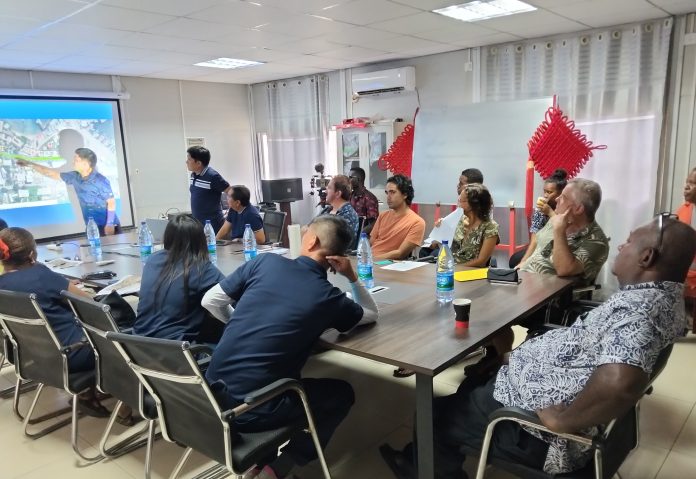
The chairman of the Kava Industry Working Group (KIWG), Max Lazarus, calls for improved domestic supply chains to seize lucrative international market opportunities.
He made the call during a meeting the KIWG held in Honiara last Wednesday, where a number of issues across kava value chain – producers, processors and exporters were highlighted.
During the meeting, discussions also focused on critical challenges, including production capacity, quality control, access to finance, compliance costs, and export logistics.
The chairman emphasised that while significant export opportunities exist, particularly in the United States, current supply levels are insufficient.
“Yes, there is opportunity for our Kava in the USA Market. But even if we take all our kava, plus from Fiji, Vanuatu and other Pacific Islands Countries, it still won’t be enough to meet the demand from only one state. USA will still ask for more,” said Lazarus.
He underscored the group’s primary focus.
“….so as the Working Group for Kava what we want is to work on our farm level or our supplies. Solomon Islands needs to work on our supplies. Coordinate everyone so we can meet the demands of potential markets, such as the USA, Europe or even Asia,” he said.
Participants at the meeting highlighted ongoing supply chain challenges, including stringent export market requirements, sanitary and phytosanitary standards, and the urgent need for a clearer domestic regulatory framework to enable growth.
The Working Group solidified its 2026 priorities, which include: establishing a formal Kava Association to represent the entire industry, advocating for the finalization and implementation of the national Kava Policy, fostering coordinated private-sector engagement and evidence-based policy dialogue with government and development partners and instituting systematic structures and governance to strengthen the sector.
“This is the initial meeting and the Kava Working Group is planning on establishing a Kava Association that will represent the kava industry, farmers and players.
“It is important, moving forward in this sector, that we have a systematic structure and good governance and continue to have round table discussions to push this industry forward,” said Lazarus.
The KIWG reaffirms its commitment to advance a competitive, compliant, and sustainable kava industry, serving as the central platform to address challenges and promote reforms that support all industry stakeholders.
The KIWG is a coalition of kava industry stakeholders in Solomon Islands focused on advocacy, collaboration, and sustainable development of the sector.
A new chapter in labour mobility between the Solomon Islands and Australia is set to begin following a successful recruitment drive by MADEC Australia.
Representatives from the Australian firm recently concluded their initial recruitment mission to the Solomon Islands, expressing significant confidence in the caliber of local workers, a statement from LMU’s Facebook page on Friday last week said.
The recruitment highlighted the candidates excellent English proficiency, strong test results, and readiness for skilled roles.
Initials placements are anticipated in sectors such as forklift, driving, horticulture, and glasshouse farming.
Following a rigorous interview process, an initial cohort of 25 Solomon Islanders is scheduled to commence work in Australia in June.
The statement said this pilot program is expected to expand rapidly, with future opportunities potentially opening in agriculture and age care, addressing key labor shortages in Australia.
MADEC lauded the professionalism of the Solomon Islands Labour Mobility unit (LMU), under the Ministry of Foreign Affairs and External Trade, for their crucial role in facilitating this partnership, the statement said.
The LMU also acknowledges MADEC as one of the first Australian labor hire companies to conduct real-time recruitment in the Solomon Islands.
This collaboration is seen as a long-term benefit for both nations, providing valuable employment opportunities for Solomon Islands workers and a reliable workforce for Australia industries.
Workers are also viewed as vital ambassadors for future labor mobility initiatives, strengthening ties and fostering economic growth between the two countries.
The Minister for Agriculture and Livestock Development (MAL), Franklyn Derek Wasi, has announced a series of ambitious national targets that aim to revitalise and expand the poultry industry in the Solomon Islands over the next three years.
The targets were outlined during a consultation meeting with local poultry farmers on Thursday, January 29, where the Minister reaffirmed MAL’s commitment to address long-standing challenges faced by the sector and to promote sustainable growth.
Wasi acknowledged the efforts of local poultry farmers, noting that despite difficult operating conditions, many have continued production to support domestic food supply.
However, he said the high cost of poultry feed and the unreliable supply of day-old chicks remain the biggest obstacles, placing local farmers at a disadvantage against cheaper imported eggs and poultry products.
“To address these challenges, MAL has set clear national targets that will strengthen domestic production and reduce reliance on imports,” Wasi said.
Key initiatives include the establishment of a new hatchery at KGVI Farm with a capacity of 10,000 eggs, supported by the Food and Agriculture Organisation (FAO) and the European Union.
The ministry also plans to procure mini feed mills to enable local production of poultry and piggery feed and develop 100 hectares of maize and corn farms on Guadalcanal to supply raw materials for feed production.
Additional plans include the establishment of the country’s first commercial poultry and piggery feed mill, the first parent flock breeding centre to locally produce fertile eggs, and the distribution of 20,000 birds to 20 selected farmers this year, along with feed, essential farm equipment, and infrastructure support.
Major infrastructure investments are also underway, including a World Bank-funded slaughterhouse nearing completion at KGVI Farm, as well as plans to acquire animal transport trucks and a mobile slaughter unit to support farmers outside Honiara.
Wasi said the targets aim to significantly increase domestic egg and poultry production, reduce retail prices to $25 per packet of eggs and $50 per whole chicken, and eventually allow the government to introduce higher taxes and restrictions on imported poultry products.
During the consultation, farmers raised concerns about high feed costs, limited veterinary services, inadequate infrastructure, high bird mortality rates, and competition from imports. MAL Permanent Secretary, Dr Samson Viulu said these concerns have been combined into the National Poultry Strategy 2026–2028.
Wasi said that future government support would prioritise committed farmers and urges all previous recipients of government assistance to submit accountability reports before further support is considered.
“Together, we will rebuild the poultry industry into a vibrant, profitable, and affordable sector that strengthens food security and improves livelihoods,” Wasi said.
DBSI loan receipt and repayment goes digital following new partnership with M-Selen
[Published on Saturday, Jan 31]
BY JOHN HOUANIHAU
Customers of the Development Bank of Solomon Islands (DBSI) can now receive and repay their loans digitally through M-SELEN, following a new partnership between DBSI and Telekom Solomon Islands.
Under the arrangement, DBSI loan disbursements can be sent directly to customers’ M-SELEN wallets. Loan repayments can also be made at any time using the M-SELEN mobile app or by dialling *123#.
Telekom’s M-SELEN Department said that the service removes the need for customers to travel or visit DBSI branches, making loan services more accessible, especially for people in rural and underserved areas.
The department said that the partnership supports DBSI’s mandate to expand its reach nationwide and improve the efficiency and timeliness of loan repayments.
Head of M-SELEN, Majidul Haque, said the partnership allows DBSI to deliver services more conveniently while making repayments easier for customers.
“Digital disbursement and repayment through M-SELEN improves access, efficiency and reliability for both the bank and its customers,” he said.
DBSI Chief Executive Officer, Aisake Radu said the integration strengthens the bank’s service delivery and sustainability.
“Through M-SELEN, DBSI can now disburse loans faster and receive repayments more reliably,” Radu said.
He added that the new service improves customer experience while supporting the long-term effectiveness of DBSI’s loan programmes.
The DBSI loan repayment service on M-SELEN is now available nationwide with zero transaction fees.
M-SELEN is a mobile money service powered by Our Telekom, enabling Solomon Islanders to send, receive, and make payments securely from their mobile phones. From utility bills to bill payments, merchant payments, concert e-ticketing, shipping e-tickets, school fees and now loan products. M-SELEN is making financial services more inclusive and convenient across the nation.
The Development Bank of Solomon Islands (DBSI) is a state-owned financial institution providing development-focused financing to support individuals, businesses, and communities across the Solomon Islands.
About 20 divisions within Malaita Province have concluded their annual preparation meeting on Friday, January 30 at the provincial chamber.
The meeting was held to update and report on their quarterly work plans, strengths and weaknesses.
According to a source within the Youth Division, after the completion of the meeting and sharing from the divisions, they are now ready for their financial year in March.
He said that the divisions will be ready for their budget planning and will be focusing on the priorities that need urgent implementation.
“After the sharing from each division, we are ready for our financial year, which will fall in March this year.
“And actually, we are ready for the budget planning, which we will look into carefully regarding urgent services and programs that need implementation,” the source said.
He also said that implementation will depend significantly on the cash flow in the province.
In the meantime, he said the meeting was very helpful to them, as it provided direct insights and broader knowledge of the services and programs that each division is providing and offering.
He said that all the divisions are also very excited to have presented their strengths and weaknesses.
“It was really helpful to us, especially for those of us who don’t know what services and programs we are providing and offering for our people.
“We are also very excited that we had time to share among us, even though the meeting shook us,” he said.
The Japanese Ambassador to Solomon Islands, His Excellency Higuchi Keiichi, encourages young Solomon Islanders and public servants to apply for the Japanese government scholarships.
Although, specific details such as the official opening date of the scholarship program were not disclosed, interested applicants are advised to liaise with the Japanese embassy for further information.
Speaking to local media during the JICA Japan annual festival held at Kukum Campus in Honiara on Saturday, January 31, Higuchi confirmed that the prestigious scholarship program will be available this year.
“Yes, there is a Japanese scholarship for young people, as well as for public servants in the Solomon Islands government.
“We encourage potential candidates to look into the application details and apply for the opportunity to study in Japan,” he said.
The JICA Resident Representative in Solomon Islands, Mitsuyoshi Kawasaki, also confirmed the scholarship, stating that his office is working closely with the embassy’s office on the program.
Mitsuyoshi said the scholarship offers a significant opportunity for government officials to pursue postgraduate studies, including masters and PhD degrees.
He added that in previous years, several Solomon Islanders have successfully graduated from Japanese universities with advanced qualifications, including PhDs.
“Recently, a Solomon Islander graduated with a doctoral degree in meteorological services from a university in Japan under this scholarship,” he said.
Mitsuyoshi said Japan is pleased to welcome Solomon Islanders to study in Japan, noting that graduates will play an important role in strengthening ties between the two countries in the future.
The ongoing bad weather has caused destruction though out Malaita Province, with reports of damages slowly coming to light.
In Heo community, West Are’are, a kitchen building collapsed and around 14 gardens were washed away by flood.
Community chief, Saverio Sinah said the damage occurred on Friday, January 23 and Saturday January 24.
He said the affected families, whose gardens were washed away by the river, are now surviving on kakake and cassava.
He said the community is yet to complete their final report on the damages, which will be sent to the disaster office in Auki for assessment.
Sinah said that they will hold their community meeting this weekend before finalising their report for assessment.
“Our meeting is underway with our community members and families affected. During this meeting, we will be finalising our report, which will be sent to the disaster office in Auki for assessment.
“We have a kitchen that is damaged and 13 gardens that have been washed away by the Heo River, he said.
Meanwhile, Pearson Simi from the Disaster Office in Auki, in an interview with Island Sun said that his office and its stakeholders are well prepared and ready to assist in responding to any reports of damage in the province.
“We are 100 percent alert and ready to assist anyone or any community that has been damaged during this bad weather.
“So, I appeal to the people of Malaita or elsewhere to report any damages that you have encountered during this bad weather,” he said.
The Solomon Islands National University (SINU) successfully concluded an intensive one-week security training for its personnel on Tuesday, January 27.
The programme covered core security functions alongside essential competencies such as basic first aid, disaster risk reduction and emergency preparedness, a statement by SINU in its Facebook page on Friday last week said.
This holistic approach ensures SINU’s security team is well-equipped to handle a wide range of situations.
The statement said the closing ceremony was graced by prominent figures including the Chinese Police Liaison Team (CPLT) Commissioner, Liu Shenghuiang, and Royal Solomon Islands Police Force (RSIPF) Acting Deputy Commissioner, Simpson Pogeava.
Dr Glynn Puilingi, Dean of the Faculty of Science and Technology commended the graduates for their commitment and discipline.
He emphasised that the knowledge and skills acquired are vital to safeguard students, staff and visitors.
“This training not only strengthens SINU security capability but also reinforces the important role of discipline in our daily professional lives as security personnel.
“Security is more than a job, it’s calling, it’s a duty of trust and one of the most trusted pillars of a safe and responsible community,” he said.
SINU expressed its ongoing commitment to its partners, particularly the People’s Republic of China to uphold safety and security across its campuses and the wider community.
Member of Parliament for Lau Baelelea constituency, Ben Maenu’u, has stepped in to support the Malu’u Area Health Centre with food and goods following a food shortage for sick patients.
The support was delivered to the Health Centre on Saturday, January 31, and the staff expressed their appreciation and gratitude to Maenu’u.
In an interview, Eddie Kairi said the support was successfully provided after the management of the Malu’u Area Health Centre called for help.
“On behalf of Ben Maenu’u, all of this food and goods that you see here are from the depths of the bottom of Maenu’u’s heart, as he wants to help the sick patients at Malu’u Area Health Centre in the North Malaita Constituency.
“I now hand over the goods to the sick patients or anyone,” he said.
A registered nurse at the Malu’u Area Health Centre, Lawrence Irobaea Jnr, said they appreciate the help that Maenu’u has provided.
He said the support shows a true leader who cares and is eager to help his people.
“We truly appreciate the support that MP Ben Maenu’u has shown.
“He is a true leader who has gone beyond the boundaries of his constituency to help the Malaita Area Health Centre.
“Maenu’u has provided medical services for North Malaita Constituency, Lau Baelelea Constituency, and Baegu/Asifola Constituency,” he said.
Maenu’u supported the Malu’u Area Health Centre with 15 bags of rice, 10 cartons of noodle, two cartons of taiyo, a bale of sugar, and other mixed goods, as well as washing materials.
Education on Bellona Island, Renbel province, is a sad story.
Problems which date back decades continue to persist.
A shortage of trained teachers. Teachers not turning up for class – it could be just for a day, some gone for months.
Resources critical to the student’s learning are lacking or in very short supply. There is no library, or if there is something of the sort, it is only a couple of books on a shelf or piled on top of a table or on the floor. Stationeries is a struggle to maintain.
Classroom buildings are also rotting away and pose risk to students and teachers. Water and sanitation are also a concern.
The Angaiho community high school
There are three community schools on Bellona. Two offer only primary and earlier level education – Mataiho and Siva primary schools.
The premier school, Angaiho high school (Bellona CHS) offers secondary up to form-5 and primary, with an ad hoc early childhood class basis.
Angaiho secondary wing and admin officeA classroom at Angaiho secondaryInside one of the secondary classrooms at Angaiho
Island Sun visited Bellona in late November, 2025, and spoke with parents, teachers and students about the island’s education.
Not a positive reply could be found, and all parties had someone to blame.
Most spoken to asked to be kept anonymous due to fear of disturbing the peace, since speaking up is considered provocative and would offend others and invite negative repercussions.
Parents – ‘education here is hopeless’
Many parents described education on Bellona as ‘hopeless’, adding that it is worsening.
A father of three, who asked to be called John, said if he had the means he preferred to send his children to receive education in Honiara.
“But, I can’t because I do not have any money to go and live and support my children in Honiara, or to send them to live with family there and support them,” he said.
John said his only option is seeking education on Bellona for his kids. But, it is a huge gamble for their future, he said.
“Almost everyday, if not everyday, one teacher would not turn up for classes,” John said.
Parents shared that this year the Angaiho school was closed for one whole school-term due to no teacher.
“I don’t know what the problem was, but the school shut its doors for the whole second term. Some teachers were here on the island, and some in Honiara,” one parent said.
“This is unprecedented. We’ve seen few instances where the school started few weeks late, or closed early before the proper ending of the term. But, we’ve never seen the school closed for a whole term,” the parent shared.
Another observation is that teachers do not adhere to daily timetables, and attend at their own whim.
“During days planes come to Bellona, you’d see teachers at the airfield during official school hours. We don’t know if the teacher had a class during that moment but chose to come to the airfield, but we hear our kids say often that they had a class skipped because the teacher went down to the airfield when the plane came,” one parent told Island Sun.
Airplane days when most on Bellona converge, a common meeting place. Seen as one factor to teacher absenteeism
Parents shared that for primary education their choice this year was either Mataiho or Siva since these two schools showed some consistency in their operations.
Newly completed classroom building at Siva primary school. Not yet open for school use a year on
Teachers – ‘No support from EP, we have our own challenges too’
Teachers spoken to similarly requested anonymity, citing the same reasons parents gave.
While concurring with the parents’ negative stories about education on Bellona, the teachers say parents and public only see one side of the coin and do not know the huge challenges teachers go through as colleagues and as individuals.
“We do not have support from our provincial education provider,” the teachers say.
Two of the schools on Bellona are run by the Rennell and Bellona provincial education provider (EP) – the Bellona CHS and Siva primary school. Mataiho primary school is run under the Seventh Day Adventist EP.
The Renbel EP CEO had not visited the schools in 2025, the teachers said.
Furthermore, matters of concern raised to the education provider’s attention were ignored such as pay cuts to some teachers, unmet claims, irregularities in instructions, finances and schedules, and internal squabbles among staff.
“One other main factor disrupting schooling on Bellona was the unprecedented huge number of deaths in 2025,” the teachers said.
In Bellona the culture surrounding deaths is still strongly observed, whereby activities cease for a day or two following the death of a person as an observance of respect, whether the death happened on the island or abroad.
The teachers said more than 30 deaths occurred last year.
“Other obligations, whether personal or work related also meant some teachers travelled to Rennell or Honiara,” the teachers said.
Mataiho School Principal, Daley Tesu’atai shares that outstanding problems in infrastructure are yet to be addressed by the SDA EP, which include classrooms, staff housing, water and sanitation.
“Teacher postings also have discrepancies which our education provider is yet to sort out or even explain to us. Recommendations sent to our EP are yet to be acted upon,” he said.
Siva school is still waiting for the opening of their new classrooms which were recently completed. The current classrooms are more than 30 years old.
Rennell & Bellona Education Provider – ‘it’s the teachers’ fault’
Renbel education provider CEO, Albert Kaipua, speaking to Island Sun from Rennell last week sympathised with the teachers on Bellona but denied their accusations.
“Firstly, it is false to say I did not visit Bellona last year, because I did, timing the visit with another programme for appraisal.
“The sad truth is teachers on Bellona are simply not performing or working, which is not a new thing. And, I have received complaints from the whole of Bellona about the teachers, and I have been working to address these complaints,” Kaipua said.
He adds that few times he had sat with the teachers in meetings, they had not voiced their grievances to him for them to discuss them and find solutions.
Kaipua said he is looking forward to a better 2026 in which he can work together with the teachers on Bellona to address whatever grievances they have and work to improve education on the island.
He said to date, school grants have been flowing well for schools across the province, with few experiencing delays only due to slow retirement.
Above all, Kaipua said that teachers’ salaries are being paid on time and consistently all year through.
Renbel provincial government – ‘We will investigate and remove non-performers’
Rennell and Bellona’s Deputy Premier, who also looks after the provincial portfolio for Education, Collin Tesu’atai told Island Sun that his government just took office on January 2 this year.
He adds however that he is aware of allegations against the Renbel education provider CEO along with negative reports on teachers on Bellona.
“Our Executive will begin work on our portfolios at the beginning of this month [February].
“I am set on seeing an improvement in education on Bellona. I am aware of allegations against teachers and the CEO, and I will be holding meetings early February when we tour the wards.
“I will see to it that whoever is not working will be removed and replaced with people dedicated and committed to teaching,” Mr Tesu’atai said.
Cycle remains – students continue to be victims
While the blame game continues between the people entrusted to educate students on Bellona, the fact remains that in the end, the ones who are victimised are the students.
Inside one of the secondary classrooms at Angaiho
There are some glitters among the sand however, with a few students who have managed to escape the vicious education cycle on Bellona by successfully securing academic passage to schools in Honiara or other provinces, and successfully pursuing their studies.
Many who had received education on Bellona are now employed, and a few who spoke with Island Sun expressed that they were ‘lucky’ to have left the island and continued education elsewhere.
While appreciating having learnt a thing or two in the island’s classrooms, they said their academic journey got a proper start elsewhere.
But, the concern is it should not be like this.
Every child on Bellona has a right to education, not just education but quality education.
So, as much of a cliche as it may sound, given the systemic failure, an overhaul could be a good place to start.
*Reporting for this story was supported by Pacific Media Assistance Scheme (PACMAS)