BY LORETTA B MANELE
There are a number of challenges in Solomon Islands when it comes to dealing with victims of trafficking.
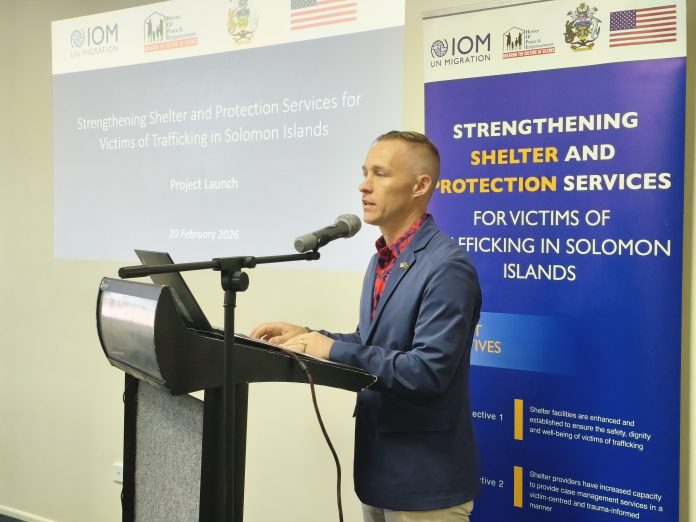
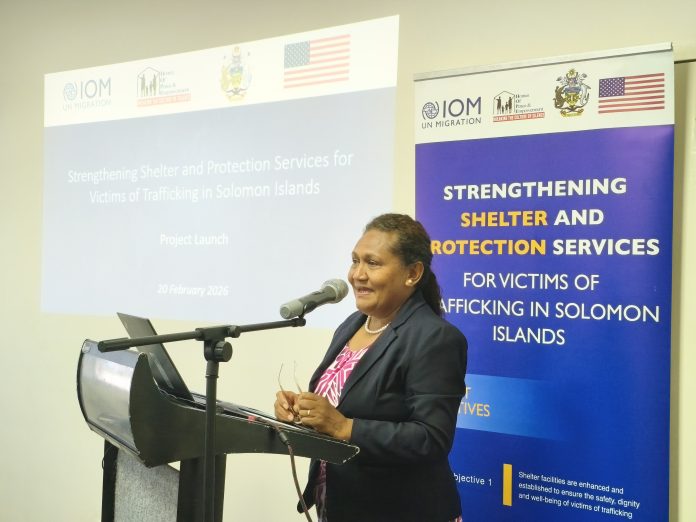
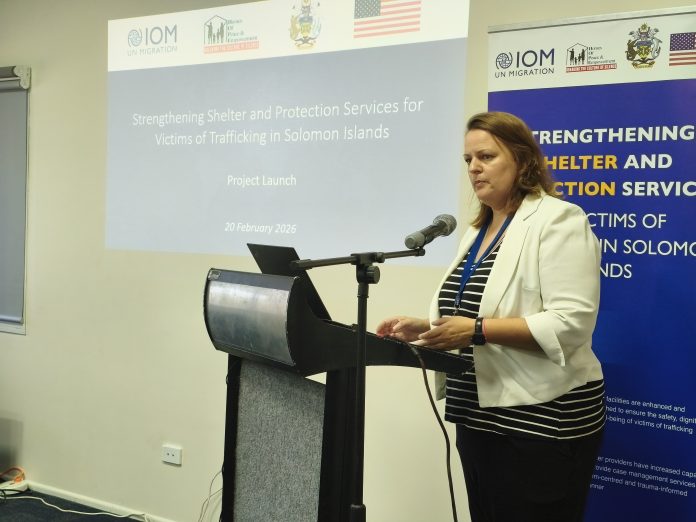
Nathalie Hanley, Programme Manager of IOM (International Organisation for Migration), Office in Solomon Islands spoke about this at the launch of the “Strengthening Shelter and Protection Services for Victims of Trafficking in Solomon Islands” Project at Heritage Park Hotel on Friday, February 20.
She said the crime of trafficking persons is a grave violation of human rights and often has serious and far-reaching consequences for those who are victimized.
“That harm is compounded when victims go unidentified or are unable to access essential protection services and longer-term support for their recovery and reintegration,” said Hanley.
Outlining the challenges in dealing with victims of trafficking in the country, she said in Solomon Islands, connecting identified victims of trafficking to specialized shelter and protection services is often challenging, partly due to the high demand for shelter services in-country.
Second to this, is that many victims of trafficking, most often women and girls are identified in remote and isolated communities.
“This exacerbates challenges in connecting victims to shelter and assisted services, which are predominantly located in Honiara or provincial capitals,” said Hanley.
She also said in cases where victims are able to receive assistance in temporary accommodation support, the challenge of constraints in funding invariably precludes them from receiving holistic social, psychosocial, and economic reintegration in a way that addresses pre-existing vulnerability factors.
Hanely said survivors deserve dignity, safety, and the chance to rebuild their lives, and this is what this project is for.
“Today’s launch signals a shared commitment to ensuring that every survivor who reaches out for help finds a system that is ready to respond,” she said.
Hanley said the project will help to strengthen that system in a number of ways, and it will be through the following channels.
– It will support the enhancement and establishment of shelter facilities that can ensure the safety, dignity, and well-being of survivors, not only in Honiara, but across all provinces
– It will further strengthen the capacity of shelter providers, case managers, and other support actors to provide victim-centred and trauma-informed protection services to survivors of human trafficking
– It will enable victims of trafficking to access sustainable reintegration support through the establishment of a dedicated direct assistance fund
The Programme Manager for IOM, in Solomon Islands said more importantly, work in this project will be grounded in partnership where government ministries, provincial authorities, civil society counterparts, faith-based organisations, and frontline officers all have a role to play.
She said the project does not exist in a vacuum and it builds on the foundations that have been laid through continued commitment and tireless work of shelter providers, case managers, social workers, counsellors, healthcare professionals, and other safety net stakeholders.
Hanley said the project acknowledges this and aims to support and strengthen their efforts.
She said as parallel programme initiatives in Solomon Islands are making strides to strengthen the country’s counter-trafficking legislation, to build the capacity of law enforcement to identify and refer victims, and to continue to support community outreach, engagement, and awareness-raising, it is expected that more victims will be identified and will be in need of support.
Hanley said as they move forward to implement the project, they will aim to keep those survivors at the centre of every decision and intervention.
Along that, they will also aim to be guided by the survivors’ experiences, to learn from their resilience and to ensure that the services extended to them truly meet their needs.
Hanley also took the opportunity, to acknowledge the US Department of State Office to Monitor and Combat Trafficking in Persons which is funding the project.
“I would also particularly like to thank and acknowledge our donor, the US Department of State Office to Monitor and Combat Trafficking in Persons, whose generous financial support is enabling us to implement this project and to sustainably strengthen protection and shelter services for all victims of trafficking identified in Solomon Islands, regardless of sex, age, or nationality.
“We are immensely grateful for the US’s funding support, as well as for the commitment and partnership that the Ministry of Women, Youth, Children, and Family Affairs and Health Trust, and all of you in the room today,” she said.
Hanley said they look forward to the work ahead and to the positive changes the project will bring to survivors of trafficking, to their communities and to the country as a whole.
For feedback, contact: [email protected]
Editor: [email protected]