Home Blog Page 1210

Overlooked slip-up?

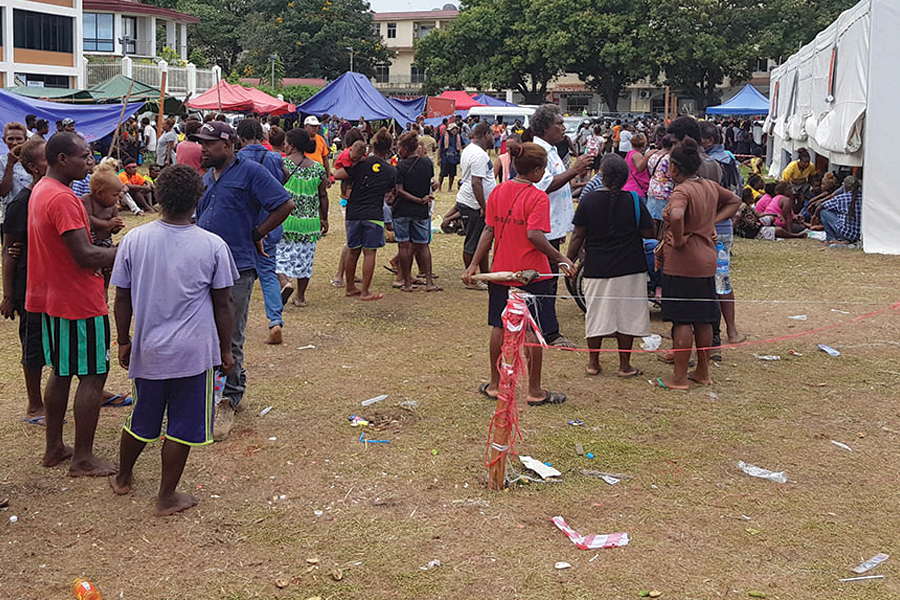
Registration ground at Town Ground.

Mothers and children suffer heat, lack of water & sanitation facilities at registration centre

BY GEORGINA KEKEA

THE lack of sanitation facilities have been raised by those frequenting the registration booths in Town Ground.

While the registration process is being carried out smoothly, mothers and the elderly have complained about the lack of water and sanitation facilities.

An electorate from Baegu/Asifola says it is disheartening to see mothers and their children bearing the heat to carry out their democratic right to vote.

He says the process is an important one for the country, but the government fails to meet the needs of the people.

He said most of the mothers have no choice but to bring their children with them to the registration centre.

“The Registration Officers (ROs) are outnumbered. How can you expect one person to meet the demand of more than a thousand electorates each day?

“Some electors have been here the whole day but still have not been able to get their names registered because there are so many people.”

The senior electorate from Baegu/Asifola says this is why a lot of people are seen to be camping in the Registration area.

He said most have been there since the registration process commences last week. However he said only two days last week was allocated for Baegu/Asifola.

“Registration for Baegu/Asifola should be carried out daily and not twice a week as has been seen last week.

“If we only have two days a week for us to come and do our registration, it will not be enough.”

He said a lot of those to be registered are mainly those that have just turned 18 and those that have decided to come back to Baegu/Asifola to vote.

Meanwhile another electorate from Baegu/Asifola also support the call for government to find a suitable location for such a process to be carried out.

“It does not look good on the government when people come for such an important activity in the country, but there is no proper water and sanitation facilities for them.

“This is a national issue. Government cannot leave people like this.”

He said government should at least provide sanitation facilities for the people.

He said the people have no choice but to wait in line for their turn to register.

Most times the need to visit the toilet seemed to be a setback for the electorates.

He said with the amount of people queuing for registration, he is also skeptical the process will be completed within the timeline allocated for this process.

“How on earth will we expect two computers to match the thousands of people here to register?

“I don’t know if the timeline provided for the registration process will be enough. There are so many people and not much workers and computers. Of course such facilities as water and sanitation must be provided for the people.”

Most of the people spoken to at the Registration centre are those that have decided to switch constituency.

Some are mainly there to support other electorates from their constituency to register.

Students and teachers share views on importance of literacy

0

BY ELLISON VAHI

AS a way forward to get jobs is to be able to read, write and use digital technologies.

“By addressing these issues now and learning throughout life, we will have a stronger SI for us, our children and our communities.”

Speaking with the paper, Mrs Sarah Houkura, a school teacher from Tuvaruhu said that a lot of students are lacking literate, thus with such a programme hosted is of a valuable, as it helps students to involve as well learn new ideas and knowledges about the importance of literacy, with especially writing and reading.

“Writing enables a person to put ideas into focus with more thought and clarity, because unlike speaking, we are able to take our time when stating what we want to communicate. We can be more selective in our choice of words as well considering the tone of the language we are using,” she said.

She adds, “helping someone to read and write effectively or acquire the basic math skills so many of us take for granted, improves the future of everyone in society. Literacy is also a critical to economic development as well as individual and community well-being.

“The need is to ensure that the workforce has a strong foundation in essential skills such as reading, writing, and working with digital technologies.”

Also speaking, Mr Prince Dan, a form 1 student said that, the hosting of the Literacy programme is an opportunity as he finds it interesting and as well he has learnt a lot more new information valuable towards their academic career.

John Hati, a form 2 students from Tanagai too said that, the programme is very interesting and whilst shared that it is very important as it helps them as well give an over view to the students on how important is them to be able to know how and improve in reading and writing.

In relation, Literacy is one of the most important skills when it comes to our personal growth, culture and development. It is even more important today because of how our economy and society are changing as around the world, governments, businesses and people are becoming more and more connected by digital technologies.

IFAN supports SPC safety of navigation project

0

BY ELLISON VAHI

WITH goals to create safer maritime routes, managed in accordance with international instruments and best practice in recognising that there is a scope for significant improvement in safety at sea, with respect of both international ferry and cruise activities, the Independent Financial Associates Network (IFAN) in support for the SPC is currently involved in an undertaking its support of a programme in the South Pacific, that was designed to improve the level of Aids to the Navigation services.

Initially presented to 13 targeted countries – Cook Islands, Kiribati, Federated States of Micronesia, Fiji, Marshall Islands, Niue, Nauru, Palau, Samoa, Solomon Islands, Tonga, Tuvalu and Vanuatu – at the Transport Officials Meeting held in Suva, Fiji in November 2015, the two-phase project was commenced in April 2016.

While Solomon Islands was chosen as the pilot country for this project, whilst, the in-country visits to the conducted with the accreditation process of SPC as Aids to Navigation Training Organisation is now in progress with the objective of delivering the Level 2 AToN manager course 2018.

In relation to, South Pacific Community (SPC) provides a regional resource of specialist technical expertise that will strengthens, or supplements, regional and the national capacity. It also designed and, with the support of IFAN, has started implementing the Safety of Navigation project, ultimately aiming to support the economic development of shipping and trade of Pacific Islands Countries and Territories (PICTs).

From the outset, the main challenge facing the project was identified as being the lack of awareness of the importance of Aids to Navigation systems in the target countries. In addition, limited capacity of managers and technicians and, in almost all countries, an absence of AToN policy and regulation to support process, procedures and resources were additional hurdles to be overcome. SPC is focusing on enhancing and raising awareness of sustainable development of AToNs through in-country visits and capacity-building programmes.

In the meanwhile, the agreement to fund Phase II and the allocation of resources to phase II was from the review of the 2016 planned activities which completed a 92.5 percent effective rate and hence, IFAN have approved based on the phase I reports.

Solomon Islands strengthens maritime safety

0

BY ELLISON VAHI

IN the face of rising maritime accidents in the Pacific region, Maritime stakeholders recently met to identify risks and hazards affecting Honiara port. Talks were centred on the need for more trainings to create a safer environment for ships operating costal island waters as well to identify the current and future needs for safety of Navigation (SoN). Provisions of aids to navigation services were also discussed.

Project Manager of the Pacific Safety of Navigation project, Francesca Pradelli, said that the maritime stakeholders meeting has provide an opportunity to hear local views and experiences on the risks and hazards of Honiara port.

“This will be invaluable information that SIMSA and SPC can use in developing options to mitigate these risks and increase the safety of navigation in Solomon Islands’ waters.” She said

She said “SPC’s Ocean and Maritime Programme, in partnership with SIMSA, will use this preliminary information to conduct a risk assessment of the Port of Honiara based upon the Simplified Risk Assessment method (SIRA) developed by the International Association of Marine Aids to Navigation and Lighthouse Authorities (IALA)”.

Meanwhile Manager of SIMSA Aids to Navigation, Mr Patrick Wamahe said the project has given an opportunity for stakeholders to have better ideas on safety of navigation approaches.

“The implementation of Phase 2 will bring clear benefits to the Solomon Islands economy.”

The project will also conduct risk assessments, develop legal frameworks for safety of navigation, and improve budgetary management.

Some of the Maritime hazards identified by stakeholders for the Honiara port includes the absence of lights and reflective materials on mooring buoys; and depth variation due to a river nearby.

Solomon Islands is one of the 13 targeted countries which has been responsive to the efforts of SPC’s Pacific Safety of Navigation project and has greatly seen clear safety improvements since the start of the project in 2016. The other 12 countries targeted under this project are: Cook Islands, Kiribati, Federated States of Micronesia, Marshall Islands, Nauru, Niue, Palau, Samoa, Tonga, Tokelau, Tuvalu and Vanuatu.

Stakeholders from the Solomon Islands Maritime Safety Administration (SIMSA), the Solomon Islands Women in Maritime Association, the Royal Solomon Islands Police Force’s Maritime Unit, private shipping companies, the Solomon Islands Ports Authority, the Ministry of Fisheries and Marine Resources and members of the media attended the meeting and contributed to discussions.

SPC Safety of Navigation Project phase 2 activities will continue in Kiribati and Vanuatu next month.

The one day workshop, this week was implemented by the Pacific Community (SPC) with support from the International Foundation for Aids to Navigation (IFAN) as part of the Pacific Safety of Navigation Project.

This was the first meeting of the sort held in the Pacific Island nation and hence, the meeting was part of the Pacific Community (SPC) Pacific Safety of Navigation Project, phase 2.

Togamana launches two new reports on ocean

0
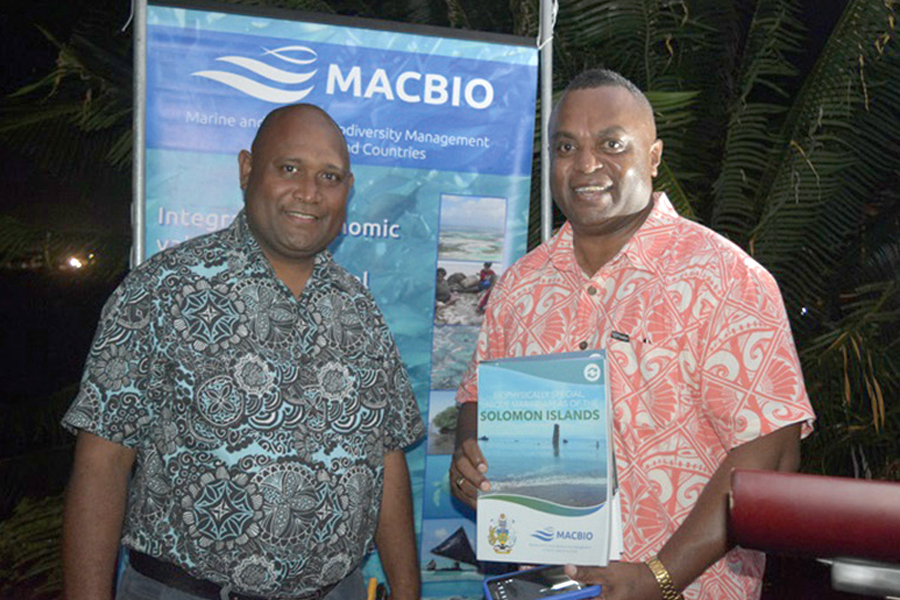
Minister Togamana and staff from the SPREP during the launching ceremony last week

BY LYNTON AARON FILIA

Minister Togamana and staff from the SPREP during the launching ceremony last week

MINISTER Dr Culwick Togamana has launched two key reports that will be set as building blocks for Solomon Islands Government’s commitment for delivery on integrated ocean management.

Last week, Minister for Environment, Climate Change, Disaster Management and Meteorology Dr Togamana launched two report documents compiled by MACBIO—Marine and Coastal Biodiversity Management in Pacific Island Countries.

The document is the country’s first report that shows 65 unique marine areas both inshore and offshore found by Solomon Islands’ marine expert.

The two reports are Special Unique Marine Area and Bioregion report.

With the Special Unique Marine Area report, Minister Togamana said it will be useful in making informed decisions about permit, coastal development, and environmental Impact assessments which is important for national marine planning.

He said government recognises the country’s marine environment that in February this year, it convened country’s marine expert to described entirety of Solomon’s MARINE environment from coast to outer bounds of exclusive economic zone.

The whole marine environment was divided into 26 deep water defined marine bioregions and 18 reef-associated bioregions, he said.

Besides is another report known as Bioregion, and this will allow Solomon Islands to improve its effort in complying with international commitments, Minister Togamana said.

He said crucial aspect about Bioregion report is it will encompasses government’s commitment on international issues such as ecologically representative network of marine protected areas as in the Convention on Biological Diversity.

Now, since the report is launched, Ocean 12 technical group will carry out wider consultation across the country as next step for developing a policy for Ocean.

“With these reports, final technical building blocks are in place for the country to start national discussion with all sectors, communities, traditional owners, industries and government’s all level,” he said.

He said the idea is how to spatially plan conflicting uses and values of Solomon Islands’ ocean can be better coordinated and managed.

Minister Tagamana on behalf of the SIG thanked the Ocean 12 technical working group and commended project partner MACBIO for successfully compiling the report.

Malaita province lauds its youths

0
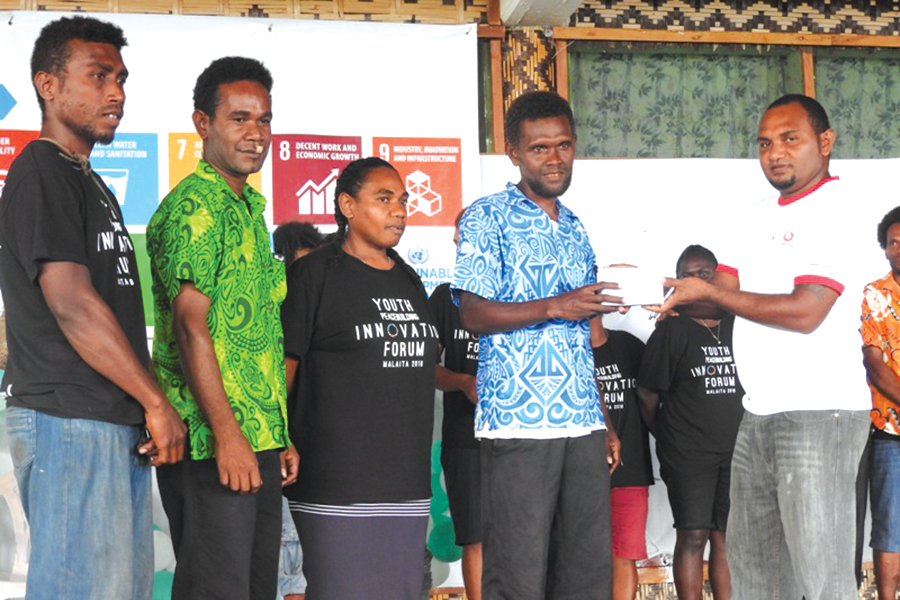
Officer form Bemobile presented gift to one of the project groups during the closing program on Sunday.

BY GEORGE MANFORD

AUKI

Officer form Bemobile presented gift to one of the project groups during the closing program on Sunday.

LAST week’s forum on peace building innovation for youths has allowed youths to be better informed on their important roles in communities.

Representing Malaita province during the closing ceremony of the youth peace building innovation forum last week deputy provincial secretary Mr Robert Wale congratulated the youths for their participation.

“I whole heartedly believe that during the last three days had been very exciting to all of the youths where it was full of speeches, dramas, presentations, testimonies and fun.

“The last three days of this forum had given all of us tools about being creative and innovative in our own settings.

“This forum had given us the opportunity to gain new insights, innovation, and an eye opener to recognise our personal viability of ventures into productivity for ourselves, your province and the nation as a whole.

“Undoubtedly the wealth of knowledge acquired or gained during these three days is useful to enable you (youths) to maximise your personality to make things happen in your life.

“I thanked UN peace building and UN women and UNDP for hosting such wonderful and auspicious youth innovation forum here in Auki, malaita province for the first time.

“The Malaita provincial government is really appreciative of this initiation to bring the forum down to our youth innovators in the province.

“What you have learnt here will rejuvenate you to become more industrious than before.

“Set your hearts and mind clear to be more innovative and creative where you will convert you to be a self starter and more productive youth and social entrepreneur.”

KOICA volunteers on 2-year mission in SI

0
KOICA staff receives two volunteers picture on center during their arrival last week—photo supply

BY LYNTON AARON FILIA

KOICA staff receives two volunteers picture on center during their arrival last week—photo supply

KOREA International Cooperation Agency (KOICA) in Solomon Islands has received its dispatched volunteers to work at Don Bosco training centre and Solomon Islands National University (SINU), last week.

KOICA staffs last week welcomed two additional volunteers who will serve in Honiara as teachers for two years.

The two volunteers are Mrs Hyuna and Mr Dong sok – fifth batch of KOICA volunteers here in Solomon Islands.

According to KOICA, Mrs Hyuna will be working at Don Bosco training center as textile teacher and Mr Dong sok will serve at SINU Institution of Tourism and Hospitality.

Currently, both have undergone two month In – Country Adaption Training Programme started last week on September 5 – October 29.

It said after completing two month on In-Country Adaption Training Programme, both volunteers will dispatch to their respective designated host organisation starting October 30.

KOICA said, “Through their willingness and capacity to serve in Solomon Islands, they are now ready to share their experience, knowledge and skills to their designated Institution.”

Whilst in Honiara, two volunteers are enjoying country’s wonderful life and took time site seeing around the capital.

Regarding their work, KOICA said office is looking forward to their voluntary contribution to each organisation.

Huge problem needing immediate attention

0

DEAR EDITOR, the seemingly intractable problem of youth unemployment in the Solomon Islands must be resolved quickly and by all means possible.

Next year the Solomon Islands will have a general election and whichever political party or coalition of parties forms the new administration one of the greatest challenges for the government, as I see it, will be to effectively address the seemingly intractable problem of youth unemployment, but how?

The Former Prime Minister of New Zealand, Helen Clark, is one of the latest to say that the issue of youth unemployment in the Solomon Islands is a potential time bomb.

An editorial piece in the Solomon Star following the successful Melanesian Arts and Cultural Festival gave a similar stark warning.

Writing in the Solomon Times on Line publication in 2014, I said:

“The seemingly intractable problems associated with youth unemployment in Honiara and the resulting evidence of increased substance abuse, including the growing and use of marijuana, the consumption of kwaso (home brew), incidences of anti-social behaviour and criminal acts have featured significantly in Editorial columns of the local press and in other articles this past week.

“Honiara isn’t alone in facing the problems highlighted and, indeed, it can be said many of the Pacific states face the same, if not more serious, issues arising from the respective nation’s ability to manage development and provide for the rapidly growing population. The Solomon Islands is no exception.

“The various schemes implemented by the government, such as the rapid employment scheme and the offshore, seasonal work offered to young people engaged in fruit harvesting simply isn’t enough to meet the needs and expectations of the growing numbers of school drop outs and idle youth flooding into the national capital from the provinces.

“I am not alone in describing the current situation as a security challenge akin to a ticking time bomb, although I likened the situation of the unemployed youth in 2009 to a tinder box. (See my letter to the Pacific Islands Report entitled, ‘Idle Solomons Youth a Tinder Box’, published on 10 December 2009)”.

In the same article I suggested that the then SIG re-examine the findings and projected solutions to youth unemployment in the excellent report styled, ‘The State of Pacific Youth – 2005’ written under the support of the United Nations Children’s Fund (UNICEF Pacific) and funded by the New Zealand’s International Aid and Development Agency (NZAID.

My recommendation, if followed, might not have proved helpful for in the subsequent report of the same name in released in 2011 the conclusion was that nothing much had changed and youth unemployment continued to be a substantial challenge in Pacific countries.

In the last few days the Prime Minister, the Hon. Rick Hou, signed a Memorandum of Understanding with the Australian Minister of Foreign Affairs and Trade, Senator Marise Payne, on a Labour Mobility Scheme

The idea of the scheme will possible provide Solomon Islanders with the opportunity to gain valuable skills and income while assisting businesses in rural and regional Australia.

A similar kind of scheme already exists with New Zealand allowing for Solomon Islanders to participate in fruit harvesting.

While greatly appreciative of the help offered by Australia, New Zealand and all the other players, locally, including Youth@Work, few have been taken to scale to address the demand that exists.

The successor to the ‘State of Pacific Youth’ reports that I have referred to has been the development of a Pacific Youth Development Framework 2014-2023. This is said to be a coordinated approach to youth-centred development in the Pacific, prepared by the Social Development Division of the Secretariat of the Pacific Community in Suva, Fiji.

Having read through the lengthy Framework over the last couple of days and studied the contents carefully, and without wishing to be critical, I very much hope the development guidance offered will help to ease the growing and worrying state of youth unemployment in Solomon Islands and in the neighbouring Pacific region.

When I consider the continuing widening gap between the country’s population and its ability to economically sustain its people with a recurring declining economy prompt-up by substantial donor aid and a continuing inadequate education system, I do concern myself greatly for the job prospects of the burgeoning Solomon Islands youth.

As an outsider one might legitimately pose the question of me as to why I care.

I can give several reasons apart from having an ongoing interest in the welfare, health and livelihoods of the people of the Solomon Islands.

When I left school, now many years ago, I too faced the long-term prospect of unemployment in Britain, but my situation was resolved by being conscripted into National Service in 1959.

After the Second World War (1939-45), the young men of Britain were called upon to meet new challenges in a rapidly changing world.

National Service, a standardized form of peacetime conscription was introduced in 1947 for all able-bodied men between the ages of 18 and 30 to undertake 2 years of military service.

National Service gave me the means of overseas travel, opportunities for further education and led to employment after finishing my military engagement.

I have a very much more personal reason, however, for concerning myself about the numbers of unemployed young people in the Solomon Islands.

In 1998, when serving as the Commissioner of Police in the Solomon Islands I accurately provided the intelligence to forecast the early occurrences which was to lead to the tragedy of the ethnic tension years.

My report and advice, including help for the local police force, and then weakened substantially by years of neglect by successive governments, went unheeded at home and regionally.

What followed was an unprecedented ethnic tension from 1999 resulting in armed conflict with militia groups and ultimately resulted in the late intervention of the Regional Assistance Mission to the Solomon Islands (RAMSI) in 2003.

In the intervening period from 1999 to 2003, the dreadful and tragic ethnic trouble caused serious economic, social and political disruptions and loss of lives and property.

The conflict also negated the programme of important structural reforms that had been initiated by the Solomon Islands Alliance for Change Government (SIAC) in 1997.

The strife consequently used up valuable resources that would have otherwise have gone to improving basic service delivery, education and educational reform.

Taking many years to get the economy back on track to its pre-ethnic crisis helped to rob the youth of potential job opportunities.

A National Youth Policy was unveiled in 2000 in order to promote youth development but it appeared to fail in meeting it’s outlined key strategic challenges, perhaps because of funding shortages or the economic and political weaknesses that lingered after the onset of the ethnic tension.

In 2018, I see, with few exceptions today’s young people are floundering. They are uncertain about what they want to do with their lives. They need a structured opportunity that will allow them to feel needed and capable and, above all, they need paying jobs.

It will be for the Solomon Islands Government to try and provide the work opportunities the youth of the country greatly and urgently need.

I truly hope to see such happen before the predicted social consequences that have been foreseen really do occur.

Yours sincerely

Frank Short

Improving financing and capacity building to counter the threat of climate change in SI

0

DEAR EDITOR, tens of thousands rallied across the world over the weekend, including in New Zealand, Australia, the United Kingdom, France and the United States in a rebuke of the dismissal of climate science and a call for action on climate change.

While the Solomon Islands remains committed to the Paris Agreement it must not remain silent and continue to work diligently to improve the means of implementation by improving financing and capacity building in order to counter the increasing threat of climate change in the country, especially when witnessed in coastal areas already seeing sea water intrusion and loss of cultivable land.

Evidence of the Solomon Islands Government efforts to improve financing and capacity building was apparent in early June this year when the World Bank approved a project to reduce reliance on fossil fuels and to ensure more than 9,300 Solomon Islanders would benefit from new of improved electricity services, including renewable energy sources such as solar.

Further evidence of the SIG’s ongoing efforts to develop renewable energy sources came last week in Nauru.

The Solomon Islands Prime Minister, Rick Hou, met with Norway’s International Development Minister, Nikolai Astrup, at the Pacific Islands Forum leaders’ summit and the PM was told Norway wanted to help the Solomon Islands develop its renewable energy resources.

In thanking Mr Astrup, Prime Minister Hou also reportedly thanked Norway for its significant contribution to the Green Climate Fund, to which it is providing more than US$270 million over four years.

It is believed that part of that fund has already gone to the Tina Hydro Project.

It is seen as vitally important for the Solomon Islands Government to do everything possible to mitigate the effects of climate change and help from regional partners, the World Bank and friends like Norway will have gone some way to satisfying citizens that some positive steps are being taken to aid capacity building and reduce the need for the importation and use of costly fossil fuels.

Yours sincerely

Frank Short

Delayed delivery of beds and wheel chairs

0

DEAR EDITOR, the promised freightage of 100 hospital beds and some 30 wheel chairs for delivery to the Solomon Islands Ministry of Health and Medical Services has been further delayed because the hospital beds are still to be released by the Wellington Hospital in New Zealand pending the delivery of replacement hospital beds for the hospital.

I am led to understand, however, by ‘Take My Hands’ by partner charity organization in Auckland, that at least the first of two forty foot containers with 50 hospital beds and the wheel chairs will be shipped from New Zealand on or about the 29 September 2018.

The medical authorities at the NRH have been made aware of the delay.

The Solomon Islands Forest Association (SFA) previously donated more than $US11,000 for the shipment of the two forty foot containers in order to aid the NRH and two provincial hospitals with the much needed hospital beds.

Yours sincerely

Frank Short