BY LORETTA B MANELE
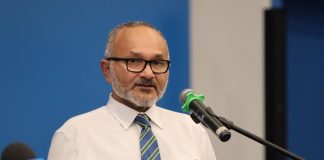
Dr Transform Aqorau, SINU’s Vice Chancellor gave an account of how we should see Solomon Islands in the next 5 to 10 years.
Delivering his “New Academic Year Opening Address” earlier this month, he spoke about the kind of society we should strive for in the future.
“I believe that we all share dreams for our country, dreams that transcend politics or problems, rooted in the desires of our people.
“Let me paint a picture of the Solomon Islands we strive to build in the next five to ten years,” he said.
Educated and empowered citizens
Aqorau firstly touched on education in which he said we want a country where every child, boy or girl in town or in the remotest village has access to quality education and the opportunity to realise their full potential.
He said in 5 to 10 years, we envision significantly higher literacy rates and more of our youth gaining advanced skills and qualifications.
Aqorau highlighted that an educated society is a confident and innovative society.
“We want our classrooms to produce not just job seekers but job creators and problem solvers.
“We want our people to be informed citizens, able to engage in national discourse and exercise their rights and responsibilities wisely,” he said.
Resilient and sustainable economy and environment
Aqorau said we want a Solomon Islands that is more self-reliant economically, tapping into the creativity of entrepreneurs and the richness of our natural resources in a sustainable way.
He said in a decade, let us see a more diversified economy where sectors like agriculture, fisheries, tourism and creative industries thrive alongside responsible mining and forestry.
Aqorau also said that we aim for communities that have embraced sustainable practices, ensuring that development does not come at the cost of our environment.
To add on, he said we envision investing in renewable energy, solar, hydro, perhaps even geothermal, to reduce our dependence on imported fuels and to reach rural areas with electricity.
Aqorau said in this future, Solomon Islands should also have stronger infrastructure, reliable transport linking our islands and reliable internet linking us to the world.
He also shed light on climate resilience.
“Crucially, we see a country leading in climate resilience with sea walls protecting vulnerable villages, climate-smart agriculture ensuring food security and emergency response systems that safeguard our people from disaster.
“We want our children to inherit an environment that is not depleted but nurtured. Oh, how we long for these things as our people out in the western journey are struggling at the moment with their values of safety and wellness,” he voiced.
A unified and inclusive Solomon Islands
Aqorau said we are proud of our cultural and linguistic diversity stretching from the clans of Makira, from our Polynesian outliers to our Polynesian and non-Polynesian heritage.
“And in a decade, we hope to see even greater cohesion and mutual understanding among our people,” he said.
Equal opportunity
Aqorau said we also seek a society that offers equal opportunity; one in which women participate fully in, where all citizens have fair access to jobs and services, and where corruption has no place.
“This means strengthening our institutions, demanding accountability from our leaders and ourselves, and living to the ideal of the leaders we serve.
“And if we are to achieve this, the Solomon Islands of 2030 will shine as a model of ethical leadership and social harmony,” he said.
In further remarks, Aqorau said most importantly, the Solomon Islands we want is one that remains grounded in our timeless language.
“We are a deeply spiritual nation.
“Our faith in God has carried us through hardships and it will continue to guide us,” he said.
Addressing the university’s students and staff, stakeholders, government representatives, Aqorau said we must remain a caring society where we look after our wanderers, respect our elders and nurture our youth.
“We must hold on to humility and hard work, traits our village life has taught us,” he said.
Photo credit: Loretta B Manele
For feedback, contact: [email protected]
Editor: [email protected]