Home Blog Page 579

PM CLARIFIES ABSENCE

0
Sogavare. Photo credit- MAVIS PODOKOLO

Sogavare explains his non-attendance at the PIF leaders meeting with US President

BY JENNIFER KUSAPA

PRIME Minister Manasseh Sogavare has clarified why he is unable to attend the Pacific Leaders’ Summit between the United States and Pacific Island nations.

He indicated that he had pressing national priorities to address in the Solomon Islands and, therefore Minister of the Foreign Affairs is in Washington at that meeting with the US President,

“We are still represented at that meeting”, Sogavare said

During a press conference held upon his arrival at the International Airport yesterday afternoon, Prime Minister Sogavare cited the time-sensitive nature of the situation, noting that Parliament had only 10 weeks left to deliberate on crucial legislative bills. As the leader of the Solomon Islands, he emphasized the need to prioritize domestic matters over international meetings.

“I have previously attended such meetings last year, and unfortunately, we did not witness any tangible outcomes. I am not inclined to participate merely to be lectured,” stated Sogavare firmly.

He urged the international community to reevaluate their approach in dealing with Pacific leaders and suggested that a change in strategy was necessary.

Sogavare further highlighted a disparity in how these meetings were structured, expressing dissatisfaction with the limited three-minute speaking slots provided to leaders.

He noted that the bulk of the meetings was often dominated by lengthy lectures from them, He referenced last year’s promise of $800 billion dollars, which had yet to materialize, as an example of the lack of follow-through on commitments.

“It’s essential to acknowledge the distinct treatment accorded to leaders by various countries. When I engage with nations like Australia, Korea, and China, they allocate an hour for bilateral discussions and treat us with the respect deserving of leaders,” stated Sogavare.

He emphasized that Pacific leaders should not be subjected to condescending lectures akin to a classroom setting.

Recently, the United States expressed disappointment over Prime Minister Sogavare’s decision to abstain from the special PIF Summit.

ENDS//

Top of Form

MPG to host IPSAS in Auki

0

BY SAMIE WAIKORI

AUKI

MALAITA provincial government will be hosting the International Public Standard Accounting System (IPSAS) training in Auki from 2nd – 13th October.

The training will be supported by national government and attend by reps from nine provincial governments in the country.

In a brief statement from MPG, the training aims at capacitating participants on IPSAS – a system in which the national government has been using in managing public funds.

They said the mission of the training is for the participants to learn and understand IPSAS and apply the system in managing public funds in the provincial level.

MPG said this is so that a similar system is use by both the national and provincial governments in managing public fund.

They said the benefit of IPSAS is that it’s easy to monitor and produce financial report on the disbursement of government fund.

MPG is happy and acknowledged national government and other stakeholders for supporting the capacity training.

They said the training will improve performances of provincial governments to be on the same note with national government on management of fund.

MPG said monitoring of public funds is a challenge responsible office within provincial governments have been facing on how to do proper financial recording or report.

They said the training will be a milestone and Malaita province together with other provincial governments are looking forward to it.

Also, MPG uttered its gratitude to host provincial reps to Auki for the training.

SI hosts 4th annual MIOP regional workshop on personal excellence

0
PNG High Commissioner to Solomon Islands, His Excellency Moses Kaul with members of the Melanesian Institute of Office Professionals (MIOP) currently in Honiara for their 4th Regional Workshop.

By EDDIE OSIFELO

SOLOMON Islands played host to the 4th Annual Regional Workshop for the Melanesian Institute of Office Professionals (MIOP) this week, bringing together about 35 women professionals from Papua New Guinea (PNG).

The workshop, held in Honiara, featured the theme ‘Pursuing Personal Excellence.’

Welcoming the participants during a reception on Monday night, PNG’s High Commissioner to Solomon Islands, His Excellency Moses Kaul, emphasized that the workshop’s theme encapsulates the dreams and aspirations of professionals in the office domain to excel in their careers and achieve success.

He stressed that setting and striving toward specific goals and objectives is essential for personal and professional achievement.

His Excellency Kaul also highlighted MIOP’s overarching motto, ‘Bridging Your Career Path,’ commending the institute for its vital role in providing ongoing training and development opportunities and creating career pathways for professionals in PNG and South Pacific countries.

He emphasized the significance of collaboration and networking among office professionals across Melanesia and the broader Pacific region in developing human capital.

“Our people are our greatest assets, and identifying and developing their potential through training is crucial,” Kaul remarked.

MIOP’s core objective is to enhance individual skills and abilities, preparing a more resilient and informed workforce with a vision for their countries and the Pacific region’s shared identity as proud Melanesians.

High Commissioner Kaul issued a challenge to all professionals and career officers to remain dedicated to their duty, as commitment to their profession opens doors to opportunities and career advancement.

Weka Ralph Avosa, the National President of MIOP, expressed hope that one or two Solomon Islanders would participate in their future workshops.

She emphasized MIOP’s goal to connect with like-minded office professionals within the Melanesian Spearhead Group (MSG) countries, including the Solomon Islands, Fiji, and Papua New Guinea, and to extend assistance to overseas participants.

MIOP has a history of successfully organizing annual workshops, with the first held in Fiji in 2018, followed by workshops in Kokopo and Daru, PNG.

The institute boasts over a hundred members, but currently, only 75 are active participants in its activities.

The 4th Annual Regional Workshop for MIOP in the Solomon Islands concluded on Friday, fostering professional development and networking among women professionals from Papua New Guinea and the Melanesian region.

Magistrate hears case of man accused of stealing a mobile phone

0

BY ROMINAH FAKA

MAGISTRATE Emily Z Vagibule Pakoa hears the case involving Jeremy Konofilia a co-accused who charged for wrongful taking someone’s property yesterday at the Central Magistrate court.

The hearing was for the defendant to take his plead however, defendant Konofilia was not present in court thus, his lawyer seeks the court for his client to be excused during the hearing yesterday as his client was a sick patient.

Defence counsel besides told the court that, prosecutions are yet to provide relevant documents between the parties. Court than instructed the police prosecution present yesterday to provide the disclosures to the defence counsel. Thus, disclosures has been served to the defence counsel yesterday in court.

Court summons the defendant to be appeared in court on his next court hearing.

Court adjourned to October 17, 2023 at 9 am for mention.

Police alleged on December 3, 2022 at around 7am complainant and her friend was sitting inside defendant Jeremy’s lodge at White River.

While the complainant and her friend were still at Jeremy’s lodge, he asks the complainant to use her mobile phone, she agrees and gave him her phone.

Later that same day complainant aunty went and asks for the mobile phone. She was informed by the complainant friend who used the said mobile that, the mobile phone was taken by Jeremy the defendant while he was sleeping inside his lodge.

Complainant went and made her complain official at White River Police Station. Police investigated the matter and arrest the defendant on the 9th of December 2022.

On the next day police interviewed defendant Jeremy, he admitted that he took the mobile phone from the complainant friend while he was sleeping inside his lodge and sold it.

The said phone is a Samsung A03 model cost $ 1,500-00.

Police Prosecution appears for the Crown and PSO appears for the defence.

Man charged for domestic violence appears in court

0

BY ROMINAH FAKA

Man arrested for domestic violence appears in court yesterday for mention.

Defendant Ishmael Renton was charged with three counts of Domestic Violence-Psychological Abuse and Economical abuse.

Police prosecution told the court, the case was a fresh matter and defendant presents in court however, he is still without a lawyer to represent him in the court.

Court extended the police bail for the defendant and asks the defendant to seek a lawyer at Public Solicitor Office to represent his matter in court.

Court adjourned to October 17, 2023 at 9 am for mention. Meanwhile prosecution to prepare the disclosures and defendant to confirm to court his lawyer on the next case hearing.

Police alleged on unknown date between the 1st and 31 of August 2022 at Mud Land, Zion Renton did psychologically abused the complainant by doing a conduct that humiliated and insulted the complainant.

Again on unknown date between 1 and 31 of July, 2023 at Mud Land, Zion defendant Renton psychologically abused same complainant by doing a conduct that humiliated him and insulted him whilst holding onto a 24inch bush knife and a steel rod and strike the copper used as fence of their compound.

Later on August 12, 2023 at same location Mud Lack, Zion defendant did economically abused Complainant by damaging his properties that include kitchen, copper, tank and wall of their dwelling house.

Police Prosecution Department appears for the Crown.

Former government employee questions termination amid post-emergency covid-19 Era

0
Corona

BY JENNIFER KUSAPA

A former government employee, compelled to resign due to non-compliance with vaccination requirements, has raised important questions regarding the government’s strategy for those who were released from work.

This inquiry arises in the context of the State of Emergency having concluded, and society adapting to coexisting with COVID-19.

The former employee has observed that neighboring countries in the region have reinstated their workers who faced similar circumstances.

It’s crucial to note that some of the terminated employees held key positions within the government, and there should be a viable pathway to reintegrate them into their previous roles. The treatment they have received appears to overstep upon their rights, and the government should address these concerns, Former government employee stated.

Island Sun reached out to the Ministry of Public Service seeking clarification on this matter but was unable to secure a response.

The “no jab, no job” policy was enforced during the State of Public Emergency, which was declared by the World Health Organization in 2021 at the peak of the COVID-19 pandemic.

During this period, the government issued directives mandating that all public servants, both at the central and provincial levels, as well as staff members of state-owned enterprises (SOEs) and other government entities and subsidiaries, must receive their initial COVID-19 vaccine dose by August 31, 2021, and their second doses by November 30, 2021.

Public servants were explicitly informed that failing to receive their first dose of the COVID-19 vaccine by August 31, 2021, would result in their inability to access their workplace starting from September 1, 2021. Furthermore, any employee who remained unvaccinated by November 30, 2021, would be considered to have voluntarily terminated their employment.

Alarming lack of proper toilet facilities revealed in the 2019 Census Report

0

BY JENNIFER KUSAPA

THE 2019 Census report has brought to light a concerning issue that a significant percentage of households in rural areas lack access to proper toilet facilities or have none at all.

The findings stated that close to half of all households find themselves without access to toilets, resorting to open defecation practices, while others make use of unhygienic toilet facilities.

This alarming situation underscores the urgent need for health awareness programs and assistance in the introduction and improvement of toilet facilities.

Honiara recorded more than half of the households (59%) that had access to flash toilets.

The 2019 Census report has unveiled a stark reality that demands immediate attention.

 A high proportion of households across the nation are grappling with inadequate sanitation facilities. Close examination of the data reveals that nearly 50% of households are without proper toilets, forcing them to resort to open defecation practices. This not only raises grave health concerns but also highlights a glaring lack of basic sanitation infrastructure in many communities.

The need for a comprehensive approach to address this pressing issue cannot be overstated.

The 2019 Census report serves as a stark reminder of the work that lies ahead, but it also presents an opportunity for positive change. Let us take action now to address this pressing issue and improve the quality of life for countless individuals and families across the nation.

Local academic says indigenous wisdom could unify communities

0
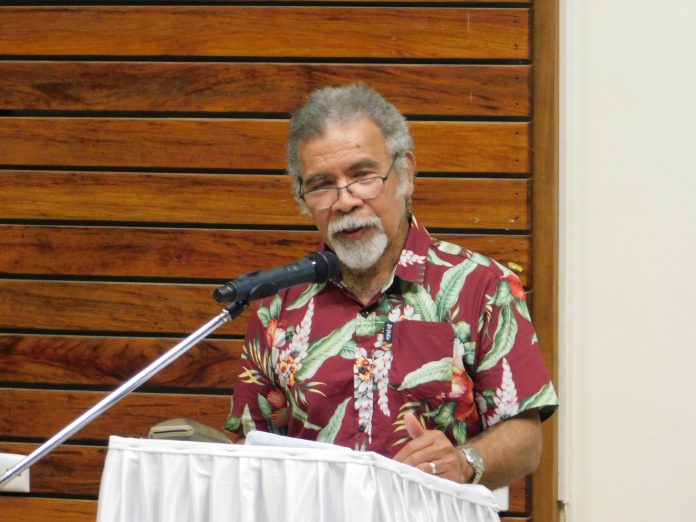
Dr. Kabini Sanga.

BY INDY MAEALASIA

A senior local academic said indigenous wisdom and knowledge could contribute towards building unity among communities in this modern times.

 Associated Professor from the Victoria University of Wellington in New Zealand, Dr. Kabini Sanga shared his insights during a tok stori session held at the Solomon Islands National University (SINU) Kukum Campus yesterday.

To support his insights, Dr. Sanga hailing from Ngongosila Island in East Malaita drew from his personal experience in his native island and his research on “Labu”, a secured place in traditional times where people can seek refuge and assistance.

He spoke on how the “Labu” as a physical place that promotes peace, considered sacred and where leaders put the needs and concerns of people as a top priority.

Speaking on this example of the “Labu” Dr. Sanga said Solomon Islanders can look into their traditional context and adopt these qualities to help us create a secure space where all communities can live peacefully together.

He added we usually use our rich diversity and traditional context as excuses preventing us to recognise our abilities to deal with most of our own internal problems. Dr Sanga said nowadays we assume that most of our problems can only be solved by looking outside without realising we do have the power and capabilities ingrained within ourselves to solve our own problems.

Public outcry sparks urgent reevaluation of CDF’s resource distribution

0

BY JENNIFER KUSAPA

THE recently launched 2019 Census report has uncovered a concerning issue plaguing the Constituency Development Fund (CDF) – doubts about its ability to ensure the fair distribution of resources.

Shockingly, a significant 35.0 percent of households have reported a negative impact, prompting a pressing need for action to address these concerns.

The 2019 Census data has underscored the imperative need to address and mitigate the negative perceptions surrounding the CDF. It is evident that, moving forward, the CDF must play a more constructive role in ensuring equitable resource distribution. An overwhelming 32.7 percent of households have voiced their desire for improved governance to take center stage in the management of CDF funds.

Moreover, the census data has unveiled a remarkable statistic – an enormous 98.9 percent of households in the Solomon Islands are now well-acquainted with the CDF. This surge in public awareness reflects a growing interest in this initiative that spans across provinces.

The report has also exposed a concerning reality; a significant 64.2 percent of households believe that the CDF has had no tangible positive impact on their livelihoods. This unsettling revelation underscores the pressing need for extensive efforts to reshape public perceptions and attitudes regarding the CDF’s potential to contribute positively to society.

Therefore, addressing the concerns surrounding the equitable distribution of resources through the CDF has become an urgent priority. While public awareness stands at an all-time high, the skepticism surrounding its impact on livelihoods demands immediate attention. A new course of action must emphasize the importance of good governance and actively demonstrate the tangible benefits that the CDF can deliver.

2019 Census report also highlighted that CDF stands at a crossroads, facing intense scrutiny and public demand for reform, and it is a need for authorities to rebuild trust and redefine the CDF’s impact, ensuring that it fulfills its promise of delivering equitable resource distribution and positive change for the people of the Solomon Islands.

POOR IMPACT

0

CDF has no positive influence on people’s livelihood according to households in the Solomon Islands

THE Constituency Development Fund, CDF, established in the country since 2013 has no positive impact, according to 64.2% of the households in Solomon Islands.

Of all the households that were aware of the CDF, the majority said there was no positive impact while a third (35.8%) of them stated that the CDF assistance had a positive impact (direct or indirect) on their livelihoods.

These findings were captured in the recently released 2019 Census report, and suggests that more work needs to be done in changing perceptions and attitudes of the people about the positive contributions of the CDF.

The main issues of negative perceptions of the CDF was the unfair distribution of resources (36%), followed closely with issues categorized under other/none (no negative impact) (34.7%).

Other key negative perceptions included the lack of good governance (12.8%), abuse of funds (5.9%), and dependency mentality/culture (4.8%). 

Nearly all households (98.9%) in Solomon Islands were aware of the CDF. This was evident among all provinces with the majority of households concentrated in Malaita (22.7%) and Guadalcanal (21.6%) – and comprising the majority of rural households (69.0%) compared to urban households (31.0%).

However, within urban and rural areas respectively, a higher proportion (78.7%) of urban households were of the view that the CDF did not have a positive impact on them compared to 59.3% of rural households.

The main areas of positive CDF development assistance on households were highest in assistance for housing materials (19%), followed by supply of energy/solar (12%).

Malaita, Guadalcanal, and Western province were impacted more from both the supply of housing materials and energy/solar supplies.

Both Malaita and Guadalcanal households were impacted more by all main areas of CDF assistance except for water/sanitation that had more impact amongst Western households and education support amongst households in Honiara.

It was also evident that of all the households that were aware of the CDF, the majority (85%) in rural areas had a positive view of the impact of CDF assistance.

When asked about how households viewed the future management and use of CDF, the majority (32.7%) stated that improvement of good governance (e.g., accountability, transparency, free of abuse and corruption, etc) was a concern that should be considered as part of the management process of future CDF assistances. This view was supported by the majority of households from Western (23.0%), Malaita (19.2%), Guadalcanal (18.3%) and Honiara (13.3%).

The second important concern related to prosecuting of corrupt officials (21.1%) and improving coordination (15.2%) of CDF assistances.

The former perception was mainly supported by households from Malaita (51.6%), Makira-Ulawa (15.8%) and Guadalcanal (12.0%). Improving coordination of CDF support was most popular amongst the Honiara households (44.5%).

In all the views for future management and use of CDF assistance, rural households have expressed the majority of all views. 

The overall impact (positive and negative) of the CDF development assistance on household livelihoods revealed key findings that should be able to inform decision making, planning and policy formulation especially in relation to the delivery of the CDF development assistance in rural areas.

–SINSO PRESS