Home Blog Page 509

VATA helps locals with value added timber product

0
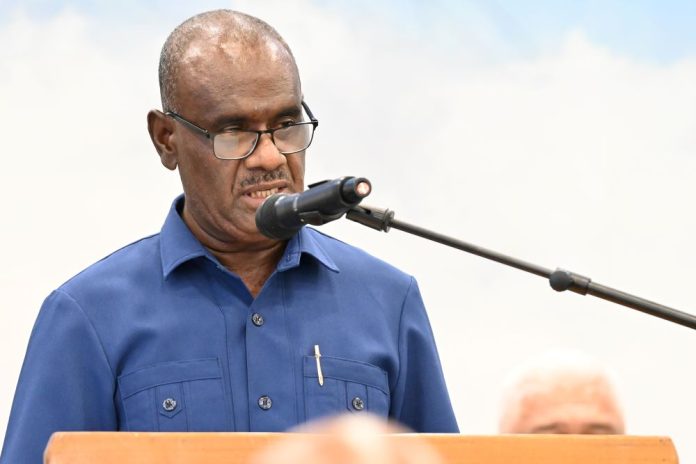
PM Manele

BY SAMIE WAIKORI

The government through Ministry of Forest and Research (MRF) is implementing downstream processing for wood/timber in the country.

This is through the establishment of the Value Added Timber Association by MFR that aims at encouraging and supporting local entrepreneurs in the forestry and timber industry.

Prime Minister Jeremiah Manele recently said in Auki that VATA has been supporting locals across the country and more than 45 percent of its financial members are from Malaita province.

He said according to VATA, most of its sawn timbers received in the recent years came from Malaita province.

Manele also said that apart from VATA’s timber yards in Honiara and Noro, the MFR is planning to establish one in Malaita province in the coming years.

“The program has over the years continued to assist timber producers from provinces through freight subsidies, provisions of mails and chainsaws.

“Also technical capacities, marketing and certification to ensure timber products meet international market standards,” he said.

The program is part of national government’s efforts to work with communities and resource owners toward reforestation and importantly to benefit from valued added forest/timber product.

PTC for NRH compound murder yet to be settled

0

BY ROMINAH FAKA

The Pre-Trial-Conference (PTC) for the case against Micheal Sodu and Philip Mamuala, charged with murdering a man at the National Referral Hospital (NRH) in November 2023 is yet to be finalised.

Prosecution yesterday informed court they had served PTC documents to defence on Tuesday this week.

Defence sought the court time to allow them to look through the PTC documents.

Court adjourned for September 12 for mention. Counsels to settle the PTC during the course of adjournment.

Micheal Sodu and Philip Mamuala are charged jointly with one count of murder and both pleaded not guilty.

The matter was committed to the High Court for the two defendants to stand trial.

The two accused are facing an allegation that occurred on November 2, 2023 at the NRH Compound.

Around 11am that day, the 43-year-old deceased went to the Mental Health Unit.

It is said the deceased normally visits the Mental Health Unit because he suffered from a mental illness.

Prosecution further alleged that the deceased later went to the sea-front market located at the Hospital compound where he aggressively reacted to the people who were there and started chasing them.

He also allegedly threw stones.

This was continued until the afternoon when Sodu allegedly attacked the deceased. Sodu stopped assaulting the deceased after he was told that the deceased was a mentally-ill person.

Later, when the deceased was lying down at the market area, the accused Mamuala went and attacked him, and Sodu also joined in the attack.

The deceased tried to defend himself from both men but was unfortunately not able to do because he was lying down.

He tried to sit up but then fell back and struggled to breathe and unfortunately died on the spot.

DPP appears for Crown and PSO appears for defence.

31 SCHOLARSHIP RECIPIENTS

0
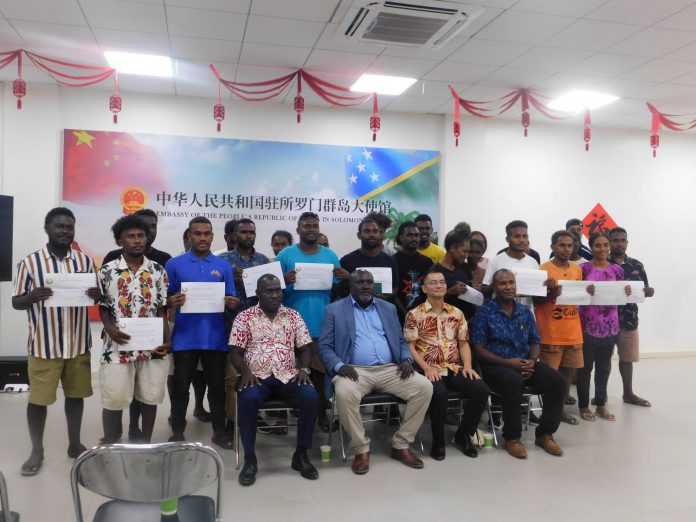
Chinese Scholarship recipients with SI Ambassador to China HE Barret Salato(left from front row)Minister of Education Hon Tozen Leokana, Charge d' Affaires Ding Yonghua.Photo supplied.

Chinese scholarship recipients set to commence studies

BY INDY MAEALASIA

THE Embassy of the People’s Republic of China in the Solomon Islands has hosted a farewell reception yesterday for the 2024/2025 Chinese Scholarship recipients.

The event marked the beginning of an exciting academic journey for 31 Solomon Islanders although three had already departed, leaving 28 presents at the reception.

The remaining recipients will soon travel to China to pursue undergraduate, master’s, and doctoral programs at various prestigious Chinese universities.

Their studies will span a diverse range of disciplines, including Science, Technology, Engineering, Mathematics (STEM), Medicine, Business, and Humanities.

During the reception, Minister of Education and Human Resources Development Tozen Leokana thanked the PRC government.

“On behalf of the Government of National Unity and Transformation. I would like to thank you- Your excellency for facilitating the PRC Government funded scholarship program for Solomon Islands” Leokana said.

The Minister also called on them to be good ambassadors of their country. “I would like to advise the students to be good ambassadors of our country in the universities in China they will be studying at. It is my humble request that you should make use of the scholarship you are offered” he advised.  

The Minister continued “I would like to caution you that the university life in China is totally different. You will have to look after yourself. There will be no longer a teacher to monitor your daily attendance like what you have experienced during your secondary school days or when you were with your parents” 

Leokana further encouraged them to embrace the “China culture way of life” by respecting the laws and customs and learning from the experience. 

Charge d’Affaires Ding Yonghua also addressed the recipients, urging them to make the most of their time in China and to contribute positively to the Solomon Islands upon their return.

Since 2019, China has awarded scholarships to approximately 160 Solomon Islanders.

SECOND DEFEAT

0
Action between New Zealand and Solomon Islands yesterday at the Friendship Hall.

…Solomon Islands Women’s Futsal Team Suffers Second Defeat in Nations Cup

BY ELTON LONARATHA JNR

THE Solomon Islands women’s futsal team faced its second defeat in the inaugural Women’s Futsal Nations Cup, losing 4-0 to New Zealand at Friendship Hall in Honiara. Despite their best efforts, the team struggled against a well-organized and undefeated New Zealand side, which dominated the match from start to finish.

The tournament began on a challenging note for the Solomon Islands, as they opened their campaign with a loss to Tahiti. However, they showed resilience by bouncing back in their second match, securing a win against Tonga. The victory briefly lifted the team’s spirits, but their encounter with New Zealand proved to be a significant hurdle.

New Zealand quickly established their dominance, taking a 2-0 lead by halftime. The Solomon Islands team, although determined, found it difficult to break through New Zealand’s defense. In the second half, New Zealand added two more goals, solidifying their victory and continuing their winning streak in the tournament.

Arthur Barko, the Solomon Islands’ first national women’s futsal coach, expressed mixed emotions after the match. While acknowledging the defeat, he commended his team for their defensive improvements. “The girls showed a lot of heart and effort today against a very confident side,” Barko said. “Our defense was solid, but finishing remains a challenge. We had our chances, but we couldn’t convert them into goals.”

Barko emphasized the importance of maintaining a positive outlook and learning from each match. “Despite the loss, I’m proud of the progress the team has made,” he continued. “They stuck to our game plan, which focused on defense and taking advantage of scoring opportunities. We just need to work on our finishing.”

Looking ahead, the Solomon Islands team is gearing up for their final group match against Fiji. Barko described the upcoming match as crucial for the team’s chances of advancing to the finals. “Taking on Fiji will be another tough test for us,” he said. “We know they won’t be an easy opponent, but I’ve seen the team’s concentration level improve, and that’s a positive sign.”

Barko is optimistic about the team’s development, noting that the players are gradually gaining confidence with each game. “The girls are slowly getting more comfortable on the court, and that’s encouraging. We’ll stick to our game plan and make sure to capitalize on every opportunity to score. Winning the final group match is essential to keep our hopes alive for the finals.”

In addition to his focus on the team’s performance, Barko expressed gratitude for the unwavering support from local fans. He urged them to continue cheering for the team as they navigate the challenges of the tournament. “The support from the fans has been incredible,” Barko said. “This is the team’s first time competing in the tournament, and they need all the encouragement they can get. Let’s keep supporting them and helping them grow in futsal.”

The Solomon Islands will face Fiji tonight at 5:00 PM at Friendship Hall. A victory in this match is crucial for the team’s chances of advancing to the finals on Sunday.

ASILAUA’S GOV’T COMMITTED

0
Premier of Malaita province, Elijah Asilaua.

MECTG commits to cooperation with national government and donor partners

BY SAMIE WAIKORI

The Asilaua led Malaita Economic Cooperation and Transformation Government of Malaita province remain committed to cooperation with national government and donor partners.

The cooperation is important to realize its goals as one of their primary focuses is to foster economic development in Malaita province.

Speaking during the Malaita 41st Second Appointed Day celebration in Auki Thursday August 15, he said this is important to create job opportunities and support local enterprise to engage on agriculture to support the local economy.

He said this includes; potential centres to support rural communities to actively engage in more micro, small and medium enterprise to grow the economy.

“Utilizing our factors of productions such as land to better manage the environment, capital and entrepreneurship mindset to drive resources owners and entertain entrepreneurs to create employment opportunities and income to grow our economy,” Asilaua said.

Therefore, he said that developing and maintaining robust infrastructure is crucial for economic and social development.

“We will continue to invest in roads, bridges, communication networks to connect communities and facilitates economy and commercial activities for self-reliance.

“Government and development partners remain vital especially as we navigate the implications covid-19 pandemic.

“I’m optimistic that our partnership with national government and development partners will assist us in the rehabilitation of Kilu’ufi hospital.

“This facility will not only alleviate but lift our existing healthcare infrastructure to serve the growing needs of our population,” Asilaua said.

He also said that in their commitment to sustainable development, his government recognizes urgent need for gender equality and the importance of including women in decision-making process.

“Addressing genderbased violence is essential to creating a safe and equitable society for all,” Asilaua said.

He said as the province commemorates its accomplishment, it must remain vigilant in addressing many challenges faced.

“The MG is devoted to working collaboratively with our citizens, national government, development partners and stakeholders to forge a promising future together,” Asilaua said.

He furthered that over the past 41 years, Malaita province had witnessed both notable achievements and formidable challenges.

“Today is time for us to learn from both our strengthen and weaknesses and keep shaping our journey together for our prosperity.

“As we celebration our theme; “empowering diversity through the spirit of unity for a brighter and more inclusive future” it resonates deeply with our current circumstances and aspirations.

“Empowering our diverse communities and fostering unity are not mere idles, but practical necessity to addressing the pressing issues of our time.

“Malaita province faced several challenges including economic disparity, limited access to essential services and the effects of climate change.

“These challenges are permanently affects our most vulnerable population and threaten our collective progress,” Asilaua said.

He said with these Malaita province will continue to work closely with the national government and donor partners to address the challenges.

Recycling garbage into a valuable resource

    1
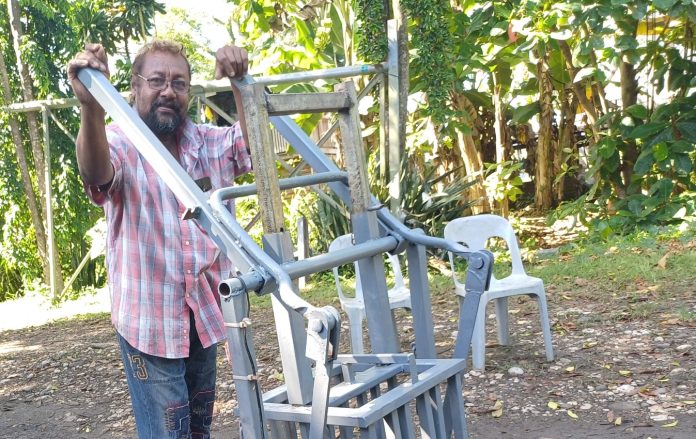
    John Cutforth Iamaea pose for a photo with 3 hallow brick molder he made

    BY JOHN HOUANIHAU

    Social media users have been sharing John Cutforth Iamaea’s three hollow block brick molder a lot lately.

    “I don’t think people will go crazy about it. It’s funny to me and I little bit surprised. a lot of people from all over the provinces and overseas also call and chatted me,’’ he said.

    The father, a mechanical engineer, welder, and graphic artist himself, is no stranger to converting waste into useful products.

    “This one is my third. Two of my friends bought two of my block brick molders. They gave the orders. Thus, I made it for them,’’ Iamaea said.

    Iamaea recently constructed three hollow block brick molders out of leftover materials from the workshop and auto parts that he gathered from the landfill. In August 2024, he finished building the three-hollow block brick molder during the first week of the month.

    “Building it is quite costly. I therefore gather offcuts or search for scraps to reduce costs. Compared to the single hollow block brick molder, the three hollow block brick molders make work even easier. You can make between 800 and 1000 bricks every day. Thus, you could hit about 5,000 bricks in a week,’’ Iamaea said.

    “The good thing about education is that I was fortunate to be an engineer. I therefore had to ensure that everything I gathered served the intended purpose for the output I produced. Since it only needs two or three workers, the three hollow block brick molder lowers labor costs,’’ claimed Iamaea.

    If he has the necessary materials on hand, the father of two can easily make three hollow block brick molders in a week.

    “Normally, I sell it SBD $15,000. But since we’re all struggling, I also feel sad for people. It might be the same suffering or struggle that I have experienced. Thus, on occasion, I urge my friends to cover the cost of the supplies, and I then make one for them,” he said.

    In terms of single hollow block brick molders, Iamaea typically received orders from people in Honiara as far away as Malaita and the western province.

    “To avoid losing out on these opportunities to foreigners or having to import goods from overseas, I intend to go into mass production, meeting demand, and maintaining standards are crucial for the locals,’’ he said.

    With his creative ideas, which have become people’s trademark and impacted many lives, Innovative Iamaea has also assisted a great number of people.

    “I just love doing it for our local Solomon Islanders, especially,” Iamaea, whose mother is from Makira, Tuvalu, and whose father is from Kara’ae, Malaita, said. “All the kindness you spread throughout the world will sometimes find a way to come back to you,” he said.

    Iamaea’s path to his current position was not smooth, despite attending prestigious institutions like King George the VI, Woodford, and Chung Wah school.

    “It was a difficult beginning for me, and the journey was too tough. Since my mother and father had separate lives, I was raised in two different homes. My aunt, who had married a Fijian taught at SICHE, looked after me. since I have no one to rely on, I have to learn everything I can,’’ recalled Iamaea.

    “During that time, my uncle ran a workshop at Ranadi and taught engineering at the Solomon Islands College of Higher Education (SICHE). I therefore spent a lot of time in the workshop during those days, which is where my interest began. With the assistance of my older brothers, I became familiar with the tools at a very young age. Thus, that is how I got to where I am now,’’ he said.

    A JOURNEY OF STRENGTH

      0
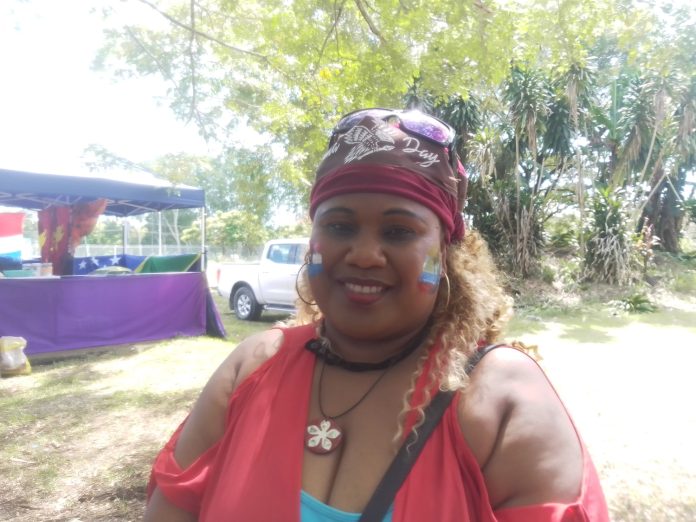
      Florence Boboria Sua.

      Florence Boboria Sua’s battle with cancer and triumph over adversity

      BY JOHN HOUANIHAU

      At just 18, Florence Boboria Sua, known as Flora Sua on social media, left the Solomon Islands to pursue her studies in early childhood education in New Zealand.

      But what was supposed to be an exciting chapter in her life took an unexpected turn when, in 2020, she was diagnosed with stage four Leiomyosarcoma cancer—a rare and aggressive cancer that develops in the smooth muscle tissue.

      Florence first noticed something was wrong when her body began to change drastically. “At that time, my body was too skinny,” she recalled. Seeking medical advice, her worst fears were confirmed when doctors delivered the devastating news.

      “The doctors informed me that I have stage four Leiomyosarcoma cancer, which develops in the tissue. When discussing the stages, it was incredibly difficult. It’s just overwhelming,” said Florence, now 38, originally from Kwara’ae and Fataleka in Malaita Province.

      The prognosis was grim. Florence was told she had no chance of surviving her illness and was advised to prepare for the worst. “That was the time when the doctors chose to let me go and informed me that I wouldn’t make it through the cancer,” she remembered.

      But Florence refused to accept this fate. Despite the doctors’ predictions, she clung to her belief that God had other plans for her.

      “I have a belief that I will survive this, and I believe God doesn’t want me to die,” she said. “To live, I also possess a strong, positive mentality. Therefore, I believe that my positive attitude contributed to my ability to survive the disease.”

      Returning to the Solomon Islands at the end of 2020, Florence decided to try traditional herbal medicine.

      One of the remedies she used was a charcoal-based medication from Choiseul. To her astonishment, after just two weeks, she noticed significant improvements. “I was able to actually see and feel improvements in my body. And I am aware that I have fully healed now,” she said with a smile.

      A year later, Florence returned to New Zealand, where the doctors were amazed by her recovery. They questioned her about how she had managed to survive and what treatment she had used. After hearing her story, they encouraged her to continue with her traditional medication.

      Florence attributes her healing not just to the treatments she received but also to her unwavering faith in God and her commitment to living a joyful life.

      “That’s one way to my healing, is to live a joyful life. You can do anything with a strong attitude if your mind is positive and happy. Your mind is a powerful weapon,” she explained.

      Her positivity and resilience have also fueled her presence on social media, where she shares her journey and joy with others. “Many thought that I was mentally ill, but no,” she said.

      “I’ve wanted to give up on things at times, but I’ve also told myself to keep going at other times. Hence, I never give up. Keep trying and enjoy the life I live.”

      Florence, who arrived in the Solomon Islands last month, will return to New Zealand at the end of September.

      Her story is a testament to the power of faith, positivity, and the will to survive, offering hope and inspiration to others facing their battles.

      Response to Gottleb and Daniels

      0

      This is a response to Arrian Gottleb and Justine Daniels raising grave concerns pertinent to China’s bilateral Assistance to the Pacific Island states that could triggered fostering of sister city bilateral engagements, published in the Island Sun on August 14.

      Over the past four decades Australia and New Zealand were seen as the region’s giant traditional powers, in enhancing Overseas Development Assistance (ODA), to all the Pacific Island states.  Despite numerous assistances rendered over a period of 45 years, there is no magnificent structures, neither hospital, no school institution, roads, wharfs, bridges, airports or what so ever, to reflect the nature and magnitude of the billions that have been invested over the years.

      Traditional donors such as Australia and New Zealand are focusing too much on Governance, and advocacy over the years, and failed miserably to placed its policy priorities on economic development. Australia’s lame excuse for not investing in economic development is based on the premise that land tenure issues have persistently hampered infrastructure work in the Solomon Islands. And there is also an ongoing need for management and maintenance of infrastructures that requires real commitment from the Solomon Islands Government.  

      Traditional donors knew that Solomon and other Pacific Island states are countries with untouched natural resources, ranging from gold, silver, phosphate, and other minerals, to prioritise economic development means footing a nation economically in order to accelerate its economic growth, by increasing its Gross Domestic Products (GDP) However, they used the Japanese situation as a case study.

      For instance, Japan, following the financial turmoil, initially attempted Keynesian policies such as building roads, and infrastructures to stimulate the economy. These policies were largely unsuccessful and resulted in mounting fiscal debt. So they instead applied technology and scientific advancement for boosting productivity and industrialisation.

      By doing this the traditional donors know for sure, that Island states with rigid and fragile economies such as Solomon Islands, Bougainville, Nauru, would be susceptible to doom and vulnerability. They suppressed the poor island states, having dominion over them, control and manipulating powers for over exploitation of their natural resources.

      Over the years Australian development assistance (ODA) focused mainly on Governance, so that they could influence legislators, policy makers to create and enact legislation that could safeguard their investments and reap resource owners.

      For instance, the Mining Act, Australia influenced the legislators to legislate that 97% goes for their mining company while land owners 1.7% and 2.3% for the state. Australia and New Zealand’s alignment in Governance over the years had caused havoc to the social and socio economic development of nation.

      The forestry act – 60% foreigner or investor, and 40% resource owners, instead of taxing both, sig taxed resources owners 25% leaving only 10% for the licensee, and 5 % for resource owners. Foreigners’ alignment in governance with the ministries is a professional method tailored, designed and tabulated over the years for suppressing island states with rigid and fragile economies in which Solomon Islands is one of them.

      Their alignment with SOEs in Governance tantamount to NPF’s cessation of NPF Housing scheme for its indigenous Solomon islanders, and allowing Australian South Pacific Oil Company to access 600 million loans without securing any asset for mortgage. Thus includes the likes of Sasape Marine, Tavanipupu Island Resorts, and Coral seas. Their influence articulated to the appointment of an Australian into the NPF Board as a Chairman, regardless of any qualification, experience or what so ever.

      They are best architectures in siphoning of monies from the state owned enterprises, they know that NPF’s Economic policies and investment policies are weak, so they tailored mechanisms and create back windows for hijacking the indigenous’ only social security. That’s where Sol Law comes as legal advisors, to remove the NPF 21 million through SIMI Insurance. Although Investigations revealed that SIMI does not have any branches in Singapore and Malaysia. These are the discrepancies of investing a lot in Governance, counterpart know very well our limitation, weakness, and strengths. This is only a few classical examples of what is happening in our state.

      Sullivan’s involvement in the former NBSI before BSP take over, 30% shares of all employees tantamount to $30, million SBD, to this very day, no employee of NBSI being a beneficiary in the money that was transferred into a trust Account that only the signatories themselves are the beneficiaries; these are some of the examples of Economic suppression.  

      For decades Australia and New Zealand’s Soft Economic policies, had attributed to “solomon islands soft landing”, a soft landing is a cyclical slowdown in economic growth that ends without a period of outright recession.

      A soft landing is the goal of a Central Bank, when they seek to raise interest rates just enough to stop an economic from overwhelming and experiencing high inflation but not enough to cause a severe down turn. Soft landings is a painless ending to a moderate economic slowdown, especially to a fragile and rigid Economy such as ours in the Solomon Islands. The term implies that our economy has returned to grow without a period of severe recession.

      Over the past 45 years during our bilateral ties with Australia, New Zealand, and USA, the Pacific Island Big Brothers soft bilateral policies revolved around Advocacy, andfailed miserably to develop monetary, fiscal and economic policies that could stimulate economic growth, and encourage market opportunities that primarily operate through some controls of supply or demand conditions of the economy.

      These soft policies allowed our bilateral partners the audacity to control their Aid monies, provide their own consultants, Engineers, and advisors to suck the Aid monies back into their countries, leaving only 10% of the Aid money served its purpose in the country. While 90% of the Aid package returned back in boomerang form. That’s the reason Why there is no Basic Economic Infrastructures established in the   Solomon Islands to reflect the nature and magnitude of the multimillions of dollars spent over the past 45 years in the country. Lack of basic Economic Infrastructures hinders economic development in the state, when those Economic infrastructures are dysfunctional, the chain of production is disrupted.

      This disruption hinders development, which causes economic deficit and, in turn, brings low standard of living. The social and socio –economic effect of such poor policies had a long-term domino impact on the state and its citizens.

      China is the world’s second largest economy by nominal GDP, behind the United states, and the world’s largest economy in 2016, when measured by purchasing power parity (PPP). China accounted for 19% of the global economy in 2022 in PPP Terms, and around 18% in nominal terms in 2022

      China over the past 60 years is aligning its self with the first world countries, for Economic Cooperation and Development, and observed how the Pacific Island big brothers are suppressing the island states with their advocacy programs, and failed miserably to build basic economic infrastructures that could help leverage the island states to access market and services both regionally and globally.

      Tropical Tug- of- war: China and the west’s influence battle in the pacific.

      The pacific is no tranquil back water, but rather a dynamic frontier of global geopolitics. The recent donation of a presidential building complex by china to Vanuatu and the inauguration of an Airstrip by Australia and New Zealand in the Solomon Islands underscores a growing rivalry that is as strategic as it is symbolic.

      Chinas Strategic Benevolence

      In March 2022, China and Solomon Islands signed a bilateral Agreement, few months later Chinese Embassy provided a funding of $1.85billion (220million) for the National Stadium, and the Solomon Islands National University Complex. Just only 6 months after the counter parts signing, the physical infrastructures reflect the nature and magnitude of the Aid money spent in the country in just the first year of our bilateral relationships.

      As part of Chinas Experience, it allows all the workers from each Ministry to attend short term training programs, look and learn from Chain’s wealth of Experience. So that Island state could learn and adopt from china’s Technological and scientific advancement. A long lasting issue that the two big brothers failed miserably to do, the social and socio-economic consequences of such poor policies resulted in Solomon Islands being a LEAST developed nation to this day.  

      China’s Bilateral ties with the South Pacific

      China’s ties with the South Pacific – development assistance, trade, investment, involvement in the Belt and Road Initiative, and more – have grown substantially since the early years of the new century. Australia and New Zealand (NZ), the traditional dominant powers in this region, have recently upped their game in order to balance Chinese activities.

      • The South Pacific, a huge but sparsely populated world region, is no stranger to geopolitical competition. China and Taiwan, jostling for diplomatic recognition, used to be the key protagonists.
      • Australia’s and NZ’s regional dominance has been challenged by China’s growing presence. China offers alternative options in terms of funding and policy to Pacific Island countries (PICs). PICs, seeking to increase their agency by diversifying political and economic relationships, generally welcome China’s more intensive engagement.
      • In the face of China’s growing regional engagement, Australia and NZ have reenergized their relations with PICs, increasing aid and diplomatic efforts. Australia’s in particular are driven by a strong security imperative.
      • The unwillingness of Australia’s conservative federal government to move away from coal remains a strong irritant for PICs, while NZ under Prime Minister Jacinda Ardern has made climate policy a defining strand of regional policy.
      • Australia’s and NZ’s planned COVID-safe travel zone could potentially be extended to PICs. Such a move would help PICs cushion the effects of the pandemic on their economies and become an exemplar of regional leadership.

      Policy Implications

      The South Pacific is facing greater geopolitical competition. Yet the region is not really on the radar of European foreign policy establishments, despite the European Union being an important cooperation partner. Increased exchanges with governmental and non-governmental actors in Australia and NZ can help foster greater understanding of the complex dynamics in the South Pacific. Such activities are, however, no substitute for deep, sustained engagement with PICs themselves.

      China’s Growing Regional Engagement

      Concerns among the region’s traditional powers, Australia and NZ, about external forces are nothing new. In the 1980s there were worries about the Soviet Union’s increased interest in the region. The Soviet threat, real or imagined, disappeared in the late 1980’s however; concerns about Libya’s romance with the postcolonial regime in Vanuatu and the independence movement in French New Caledonia had also largely dissipated by that time. What remained was the rivalry between the People’s Republic of China (PRC) and Taiwan, the key protagonists of geopolitical competition. Decolonization in the South Pacific, starting with Samoa in 1962 and ending, for now, with Palau in 1994, provided Beijing and Taipei with opportunities to boost their international legitimacy by befriending countries that would recognize them diplomatically.

      The emerging marketplace for diplomatic recognition saw Taipei engage in chequebook diplomacy, offering development aid – presented in the case of the PRC as “South-South cooperation” – in exchange PRC provided USD 1.62 billion in aid to PICs between 2011 and 2019, making it the largest donor behind Australia and ahead of NZ. Well over 70 per cent of Chinese overseas development assistance (ODA) has taken the form of concessional loans, thus having to be repaid at some point. What also sets Chinese ODA apart is that there is a huge difference between funds committed and funds spent. In geographical terms, China’s ODA is concentrated on the more resource-rich Melanesian PICs, with PNG receiving one-third of funds.

      The PRC has by now a fairly extensive diplomatic presence in the region. Since 1989 it is an official dialogue partner of the PIF. The PRC has thrice convened the China-Pacific Island Countries Economic Development and Cooperation Forum, a “multi-bilateral grouping” in which China engages with its diplomatic partners and announces aid packages. China’s rising regional profile has also been marked by two visits in recent years by President Xi Jinping.

      Apart from the competition with Taiwan, there have also been other factors behind Chinese engagement in the region. Business opportunities and broader economic motivations have clearly played a role. Some scholars emphasize the strategic nature of it, seeing such engagement as part of China’s longer-term plan to become the leading power also in this part of the Pacific.

      Australia’s tug of war with China over the Coral Sea cable system, resulted in it being constructed by Vocus Communications and Alcatel submarine Networks over 18 months with the intention that Australia will meet the costs. However Australia reversed the bill of 150 million for SIG Government to meet, luckily NPF meet the costs, that is a classic example of how the Big Brothers suppressing small island states.

      The government in Canberra likes to emphasize that the initiative is not directed at any one country but constitutes a positive contribution to the region – Australia’s “Pacific family.” Yet, it is clear that the Step-up seeks to balance China’s growing engagement there. Australian governments had long liked to believe that is was possible to enjoy the best of both worlds by benefitting from China’s economic rise while also being allied to the US. Under Morrison’s predecessor Malcolm Turnbull, Canberra finally came to the conclusion that it needed to push back both against Chinese interference in domestic politics and public life and against China’s growing influence in the region – which might undermine PICs’ sovereignty. The domestic pushback, culminating in the “Espionage and Foreign Interference Act” of 2018, and the Pacific Step-up are thus two sides of the same coin.

      The Step-up consists of measures ranging from the redevelopment of the Manus Island base to the promotion of people-to-people exchanges. Main activities include:

      • substantially raising ODA to the South Pacific, reaching AUD 1.4 billion (around EUR 850 million) in the 2019/2020 financial year;
      • building an ODA-financed underwater Internet cable linking the Solomon Islands and PNG to Australia (outbidding China’s Huawei telecommunications company);
      • establishing the Australian Infrastructure Financing Facility for the Pacific, which can draw on AUD 1.5 billion in loans and AUD 0.5 billion in grants. To better compete with China on infrastructure the government has also made available AUD 1 billion for Export Finance Australia, whose remit got extended to overseas infrastructure projects;
      • introducing a new Pacific Labour Scheme which allows low- and semi-skilled persons from the South Pacific to work for three years in rural Australia;
      • launching the Australia Pacific Security College, devoted to the training of mid- and senior-level officials from the region;
      • making available a semi-mobile infantry unit and, in the future, a large-hulled vessel for humanitarian and disaster-relief missions in the region;
      • new diplomatic posts in the region and a new coordinating “Office of the Pacific”;
      • significantly intensified high-level visit diplomacy.

      Solomon Islands (SLD) And Australian Trade, revolves around the following: – main product that Solomon Islands exported to Australia were gold, (16.4m) sawn timber wood (2.58m) and oil seeds flowers (764k) over the past 5 years.

      In return Solomon Islands imported rice alone from Australia valued at $976, million per annum. Our bilateral ties with Australia did not base on Trade and investment. But rather on spoon-feed diplomacy.

      Many of Chinese activities in the region in recent years include the building of a new terminal at Samoa’s international airport, have been carried out as part of China’s Belt and Road Initiative (BRI). When Xi visited Fiji in 2014, he invited the PICs to participate in the “21st Century Maritime Silk Road” – that is, the maritime part of the BRI. By early 2019, nine PIF members had signed Memorandums of Understanding regarding participation in the BRI. Generally, China’s greater presence has been welcomed by PICs. The emergence of China as a major player in the region has endowed PICs with greater agency, and helped them to reduce their dependence on traditional development partners.

      Australia “steps up” its regional engagement

      Australia and NZ worry that China’s more opaque and unconditional financial support undercuts the good-governance approach of their own ODA programmes focused on the region. Other perceived problems include the mixed quality of some of the Chinese infrastructure projects there, the lack of maintenance of existing facilities, and the fact that it is mostly Chinese workers who participate in these projects. Finally, and perhaps most importantly, as mentioned there are also concerns that the debt burdens of individual PICs will become unsustainable and that China might transform its leverage in this regard into political capital or even use it as a pretext for the seizure of assets in the PICs (some of which might ultimately be used for military purposes).

      This leads to the heart of security and geostrategic concerns that have animated relevant discourses in Australia. The South Pacific is far away from current or potential trouble spots in the Indo-Pacific and is unlikely to become a new hotspot for militarized confrontation. The region matters, however, in strategic terms in the increasing geopolitical competition between China and the United States (and its regional ally, Australia). The ability – or presumed inability – of PIC governments to remain free of Chinese influence has emerged as a significant concern for strategic circles in Australia. This is connected to earlier, long-standing concerns about state fragility and internal security issues in the PICs and their ramifications for Australia. These concerns led to a number of Australian-led “cooperative interventions” from the late 1980s – usually jointly with NZ – in places such as the Bougainville region of PNG or the Solomon Islands. Australia’s “age of intervention” in what has been called an “arc of instability” only came to a close in 2017 with the end of the multibillion, 14-year-long Australian-led Regional Assistance Mission to the Solomon Islands (RAMSI), an initiative to stabilize the country and to rebuild key state institutions here.

      *To be continued

      Pr Everest Edgar Kairi

      Seijong National University,

      Center for Asia Pacific

      Warrant of arrest for woman accused of stealing $20k

      0

      BY ROMINAH FAKA

      The magistrate court has issued a warrant of arrest for a woman accused of stealing after she failed to attend her court session yesterday.

      Loana Sisifiu faces 15 counts of simple larceny for allegedly stealing from two different women.

      Allegations said Ms Sisifiu conned the two complainants saying the money was going towards their travel to Australia, visa and train fares in Australia.

      Sisifiu denied the charges and a trial was set.

      Defence had sought for a settlement out of court but prosecution rejected it, saying this matter was serious and therefore needed to be settled in court.

      Court adjourned for August 24 for review of warrant.

      The accused Loana Sisifiu was charge in relation to allegations between January and April of this year in Honiara, where she lied to two different women and obtained over $20,000 from them.

      Prosecution further alleged that accused obtained the money from the two women whom she collected in various amounts on different dates for airfares to travel to Australia, Visa and for train fares in Australia.

      The allegation states that, one of the victims also claim that the accused gave her a fake plane ticket as well.

      The two alleged victim lodged their complaints to the police after the accused promise them for helping them to obtained their air fares and Visa did not happen after they gave her their money.

      John Wesley Zoze of ODPP appears for the Crown and Lazarus Waroka of PSO act for the Sisifiu.

      Sentence for 2 cops guilty of assault Aug 23

      0

      BY ROMINAH FAKA

      Sentence for two police officers accused for assaulting a 17-year-old boy at the Central police station watch house on Christmas Eve 2020 will be delivered on August 23.

      Lawrence Moli and John Tautai were charged jointly with one count of assault causing actual bodily harm and both pleaded not guilty to the charge and a trial was conducted last year before Principal Magistrate Fatimah Taeburi.

      After the prosecution and defence completed their case, the court delivered a judgement where court found the two police officers guilty.

      Court heard in December 2020, Moli and Tautai allegedly assaulted a 17- year-old boy at the Central Police Station, Watch House.

      The complainant had been brought to the police station by his father, who was also a police officer himself, because his son was drunk and caused nuisance at their residence.

      Myrella Cleven of Public Prosecution office appears for the Crown and Emy Rusi of Public Solicitor Officer represent both of the defendants.