Home Blog Page 497

SICCI shares remarkable insights with students

0

BY JOHN HOUANIHAU

JAMES Dolarii, CEO of the Solomon Islands Chamber of Commerce and Industry (SICCI), delivered an inspiring address to students during the University of the South Pacific (USP) Open Day at the King George USP campus in Honiara.

Giving his keynote speech as the Guest of Honor on Tuesday last week, Mr Dolarii, explained one of the key roles of the Solomon Islands Chamber of Commerce to the students.

“The song that the Solomon Islands Chamber of Commerce, our private sector, sang throughout the past and now and into the future is the engine of growth and when we speak about the engine of growth, we are talking about businesses making money to ensure that jobs are created and to ensure that the economy of this country is on a high-performing economy,’’ he told the students.

He further told the students that they are the resources of this beautiful nation Solomon Islands.

“And today, you who are here, we are the resources of this country, this nation, the great nation of Solomon Islands. Today and shortly, we need more doctors, more entrepreneurs, and more businesses,’’ said Dolarii.

“And I am happy that you are all listening today and I’m speaking to around over 500 businesses for Solomon Islands in the next 20 years or 15 years. If I live to that year, I am very happy to see you all get into business, do business and create more jobs for our people,’’ he said.

He also acknowledges forefathers, the leaders from the helm of this country Solomon Islands, right down to small dwellings and family units, parents, and guardians.

“For the leadership and dedication in ensuring we progress in all that we do for education. My colleagues, I’m saying colleagues here because I’m a student of the University of the South Pacific and I believe you will make the decision today to be a student of our USP in the next year or the next two years.

“So please make your decisions, prioritize your education journey, and remember to have a higher motivation and a bigger dream in your growth,’’ he said.

BACK TO FARMING

0
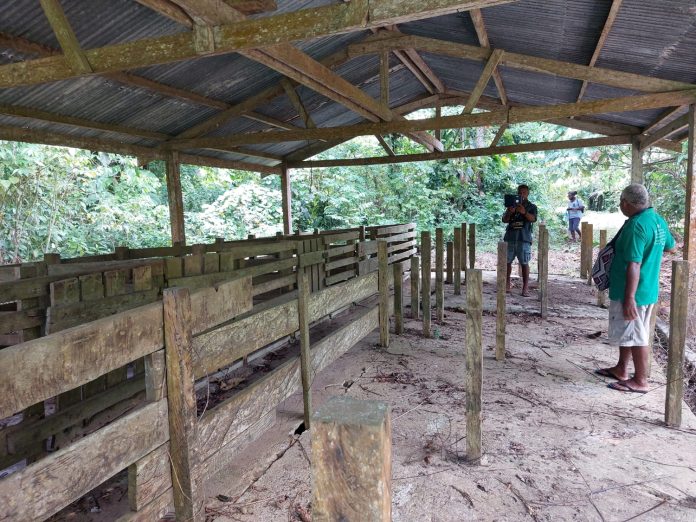
Hakama pig yard.

Central province to revive Hakama farm, set to boost provincial revenue

BY JOHN HOUANIHAU

The Central Island Province Premier (CIP) Michael Salini together with the province’s agriculture and lands division staff visited the Hakama farm recently.

The newly elected premier said the visit aims to discuss some of the issues of landowning groups and surrounding communities before reviving the farm as part of the government’s policy to prioritise agriculture as one of the key sectors.

“That is apart from Tourism and Fisheries,” said Salini.

He said that as part of the programme they already bought some piglets, equipment and feed to start with the piggery breeding programme.

“Next will be the cattle etc. We are also looking for support to help us with the major developments of the farm.

“Some are already indicated support but will need to work on the details,” he said.

Salini stressed that he hopes that through CIP’s sister relationship with a province in China, CIP can tap into support in terms of technical support and equipment.

“What strikes me is while Hakama is such a beautiful farm with so much potential, it will need a lot of investment to get it up and running. We need investments in housing, facilities, staffing, equipment etc.”

The Premier said that the Government will need to work hard to revitalise the once thriving farm to its former state and more.

“We need to bring modern technology and know-how that help us develop it. Hakama can be a food bowl for the country if we get it back up and running.

“There is so much potential in that place. We need to work on that potential to realise it,” he said.

“Overall, there is so much to do in our province.

“We need to work together and I believe we can develop our province into a prosperous and peaceful place we can all enjoy and be proud of.

“The story of Hakama is the story of Central Province. we can get it all back together. It’s not impossible,” said Salini.

‘TAKE IT TO PARL’

0

Transparency Solomon Islands calls for OAG’s audit report on ESP to be debated in parliament

BY JOHN HOUANIHAU

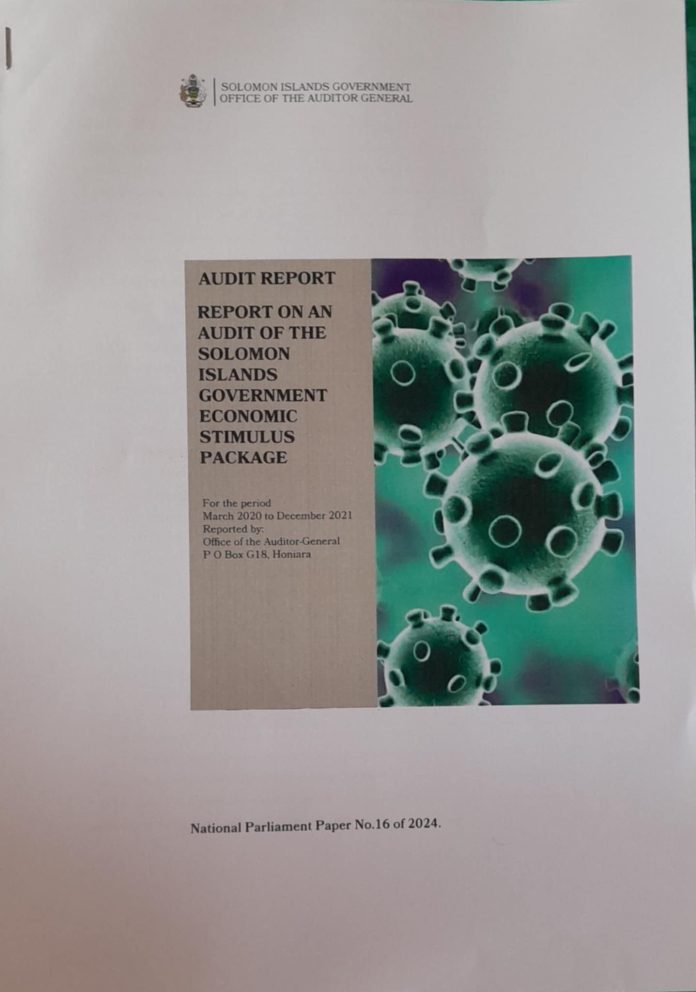
Transparency Solomon Islands (TSI) has highlighted the need for the Auditor General’s report on the Economic Stimulus Package 2020-21 to be brought to parliament.

The Auditor General’s office (OAG) released its audit report of the economic stimulus package (ESP) covering the period from 2020-2021 on Wednesday this week.

The report uncovered an extensive pattern of major fraud risks involving government ministries, agencies and officials, private businesses and individuals.

The ESP programme saw the spending of $309 million public funds with no set rules, laws or framework, no transparency, no documentation and no accountability.

Although a small portion of the report mentions few individuals receiving and utilising funds, the overwhelming majority of findings point to – companies getting windfall profits and individuals getting rich overnight.

Speaking to Island Sun yesterday, Transparency Solomon Islands’ (TSI) acting CEO, Legal Officer Joy Abia stresses that “such reports are significant for public transparency and require a debate in the parliament”.

Ms Abia also highlights that “nothing or no conviction has been made for the past years” following such a report being made known.

“It is a requirement, that such reports must be brought and debated in the parliament.

“This will allow the public to access and have many insights regarding what happened.

“That is transparency and accountability. It would be also better to review the legislation,” she said.

“Review of the legislation is one of the important aspects to strengthen and enhance the work they do. It’s a must also for the government to consider this,” said Abia.

Briefing media on the Report before its official launch on Wednesday, Auditor General David Dennis clarified that his office does not prosecute nor does it comment on policies, although popular public view desires this.

Mr Dennis also clarified that the report does not comment on the whether the ESP was effective in achieving its purpose to buffer the economy against the pandemic’s impacts or not.

The followings are a few examples of the discrepancies the OAG investigation found:

One government official was found to have signed off on 251 cheques totalling $6.8 million purportedly on behalf of recipients. The was no document to prove this officer was authorised by the recipients to do so.

This same officer was involved in encouraging and preparing applications for individuals, the report said.

Three government officers (including the one above) were found to have signed off on a ‘vast number’ of payments on behalf of recipients, with no documents to say whether these three officers were authorised to.

An ESP recipient was given an $80,000 cheque and told to cash it and return to the government office, where the officer took $20,000.

More than 2,000 grant payments were made, but only 200 applications could be found for review by OAG, raising the question as to where and what happened to the rest.

There was no standard application form, and applications ranged from 30-page comprehensive proposals to a single page.

One letter simply stated ‘I am writing to request the above funding ($1 million) to assist in enhancing the transportation needs of my constituency. Grateful please to facilitate the disbursement as soon as it is practicable.’ This was a cash grant to a MP with no requirements attached.

One constituency got $1million for transport purposes and $200,000 was paid out as ‘canteen assistance’.

Of the 24 payments for infrastructure which totalled $14 million, all were for government MPs only – none for any Opposition MP.

Government helped themselves to the bulk of $55 million for constituency offices for productive and resources sector or infrastructure. Opposition MP constituencies generally received less.

Double dipping by some recipients who took from the constituency ESP funds and the main ESP grant process, due to the use of constituency development offices to distribute funds.

One constituency development office purchased a capital equipment for $1.75 million based on only a single quote using ESP funds.

Some preferred suppliers received windfall profits when paid directly by ESP but the recipients did not collect their materials. No government follow-up.

Some recipients received far less than they had applied for, while others got far more than they had requested.

Case study shows requests varying from $2,719 to $3,860 and each were approved $15,000. Another applied for $5 million but received only $5,000. No documents to explain these approvals.

‘We must not forget the traditional landowners’

0

BY LORETTA B. MANELE

As we chart the future of this nation, let us remind this house that we must not forget the traditional landowners of this country.

The statement was made by Member of Parliament for Northwest Guadalcanal Francis Sade in parliament recently.

He said acknowledging the traditional land owners of the land the capital sits on is important because it will foster cultural respect, reconciliation and awareness.

Sade voiced that more than 80 percent of land in the country is customary land hence if we want development, we will need land that is customary owned to do that.

Speaking of traditional landowners, he said people at Tandai area are still crying because government doesn’t recognise their struggle after they’ve given up their land for the development of the economic hub of this country.

“If you take a walk from the boundary of Honiara and Guadalcanal, the people who gave their land for the development of this city don’t even have a road”

Sade mentioned that people are complaining and don’t want to give up their land because government doesn’t recognise them.

He added that even traditional landowners living at Mataniko area don’t have water supply despite the existence of a SIWA pipeline there.

Sade reiterated that government must acknowledge them and put them at the forefront of development agendas and engage them in meaningful participation in development.

Aviation industry to benefit from MOU with PRC

0

BY LORETTA B. MANELE

The country’s aviation industry will benefit greatly from its Memorandum of Understanding (MOU) with the People’s Republic of China (PRC), China.

Minister for Foreign Affairs and External Trade Peter Shanel Agovaka spoke on this in parliament.

The MOU was signed during Prime Minister Jeremiah Manele’s recent visit to China.

Agovaka told parliament that they signed 13 MOUs during the visit and one of these MOUs is the MOU regarding the aviation sector.

He said the MOU is between the Civil Aviation Administration of China (CAAC) and Solomon Islands’ Ministry of Communications and Aviation (MCA).

Agovaka said this agreement will enable MCA to exchange views, best practices, share information, expertise and knowledge with PRC’s civil aviation authority.

The Central Guadalcanal MP stressed that this will further benefit the country’s aviation industry as it plays a vital role in connectivity and trade.

On another note, he said there is also interest from Solomon Airlines to acquire a plane from China.

Agovaka said the plane, a Y12F aircraft is capable of cooperating to all 22 domestic airstrips in the country without fuel stops while carrying a full capacity of cargo in comparison to our twin otter that can only carry limited cargo and requires to be fuelled up.

“This will greatly enhance the movement of our people and cargo to all the provinces.”

Dubious applications for ESP were approved: OAG report

0

BY NED GAGAHE

The Office of the Auditor General (OAG) audit into the Economic Stimulus Package has uncovered irregularities in applications submitted.

The report released by OAG found some applications were all on a single hand-written page with the same pen.

This finding was presented in a case study presented in the report to highlight the issues found amongst the small number of applications made available to the OAG.

The report revealed that there were the group of applications that were received from seven villages in one province.

All were prepared by the same person as the handwriting and format were identical. The argument used to support the request in each case was.

“We have a lot of local chickens roaming the village vulnerable to dogs and prey birds. Therefore, we need your assistance for proper keeping and feeding for cash.”

The report stated that there were two other sections for each application. One provided the name of the village, ward, and constituency and the other provided details of the materials needed to cage and support the chickens – chicken wire, nails, chainsaw hire, chicken food etc.

The report revealed that the amounts requested ranged from $2,719 to $3,860.

The amount approved in each case was $15,000, significantly above the amount requested.

Man fined $1000 for drink driving

0

BY ROMINAH FAKA

A man has been fined $1,000 for drinking alcohol while driving.

Court sentenced Nickson Visona for a fine of $1000 for presence of alcohol in his blood when driving along Mendana Avenue Road.

Court also directed for Visona to pay the amount before November 1 and if he fails he will receive a default judgment of four months imprisonment.

Visona was charged with presence of alcohol in persons blood and he plead guilty to the charge.  

Court heard on July 6 this year, Visona drove a black Toyota ray-4 registration no. MD-0696 along Mendana Avenue Road in front of Central Police Station.

At that time RBT operation was been conducted by the traffic office and a preliminary breath test was carried out from him and the result shown 0.085% which was over the prescribed level.

Visona later dealt with accordingly at the Kukum Police Station. And was formally charged for offence of presence of alcohol in person blood.

Abel Maelanga of Police Prosecution Department act for crown and PSO for the Visona.

2 women accused of unlawful wounding, case returns Oct 14

0

BY ROMINAH FAKA

A case of two women accused of unlawful wounding has been adjourned for October 14.

Anna Vathagi and Lisa Kope are expected to take their plea then.

The matter was heard in court on Monday and court imposed strict bail conditions on Vathagi and Kope because they lived in the same community as the complainant.

Prosecution informed court that full disclosures were served to the Public Solicitor’s Office (PSO) on September 23.

Court also heard the women were without legal representation.

After imposing the bail conditions court directed for the PSO to allocate a lawyer for the two accused during the course of adjournment.

Vagathi and Kope are sisters in law.

It was alleged on July 2, 2024 the complainant was busy preparing chemical for spray at GPPOL 2 Tetere Estate Office chemical shed.

The two accused approached her and assaulted her – Kope gripping the complainant’s arms while Vagathi hit her head with a rock.

Allegations said prior to the attack the complainant and Vagathi were not in good terms because the complainant had arranged a girl for Vagathi’s husband to have a sexual affair with.

A cultural reconciliation was held between Vagathi, her husband and the girl.

Following this reconciliation, Vagathi and Kope went and attacked the complainant.

The matter was reported at the Tetere police station and the two accused were apprehended.

Martha Mutukera appears for the crown and Delilah Kukura appears for defence.

High fraud risk in ESP payment: audit report

0

BY JOHN HOUANIHAU

No accountability for the productive and resource sector grants under the covid-19 Economic stimulus package, the OAG ESP audit report has found.

This is a major and continuing breakdown of internal control and represents a major fraud risk, said Auditor General David Dennis.

According to the OAG 2020-201 audit report the grants were paid through three different mechanisms under the productive and resource sector.

“Some were paid through the MoFT payment system either to recipients directly or to local business to buy goods, some were paid in cash being processed through Imprest Account and some were paid through Constituency Development Fund,” Dennis said.

Based on the breakdown of the payment methods, the total amount paid through the Treasury corporate services Imprest Account for 369 payment accounts for $33,547,270.

The OAG report further found that the amount paid to constituency offices accounts for $41,254,635 for 115 payments and $59,986,256 paid directly to businesses.

For the three methods of payment, it has a total of $134,788,161 accounts for a total of 1999 payments.

Most of the payment meanwhile were signed for by three officers – one of the officers signed for 251 cheques with a total value of $ 6.8 million.

“There was no further accountability for these payments,” Dennis said.

The report also showed that out of the $14 million paid to Constituency Development Offices (CDO) to support infrastructure developments, 24 payments were awarded to CDO where the MP was a Minister of the Government.

“None of these payments went to offices where the MP was a member of the opposition,” said Teika.

Further, a further $5 million was paid to the Development Bank of Solomon Islands (DBSI) and was recorded as being for infrastructure which was not specified in the ESP Booklet.

The audit report also showed that cash grants totalling $33 million were paid to farmers and local produce-handling businesses and $7 million to tourism operators.

“However, applications were not always filed with payment forms or payment documentation. The payment process breached expected internal control procedures in that officers personally signed for beneficiaries but provided no evidence that they handed the payment to the designated person.

“This was a significant breakdown of internal control- allowing government officers to sign for payment for beneficiaries who may not even be aware they are due to receive payment or how much they are to receive was a major fraud risk.”

ESP PAYMENT DISASTER

0

-AG audit report on Economic Stimulus Package shows major fraud risks

-3 govt officials signed off on many payments, one of them cleared 251 cheques totalling $6.8million

-Over 2,000 grant payments, only 200 applications could be found for review by OAG

BY NED GAGAHE & IRWIN ANGIKI

Government’s $309 million Economic Stimulus Package in 2020 to revitalise the economy during the pandemic was a payment disaster, an audit has found.

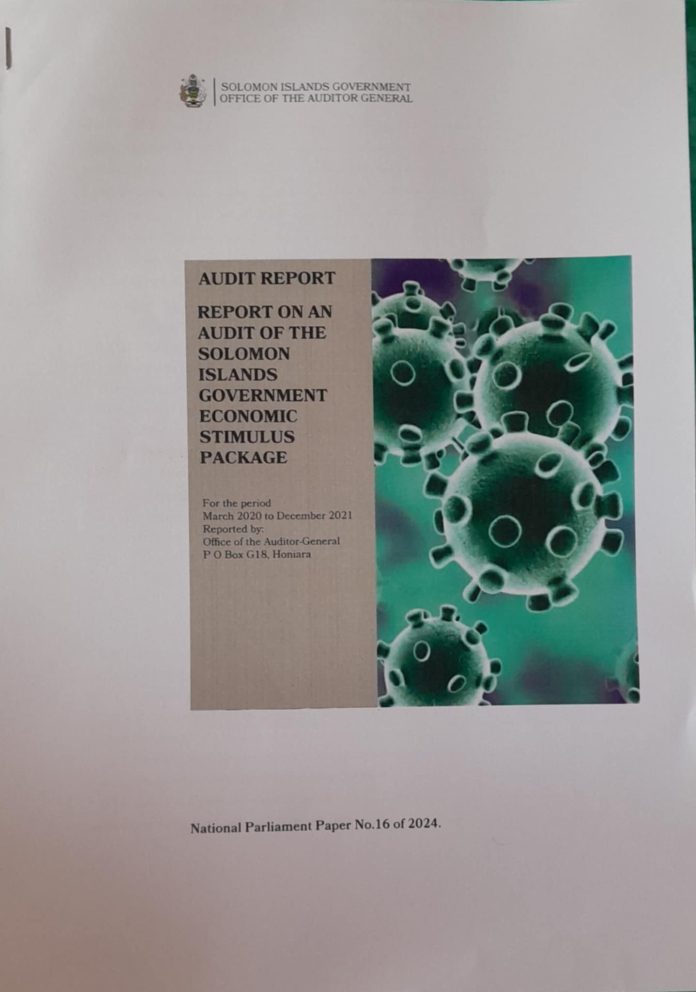
The Auditor General’s office (OAG) yesterday released its audit report of the economic stimulus package (ESP) covering a one-year period from 2020-2021.

At a pre-launch pressor with media, Auditor General David Dennis said the audit found the implementation of the ESP was challenged – lack of laws, rules and administrative resources, high risk of fraud from risky imprest account practices, lack of guidance, transparency and documentation, conflict of interest, and inefficient use of public funds.

Some examples of the many discrepancies include:

One government official was found to have signed off on 251 cheques totalling $6.8 million purportedly on behalf of recipients. The was no document to prove this officer was authorised by the recipients to do so.

This same officer was involved in encouraging and preparing applications for individuals, the report said.

Three government officers (including the one above) were found to have signed off on a ‘vast number’ of payments on behalf of recipients, with no documents to say whether these three officers were authorised to.

An ESP recipient was given an $80,000 cheque and told to cash it and return to the government office, where the officer took $20,000.

More than 2,000 grant payments were made, but only 200 applications could be found for review by OAG, raising the question as to where and what happened to the rest.

There was no standard application form, and applications ranged from 30-page comprehensive proposals to a single page.

One letter simply stated ‘I am writing to request the above funding ($1 million) to assist in enhancing the transportation needs of my constituency. Grateful please to facilitate the disbursement as soon as it is practicable.’ This was a cash grant to a MP with no requirements attached.

One constituency got $1million for transport purposes and $200,000 was paid out as ‘canteen assistance’.

Of the 24 payments for infrastructure which totalled $14 million, all were for government MPs only – none for any Opposition MP.

Government helped themselves to the bulk of $55 million for constituency offices for productive and resources sector or infrastructure. Opposition MP constituencies generally received less.

Double dipping by some recipients who took from the constituency ESP funds and the main ESP grant process, due to the use of constituency development offices to distribute funds.

One constituency development office purchased a capital equipment for $1.75 million based on only a single quote using ESP funds.

Some preferred suppliers received windfall profits when paid directly by ESP but the recipients did not collect their materials. No government follow-up.

Some recipients received far less than they had applied for, while others got far more than they had requested.

Case study shows requests varying from $2,719 to $3,860 and each were approved $15,000. Another applied for $5 million but received only $5,000. No documents to explain these approvals.

“We did not see any authorisation documents from beneficiaries authorising the officer to collect the money on behalf of the beneficiaries,” Dennis said.

Cash grants totalling $33 million were paid to farmers and local produce handling businesses, the report said. $7 million was paid to tourism businesses.

The report said applications were not always filed with payment forms or payment documentation, so it was not possible for the OAG to confirm that all payments were made in response to valid applications.

“The payment process breached expected internal control procedures in that officers personally signed for many payments for beneficiaries but provided no evidence that they had handed the payment on to the designated person. This was the case with almost a third of the payments made through the Imprest Account.

“This was a significant breakdown of internal control – allowing government officers to sign for payments for beneficiaries who may not even be aware they are due to receive payment or how much they are to receive was a major fraud risk.

“Funding through the Imprest Account was important for applicants to meet their household needs, but applicants told us they were frustrated by decisions to approve less than the amount applied for which was often unexplained. Reduced funding also caused problems, for example, applicants could not complete projects or had to delay them until they could find further funding,” the report said.

Auditor General Dennis revealed that a total of 16,000 applications were received for the ESP programme.

“We also found that the resources needed to adequately receive, process, take, and document the thousands of applications was grossly underestimated, resulting in weak internal controls. What that means is that when this was designed, the legal framework was lacking. There wasn’t a set of regulations for grants, for example,” Dennis said.

In anticipation of the negative economic fallout of the COVID 19 pandemic, the Solomon Islands Government implemented the $309million ESP programme to support and enable businesses and households to continue to produce, trade, employ people, spend and boost aggregate demand in the economy.

The ESP was approved by Cabinet and published on May 6, 2020.

Applications for the support were accepted starting May 26, 2020 with payments made throughout 2020 and 2021.