LEARNING about human rights is empowering women to speak out and improve equality in Solomon Islands.
A report issued from the global educations on human rights in Solomon Islands has divulges that most women are taking responsibilities in addressing the needs of or the family such as gardening, house cleaning, marketing, cooking and washing as part of their daily job.
Some woman are concerned about the consequences of their low status, including their powerlessness in decision-making and the high levels of domestic violence.
Since logging is a common issue in Solomon Islands resulting from man making decision. A well trained human rights Paralegal female Miri (partly funded by Australia Aid) is very concern on the logging issue by the large international company.
Meri stated that logging is significantly affecting the forest and the community have very little benefits as a results.
She added that in her cline, females had no power against males to speak for the right of the Community.
When their clan gathered his people to discuss the logging issue, she also attended. When Meri was about to share his points, she first ask the men if he could add something, but the man family couldn’t allow her to spoke on behalf, but she apologise to those men before she spoke.
She added that, their clan only receive short term economic benefits but looking in the long term, his generation will suffer from the effects of logging. Her points creates a door way for his people to see that she has a concern for the future generation of his clan.
Step-by-step the women of Solomon Islands are showing that they are capable of doing many things that they had previously been excluded from. Others can see that the culture survives and even thrives with the greater participation of women.
MALARIA is a life-threatening disease caused by parasites that are transmitted to people through the bites of infected mosquitoes. It can be fatal. Occurring in the tropics, about half the world’s population live in areas where malaria is present.
Prevention and control of malaria can be through limiting mosquito breeding areas of stagnant water, spraying around homes, preventing mosquito bites, and sleeping under mosquito nets treated with insecticide.
Young children, pregnant women and people living with HIV (who have depleted immune systems) are those most at risk of malaria. Healthy adults who live in malaria-prone areas are likely to have developed a degree of resistance and their symptoms may be less severe than those with no immunity. Malaria mostly affects poor people who cannot afford treatment or have limited access to healthcare. It traps families and communities in a downward spiral of poverty.
Combating malaria requires a multi-pronged approach: tackling the parasite that causes malaria, the mosquito that transmits it and the infected human whose blood multiplies it.
Preventing mosquitoes from biting humans is vital to limiting the spread of malaria. People can sleep under bed nets that have been treated with long-lasting insecticide, tucking them under bedding even though they may be hot and stuffy, and ensuring to check them for holes. They need to seek healthcare quickly if they have malaria in order to limit its spread to others.
Also, Mosquitoes can be prevented from entering houses by spraying insecticide on the walls and ceilings. Burning mosquito coils made from pyrethrum daisies (most commonly chrysanthemums) and coconut husks also limits mosquito bites at night.
Early treatment reduces the severity and length of the illness. Quinine harvested from the bark of the cinchona tree in present-day Peru and Ecuador was traditionally the main form of treatment. While quinine interrupts the parasites’ breeding cycle, it is short acting and can have serious side effects.
In the 1940s a synthetic medicine, chloroquine, was introduced. It was inexpensive, safe and provided long-lasting protection against all forms of malaria. However, poor usage led to the development of resistance.
Since the 1980s a new drug based on a traditional Chinese herb, qinghaosu, has been used. The active ingredient is artemisinin, and it has significantly contributed to the decline of malaria. Artemisinin is used in combination with other drugs to reduce the development of resistance.
The global malaria eradication campaign, launched by the World Health Organization in 1955, was effective in eliminating malaria in many temperate and subtropical-zone countries through treatment, swamp drainage and spraying walls with DDT. Lack of funding prevented the expansion of these programs to tropical countries.
Recently the Roll Back Malaria Campaign and the Millennium Development Goals have renewed efforts to tackle malaria.
Whilst, The Solomon Islands Government has supported malaria elimination programs for more than 40 years, but difficult terrain, use of outdated drug regimens and lack of finance led to a peak number of cases.
New programs, treating those infected quickly, distributing treated bed nets, indoor spraying, drain clearing and community education, are reducing the incidence of malaria. A network of medical centres, with doctors, researchers and other medical staff using radios to communicate across the country can respond rapidly when high numbers of malaria cases are reported.
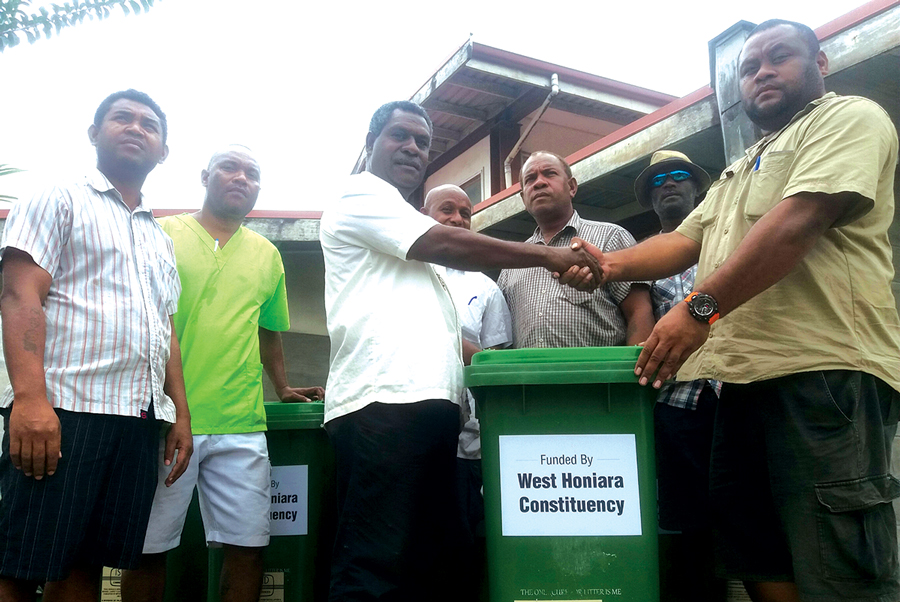
West Honiara Constituency Development Officer, Brian Taupiri (right) handed over the rubbish bins to the NRH executive and staff, Director of Nursing, Father Selwyn Houniola and witnessed by some of the nurses or the NRH.
West Honiara constituency donates bins to hospital
By Gary Hatigeva
West Honiara Constituency Development Officer, Brian Taupiri (right) handed over the rubbish bins to the NRH executive and staff, Director of Nursing, Father Selwyn Houniola and witnessed by some of the nurses or the NRH.
THE National Referral Hospital (NRH) is the latest to have benefited from the continuous generosity of the West Honiara Constituency leadership and its people, for the donation of 20 rubbish bins.
This comes after growing concerns over the littering of wastes and rubbish within the National Referral Hospital compound, which received criticisms from patients and concerned citizens.
After continuous pressure to tackle the issue and being constrained with limited funds, the executive of NRH made calls for support and assistance, thanks to the Member of Parliament for West Honiara, Namson Tran MP, who according to his officers, saw the genuine need for help.
West Honiara Constituency Development Officer (CDO) Brian Taupiri explained during a low key handover ceremony of the bins, that their MP expressed no hesitation after receiving the request because it is about maintaining the country’s only national referral hospital clean.
Taupiri added that it is everyone’s concern to see that the issue of littering and cleanliness within the hospital vicinity is maintained for a healthy environment.
“Remember, cleanliness is part of healthiness and the only way to achieve this, is through close collaboration between the hospital management and staff, and the public.
“So I kindly ask all of us to respect the hospital and its facilities, which off course includes the new bins that are handed out today (yesterday),” the CDO appealed.
Receiving the bins on behalf of the NRH executive and staff, Director of Nursing, Father Selwyn Houniola was emotional when he received the equipment yesterday.
“It’s been quite a while since this issue of waste management here at the hospital was dealt with through the heavy presence of equipment as such to ensure the maintenance of a clean and tidy instititue.
“We have been handicapped and kept inside the confines of this hospital but with this generous donation, let me assure you that we will ensure they are looked after and will certainly help our responsible divisions keep this institute clean and healthy,” the Director added.
He then thanked the West Honiara Constituency and its MP for what he described as a worth assistance and timely, as the issue of waste and littering had slowly become a big problem for the hospital to deal with.
He further added that the donation has more significance as the institute has a national status and outside of the West Honiara Constituency, yet MP Tran chose to continuously supporting it.
The donation of the bins is something the West Honiara CDO stressed and suggested for the NRH executive should not be too troubled on, as it is where all patients from clinics and rural health centres within the 50 constituencies are referred to.
“We all use benefit one way or another from this important service and should therefore take pride of it and help those in charge, look after it,” Taupiri further stressed.
It is not the first for Tran and his constituency to have been involved in supporting the National Hospital.
NRH has been a regular recipient of past assistances from the MP for its various sections, with the recent being through the Rotary Solomon Islands, for hospital equipment.
Diocesan Secretary (DS) of the Anglican Diocese of Malaita, Mr Anthony Maelasi
BY SAMIE WAIKORI
Auki
WORK is progressing well toward the establishment of an Anglican Church of Melanesia (ACOM) secondary school in Malaita.
Diocesan Secretary (DS) of the Diocese of Malaita, Mr Anthony Maelasi recently told this paper that, “despite several challenges faced, things are going on reasonably well”.
He said MEHRD is now finaliSing the Terms of Reference (TOR) for a feasibility study to be carried out on the project site, as well as the detailed design of the school.
According to MEHRD, this is one of the national projects of the current government.
Maelasi said they are expecting the feasibility study to be completed within the remaining part of the year and work on the project to begin as of next year 2019.
He said 38.89 hectares of land was initially negotiated, acquired and registered for the project. An MOU between ACOM and the land owners will be signed soon.
Maelasi also stated that the proposed secondary school at Ilikata Tolokwasa land will cater for forms one to seven.
This paper understands that the establishment of this school will be additional to the current five owned by ACOM, namely, Selwyn College, St. Nicholas College, C.E. Fox Sa’a, Norman Palmer and St. Stephen’s College Pamua.
It is also known that there are also several rural training centres in the country owned by ACOM.
PROVINCIAL Police Commander (PPC) Western province, Chief Superintendent Mathias Lenialu thanks the people of Western province for a peaceful 40th anniversary of independence celebration from July 4-6, 2018.
“This is a very positive outcome for the people here in Western province especially residents of Gizo Town and visiting people from our neighbouring islands,” says Lenialu.
“So far there is no report of any criminal activity received and there were no arrests made during the celebration.
“I want to thank the people here in Gizo and our visiting people from our islands for making this event a crime free event where everyone participated peacefully.
“I also want to thank community, church and women leaders as well as elders, youth and children for the good behaviour shown during the celebration.
“And I also thank my officers for their dedication and working together with our communities to ensure the celebration ran peacefully. Let us all continue to work together for the betterment of our people.”
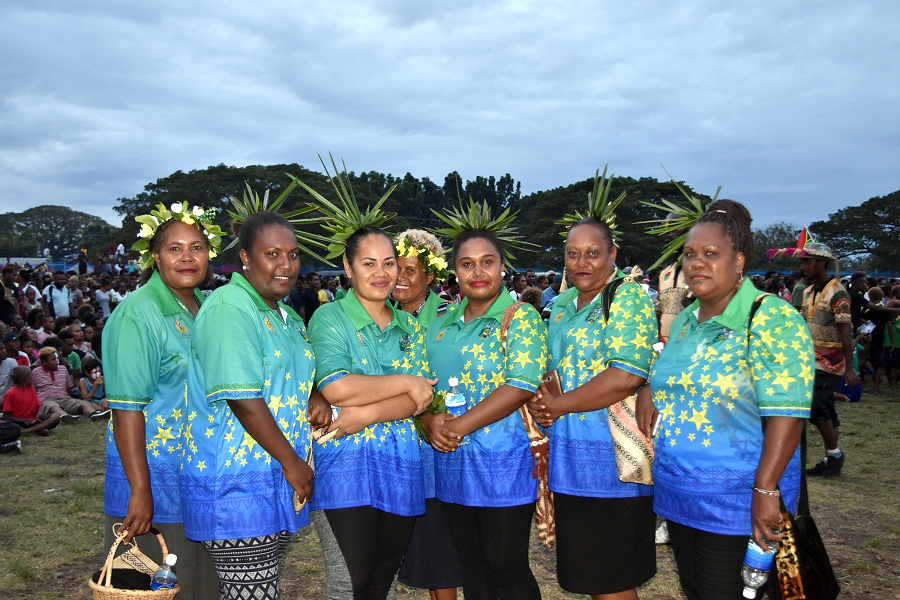
Solomon Islands women of 'Stage of Change' at the closing ceremony
BY LYNTON AARON FILIA
THE 6th Melanesian Arts and Cultural Festival 2018 are believed to foster another pathway for future connection as reflected in the theme – “Past Recollection, Future Connections”, Acting Prime Minister Manasseh Sogavare said.
The 6th MACFest officially ended on Tuesday this week followed by a handover of the MSG flag to Vanuatu as the next host country.
This year’s event is one of the Solomon Islands’ biggest occasions held after RAMSI’s departure last year in June, thus it contributes towards restoring peace and strengthening the country’s culture including MSG members.
With the festival’s objectives and theme, “Past Recollection, Future Connections”, Mr Sogavare said it has been achieved.
A local taking a picture with two dancers from PNG, reflecting the reconnection.
In his keynote address he said, “I believe we have achieved the objective of the 6th MACFest period.”
He said over the past 10 days participants have exchanged ideas, skills and knowledge, had the opportunity to showcase products and traded and even realise economic opportunities.
“I believe you fostered and establish partnership for future connections and I’m certain that the festival help us reconnected, revive renew of commitments of our people and cultures in Melanesia,” he said.
Solomon Islands women of ‘Stage of Change’ at the closing ceremony
He congratulates and thanked the MSG member countries and other countries beyond the region saying they help contributing in achieving the objectives of the festival to ensure that all embrace and believe according to the festival theme.
“Helping one another is spirits of you are brother’s keeper is an intense Melanesian value which we must continue to uphold because it sets us apart as a people in the world.
“We are wantoks and nothing must and should be allow to change that.”
Sogavare also encourages MSG members that we are powerful and control more than 90 percent of the population and resources in the region outside Australia and New Zealand.
Vanuatu will host the seventh MACFest in 2022.
PNG rep, presents their gift to Deputy PM, Sogavare.
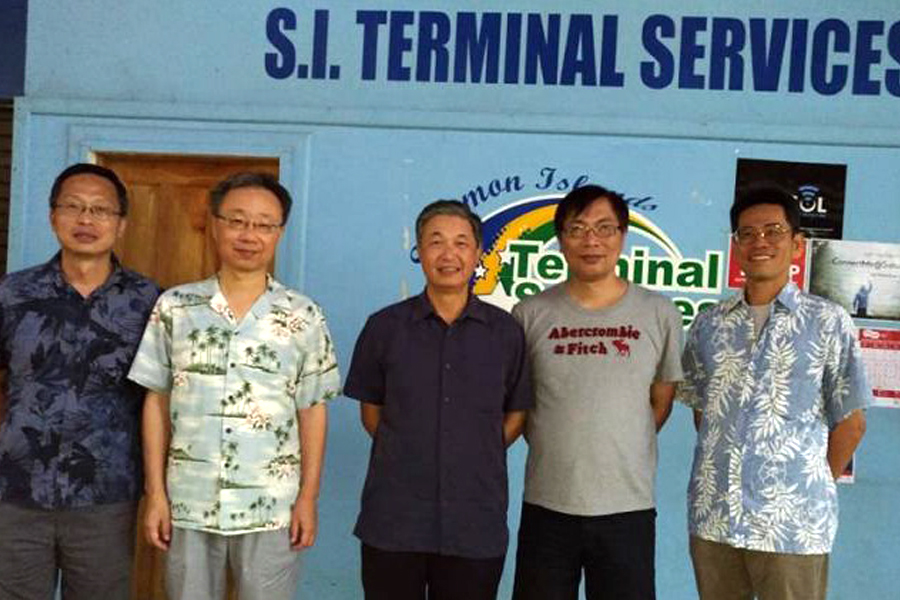
Minister Counselor Mr Calvin Yen (centre) with Taiwan’s Ambassador HE Roger Luo (second left) with other staff of
the Taiwanese Embassy.
BY LYNTON AARON FILIA
Minister Counselor Mr Calvin Yen (centre) with Taiwan’s Ambassador HE Roger Luo (second left) with other staff of the Taiwanese Embassy.
MINISTER Counselor for Taiwan’s Embassy in Solomon Islands was bade farewell by the Ambassador His Excellency Roger Luo on Sunday July 8, 2018.
Mr Calvin Yen after completing two and half years as Minister Counselor for Taiwan’s Embassy in Solomon Islands has left the country on Sunday July 8.
The Embassy expressed its gratitude for the good work Yen has done in fostering the relationship between Solomon Islands and Taiwan.
Taiwan and Solomon Islands have been good friends for more than 30 years, and their friendship has not changed, and numerous support of human resources have been deployed here to maintain the partnership.
Taiwan’s Deputy Counselor Mr Oliver Weng said Yen has served in the Solomon Islands for two and half years and has been instrumental during his term in office.
The Embassy has promoted Mr Oliver Laio as new Minister Counselor.
ON the morning of July 7, 1978, Solomon Islanders in various locations throughout the country lower the Union Jack and raised the Solomon Islands flag. A birth of a new nation, 40 years later to be ravaged by a civil conflict in 1999 to 2003, deteriorating socioeconomic development, rampant corruption and a malfunctioned public service that contributes to lack of development and poor government services.
But who are we blaming for all these misfortunes? Will we be lamenting on the institutions left by our colonialist or review ourselves on our failures and visions towards the future. Indeed, there are many commentaries often made by scholars, journalists, politicians, development partners and others pointing to the lack of consciousness or a sense of nationalism as one of the country’s largest challenges to development. Francis Fukuyama a Japanese American scholar emphasises the country’s informal social network (the wantok system) as the culprit to lack of modernisation.
The story line portrays that the fragmentation of the wantok system produces weak institutions that have failed to drive development. But is this the case for lack of development at the rural areas? Is Solomon Islands’ fault lines really ethnic diversity and fragmented informal social networks? Just recently, we close the Melanesian Arts Festival where we showcase our cultural heritage with other neighbouring island nations. Solomon Islander even recognises the importance of their culture and traditional land tenure system within the national constitution. So if the wantok system and culture are important elements to development in the Solomon Islands. What is it? What is the wantok system?
Informal social networks have been around for generations in both developed and developing countries. Although different societies use and apply them in various context and setting, many have used them to cope with hardship or elevate themselves from poverty. In more developed countries informal social networks are often organised and practised in more formal arrangements such as social clubs doing community services, neighbourhood watch groups and sports or building networks in business and commerce. In the developing world where government organised social protection mechanism are weak, informal social networks are important social safety net that assists people to access needed resources, jobs, educational placements, favours or just basic essentials household needs to survive. Informal social networks are formed and organised around family, kinship, church groups, sport clubs, neigbourhoods or just work colleagues. In Latin America, such informal social network is popularly known as ‘Parenteso’ that allows families to seek assistance via the extended family or kinship. Similar informal network is called ‘Jeito’ in Brazil, ‘Blat/Sviazi’ in Russia and ‘Yougo’ in South Korea. In the Pacific region, particularly in Melanesia, especially in the Solomon Islands, Vanuatu and Papua New Guinea, such informal social network is called the ‘wantok’ (one- talk).
The term ‘wantok’ is a Solomon Islands pidgin term that refers loosely to people who are united through kinship or share the same language, although people use and understand it differently. The term Wan-tok comes from the English word ‘one-talk’ which literally means speaking the same language or belonging to the same kinship group. The wantok system however, refers generally to the widespread practice of helping and favouring one’s wantok. Such informal social networks are also found practised in other Pacific Island countries. In the Fiji Island, it is called the ‘Kerekere system’ ‘Karekare’in Kiribati and ‘Fa’asamoa’ in Samoa. In Vanuatu it is called the ‘Penama’ System, to which describes a tendency of Penama people favouring their own people over other in assisting and helping those in need.
In a more rural setting, a Santa Isabel chief (Jason Leguhavi) once said “The wantok system is a system that involves people who are related (clan and kin-members) working together in assisting and looking after each other in their livelihood. However, the system also includes those individuals who are married to us (sons and daughter of our brothers) and those relatives who are members of the village. In Santa Isabel, those who are born from our brothers are considered not of the tribe (only have secondary rights to land), because their mother is of another tribal group. The wantok system also caters for the welfare of these groups of people in the tribal land. In Uta language this system is call ‘glegu gu’, in Bugotu language it is call ‘tamagha’. ‘Glegu gu or Tamagha’ are terms used to refer to our sons and daughters (nephew and nieces) who are born from our brothers. These individuals we cannot say no or turn our backs on them whenever they need assistance or help.”
Although the system is known in many different languages throughout the Pacific, the term ‘wantok’ describes a cultural way of life based on relationship building (sharing and caring) and reciprocity network that urban and rural households and communities use to cope with stress and shock that affect their livelihoods. Sometimes it can be viewed as a social network that promotes kinship and group identity, where individuals from the same tradition language come to collaborate. However, Melanesians employ the wantok system to influence politics, power (who get what) and control (resource sharing and equality) in their society. At the village level, the wantok system is widely practiced as a social system to maintain social order (family ties and respect), governance (land rights), resource sharing (wealth and redistribution), and to cope with daily stresses of life.
From a theological view point, Maladede a theologian from Papua New Guinea described the ‘wantok system’ as a culture that possesses certain characteristics and roots which she describe as tangible’, has ‘structure’ and ‘intangible’. She argues that in Papua New Guinean culture for instance, the circle of intangible are ‘beliefs’, ‘natural theology’, ‘world view’ and ‘philosophy of life’, which cannot be changed. Structure includes the ‘community’, ‘relationships to the living and the dead’, ‘environment’, ‘exchange and marriage’. The tangibles which can be altered or change are; customs, ‘rituals’, ‘behavioural patterns’, ‘mannerism’, ‘social habits’, ‘fashion’ and the ‘arts forms’.
In any Melanesian society the ‘wantok system’ consist these three characters, however, it is the intangible factors that shape and drives the philosophy of the ‘wantok system’. Although, the structures and intangible factor may or can change, the ‘wantok system’ as a belief and philosophy is embedded and ingrained in the society’s political and economic systems. Therefore it is natural for any Melanesian man to always serve his families and relatives first. In other words, family and relatives are important assets and must be assisted in any circumstances. However, Mohanty an associate professor from the University of the South Pacific has observed that the wantok system is gradually fading due to modernisation factors but is still relevant and widely practiced by the socially and economically vulnerable. So what do we need to do about it?
Derek Mane
Derek Mane Smiles has a PhD in Development Studies from the University of the South Pacific, Fiji Islands, MA (Political Science) from the University of Hawaii at Manoa (USA), and BA (Hon) from the University of Papua New Guinea (International Relations and Public Policy).
THE Pacific Community (SPC) is currently running a leadership course for six local female mid-level public servants.
Four of them come from the Ministry of Development Planning and Aid Coordination (MDPAC), Ministry of Lands, Housing and Survey (MLHS), Ministry of Foreign Affairs and External Trade (MFAET), Ministry of Fisheries and Marine Resources (MFMR) and two come from Youth@Work and SeifPles.
This is the fifth group to undertake this course. The course is based on the Singapore Cooperation Programme (SCP) course given to SPC by the Singapore Civil Service College (SCSC).
SPC’s Regional Director, Mia Rimon, has set the course in the context of Melanesia.
Rimon said the course is designed for managers and leaders.
She said it equips participants to be able to develop their own work ethics and integrity to a higher level, while learning to be leaders.
Rimon said at the heart of public service excellence are leaders who drive the purpose and mission of their organisations and their success in achieving the development outcomes for Melanesia.
“The ability to develop and lead high achieving teams that produce exceptional results is an increasingly important skill for staff in leadership positions,” Rimon said.
She said even without being in a position of authority, learning how to be the most productive and effective staff for their organisations is essential to their collaborative success.
The participating public servants will spare 12 hours of staff time over several months to cover topics in the course.
Topics covered in the course includes; managing projects, communications, leadership, vision and motivating teams, managing conflict and so forth.
Rimon said through this course it has the potential to help locals change this country and increase its civil society for better.
She has already run this course with staff of the SPC country office in Honiara, staff of SPC regional office, leaders of the Youth@Work programme and staff of the Melanesia Spearhead Group.
SOLOMON Water has labelled the front page article in the Island Sun newspaper by Mr Alfred Sasako on Wednesday’s headlined ‘New Water Fee’ as misleading.
The article claimed that thousands of Solomon Water’s customers have been dealt an extra bill to pay in the event their accounts are disconnected and forfeiture of their initial deposit.
“Apart from settling their arrears and reconnection fee, defaulters will now be required to put down a house deposit fee.
“House deposit once upon a time only applied to new connections.
“Now it appears that once an account is disconnected, the account holder has to pay a new house deposit besides arrears and reconnection fee.”
In one case, the article cited, a current existing customer was told to pay $1,010 (one thousand and ten dollars) in new house deposit charge before his account could be reconnected.
The new charge prompted the customer to demand an explanation from the Solomon Water management, saying such a huge outlay is not justified.
He said the new connection and reconnection fees are fair but certainly not the new house deposit charge when one is disconnected.
However, according to Solomon Water in their media statement, the house deposit is not a new fee but is a current fee which has been in place for several years and is charged to customers in the following situations.
On application for a new water connection
Existing Customers who have not paid initial House deposits
Customers whose accounts have been closed or disconnected due to unpaid water fees for a period of time. Standard practice and the exact purpose of the house deposit is that the deposit be used to offset the arrears. As the house deposit has been used for payment of unpaid water bills, the customers will be required to reinstate their house deposit before reconnection can occur.
“The complainant in this instance had never paid a house connection, so falls into category 2 above,” says Solomon Water.
“It should be noted also that after the complainant’s water was disconnected in 2017 for unpaid charges, an illegal connection was made, and the customer only came forward to pay the account, including house deposit, account arrears, illegal fee and reconnection fee when the illegal connection was disconnected by Solomon Water staff in June 2018.
“To clarify, there is no new fee, the complainant has simply been charged appropriately in accordance with our fees.”
Solomon Water’s General Manager Mr Ian Gooden says, “This was all explained to the complainant’s family member when the charges were paid, and had the complainant approached us, this could have been explained to him as well and an erroneous and defamatory article in the press would have been avoided.”
He said neither the Solomon Water executive nor the communications team from Solomon Water were contacted by the journalist for information on this issue.
Being in their announcements every now and then, people who wish to complain about Solomon Water’s services are requested to take their concerns to their Office or dial their landline phone number on 23985, and not the press.
Solomon Water’s Chairman, Phil Bradford also reminds everyone that those people who make illegal water connections and steal water from Solomon Water are in fact stealing money from the good customers who must be forced to subsidise the thefts.
Mr Bradford requests any person who is aware of an illegal water connection to report it to Solomon Water.