Home Blog Page 956

EDITORIAL- Let’s not repeat the mistakes of logging

0

GOVERNMENT last year came up with a policy to fast-track three mining operations for the country.

This was devised with the intention to generate much-needed revenue for the Government in light of the COVID-19 pandemic.

The mining operations were earmarked to take place in Isabel, Choiseul and Renbel.

All three mining companies, who were also loggers, have been issued prospecting licences. They are now waiting for their mining leases.

But while the Government is moving into mining, we must be careful not to repeat the mistakes of the logging industry.

Opposition leader Mathew Wale made a good suggestion on how the Government should play in the emerging mining industry.

One of those suggestions is the establishment of a State Owned Enterprise (SOE) that would invest in the mining sector.

Such an SOE, according to Wale, could hold shares in other mining companies and may self-form wholly owned mining companies.

He said the SOE would ensure that ethical behavior and practices are followed by companies and transfer pricing is eliminated.

“The SOE would also be a platform for share interests for landowners of locations where various operations occur.

“Such an SOE would be linked to a Sovereign Wealth Fund or Future Fund, into which all mineral revenue should go to be invested for the benefit of future generations of Solomon Islanders.

“The SOE can acquire the technical capacity and funding it needs.”

What Wale was suggesting is not only genuine, but the way forward for the country if it is to be in control and benefit from the mining industry.

The logging industry should provide us with enough lessons already.

Although it contributed to 70 per cent of our foreign earnings, it did very little to improve the livelihood of our people.

Furthermore, it was an industry largely driven by foreigners. Our people, who are the forest owners, were mere by-standers.

This is why our people were left high and dry at the end of every logging operation on their land.

Now, we see that some of these loggers are migrating to mining.

Unless we set a new operations manual in the mining industry, these same loggers will come in and continue the same standard of practice they’ve been used to in the logging industry.

We don’t want the mining industry to be another get-rich quick scheme for foreigners.

As a country and people, we must be in charge of the industry. We should be the ones calling the shots and set the operating standards.

Red Cross helps affected families

0
Red Cross logistics person Philip Surukwanga making sure items are set to be provided to the affected families.

SOLOMON Islands Red Cross Society has stepped in to assist families of an incident in Tuebala village in Guadalcanal Plains during last weekend.

This involves the Red Cross providing tarpaulins, shelter kits, hygiene kits, blankets, buckets and drinking containers to the families.

The incident occurred on Easter Monday which saw 58 families leave their homes to seek safety at Gorou Catholic Church Hall, following an intrusion into their settlement by people of a nearby village and torching homes and destroy fruit trees.

Speaking in relation to the incident, a village elder Bernard Chonigolo reflects on the effects of the incident and what they did.

“It was on Easter Monday; many of us has just woken up and preparing breakfast and go out for work,” Chonigolo said.

“We were taken by surprise when men of the other village began shouting in the bushes and coming towards us,” he added.

“We can sense that they are angry and are going to cause trouble. Many of us fled for our lives with only the clothes we wore.

“We were left with nothing and that we do not know where we could get assistance from.

“Luckily one of our females thought to try and seek help from anywhere possible, reaching Red Cross office and making a report on what has happened to us.

“It was sad situation for us as we have been living here for the past 16 years.”

Likewise, the affected families are now provided with shelter at the Gorou Catholic Church Hall, where Catholic Parish leaders there have been kind in taking them in for the moment.

“We are so thankful to the Catholic Church leaders here at Gorou for kindly accepting us and providing shelter for us here.

“It would have been very difficult for us if we were not being able to find anywhere to shelter just after the incident.

“We are also grateful to the Red Cross for stepping in to relief our situation too,” Chonigolo further stated.

—RED CROSS

YES, BUT …

Dr Alex Munamua with the AstraZeneca vaccine that arrived last month/

Government reacts to ‘blood clot and AstraZeneca’ findings by continuing vaccination rollout

BY ALFRED PAGEPITU

Government will continue with its AstraZeneca vaccination rollout programme despite a recent finding linking the vaccine with blood clots.

On Thursday last week, the European Medicine Agency (EMA), a medical arm of the EU, published in its website that “unusual blood clots with low blood platelets should be listed as very rare side effects of Vaxzevria (formerly COVID-19 Vaccine AstraZeneca)”.

Having said this, EMA also echoes the usual advice that vaccinations must continue since the “overall benefits of the vaccine in preventing covid-19 outweigh the risks of side effects”.

While many countries have reacted to this EMA finding by altering their AstraZeneca vaccination programmes, Solomon Islands has chosen to trudge on.

In the UK under-30s are being offered alternative jabs to AstraZeneca, Australia is applying alternative jabs for under-50s, similarly France and Belgium are offering alternative jabs for under-55s even those who have taken their first AstraZeneca shot, Italy and Spain have restricted AstraZeneca dosage to over-60s.

Sadly, Solomon Islands does not have any alternative available. Last night’s newly arrived Sinopharm, according to government, will be stored until given the greenlight by the World Health Organisation (WHO) for use.

Permanent Secretary for Health and Medical Services (MHMS) Pauline McNeil, in a talkback show yesterday said that “the report does not say, however that will stop the roll out of the vaccine, but for the health workers and technical expects to be aware of these linkages”.

Mrs McNeil said the Ministry of health has technical working group (TWG) which reviews such issues, so the decision of TWG last week, they decided that the roll of the AstraZeneca vaccines will continue to be implemented and rolled out.

“This because the benefits outweigh the risk of the vaccination, so the decision of the ministry through the technical working group is to continue the roll out of the vaccine,” she said.

Dr Yogesh Choudri, technical advisor to the ministry of health, reinforces this, saying the EMA findings did not confirm AstraZeneca as a cause for the blood clots.

“Having a blood clot disorder is not uncommon with other vaccines we have seen with Moderna and Pfizer covid-19 vaccine, but this typical presentation that we have seen is reported because it’s quite possible that we are diagnosing it more that this has been reported. However there is a possible link issued but that is not a possible cause.”

He said the health ministry’s technical group continues to closely monitor the situation and work closely with the World Health Organisation (WHO) and other authorities.

AstraZeneca is the only WHO-approved vaccine available for Solomon Islands, with a current 24-000 dose roll-out being piloted.

Rollout was launched on April 24 with quite a number of leaders, including prime minister Manasseh Sogavare taking jabs to show confidence in the vaccine. However, on the overall, this show failed to convince many.

Three days into the rollout programme and government was forced to admit that the turnout for the first phase, which involved 7,000 doses to be administered in Honiara, was very low – the number just shy of 600.

A hard directive from PM Sogavare the following week, coupled with a threat from the Attorney General for frontliners to resign if they refused the jab, seemed to do the trick.

The numbers of frontliners turning up for jab jumped.

This has brought the numbers of the inoculated to 3,044, according to PS McNeil, in her talkback show remarks yesterday. But, still, this figure remains below the halfway mark with rollout entering its fourth week.

Solomon Islands recently received 24,000 doses of AstraZeneca vaccine from the WHO-led COVAX scheme. Seven thousand of this was allocated to the first phase, which involved jabbing frontliners in Honiara.

Second phase, which gets the bulk (17,000 doses), would be implemented in the border communities following the Honiara piloting.

So far, according to McNeil, border communities are embracing the idea of getting vaccinated in support of the government’s drive against covid-19.

A huge awareness programme is currently on in the border communities.

Border communities include Shortland Islands, Malaita Outer Islands and parts of Choiseul province. These regions have been classified as high risk due to their proximity to the border with PNG, our covid-stricken neighbour.

Blood clots ‘very rare side effect’ to Astra vaccine: EU drug regulator

0

BY ALFRED PAGEPITU & IRWIN ANGIKI

Blood clots have been concluded by European medicine regulators to be a “very rare side effect” of the AstraZeneca covid-19 vaccine. However, they urge vaccination to continue.

AstraZeneca is the only WHO-approved vaccine available for Solomon Islands, with a current 24-000 dose roll-out being piloted. Ministry of Health has not responded to Island Sun’s enquiry for comments.

The European Medicine Agency (EMA), a medical arm of the EU, published in its website on Thursday last week that “unusual blood clots with low blood platelets should be listed as very rare side effects of Vaxzevria (formerly COVID-19 Vaccine AstraZeneca)”.

Having said this, EMA echoes the usual advice that vaccinations must continue since the “overall benefits of the vaccine in preventing covid-19 outweigh the risks of side effects”.

“EMA is reminding healthcare professionals and people receiving the vaccine to remain aware of the possibility of very rare cases of blood clots combined with low levels of blood platelets occurring within 2 weeks of vaccination. So far, most of the cases reported have occurred in women under 60 years of age within 2 weeks of vaccination. Based on the currently available evidence, specific risk factors have not been confirmed.”

EMA notes that “the blood clots occurred in veins in the brain (cerebral venous sinus thrombosis, CVST) and the abdomen (splanchnic vein thrombosis) and in arteries, together with low levels of blood platelets and sometimes bleeding.

“[EMA] carried out an in-depth review of 62 cases of cerebral venous sinus thrombosis and 24 cases of splanchnic vein thrombosis reported in the EU drug safety database (EudraVigilance) as of 22 March 2021, 18 of which were fatal. The cases came mainly from spontaneous reporting systems of the EEA and the UK, where around 25 million people had received the vaccine.

“COVID-19 is associated with a risk of hospitalisation and death. The reported combination of blood clots and low blood platelets is very rare, and the overall benefits of the vaccine in preventing COVID-19 outweigh the risks of side effects.

“EMA’s scientific assessment underpins the safe and effective use of COVID-19 vaccines. Use of the vaccine during vaccination campaigns at national level will also take into account the pandemic situation and vaccine availability in the individual Member State.

“One plausible explanation for the combination of blood clots and low blood platelets is an immune response, leading to a condition similar to one seen sometimes in patients treated with heparin (heparin induced thrombocytopenia, HIT).” Said EMA in its website on April 7.

While governments around the world are responding to this EMA finding by altering their AstraZeneca vaccination programmes, Solomon Islands government has chosen to continue with its above-18 years old AstraZeneca jab programme. [See separate article]

In the UK under-30s are being offered alternative jabs to AstraZeneca, Australia is applying alternative jabs for under-50s, similarly France and Belgium are offering alternative jabs for under-55s even those who have taken their first AstraZeneca shot, Italy and Spain have restricted AstraZeneca dosage to over-60s.

However, a spin to these varying policies as experts have cautioned is that “the confusing messages about the vaccine could still dampen enthusiasm for it at a time when Europe and many other parts of the world are facing surging cases”.

According to the Paris-based AFP news agency, AstraZeneca is administered in more countries than its other WHO-approved counterparts (Pfizer-BioNTech and Moderna); 111 countries. BBC reports that AstraZeneca makes for 90 percent of the vaccines dished out by COVAX, the WHO-led scheme designed to ensure poor countries, including Solomon Islands, access covid-19 vaccines in time.

AstraZeneca company has come out welcoming the EMA finding that the blood clot cases “have a possible link to the vaccine … as an extremely rare potential side effect”.

The company adds that it is working on improving its product:

“Overall, both of these reviews reaffirmed the vaccine offers a high-level of protection against all severities of COVID-19 and that these benefits continue to far outweigh the risks.

“AstraZeneca has been actively collaborating with the regulators to implement these changes to the product information and is already working to understand the individual cases, epidemiology and possible mechanisms that could explain these extremely rare events.

“In addition, the World Health Organisation (WHO) today [April 7] said that, based on current information, a causal relationship is considered plausible but is not confirmed, adding that further specialised studies are needed to fully understand the potential relationship between vaccination and possible risk factors.” [AstraZeneca website, April 7]

Meanwhile, WHO is not budging from its support of the vaccine, reiterating the need for vaccination to continue in spite.

Responding to the EMA finding on April 7, WHO in its website announced:

“Based on current information, a causal relationship between the vaccine and the occurrence of blood clots with low platelets is considered plausible but is not confirmed. Specialised studies are needed to fully understand the potential relationship between vaccination and possible risk factors.

“The GACVS subcommittee will continue to gather and review further data, as it has done since the beginning of the COVID vaccine programme.

“It is important to note that whilst concerning, the events under assessment are very rare, with low numbers reported among the almost 200 million individuals who have received the AstraZeneca COVID-19 vaccine around the world.

“Rare adverse events following immunizations should be assessed against the risk of deaths from COVID-19 disease and the potential of the vaccines to prevent infections and reduce deaths due to diseases. In this context, it should be noted that as of today, at least 2.86 million people have died of COVID-19 disease worldwide.”

For Solomon Islands, the EMA finding may not mean much, now, since AstraZeneca is the only WHO-approved vaccine available. The recently arrived Sinopharm, government says, will not be used but stored until such a time it is given the greenlight by WHO.

However, the EMA finding may not be helpful to a government facing a skeptical population (including its frontliners) with an AstraZeneca vaccination drive plan. High low-turnout to the country’s vaccination programme indicates the populace’s hesitancy towards the vaccine. Today, three weeks from launch and the programme is still to reach halfway in its 7,000-dosage planned for Honiara (first phase of rollout).

Leaders can only bank on public seeing the benefits of taking the jab in relation to the risks of not taking it. More so, understand the very low chances of getting one of the rare side effects.

As one UK covid-19 expert said to the BBC, quoted in an April-9 article, hammering home on the rarity of the blood clot: “I mean it’s the equivalent of the risk of dying in the bath, drowning in the bath, for example, it’s that rare, or a plane landing on your house.”


‘Can the ministries do it in 8 months?’

0

By EDDIE OSIFELO

OPPOSITION Leader, Matthew Wale has questioned the capacity of all government ministries to implement the $4 billion budget in the remaining eight months.

Delivering his budget speech in Parliament last Friday, Wale said all ministries are confident in their capacity to implement their budgets.

“However, it is important to note the historic low execution rates recorded by some ministries and see if this is due to capacity constraints and whether any such constraints have been addressed,” he said.

Wale reflected on agriculture from 2016 to 2020 which had an average execution rate for recurrent expenditure is 65%, and Development budget is 35%.

“And in 2019 and 2020, Ministry of Agriculture recorded the highest number of virements (totalling 3.6m in 2019 & 4.4m in 2020).

“A look at the virements is a reflection of the robustness of the budgeting process and budget execution capacity.” he said.

Wale said Forestry – 2016-2020: average execution rate: Recurrent 68%; Development:32%; Virements are also an issue.

He said Fisheries – 2016-2020: Budget execution rates, Recurrent 67%, Development 33%; Virements are heading in the wrong direction.

Wale said the historical evidence is clear that government’s budget implementation is a very real challenge.

“Of course, there are any number of issues that may contribute to this problem.

“Government’s announced reduction of the size of the public service must take this serious matter into consideration, to ensure an already weak budget execution capacity is not further eroded,” he said.

“Have the constraints to budget execution been addressed? This is not clear from the budget documents themselves.

“However, the ministries, by and large, have confirmed there has been no real change to their capacities to implement the budget,” he said.

Wale said in light of this, therefore, it is not unreasonable to conclude that “we are to expect similar budget execution rates in 2021 or perhaps even worse, and given only another eight months remaining for this budget, we are to expect that some budget outcomes may not be delivered as stated.”

Debate on the budget continues today.            

Gov’t slammed for no funds to address gender violence

0

BY ALFRED PAGEPITU

Leader of the Opposition, Matthew Wale has slammed DCGA government for not allocating enough fund in the 2021 Budget to address gender-based violence which he says has increased sharply.

Wale when debating on the on the 2021 Appropriation Bill on Friday said the government clearly does not take seriously the scourge of domestic and gender-based violence in our society beyond the rhetoric.

“If it did, the size of allocations would show it,” Wale said.

“We are not unlike any other country in the world in this matter unfortunately.

“Gender based violence has increased sharply in recent times, at least by 15 percent where records are kept, and we don’t even have a proper recording system for this problem,” Wale said.

Wale said the need for refuge or safe houses in each province is both urgent and desperate.

He said the Government cannot continue its current business as usual attitude to this problem in our midst.

“It must collaborate with the churches and NGOs and invest in a rollout of safehouses across the nation, whilst simultaneously adopting a proactive preventative approach.”

He added that given the urgency and desperation of this situation, it is important that government considers renting properties for safe houses, as it plans for long term solutions.

“There is nothing in this budget to address this cancer. Is it because this problem predominantly affects women, young girls and children?” Wale questioned.

He said that in difficult uncertain times, “we must unite to fight together. Such unity is empty if we continue to turn a blind eye to the weak, the marginalised, the suffering, the abused, the violated in our midst.

“I am very ashamed of this blatant, and it seems deliberate, neglect. We continue on with our insulated lives oblivious to the suffering of our women folk.

“This is not the Solomon Islands society we want to see or build,” he said.

Wale said the Government must show more empathy and compassion.

“Health safety and social safety are connected to national security – surely there is somewhere in these cold-blooded calculations that we can find to fit in funding for our vulnerable and abused women, girls and children.

He made a direct appeal to the PM to intervene personally in this matter and find serious funding to adequately respond to this great need.

Landowners plans to shut down Ziata water source

0

BY ALFRED PAGEPITU

THE Landowning tribes of Munda have decided to shut down the Ziata water source, again.

This was confirmed to Island Sun by spokesman for GMMV Tribes, Mr Rex Biku, yesterday.

Biku said they were expecting the national government to respond positively to their goodwill.

He said that they submitted a letter to the Prime Minister’s Office (PMO) on March 8 this year. Since then the government has not responded.

“Hereof the GGMV Tribes appeal and take to your attention a 14 days grace period to reconsider your decision of how and why you reject our request and please respect our tribe’s intention to meet with your delegation concerning the subject matter.

“But since the government has not responded to our request to sort the issues surrounding the water source, we’ve decided to shut down the source again this after,” Biku told Island Sun.

He said government failed to respond to their letter to the Prime Minister on various issues surrounding the source.

“These issues include ownership and payments,” he said.

Mr Biku said it is clear the government does not want to listen to them.

“If the government fail to response within the 14 days grace period of date they received our letter, the GGMV tribes will demand SIWA to closed down Ziata Customary land Water Pump Station and took in charge of the Water Pump Station key from the Solomon Islands Water Authority (SIWA) at Noro until such time the Government and responsible authority step in to settle our grievances.

“Sadly, we understand the closure of Ziata Pump Station will affect prominent businesses in Noro, such as SOLTUNA, NFD and other Government and private business households in Noro Township and the Noro residents.

“Least we cannot dwell on providing free service to the government whereas the resource owner received nothing from our resource.”

The landowning groups who are behind the action include Gumi, Gemu, Veo, and Miabule.

Shortland chiefs ready to support roll out of covid-19 vaccine in communities

Chiefs in the Shortland islands have conveyed their support for the covid-19 vaccine rollout in their communities.

In a media statement over the weekend, the Health ministry applauded FAMOA Council of Chief in the Shortland Islands, Western Province for confirming their support towards the Ministry’s planned deployment and roll out of COVID-19 vaccines along Shortland communities that are in close proximity to Bougainville.

Bougainville, recently recorded increases in the number of COVID-19 cases and coupled with occasional illegal border crossings, Shortlands including western borderline communities in Choiseul province and the Malaita Outer Islands (MOI) are areas of great concern, for possible entry of COVID-19 that can potentially trigger community transmission.

This led to the inclusion of communities along the western border as priority groups to receive vaccination. Thus, a total of 17,000 vaccine doses have been allocated for all persons 18 years and above along these communities.

As part of the vaccine roll out, health has commenced deployment of national health staff with personals from surveillance, clinical and risk communication and so forth to support ongoing joint borderline operations and vaccine awareness and training of vaccinators. This week vaccine awareness was conducted for FAMOA Council of Chiefs in Shortlands where pre awareness survey conducted showed that only 33 percent of the FAMOA members supporting the uptake of the vaccine. Post awareness survey showed all chiefs.

confirming their support towards the vaccines and pledged their willingness to support the roll out.

Health Permanent Secretary Mrs. Pauline McNeil said that the Ministry of Health is very pleased to learn of the 100 percent support confirmed by the FAMOA Council of Chiefs.

“Thank you FAMOA Council of Chiefs for your support, the ministry applauds the decision undertaken as it will preserve the health of our people in Shortlands and the rest of the country once we vaccinate all persons 18 years and above”,

“This is so because having most-at-risk vaccinated will prevent them from being sick, hospitalized or die from COVID-19 and more importantly prevent spread of the virus to others”, explained Mrs McNeil.

She also added that health will be doing the same with provincial and communities’ leaders in Choiseul and Malaita provinces in the coming days to rally support of these important individual for a smooth roll out of vaccination scheduled for coming days.

Ministry of Health is reiterating calls to the public to ensure that everyone only listen to accurate and right information from reputable sources such as the Ministry of Health including others such as WHO and UNICEF for information on vaccination.

More deployments of national health staff to support provincial health teams to prepare for the roll out of the vaccines along the western border communities is in progress.

MHMS PRESS

Wale laments state of NRH

National Referral Hospital. Photo supplied

BY ALFRED PAGEPITU

LEADER of Opposition, Matthew Wale is worried about the state of the National Referral Hospital (NRH) describing it as an institution desperate on a number of fronts.

In his speech on the 2021 Appropriation Bill in parliament on Friday, Wale said the infrastructure is so dilapidated making it a very challenging workplace.

He said the hospital corporate governance is chained to public service processes and procedures that are inefficient, unresponsive and are probably not appropriate for a peak hospital dealing with people’s health, life and death.

“Its clinical governance is in a perilous state, long neglected.”

“This situation is totally unacceptable and has become untenable,” he added.

“NRH needs a total transformation, and this need is both desperate and urgent, not for the pacific games, but for our people and the health professionals that work at the NRH,” said Wale.

Wale said it is blatantly obvious that the NRH needs an independent board to manage it at an arm’s length from the ministry.

He also adds that the budget must still be fully funded by government, but an independent Board should have responsibility for its own planning, development, governance, staffing, and performance.

He said the Hospital equipment budget needs to be adequately funded. NRH must now have equipment for dialysis treatment. 20% of deaths at the NRH are due to kidney failure.

“This is a significant percentage, and government must take action. It is good policy to tax plastics, sugar and soft drinks.

“I suggest that government add salt to that list”, he said.

Hon Wale further urged the government to ring fence the revenue collected from these taxes, and from alcohol and tobacco for health expenditure directed at the NCD crisis, and the need for appropriate equipment at our hospitals, especially the NRH.

“Ringfencing this revenue to health would also enable funding and the long-delayed roll out of the role-delineation policy to commence,” he said.

New equipment for South Malaita road works

0

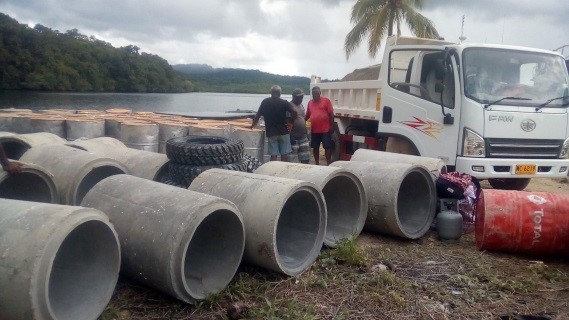
A new eight-ton dump truck and other road work materials have been successfully delivered to the constituency recently.

The Small Malaita Constituency Office this week issued a statement that much needed equipment and materials required for its road infrastructure project had been successfully delivered recently.

The statement said the consignment which consists of a new eight ton dump truck, fuel, culverts, gravels and other hardware materials for the road construction were transported on a chartered boat on Tuesday 30th March 2021.

The new truck for road construction on South Malaita

The Small Malaita Constituency Office said the new dump truck and materials are funded under the PRC funding from last year.

The SMC Office said that the inclusion of the new dump truck will boost road works as it has a large capacity in terms of its tonnage. They said that with the arrival of the new truck the current fleet of various road machineries now stands at 9 machines.

The statement added that the development of road network is vital as it provides linkage between the surrounding communities to the Afio Township.

 “The road infrastructure project is the first priority under the Small Malaita Constituency Infrastructure Development Programme which we have been working on in the last Six years”, the CDO said.

He said road construction work is underway at the moment and is expected to reach Rorongo by the end of April 2021. 

…..SMCO PRESS