Home Blog Page 936

SI economy dropped before covid-19: CBSI

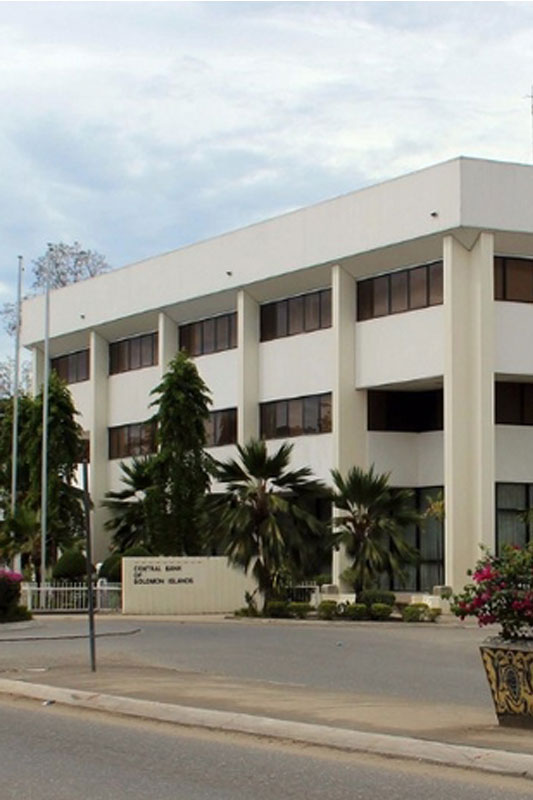
Central Bank of Solomon Islands. Photo by CBSI

By EDDIE OSIFELO

THE Solomon Islands’ economy had slowed down prior to the coronavirus pandemic, according to a Central Bank of Solomon Islands reports.

Economic Association of Solomon Islands (EASI) President, Reuben Tovutovu said this in response to Asian Development Bank’s (ADB) Solomon Islands flagship report, the 2021 ADO Report.

The Asian Development Report states the country’s Gross Domestic Growth has contracted to negative 4.5 percent in 2020 due to the pandemic induced recession.

Tovutovu said the covid-19 only exacerbates (worsen) the decline.

He said some of the challenges resulting from this poor economic performance include:

  1. Increasing unemployment rate and the likelihood of remaining high into the future, especially as new graduates enter the labor market,
  2. further deterioration of the quality-of-service delivery. The reprioritisation policy needs to be managed effectively in order to avoid crowding out of investments in plans and activities that create social cohesion and crime-prevention. The one specific area of concern is the reallocation of funds from other ministries to ministry of health as a measure to contain the covid-19. In doing so, this will disrupt the flow of work plans of other important ministries, eventually affecting the key role of the government, i.e, service delivery.    One clear example is the postponement of tertiary scholarships since 2020.
  3. Decline in the overall standard of living. It is hoped that the Government’s current freeze on new recruitment is only temporary.

EASI was established in 2001 as a Charitable Organisation.

Some of its main objectives include: to further the study of economics science, to stimulate economic research, discussions and debate in the country. 

As a professional body representing economists in the country, EASI has been conducting seminars with some key government ministries such as Lands and Ministry of Infrastructure Development, and recently collaborated with Solomon Islands Chambers of Commerce and Industries (SICCI) on “Private Sector Covid-19 Recovery Strategy”.

Illegal harvesting and stockpiling of beche-de-mer high in Luaniua

0
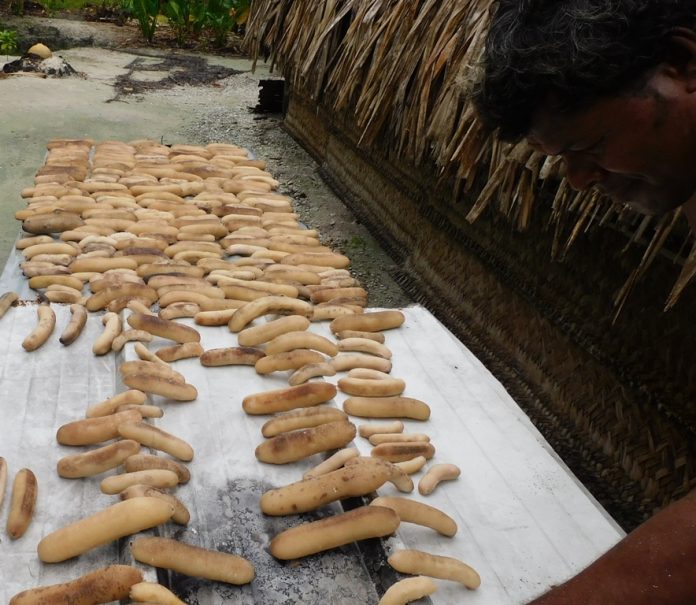
The current illegal bech-der-mer activity in Luaniua, Lord Howe

BY SAMIE WAIKORI

AUKI

Stocks of illegally harvested beche-de-mer are reportedly piled in the Luaniua community of the Malaita Outer Islands’ Ontong Java circle.

Sightings of the piles and open practising of illegal harvesting are contained in a report by a government health team which recently toured the Malaitan outliers on the vaccination programme.

The Ministry of fisheries and marine resources is being called on to investigate this report further and act.

The health team reports that illegal harvesting and stockpiling is rife in Luaniua community and settlements on nearby islands.

They add that the activity is heavier in Luaniua than Pelau, the other main island in the lagoon.

The report describes locals as practising illegal harvesting openly without fear of being seen.

Another highlighted point is that there is no law enforcement system to hold these illegal fishers accountable for breaking the law.

The report adds that large stocks of processed beche-de-mer can be found on the islands.

Meanwhile, Auki fisheries office confirms to Island Sun Auki that the ban is still in force and harvesting of beche-de-mer at this time is illegal.

Auki fisheries adds that there is also no date set yet on when the ban will be lifted, and that all citizens should abide by the law.

On that note, the report also shared the serious economic situation people face as a result of covid-19 and the ongoing impacts of climate change on the islands.

 It said bech-der-mer is the only resource people in Lord Howe depend on and it has been years since the last lift of bech-der-mer nationwide.

The report reiterated that the current economic situation experienced in MOI needs deliberation from the national government to act in possible way to rescue people from the situation.

Economy expected to recover in 2022

Elma Elbling ADB Pacific Country Office

By EDDIE OSIFELO

THE Solomon Islands economy is expected to recover to one percent in 2021 and 4.5 percent in 2022 as fishing and construction rebound.

However, logging output is expected to continue falling.

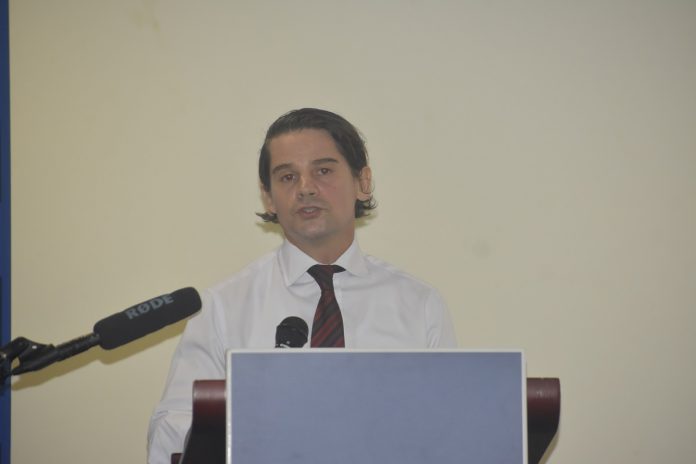
Asian Development Bank’s Solomon Islands Country Office Unit Head Elmar Elbling said this when he presented Asian Development Outlook (ADB) 2021 at Heritage Park Hotel yesterday.

Elbling said as part of its policy redirection, the Solomon Islands government declared a hiring freeze in February with positions vacant since January made inactive.

He said although essential services and education are exempted, the freeze will contract public services.

“Growth in construction and related business is expected to benefit from infrastructure projects, notably the Tina River Hydropower Project, upgrades to transport, the rehabilitation and expansion of water supply and sanitation systems, and construction for the 2023 Pacific Games.

“The fish catch will likely rebound in 2021 and 2022, but logging output is expected to fall further to 1.8 million cubic meters, reflecting government efforts to improve sustainability,” he said.

Elbling said the government is relying on the COVID-19 Vaccines Global Access Facility (COVAX) to provide vaccines for the remainder.

He said it aims to vaccinate the whole population by the end of 2021, but this may prove to be a challenge, especially on outer islands.

“Only 19 cases of COVID-19 had been recorded as of 31 March 2021, all of them repatriates.

“Despite the cuts in spending, budget deficits are expected to persist in 2021 and 2022 with the need to continue funding for COVID-19 preparedness and support to the economy, subsidies to keep Solomon Airlines operational, and expenditures for the Pacific Games,” he said.

Elbling said inflation is expected to ease to 2.5 percent in 2021 as food supply chains normalize, then accelerate to 3.5 percent in 2022 in tandem with global price increases.

He said although exports in particular fish, crops, and minerals are expected to rise, the current account deficit is forecast to widen to equal 9 percent of Gross Domestic Product in 2021 and 11 percent in 2022 as imports rise to supply construction projects.

High population growth rate challenges country

0
Economic Association of Solomon Islands President, Reuben Tovutovu

By EDDIE OSIFELO

ECONOMIC Association of Solomon Islands (EASI) says one of the challenges confronting the country is the high population growth rate.

The recent national census confirmed the country’s population has reached more than 700,000.

EASI President, Reuben Tovutovu said this in response to Asian Development Bank’s (ADB) Solomon Islands flagship report, the 2021 ADO Report, that unprecedented times demands unprecedented but workable policies.

Tovutovu said currently Solomon Islands has the highest rate in the region with 2.7 percent annually.

He said translated into classrooms, this is equivalent to 1.5 classrooms per day, or 548 classrooms per year.

“However, although the twin challenges of high population growth and urbanisation can create a myriad of socio-economic challenges, they can also be catalysts for growth and innovation, for example as sources of markets for local produce,” he said.

Furthermore, Tovutovu said with the launch of the undersea cable in early 2020 resulting in low costs of data, digital platforms for doing business, especially connecting rural producers to urban markets should be promoted.

He said this will not only indirectly stimulate increased local food production but also ensure food security in the short to medium term.  

Impact of quarantine on economy revealed

By EDDIE OSIFELO

THE Solomon Islands economy contracted by 4.5 percent in 2020 with log output falling by 12 percent and fish catch by 40 percent largely due to quarantine restrictions on production and shipping.

Asian Development Bank’s (ADB) Solomon Islands Country Office Unit Head Elmar Elbling said this when he presented Asian Development Outlook (ADO) 2021 at Heritage Park Hotel yesterday.

Elbling said construction also slowed as the movement of equipment materials, and workers from overseas were delayed.

He said logging and crop production also suffered under the impact of Cyclone Harold, which struck in April.

Furthermore, Elbling said growth in public services accelerated from 1.3 percent in 2019 to 1.7 percent in 2020 due to COVID-19 related spending.

He said an Economic Stimulus Package contributed to an increase in the fiscal deficit from the equipment of 2.0 percent of Gross Domestic Product in 2019 to 2.5 percent.

“In November 2020, the government announced components of a major policy redirection to focus on protection from COVID-19, economic recovery, and sustainable development.

“It also delayed passage of the 2021 budget until April 2021,” he said.

Elbling said inflation almost doubled from 1.6 percent in 2019 to 3.0 percent in 2020, reflecting in part a tripling of the price of betel nut in early 2020 as adverse weather affected supply.

He said food prices rose by 1.3 percent in 2020 because of damage from Cyclone Harold and tax hikes for rice, sugar, and sugary beverages.

“Higher inflow of grants and declining imports shrank the current account deficit significantly, outweighing the 18 percent fall in exports, which saw logs and timber down by 21 percent and fish by 16 percent.

“Imports fell by 19 percent, led by declines of 28 percent for machinery and vehicles, 23 percent for manufactured goods, and 20 for fuel,” he said.

Elbling said to address stress on the balance of payments caused by COVID-19, the government secured in June a $28.5 million financing from the Rapid Credit Facility and the Rapid Financing Instrument of the International Monetary Fund, which also provided debt service relief through the Catastrophe Containment and Relief Trust.

He said Gross International reserves were up by 12.4 percent at the end of 2020 and were sufficient to cover 19 months of merchandise imports.

Stealing is a crime: Court

BY JENNIFER KUSAPA

PRINCIPAL Magistrate Augustine Aulanga has reiterated taking another person’s property without consent is a crime and it will always have punitive consequences.

He made the statements when sentencing a 17-year-old at the Honiara Magistrate Court earlier this week.

The 17-year-old female juvenile was charged with two charges of simply larceny contrary to section 261(1) of the Penal Code.

The first charge relates to the theft of 61,288 Philippine currency known as “peso”, and the complainant is the grandmother of the accused.

Whilst the second charge relates to the theft of an external hard drive, a portable charger and a Wi-Fi modem. She committed this offence by cutting the suitcase of the complainant and then removed the stolen items. This occurred on December 8, 2019 and at the same Townground area in Honiara. All the stolen items have already been retrieved and recovered.

Aulanga said in his sentence the accused is a young person of 17 years old and therefore, a juvenile. The law of Solomon Islands and even abroad have always strive to ensure that a juvenile be treated differently and leniently by the court during sentencing, compared to an adult offender.

“This is because a juvenile does not fully understand the consequence that will follow when committing an offence. This is attributed to the fact that a juvenile is immature and is prone of making mistakes compared to an adult or matured person,” Aulanga said. 

However, the offender should know that stealing is a crime. It is the taking of another person’s property without consent. Since it is a crime, it will always have punitive consequences. Therefore, as a 15 year old girl at the time of the offending, common sense should tell her to keep her fingers off from other people’s personal items.

“I understand she is related to the complainants so I don’t see any reason why she should have asked them first before taking their properties,” Aulanga said.   

He also said since the two charges do not involve violent offending, he considers rehabilitation as the paramount consideration for the sentence for the accused.

Aulanga also said the situation of Solomon Islands is always prone to juvenile recidivism or the risk of a juvenile returning into the bad or vicious cycle of reoffending because of the lack of government supervisory or support programs to monitor the behavior of a juvenile offender following release from imprisonment.

Facilitating rehabilitative sentencing mechanisms and at the same time, ensuring a juvenile is held accountable for the crime committed, is the appropriate and preferred conventional approach in dealing with a juvenile offender, Aulanga said.

Therefore, Aulanga sentenced the accused on the first count, one year imprisonment but was substituted with a compensation order for her to pay $9,840 (SBD), an amount equivalent to 61,288 pesos, to the complainant before or by 31st July 2021. Breach of which, the offender will be arrested and brought to court to serve the 1 year term with immediate effect.

Whilst for the second charge that involves the theft of the external hard drive, the portable charger and the Wi-Fi modern, the court imposes six months but fully suspended for 12 months on the condition that she is to be of good behavior and will not commit any new offence during this operational period, the reason for imposing this suspended term is that all the stolen items had been recovered.

Man, evaded police since 2018, arrested

0

BY JENNIFER KUSAPA

Police have arrested a man who had been evading them since 2018.

He was apprehended on April 24, this year.

Deputy Police Commissioner Ian Vaevaso said the alleged suspect had been on the run since 2018 following an alleged murder incident at Afeala village, East Kwaio, Malaita Province.

Vaevaso said the man had a co-accused who had already been arrested during investigations.

Last week police were alerted to reports that the wanted man was onboard the ship, LC Gulatatae, heading for Honiara from west Kwaio.

Central Police station in Honiara were alerted and they arrested the man on arrival at Pt Cruz wharf. He was placed in custody awaiting further dealing and remand application.

Vaevaso thanks the communities for working together with police leading to the arrest.

“This kind of working together is something that police expects from our communities and for police to be successful in there is for public and community collaboration,” Vaevaso said.

Meanwhile police said the suspect has been charged with murder contrary to section 200 of the Penal Code.

Last day for jab

Staff-of-National-Public-Health-Laboratory-with-the-V-sign-indicating-their-done-with-first-Covid-19-vaccine-jab

BY MAVIS N PODOKOLO

THE first phase of the AstraZeneca vaccination rollout in Honiara is expected to complete today, says Pauline McNeil permanent secretary to Ministry of Health and Medical Services.

According to McNeil, 7000 doses of AstraZeneca vaccine were allocated for Honiara to be administered.

“Hopefully vaccination rollout will be completed today Friday, April 30, 2021,” she said.

However, she hints that the priority is to fully utilise the 7000 doses, which may mean extending the days if supplies are not exhausted by today’s end.

McNeil said the ministry of health will continue vaccination until they fully utilise the 7000 allocated AstraZeneca does for Honiara.

With this she called on those who have not yet been vaccinated to come forward and get their jab today.

McNeil said those who are to be vaccinated include frontlines, those who are above 40 years of age, public figure, 18 years old above, Parliament Members, public figures, Members of the diplomats, former Governor General, Church leaders and community leaders, sporting groups and others.

Illegal beche-de-mer harvesting hinders vaccination in Luaniua

Vaccination roll-out program at Luaniua in Ontong java last year.....Photo supplied

BY SAMIE WAIKORI

AUKI

Current illegal harvesting of beche-de-mer in Luaniua, Ontong Java, has reportedly hindered successful vaccination of all eligible people there.

A government health team which recently toured the Malaitan outliers, Ontong Java and Sikaiana, released a report saying this led to only 50 percent of Luaniua’s eligible population being vaccinated.

The health team also stressed the continued high risk in Luaniua due to this low vaccination turnout.

Only 270 people out of the estimated 1000 eligible 18-years-old and above from Luaniua community and nearby settlements were vaccinated.

The report elaborates that other contributing factors could include myths about the AstraZeneca vaccine and associated fears among the islanders.

But, regarding myths, the health team is adamant that it had debunked the false rumours attached to the vaccine before the vaccination programme ran.

The report also took into account the fact that the vaccination is not compulsory, which is taken as another possible factor contributing to the low turnout in Luaniua. In other words, some simply chose not to be jabbed.

However, the health team reported receiving information that a large portion of Luaniua’s population were scattered throughout the lagoon atolls on beche-de-mer fishing expeditions.

These people did not turn up for jabs, it is reported.

The report meanwhile said that the vaccination program was also conducted in Pelau (the other main island in Ontong Java) with an overwhelming turnout.

More than 400 people were vaccinated, equivalent to 80 percent of the small population on the island.

The report said the remaining 20 percent are those who recently left the island to Honiara.

Rolling out SafeNet to provinces a learning process for MWYCFA: Ngai

0
supervising director for the Women's Development Division (WDD) within the Ministry of Women, Youth, Children and Family Affairs, Vaela Ngai said the rate of Domestic violence has increased over the years.

BY MAVIS PODOKOLO

DIRECTOR to Ministry of Women, Youth Children and Family Affairs Vaela Ngai says SafeNet rollout process to the provinces has been one of great learning for the country.

“The SafeNet roll out process to the provinces has been one of great learning for us in the Solomons,” Ngai said

She said for the past years SafeNet has been mainly established at the national level around the capital, Honiara until more recently beginning in 2018 they began the process of rolling out to the provinces.  

“We have rolled out SafeNet to four of the nine provinces and will continue to the remining five provinces this year,” Ngai said.

She stressed while there are standards and principles that govern SafeNet work regardless whether it is at the national or provincial level, they have tailored the safe net model to fit the context of four provinces.

Ngai added for instance, the need to expand the provincial SafeNet members to include community groups and leaders including chiefs as an entry point into the referral system for victims and survivors of GBV.

“This was to provide that link between victims and survivors from rural and remote areas to the Gender Based Violence services and referral system,” she said.