Home Blog Page 656

Mass cattle vaccination in Malaita

0

BY SAMIE WAIKORI

THE Reach Consultancy Firm (RCF) will begin a free mass vaccination rollout on cattles in Malaita province.

RCF comprises of Malaitan experts in various fields including medical and agriculture.

The vaccination came after a MOA signed between MARA government and Director of Reach Consultancy, Former PS of Malaita province, Mr Fredrick Faabasua on November 10 2022.

In a statement from Faabasua, on the day the MOA was sealed a team of experts from Reach Consultancy Firm began vaccinating cattles at Dala Farm, a farm owned by Malaita Provincial Government.

Witnessing the vaccination was Premier of Malaita Province, Daniel Suidani, who was impressed to see a milestone achievement between his government and the private sector.

Faabasua said that under the MOA, Reach Consultancy will source the important vaccines from its overseas agents in Queensland, Australia at its own expense to provide the ground expertise, while the Malaita Provincial Government provides the logistical support on the ground.

“The vaccination rollout aims to cover all cattle on Malaita Island and this will be a mass rollout free to all farmers throughout the island.

“The only thing is for farmers to prepare yourself by establishing a proper stockyard so we can administer the drugs to your animals. Farmers will not pay for this service as it is provided free for you at your door step, although these vaccines are not cheap to acquire.

“The vaccination is important as it will protect your cattle from Leptospirosis to prevent abortion and Black Leg as there is certainly evidence of Leptospirosis on the island.

“Vetmec which will kill all internal and external parasites and SWAT pour on to eradicate Buffalo flies that can caused BEF or three-day sickness that there is evidence in cattle on Malaita.

“When cattle are vaccinated from Leptospirosis, it is a guarantee that your pigs, dogs and including us human beings are protected,” Director of Reach Consultancy stated.

He said that as part of the rollout, Reach Consultancy team will visit cattle farms in West Kwaio and Central Kwara’ae region from November 14 with the vaccinations.

Faabasua said the team will also send one of its officers to the Kwaibaita region in East Kwaio/Kwaraáe where currently is the main supplier of beef on Malaita to prepare farmers for the vaccination rollout ahead.

Adding that after completing the central, eastern and western regions of Malaita Island, the team will go North and South regions.

He said this would be the first doze of the roll-out and its second dose will applied after a period of 5-6 weeks, depending on the financial support they will get from MARA provincial government.

Faabasua said the Reach Consultancy thanked Malaita provincial government for small financial support continues to receive to carry out the vaccination roll-out on cattle in the province.

However, he said given the geographical challenge to reach to four regions in the province with the roll-out, Reach Consultancy definitely need logistical support and they’re calling on generous donor to support this life changing engagement with cattle farmers on Malaita.

“When we talk livelihood, the improvement of cattle stock, supply and quality is the answer and part of this equation.

“This is a start of bigger things ahead to come in reviving the cattle industry on Malaita that will be led by private sector,” Faabasua said.

He said the Reach Consultancy expertise ground team led by Director Mr Faabasua Faabasua, Dr Israel Wore, (the only available Veterinary Doctor in Solomon Islands), Mr Wilfred Maeluma, a retired livestock lecturer at SICHE now SINU, and Mr Rex Ramoiau, a retired livestock officer at the MAL Agriculture Extension Office in Auki, and Mr Ledley Diudi, another retired livestock officer from MAL Auki who still have contract with MPG that will ends in November 2022.

Gauze runs out at NRH

0
National Referral Hospital

BY IRWIN ANGIKI

The national referral hospital has reportedly run out of gauze, affecting services such as medical operations.

It ran out on Friday 11th of November, a doctor at the (NRH) told Island Sun on condition of anonymity.

“Last week, operations in the theatre could not be carried out because oxygen supplies had run out. Later, the gauze ran out.”

The oxygen problem has been resolved with reinforcement of re-agents, the doctor says.

“Now, it is gauze.”

A mother, who prefers to be called by her first name, Mary, shares her frustration to the paper yesterday:

“My son was supposed to have had his operation last week. When we came as scheduled on Tuesday last week, we were told there was not going to be any operation because of oxygen had run out, and were advised to return this week.

“When we came today [Monday, Nov 14] we are again told there will be no operation because there is no gauze. And, we are being advised to try come again on Thursday, implying that it is not confirmed whether there would be any operations for my son on Thursday too!”

The National Medical Store at Ranadi says this shortage will “hopefully” be resolved by today [Tuesday, Nov 15].

“NRH just called us today [Monday, Nov 14] about the Gauze shortage, and our boss has gone to sort this out with the container at the Ports,” an officer at the Medical Store spoken to said yesterday.

“Hopefully if all goes well, gauze will be available at the NRH tomorrow.”

Meanwhile, Ports has confirmed to Island Sun that the National Medical Store has few containers at their storage yard, and that one had been cleared yesterday.

No comments could be sourced from the Health ministry (MHMS) before this paper went to print last night.

Gauze are highly useful accessories in hospital and clinics.

Gauze is available as pads or sponges, which are used in many applications, especially for general cleaning, dressings, prepping, packing and debriding wounds.

It can also be used as a temporary absorbent dressing over wounds.

It is heavily used in operation procedures in the theatre.

Frigate Island on path to being tourist haven

0

BY SAMIE WAIKORI

THE white sandy island of Nafinua, also known as Frigate Island, outside of Namuga, Star Harbour of East Makira, is on its way to becoming a tourism haven.

A MOU was signed on Monday, November 7 between Ministry of Culture and Tourism, investors and landowners of East Makira for the development of the island into a resort.

An advocator for tourism in Star Harbor, Alfred Murray, who is also the owner of Star Beach resort at Namuga, said the MOU is historic for tourism in Makira-Ulawa province.

He said Makira-Ulawa unlike other provinces is far behind in the industry and the MOU sets a basis for development of tourism in the province.

Murray said during the ceremony last week, landowners and people learnt from national government and investors on the cooperation they will sow for the development.

He said there were also traditional dances and other activities performed to mark the historic event.

Murray, who played vital role in negotiating the development, said this is the beginning and they are eager to see the development extend to other parts of the province.

He said Makira Ulawa province has some breath-taking natural beauties worth exploring and tourism would be a blooming development for the province, if government prioritises it.

“This is the beginning and we would like government to step-up infrastructure development in the province to support the thrive of the industry in the province.

“Also, resource owners in MUP to work together and allow their resources for tourism and other developments that support the industry,” Murray said.

He said after the MOU, construction continued from initial work carried-out on number of bungalows on the island that hindered by the pandemic early this year.

Murray said work on the resort will soon complete and ready for operation.

He thanked national government and investors where most of them from Australia for support and efforts rendered for the development of Nafinua Island into a tourism destiny.

A concrete structure with a deep history

    0
    The gate, or torii, of the Shinto shrine that was buried when Sakurajima erupted on 12 January 1914.

    By OFANI EREMAE

    LOCATED under a tree at the foot of the towering Sakurajima volcano in Japan’s south, this odd concrete structure bears little semblance to the rich history of the island it occupies.

    Indeed, it looks quite desolate and inconspicuous, and may not attract a second glance from a passerby.

    But behind the simple, spare lines lies a deep history that goes back 108 years, to 1914.

    The story went like this:

    This concrete structure was actually the gate, or torii, of a Shinto shrine.

    Sakurajima volcano burst to life on 12 January 1914. It was a major eruption.

    All the houses of Kurokama village below the volcano were covered with ash and pumice stone, with only their thatched roofs remaining visible.

    The three-meter high shrine gate was also buried, with only the top exposed.

    Days after the eruption, villagers tried to salvage the gate because of its cultural significance. 

    However, the head of the village at that time decided to keep it buried to remind future generations of the dreadful disaster that killed up to 58 people and destroyed more than 2,000 homes.

    And, so, the buried gate remained as it is until today.  This piece of history is one of many you come across when visiting Sakurajima.

    No major eruptions have taken place since 1914, but Sakurajima remains one of the world’s most active volcanos to this day.

    When a group of journalists from the Pacific and Caribbean visited on Thursday, they were told an eruption occurred that morning. To the island’s 600,000 residents, such a minor eruption is not unusual. They’ve gotten so used to it that it’s just part of their daily routine.

    But this is not to say the people are unaware of the danger and risks the volcano poses. They are well aware and their level of preparedness is unprecedented.

    In fact, their government – they are part of Kagoshima Prefecture – has invested so much over the years in the monitoring of the volcano and preparedness of the residents.

    Sakurajima International Volcanic Sabo Center is one example.

    The towering Sakurajima volcano, which remain active to this day. Photo supplied.

    The center is a world-class facility that manages information on debris flow, and on volcanic activities for possible evacuation warnings. Three high-tech observation tunnels worth S$22 million were als o built on the island to monitor the volcano.

    Tomohiro Nakashima is the Chief of Crisis Management Division at Kagoshima City.

    “We are the leading city in volcanic disaster preparedness,” Mr Nakashima told the visiting journalists.

    “Sakurajima is the only volcano in the world with three observation tunnels. This fact indicates that the response to the large-scale eruption expected in the near future is an urgent issue,” he added.

    Besides these high-tech facilities, Kagoshima City also built 13 roadside emergency shelters so that residents and visitors could take immediate cover in the event of an eruption.

    Mr Nakashima said evacuation drills for residents are also conducted once a year as part of their disaster preparedness.  The first recorded eruption of Sakurajima was in 708 and the volcano has been in almost constant activity since then.

    One of the most interesting facts about Sakurajima, according to published reports, is that it was itself an island until 1914. Lava flows from a large eruption that year spread and hardened, connecting the island to Osumi Peninsula.

    Since 1955, the volcano has erupted 100-200 times a year.

    In 1994, there were 126 eruptions and on May 23, 1995, an explosive eruption sent ash 2,500 meters above the summit crater.

    In 2013, another major eruption occurred, sending ash up to 5,000 meters and coating nearby Kagoshima. Ash falls up to 143 times per year, depositing an average of 100mm annually.

    People can be seen walking around the town, or sometimes even in Kagoshima City, with umbrellas to protect their clothes and skin from falling ash.

    Despite the constant risks island residents face from the volcano, relocation is not an option.

    Residents seemed to love their island,and would rather live with the volcano there than elsewhere.

    Yokohama shows the way to disaster preparedness

    0
    Journalists from the Pacific and the Caribbean, along with their program coordinator from the US pose for a photo following a flood demonstration at the Yokohama Disaster Risk Reduction Learning Centre. Photo: Floyd K. Takeuchi

    By OFANI EREMAE

    AS global temperatures continue to rise, weather experts have warned of more intense cyclones, flooding, and rising sea levels.

    The Pacific region, they say, is on the frontline of climate change. So, the future of the region’s inhabitants is at stake.

    Already, we have seen an increase of Category 5 hurricanes, as well as flash-flooding, that have terrorized communities across the region, and made life harder for them.

    The number one question worth asking is, are we prepared to face this disaster and minimize the loss of lives?

    In Solomon Islands, the 2014 devastating flash-flood that ripped through capital Honiara is a stark reminder of our lack of preparedness.

    It was the worst and most severe flooding (and certainly not the last) to have hit the country. At least 21 people lost their lives, while hundreds were left homeless.

    Simply, no one expected the flooding to be so intense and that families living on the banks of Mataniko River, and who have lost loved ones, did not prepare for it.

    In fact, our lack of disaster-preparedness is our biggest failure in the face of rising global temperatures.

    Training people to prepare and take care of themselves is all that is needed to save lives during a disaster.

    And no one seems to do this better than the local government of Yokohama City in Japan, where I visited the other week.

    I am part of a group of senior journalists from the Pacific and the Caribbean on a 10-day media fellowship sponsored by the Association for Promotion of International Cooperation (APIC) in partnership with the Foreign Press Centre of Japan.

    When we called into Yokohama, a city of more than 3.7 million people, staff of the Yokohama Disaster Risk Reduction Learning Center (https://bo-sai.city.yokohama.lg.jp/en/ ) were eagerly waiting to demonstrate the work they are doing preparing residents of the city for any disasters.

    “Preparation is everything if we are to save lives in times of disasters,” says Hiroshi Mizutani, Manager of Regional Disaster Prevention Division, Crisis Management Office of the City of Yokohama.

    At the centre, residents, school children, and people with disabilities have all been given the opportunity to take part in disaster preparedness exercises designed to help people understand what to do during flooding, cyclones or earthquakes.

    Besides, the city has also established 459 evacuation centres, located at selected schools that can be used in times of disasters.

    The Yokohama Disaster Reduction Centre is opened to school-age children to learn disaster preparedness technics at a younger age.
     

    Mizutani said it is important that people take responsibility for their own evacuation and safety during disasters. This is why the demonstrations and exercises the centre provide are important, he added.

    The Pacific, in particular the Solomons, where disaster preparedness is terribly lacking, has a lot to learn from the Yokohama model.

    This is a Japanese city that is prepared to share their experience with the Pacific and others out there.

    Remember, global temperatures are rising. Floods and cyclones are now more frequent than ever before. The sea level keeps rising and is eating away our shorelines.

    What are we waiting for?

    We cannot wait for another flash-flood or a category 5 cyclone before we act. The worst is yet to come.

    Solomon Islanders need to prepare now!


    When a classroom is turned into a museum

    0

    The four-storey Arahama Elementary School building that has been turned into a monument to remember the 2011 earthquake.

    By OFANI EREMAE

    IT once served a thriving community of 2,200 residents.

    But today the four-storey Arahama Elementary School, near Sendai city in Japan’s north, stood quiet as a monument left in memory of those who lost their lives in the 2011 Great East Japan Earthquake in the Arahama area.

    “It’s no longer used as a school,” Takayama Tomoyuki, who took a group of visiting journalists from the Pacific and Caribbean on a guided tour of the building, explained.

    The journalists are in Japan on a 10-day media fellowship funded by the Association for Promotion of International Cooperation (APIC).

    Tomoyuki said after the tsunami flattened the Arahama area, located just 700 metres from the Pacific Ocean’s coastline, residents of the area sat and discussed the future of the school.

    “After much discussion, locals resolved to close the school and turned it into a museum,” he added.

    That was because the neighborhood has been designated a high-risk area for disasters, so many former residents have resettled further inland, in the Arai Station area.

    Arahama Elementary has served its residents since 1873. It is the oldest elementary school in the area.

    Like many residents of the coastal areas of Sendai, Tomoyuki remembered the 9.0 magnitude earthquake and 8.4 metre high tsunami well, which hit the region on 11 March 2011.

    “It came from that direction,” he said, pointing to the southern direction, just 700 metres down the road, where the tsunami, which caused the destruction, came.

    “It brought with it debris and cars, and left them inside the first floor of the building,” Tomoyuki said.

    “You see the sign up there, this is where the tsunami reached,” he added, pointing to the second floor of the classroom building.

    Although one female student lost her life in the disaster, Arahama Elementary School had in fact saved 320 people on that day, who took shelter in the upper classrooms.

    They include children, teachers and other evacuees, who made it to the building just before the tsunami came.

    The 320 remained in the classroom until rescue helicopters came and got them out to safety throughout the night.

    The first and second floors of the school were flooded by the tsunami.

    Visitors can see the ripped floor tiles and bowed blackboards in the first-floor classrooms, and the high water mark of the tsunami on the second floor.

    On the undamaged upper floors, each classroom has been converted into an exhibition space.

    There is a room which plays films showing how people survived at Arahama on March 11, with footage of the school surrounded by the ocean.

    In another room, a detailed 3D model memoralizes the homes and businesses that once stood in Arahama.

    The buckled, dirty clock which marks the moment everything changed is preserved in a glass cabinet in a room on the fourth floor, alongside other relics of the destruction and educational displays about disaster prevention.

    On the wall in the hallway of the second floor, hangs a plastic sign showing the high-water mark of the tsunami, which was 4.6 meters high when it struck the school. It was double that when it initially hit the beach

    From the roof-top, there are clear views of the ocean, the ongoing recovery-related construction taking place, and 10 kilometers in the distance, downtown Sendai.

    In the space between the ocean and the school, Tomoyuki spoke of the once thriving community of 2,200 residents and 800 houses.

    Today, only swathes of sectioned blocks where families once lived, now transformed into a dried-out manicured grassland with no meaningful signs of the thriving life that once existed there.  

    On the morning the journalists visited the school, there were many people who came to the school to learn about the tsunami, as well as those who came to pay their respects.

    The reality of this beautiful school, which has served its residents for almost two centuries, being turned into a monument is unthinkable.

    But with the neighbourhood now declared unliveable, Tomoyuki says turning the four-storey Arahama Elementary School building into a monument was the best way to remember a disaster that had claimed so many lives and changed the course of history.

    turned into a museum

    Health strategic plan covers climate change Health strategic plan

    0

    By EDDIE OSIFELO

    THE impact of climate on health-related issues is highlighted in the National Health Strategic Plan 2022-2031, launched at FFA Headquarters on Monday 7th November 2022.

    The country is vulnerable to rising sea levels and natural disasters such as tsunamis and sea surges associated with cyclones; and around 35 percent of the country population live in low elevation coastal zones (0-10 metres above sea level).

    The National Statistics Office estimates that Solomon Islands has a population of 721,455 at the time of the 2019 census.

    The population is relatively young, with around 41 percent aged less than 15 years.

    The population is forecast to increase to 912,567 by mid year 2031, an increase of around 191,000 from the 2019 provisional population count.

    According to the report, warm temperatures increase the risks of water and vector borne diseases, such as diarrhoea and malaria, injuries and illnesses, and heat stress.

    Further to that, the report states the country faces hazards that intersect with climate change, including poverty, inequality and poorly planned development.

    It says climate change may increase the number of people at risk of heat related medical conditions, particularly the elderly, children, those who are chronically ill, and at-risk occupational groups.

    The report also states climate change increases risks to food security through land degradation associated with salination of the soil in coastal areas, impacting nutrition and health.

    Apart of that, Solomon Islands consists of six major islands – Choiseul, Guadalcanal, Malaita, Makira, New Georgia and Santa Isabel – and 992 smaller islands, atolls and reefs covering 28,466 square kilometres.

    The topography ranges from thickly forested volcanic uplifts with deep ravines to low lying coral atolls.

    Low investment in child protection

    0

    BY MAVIS N PODOKOLO

    EVIDENCE shows that the level of public investment in child protection in Solomon Islands is very low.

    That is according to the Permanent Secretary of the Ministry of Women Youth, Children and Family Affairs Dr Cendrick Alependava at the one-day inception workshop on economic Costs of Violence against Children (VAC) in Solomon Islands held on 9th November 2022.

    “Existing evidence shows the level of public investment in child protection issues, particularly in prevention of and response to violence against children, which is a core part in child rights, is very low,” Alependava said.

    He said the relevance of violence against children in Solomon Islands is very high.

    Alependava stressed the DHS survey 2015 indicates 85.5 percent of children aged two to 12 experience some form of violent discipline, with 22 per cent reporting ‘severe physical punishment’. Similarly, in the 2009 Child Protection Baseline Survey, 72 per cent of parents reported having used violent or physical discipline against children in their households.

    He adds with that the aim of this Analysis (workshop) is to produce evidence on the economic implications of violence against children for Solomon Islands.

    Alependava said it will estimate the economic loss, in the form of a certain percentage of GDP, due to the prevalence of violence against children (VAC) in the country. It will also supplement the rights-based approach normally used in advocacy around VAC as well as show us that it has economic consequences that hold us back, as a country in our economic growth.

    “With this study, we aim to form a broader coalition around prevention of and response to violence against children and enhance our chances in advocacy for resource allocations and mobilization, both with the government, especially to our leaders and policy makers as well as our Donor partners. In addressing violence against children, we can all help to put our beloved Solomon Islands on a more positive economic growth trajectory,” he said.

    Gov’t cuts budget for medicine

    0

    By EDDIE OSIFELO

    THE Government has only provided a budget of $35.8 million in its 2021 budget to purchase medical stocks including medicines, drugs, dressings, equipment and commodities.

    This was despite the value of the stock at the National Medical Store in Honiara was set at $92.6 million in December 2020.

    A report in the National Health Strategic Plan 2022-2031 launched Monday this week in Honiara confirmed stock availability for critical and essential medicines at National Medical Store (NMS) remained constant since 2017.

    In 2017, there was 90 percent of stock available, with 72 percent in 2018, 93 percent in 2019 and 82 percent in 2020.

    While for stock availability for critical and essential medicines at Primary Health Care Facilities dropped in the last three years.

    In 2017, there was 72 percent in stock at the PHCF but dropped to 38 percent in 2018, 24 percent in 2019 and 32 percent in 2020.

    The report states while they have good confidence in the medicines and consumable data coming from the NMS, National Referral Hospital, Second Level Medical Stores (SLMS) and some Area Health Centres due to their use of M-Supply, they have low confidence in stock availability data at all other health facilities.

    Further to that, the report states the storage situation at the NMS is deteriorating due to inadequate storage relative to population growth and this has been compounded since the COVID19 outbreak.

    It says 19 SLMS in the provinces supplement storage at the NMS and support distribution at provincial level.

    “There is a five year plan for new strategically located SLMS storage facilities to be established (for example, in the Shortland Islands) but this has yet to be realized.

    “Buffer stores in Noro, Kilu’ufi and Guadalcanal provinces are planned as higher capacity SLMSs to address some of the national security risks associated with the NMS and also to reduce pressure on it,” report says.

    Moreover, a National Medical Equipment Committee oversees the procurement, distribution and management of medical equipment for tertiary, secondary and primary health care services in line with Role Delineation Policy (RDP) guidelines.

    It says many health facilities lack basic medical equipment.

    The report says this Committee will be amalgamated to the Infrastructure Committee and renamed “Infrastructure and Medical Equipment Committee.”

    STILL NOT FRIENDS?

    Deputy Premier apologising to PM and Govt

    MARA distances itself from Tuesday’s reconciliation with PM Sogavare

    BY IRWIN ANGIKI

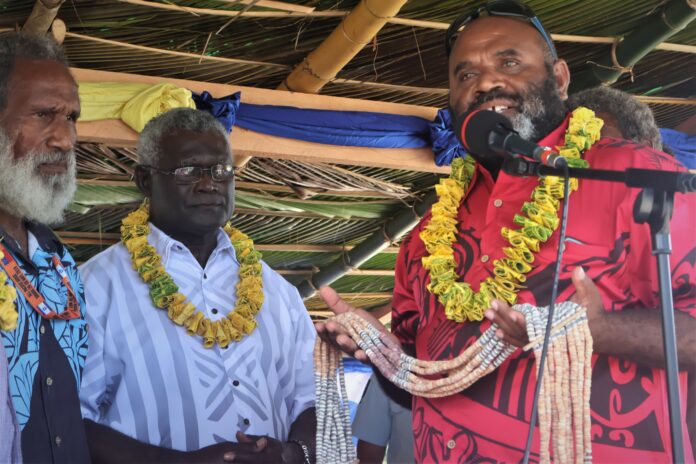
    The Malaita Alliance for Rural Advancement (MARA) government of Malaita has distanced itself from a reconciliation with Prime Minister Manasseh Sogavare this week.

    Malaita Deputy Premier Glen Waneta, on Tuesday, initiated a reconciliation ceremony with Mr Sogavare during the ground breaking for Suava Bay’s growth centre and market projects, North Malaita.

    The office of the prime minister has labelled the reconciliation as something “that was not planned as part of the official programme”.

    In a media statement yesterday, the OPMC said: “Malaita’s Deputy Premier Glen Waneta on the occasion of the ground breaking ceremony at Suafa Bay, North Malaita, acted on a conviction by placing a Tafuliae (Shell Money) on Prime Minister Hon Manasseh Sogavare (that was not planned as part of the official program) and pleaded for forgiveness on behalf of the Malaita Provincial government for the setbacks caused to the rest of the nation.”

    Sogavare has accepted this apology, also granting his forgiveness, according to the OPMC statement.

    This was done on the understanding that the apology and begging for forgiveness was done on behalf of MARA for the political differences between it and Sogavare’s DCGA government.

    “Prime Minister Sogavare assured the Malaita Deputy Premier, the National Government has fully accepted his apology saying, there is now no resentment between SIG and MARA.” The OPMC statement concludes.

    However, in an attempt to clarify this yesterday, MARA has annulled any notion of a reconciliation between it and DCGA.

    Rather, it claims the reconciliation was on a personal level for the PM being married to a Malaitan woman, the fact that she is from the northern region in which the ground-breaking ceremony was held, that she had accompanied her husband to the occasion, and that during last year’s November riots the couple’s home was damaged by looters, some of whom may have been Malaitans.

    The MARA statement, disseminated by Premier Daniel Suidani’s political advisor Mr Celsius Talifilu yesterday evening said:

    “It must be correctly stated that the reconciliation that took place between the Hon Prime Minister and the Deputy Premier was a kastom ceremony conducted in recognition of the fact that madam Sogavare is a Malaitan and she had accompanied her husband who is the prime minister to Suafa, Malaita province. And that during the recent riots in Honiara, there would be Malaitans who were also involved in the damaging of the PM’s property at Lunga.

    “The reconciliation was to apologize to the PM for being married to a Malaita woman and that during the recent riots their property among other things was destroyed by looters that would also include people from Malaita province. Therefore by kastom, it is prudent that the Deputy Premier says sorry and apologies to madam Sogavare and her husband the Prime Minister on behalf of the people and government of Malaita province.

    “The Deputy Premier would also like to state clearly that the reconciliation cannot be seen as a reconciliation between the MARA government and the DCGA government. That was not what the reconciliation was about. It was rather a kastom ceremony to say sorry and apologize to someone who is an in-law to a tribe in the northern region of Malaita.

    “To be clear the reconciliation at the Suafa growth center has not altered nor changed any policy positions of the MARA Malaita Provincial government. This includes the MARA government’s position on development principles as set out in the Auki Malaita Communique and the 15 points log of claims submitted to the DCGA government on the second appointed day of the province in August. On the latter, it was the DCGA government that made the request for the log of claims. The MARA government is still waiting for any official responses from the DCGA government.”

    While this statement from MARA may have cast dark clouds on a reconciliation many Solomon Islanders were looking forward to, it gives some hope going forward for the two governments.

    In concluding, the MARA statement says: “It could be that this is a stepping stone to a more concrete reconciliation ceremony in the future where the issues contained in the 15 points log of claims to the DCGA government could be discussed and addressed. Similarly, other issues of concern between the two governments could also be settled once and for all.”

    Meanwhile, witnesses to the reconciliation told Island Sun last night that they did not hear Deputy Premier Waneta mention anything as claimed by the MARA statement at the occasion.

    “We heard Waneta say that he acted on behalf of Malaitans and the MARA government and that the reconciliation was to apologise to PM Sogavare and humbly ask his forgiveness for ‘whatever our shortcomings, what we caused to the nation and setbacks we caused’,” the witnesses say.

    “Perhaps Waneta may have forgotten to explain to the prime minister and everyone present what the sudden reconciliation was for.”

    ////////////