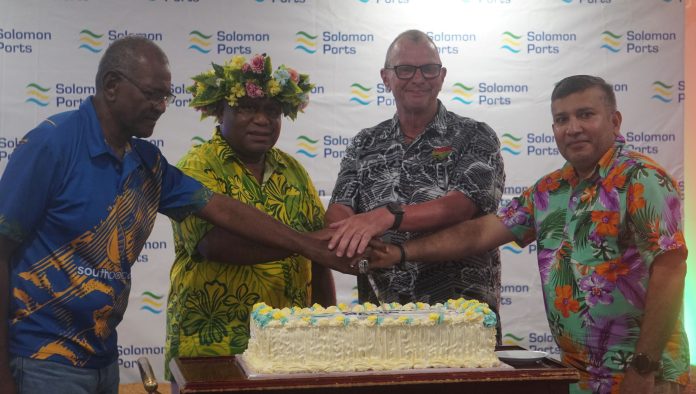
The Solomon Islands Ports Authority (SIPA) hosted its 2024 Stakeholders’ Appreciation Night on Saturday at the Heritage Park Hotel, as a gesture of gratitude.
The event saw each stakeholder receive a recognition award as a token of appreciation for their contributions to SIPA’s operations and success.
SIPA Chief Executive Officer (CEO), Mr. Eranda Kotelawala, addressed the attending stakeholders, highlighting the interdependence between SIPA and its stakeholders.
“What we do is facilitate trade. Whether you are importing or exporting, you keep the ports moving. All the volumes and our revenue are determined by how well you are doing. If you are not doing well, it means the port is not doing well too. But if you are doing well, the port is doing well,” Kotelawala stated.
He emphasized that SIPA’s success is closely tied to the success of its stakeholders.
“That is why you are part of our business. You are the key stakeholders of our success—whether it’s the infrastructure projects we undertake, the new systems we implement, our expansions, or the future that depends on our success as a collaborative effort,” Kotelawala said.
SIPA’s initiative to recognize the contributions of its key stakeholders began in 2019 but was paused due to the COVID-19 pandemic, until this year.
“This is really a big thank you to all of you for your valued support in making our ports one of the most successful state-owned enterprises in the Solomon Islands and one of the best ports in the region,” Kotelawala remarked.
He expressed that the recognition was sincere and not just a marketing tool, gimmick, or publicity stunt.
Although not all stakeholders were present, Kotelawala hopes to host a much larger event in the coming years.
“We are not in a position to invite all our stakeholders due to certain restrictions, such as space and other factors. But when we have more space in the future, we plan to make it a much bigger event,” he added.
The East Malaita road covers a total distance of 46km from Ferakui (Dala) to Atori. This does not include the Nafinua junction, which leads to Faumamanu and extends as far as Aufasu, roughly another 10km.
This is the East Malaita road, not the 21km stretch from Ferakui (Dala) to Baratalo, which is often referred to as the East Road. To clarify, that 21km section is just a part of the entire 46km East Malaita road.
A member of the East Malaita community made this explanation to set the record straight regarding the current road maintenance being conducted by the national government through the SIRAP project on the 21km section from Ferakui to Baratalo.
He pointed out that this misinformation has been circulating for some time, with the East Malaita road—commonly referred to as East Road—often being mistakenly associated with only the 21km stretch currently being rehabilitated.
“This misinformation confuses the public, especially the traveling public of East Malaita, making them assume that the entire East Road is under maintenance,” the community member said.
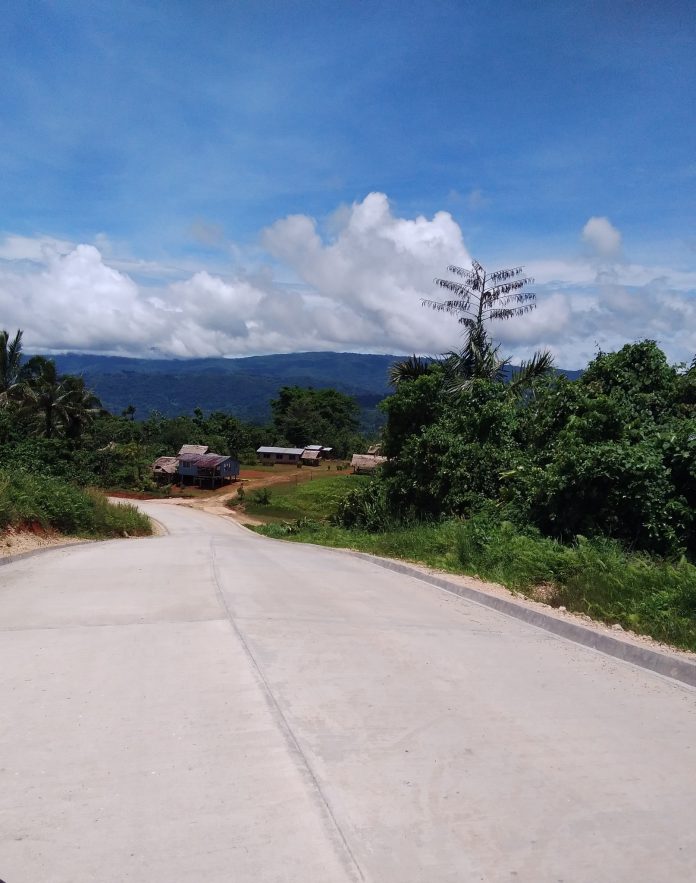
The current status of the 25km road section from Baratalo to Atori along East Malaita road.Photo supplied
He also noted that the 21km section being rehabilitated lies within the West Kwara’ae constituency, and the people of East Malaita are still struggling with the remaining 25km stretch from Baratalo to Atori.
“We acknowledge the national government and the World Bank through the SIRAP program for rehabilitating the 21km road section,” he said. “But people are still facing difficulties with the 25km section from Baratalo to Atori.”
“To be frank, we are very happy to benefit from the improved 21km stretch under the SIRAP program. A lot of work has been done on that section, including routine regravelling, installation of culverts and drainage systems, and even concreting some parts of the road,” he added.
However, despite these improvements, the challenge with East Road remains significant. The other 25km stretch is in poor condition, which continues to hinder transport and the delivery of goods and services to East Malaita.
“While we appreciate the improvements to the 21km section from Ferakui to Baratalo, we are also requesting similar projects to improve the 25km section from Baratalo to Atori,” he said.
“This would complete the full improvement of the 46km East Road.”
Premier of Malaita Province,Elijah Asilaua, has called on Malaitans to invest in their province.
He made the call at the opening of the BSP gas station in Auki last week, an investment by Malaitan entrepreneur Mr. David Leong, who is one of the country’s young entrepreneurs.
“Just like Mr. David Leong and his team have done with the opening of this fuel service, he and his team have the heart to invest in Malaita. And let me assure you, think positively and work together for a better tomorrow,” he said.
Asilaua recalled that Malaitans are industrious people who strive to build a better socio-economic society, despite the many challenges they have faced. However, he emphasized that the true spirit of working together, with a strategic vision, is needed to build a prosperous Malaita.
“I am optimistic that by working together, through strong teamwork with our provincial and national government and other stakeholders, we can build a brighter future for Malaita. I believe everyone of us is looking forward to a sustainable livelihood where a healthy lifestyle thrives in a supportive family and community. That reflects the reality of every man, woman, and child, with strong participation.”
“Let me emphasize that these cannot be easily achieved overnight. It requires our spirit of cooperation, ownership, peace, and unity,” he said.
Asilaua, on that note, called on Malaitans to rid themselves of poor working attitudes and instead show respect for one another. He urged them to take pride in and ownership of the province’s development.
“I have no hesitation in embracing the importance of investing in our true wealth—our human resources—so that we can fully utilize the heritage of our natural resources for our economic prosperity,” he said.
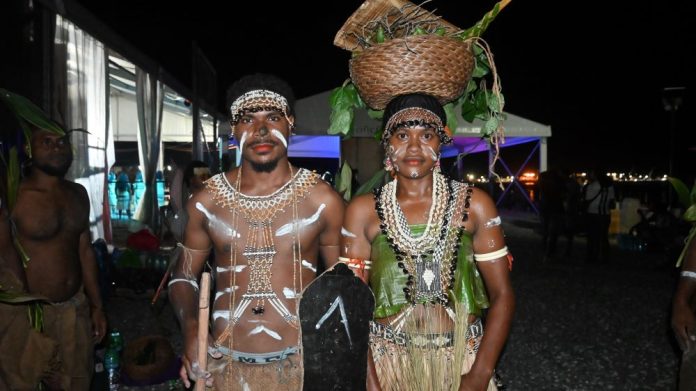
The Solomon Islands National University (SINU) cultural night, held over the weekend, was graced by the presence of the Ambassador of the People’s Republic of China to Solomon Islands, Cai Weiming.
The event was themed ‘Heritage and Horizon: Bridging Traditions and Knowledge.’
Speaking during the opening of the show, Ambassador Weiming expressed his delight in being part of the celebration of the rich and diverse cultural heritage of the Solomon Islands.
Weiming emphasized that cultural heritage and diversity are invaluable treasures that have shaped the past and will define the future.
“In this rapidly changing world, the values of peace, diligence, education, and innovation must be further explored,” he said.
“China welcomes mutual enlightenment. Through cultural exchanges, we can enhance mutual understanding and work together to protect and develop cultural diversity for a better shared future,” Weiming added.
He concluded by expressing hope that the event would serve as a bridge for cultural exchange between China and Solomon Islands.
“Let us join hands to create a more harmonious, intelligent, and innovative world. Let us dream bold dreams, make wise plans, and take steady steps toward a brighter future for the relationship between our two countries and peoples,” he said.
At the same event, Minister for Culture and Tourism, Choylin Douglas, praised the cultural show’s theme, describing it as profoundly significant.
“The theme speaks to the essence of who we are as Solomon Islanders, reminding us that our heritage is not just a collection of traditions from the past but a vital source of wisdom and guidance for our future.
It connects the past with the present and ensures that the knowledge of our ancestors continues to inspire and shape the paths we take today and tomorrow,” Minister Douglas said.
She encouraged students to embrace the theme.
“We live in a rapidly changing world, where modern influences can sometimes overshadow the values and traditions that define us. But events like this remind us of the strength and beauty of our diverse cultures.
I urge you all to take pride in your roots, to value the customs, languages, arts, and stories passed down through generations. By doing so, you are not only preserving your heritage but also enriching your own identity,” she added.
Minister Douglas also commended the SINU Student Association, faculty, and everyone involved in organizing the event.
“Your efforts in organizing this event demonstrate the value you place on our culture, and for that, I commend you. Let us continue to celebrate and promote our unique heritage, bridging traditions and knowledge as we move forward together,” she concluded.
Sentencing and mitigation for an 18-year-old male who pleaded guilty to stealing money and a mobile phone from a Chinese at the Central Market will be heard this Wednesday.
The case was heard at the Honiara magistrate court on Thursday last week and was administratively adjourned for Nov 27.
The juvenile admitted to stealing $69,500 and a Huawei smartphone from the Chinese woman at the main market on July 18 this year.
Prosecution charged the defendant with simple larceny and he pleaded guilty to the charge on November 13.
Allegations said at around 7am the defendant with help of another boy stole a bag of money from the complainant’s vehicle, which she had parked at the market parking lot.
The complainant May Zhao Sheng was doing her shopping when the incident happened.
Later when she returned and found her properties missing she sought help and identified the accused from the central market’s cctv camera footage.
Later the defendant was arrested and charged.
Police Prosecution Department act for crown and PSO for defendant.
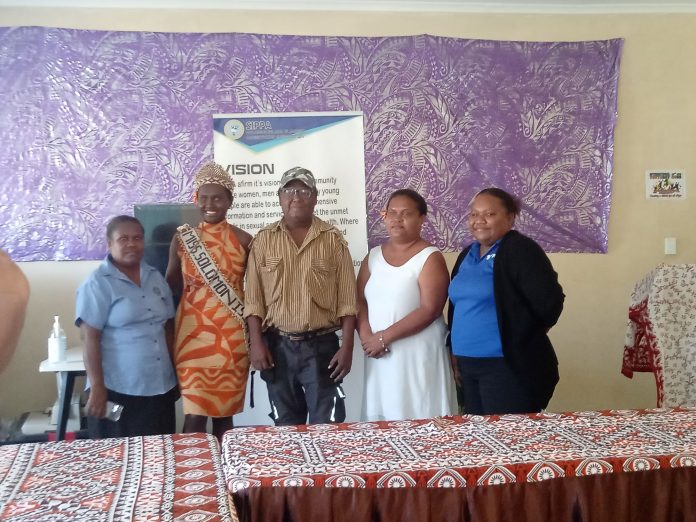
SOLOMON Islands Planned Parenthood Association (SIPPA) had the honor of hosting Miss Solomon Islands, Elsie Polosovai, for an insightful tour of its operations last Friday.
SIPPA’s board members and staff warmly welcomed the Miss SI team and provided a tour of the office, which included visits to the clinic’s consultation rooms and the staff offices, giving a firsthand look at their day-to-day operations.
Passionate about reproductive health and women’s health, Polosovai’s advocacy aligns well with SIPPA’s mission and vision.
Speaking to the media, SIPPA’s Board Treasurer, Lilly Chekana, reflected on Polosovai’s visit, stating, “We know that her platform is all about empowering young girls, and at the same time, she is an advocate for women’s health. So, having her visit SIPPA is a way for us to reach out more, advocate more, and encourage more youth, girls, and women to come and access the services at SIPPA.”
Chekana pointed out that, given the cultural and religious challenges faced within communities regarding the use of contraceptives, SIPPA hopes to work closely with Polosovai on effective advocacy strategies.
Polosovai had planned this visit even before her crowning and expressed her excitement and gratitude for the opportunity to see the organization’s operations firsthand.
Her visit to SIPPA is one of a series of visits she has conducted to several organizations since becoming Miss Solomon Islands
The case against a man arrested by Janus for alleged false pretence and forgery has been adjourned for December 31.
Crisbane Hebala, 47, is facing 11 counts of false pretence and 18 counts of uttering a forged document.
The matter was mentioned at the Honiara Magistrate court yesterday but prosecution said it was yet to obtain certain documents which would be served to the defence.
Court adjourned the case for December 31 to allow prosecution time to collect the outstanding documents and serve them to defence.
Allegations said the accused committed the offences in 2021, 2022 and 2023 when he was the sales manager of Raretech Enterprise, a Honiara based business which supplies ICT equipment and services.
Hebala allegedly provided multiple false invoices from competitors to the Ministry of Mines Energy and Rural Electrification in order to ensure that Raretech Enterprises provided the lowest quotation for goods and services and ultimately win contracts to supply ICT equipment to the Ministry.
John Wesley Zoze represents the crown and George Gray represents Habala.
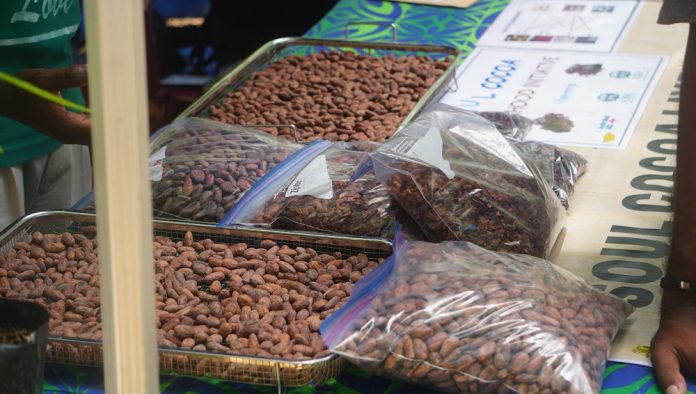
Producing cocoa until you reach that standard quality of cocoa you want needs a little bit of patience.
Patrick Mesia, is the project manager for Sol Cocoa Livelihood project in which ADRA (Adventist Development and Relief Agency) in Solomon Islands is carrying out in communities in Guadalcanal, Makira and Western provinces with funding support from ADRA Australia.
Recently, Mesia and his team joined the World Food Day celebrations which was held late last month.
Students and passer byers were interested to see the display of cocoa beans at the stall and listen to one of the guys at the stall talk about cocoa.
Meanwhile, Mesia happily agreed to chat with the media and told us about the project he is heading.
The project is being piloted in 7 communities and they want to replicate the best practice produced from this 3-year project in other communities.
Like any project that involves planting, they start from the nursery stage where they look for the best varieties of cocoa for farmers to grow.
Farmers are also assisted to carry out proper management until the cocoa trees bear fruit.
“We also train them how to ferment and dry to produce quality cocoa and we lead them to a boutique market”
Mesia pointed out that it is not a bulk market where you get small or under-quality beans but rather a high-end market.
He added that the income received from the project goes towards savings for women which is another component of the project.
“So, income that we are receiving is managed so families can benefit from it”
To top that off, the project is also involved in the downstream process so they are also producing chocolate.
Mesia expressed that they are linking farmers from the cocoa tree to what is normally processed from the cocoa fruit.
From his perspective, this link is important because it is not until farmers look at it and realize that it’s something to eat that they will worry about the quantity.
“So, we found that linking the trees to the end product is a helpful project”
In any accomplishment or project there are bound to be some bumpy rides along the way, which we normally refer to as “challenges”.
Mesia continues on to talk about several challenges they’ve encountered while carrying out this project.
Patrick Mesia, project manager for ADRA Solomon Islands.
He said there were a lot of challenges and one of them is leading farmers to the quality of the product which as he stressed, needs a little bit of patience.
So, what happens is, the farmers produce their first batch of cocoa and bring it in for testing with the help of CEMA.
After it’s been tested, Mesia and his team will give farmers feedback.
He reiterated that this step needs more patience from the farmers because they’ll have to keep going until the quality of cocoa is consistent and this is when they are told that they are on the right path or as he puts it “are doing okay”.
The “drying process” is also another challenge, particularly when it rains throughout the whole week.
Mesia said the process works better if you have a lot of good sunshine.
If not, they will try to be innovative and use heaters however this will be for the next phase of the project.
“So, if it rains for a week, we can use heating elements for drying”
Efficient access by means of travel poses as another challenge.
Some of the roads leading to some of the communities inland are difficult to travel on hence the government should assist in the improvement of roads so farmers can travel easily when they bring in their products.
Mesia said farmers struggle when travelling to bring their products to them.
Teamwork was the fourth challenge mentioned.
For most of the communities, Mesia found that working together in a team is a little bit challenging because the people in those communities like to work individually.
“We are trying to work in groups of farmers, we call them micro lots of farmers. Like five farmers work together and have one central processing unit so that everyone comes together in one unit”
Mesia said that you can only maximize quality of your product to maintain that quality if you work in micro lots or in groups rather than individually.
“This is because one farmer may reach the quality we want and the rest may struggle so we want them to work in groups”
Last but not the least, there is the challenge of future farming practices in terms of planting cocoa which must go in line with the EU Deforest regulation which is to not cut down forests before planting.
Mesai said this is a big challenge for them because the normal practice of farming is to cut down trees or forests before planting.
“But with that EU regulation, if we don’t follow it, we don’t access the EU markets. So, in doing that, we will try to make an integrated farming approach. That means planting some fruit trees, some cocoa trees, some local varieties. So, you have a more integrated agroforestry approach. That’s the future going forward”
On the other hand, Mesia said they have actually opened a boutique market for them in New Zealand.
“Just for information, in the last few weeks sixteen overseas chocolate makers from the UK and Europe came following a story about quality beans”
He mentioned that when they are producing the quality, the demand is already there from overseas.
“The challenge now is we might not have enough to supply all the interest outside so that’s why we need to replicate in many more communities so that we meet that volume of supply”
Mesia said that now that they have a market outside, going forward they are thinking of expanding to other provinces like Makira, Russell Islands and Isabel.
He stated that they would be very happy if they could expand to other provinces because you never know there maybe something nice out there like unique flavours of cocoa from other provinces.
Chikako Ito or “Chiko”, spends her days as a midwife at Naha Clinic, East Honiara, tending to pregnant women and girls.
But it was one particular, heartbreaking encounter that would forever change the course of her mission in the Solomon Islands.
During a regular shift, Chiko referred a woman to the National Referral Hospital (NRH) for further treatment. When the woman returned for a follow-up visit, Chiko learned that she had never made it to the hospital because she couldn’t afford bus fare and was embarrassed to ask her husband or relatives for help.
This encounter, like many others, struck a deep chord in Chiko’s heart, fueling her determination to take action.
“I kept thinking of what I could to improve gender equality and women empowerment in this country,” recalls Chiko
In the Solomon Islands, financial independence remains a distant dream for many women. Limited access to education, economic opportunities, and the constraints of traditional gender roles often leave women especially housewives reliant on men for their most basic needs.
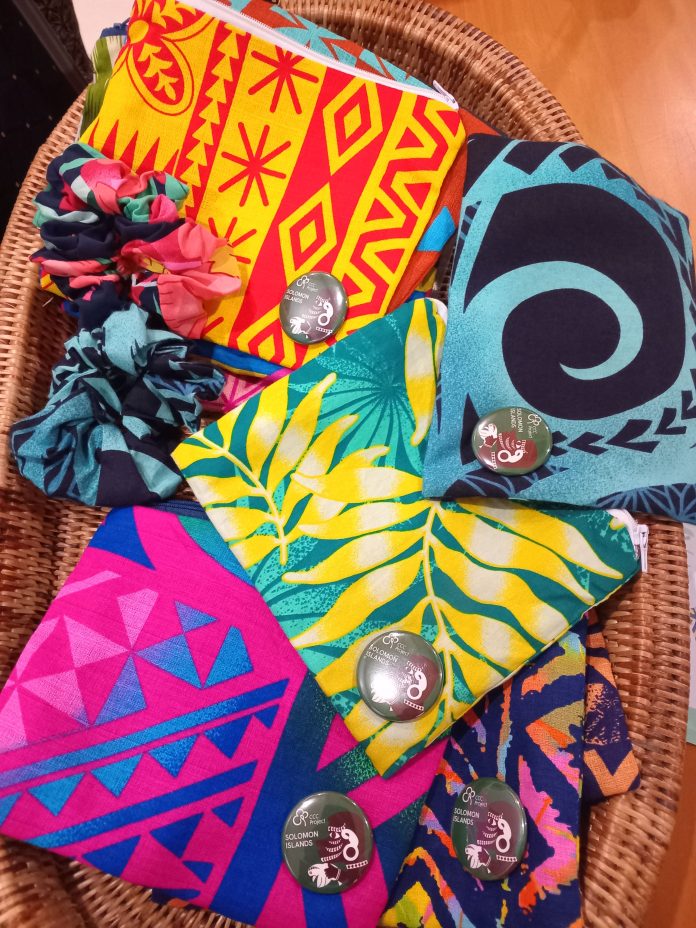
With zero external support, and relying entirely on her sewing skills and personal salary, Chiko launched the Create opportunities, handicrafts, Connect Collaboration among women (CCC) Project—an initiative to teach females how to create handmade sewn products for sale, empowering them to be financially independent females.
Shania Teatanga busy at work photo credit CCC Project in Solo FB page.
Teaming up with 10 females, including local designer of Tingiia Fashion, Janet Temasi, both women realize their shared vision is to help all women.
“When she came up with her idea, I was so excited,” recalls Janet. Inspired by Chiko’s generosity, Temasi adds, “It is nice to have someone from a different country willing to help community ladies. she(Chiko) gave it all from her heart, she did not demand for pay, she found opportunities for all the ladies.”
On weekends, Chiko and Janet would meet to cut fabric from off-cuts at Janet’s shop and new materials purchased by Chiko.
Janet would carefully measure and cut the fabric into consistent sizes to ensure uniformity in the purses, and accessories they were creating for the project.
They were joined by several young girls from Janet’s household and community.
“These girls didn’t know how to sew at first, but they came in and learned,” shares Janet. ‘It was difficult at first, but they were eager to learn.”
Soon after striking a deal with the General Manger of Kitano Mendana Hotel, they started supplying the hotel with their first products including lady’s purse.
For these girls, the CCC project gave them the opportunity to discover new skills and experienced self-growth.
“I only do sewing just to make bags but when Chiko would inspect our products, it has forced me to always do my best. It has made me to learn as much as I can,” says 24-year-old Charity Tinohitu
“Since joining the project, I have become competitive, and it has encouraged me to always strive me to be better,” shares 22-Year-old Davila Tena
(From left )Mendana’s Guest Relation Officer Francis Deve , Charity Tinohitu, Chikako Ito, Shania Teatanga, Davila Tena and Janet Temasi with the latest CCC Project products.
The girls also shared their heartfelt gratitude to Chiko and Janet for the opportunities they’ve been given.
“I’m so thankful for everything Chiko and Janet have taught me,” says Charity “They’ve shown me how to be make good use of my talents to be financially independent too.”
Despite these inspiring successes, the project faces significant challenges in scaling the project and reaching more women.
“A lot of girls and women have expressed their interests to join the project but we currently do not have enough sewing machines,” shares Janet.
However, Janet remains optimistic, “Chiko and I are taking one step at a time to avoid stressing ourselves out.”
With the funds raised from their sales, Janet expresses excitement on purchasing the project’s first ever sewing machine.
“We will purchase a small machine and whatever is left will be shared among the girls,” explains Janet.
Chiko’s vision for the future of the project is clear: to create a sustainable, self-reliant system that will continue empowering women even after she leaves the Solomon Islands.
She acknowledges that it’s challenging for many women to balance household responsibilities while striving for financial independence.
“If you have a dream, don’t give up—build your confidence,” encourages Chiko
Janet, too, offers her own advice: “You all have great potential. Don’t rely entirely on your husbands; you can create something with your own hands. Don’t isolate yourselves—go out and nurture your talents and skills.”
The Solomon Islands council of trade union (SICTU) has echoed calls for the Australian government to improve conditions for seasonal workers in the PALM scheme.
This includes – freedom to change employers, a minimum of 30 hours work per week, decent and fair accommodation, having fair and accessible superannuation.
This call was made by the Pacific Islands council of trade union (PICTU) the peak body for trade unions in the Pacific, during a meeting on November 11 in Brisbane, Australia ahead of the 2024 Labour mobility annual meeting (PLMAM).
The suggested improvements are a collective of complaints and feedbacks from seasonal workers under the PALM scheme.
In a statement on November 14, 2024, SICTU reiterated that it represents Solomon Islands workers in Australia, as PICTU does for Pacific workers there.
“While noting the positive reforms the Australian Government has made to the Pacific Australia Labour Mobility (PALM) program that have been introduced since the last PLMAM, PICTU calls on the Australian Government to urgently make the following reforms to PALM to protect the rights of Pacific workers and prevent exploitation,” the statement said.
-PALM workers should have freedom to change employers: PALM workers must have worker-driven mobility – currently workers are effectively tied to their employer-sponsor, which creates a power imbalance that can lead to exploitation. Workers must be able to easily change employers, just as local workers can. This will enable workers to leave exploitative situations, seek better pay and conditions, or a more suitable role.
SICTU through PICTU calls on the Australian government to ensure the following:
-Guarantee a minimum of 30 hours a week, each week for short-term workers: PALM workers should not leave Australia in debt. Unfair deductions and no minimum hours will leave PALM workers in poverty and hardship. The implementation of the guaranteed minimum hours of 30 hours a week, each week for short-term PALM workers on 1 July 2025 to enable workers to earn enough money to support themselves in Australia and their families.
-Accommodation must be decent and fair: Accommodation costs must be comparable to local market rates, and of a decent standard that enables to workers to live in dignity and safety.
-Make super fair and accessible: Make it easier for workers to claim their superannuation, remove the tax on Departing Australia Superannuation Payments (DASP) for PALM workers, expand options to improve the portability of super, and ensure workers have the right to choose their own superannuation fund.
-Access to the social safety net for PALM workers: Currently PALM workers have to take out private health insurance, which is a cost burden and deters workers from seeking health care – PALM workers must have access to Medicare and the social safety net.
-Union involvement in pre-departure briefings and worker mobilisation: The Australian Government must urge Pacific Island Governments Pacific Unions must be invited to attend the pre-departure briefings, and must be consulted in the worker mobilisation process to mitigate ‘brain drain’.
-Decent work for workers on return to their home country: The Australian Government must invest in skills development for PALM workers, and work with Pacific Island Countries to ensure that PALM workers are given support to reintegrate and given opportunities for engagement in decent work in the formal sector, and that Pacific Island Countries adopt a tripartite approach to worker reintegration.