The case of Member of Parliament for Ugi/Ulawa Constituency William Bradford Marau has been further suspended to February 5 for interim-mention.
During interim-mention yesterday, defence informed court its key witness recently passed away.
Therefore, defence sought an adjournment for at least a month and for the trial to be vacated to another date.
The duty prosecutor informed court that if the matter can be suspended to a later date, for the counsel in carriage of the file to appear personally in court, to respond to the issue raised by the defence.
The trial date was already been set for February 10.
Court after hearing the issues raised by defence adjourned the matter to February 5 for mention, and made directions for any applications for vacating the trial to be heard on February 5.
Marau was re-elected as the Member of Parliament for Ugi/Ulawa Constituency 2024.
Prosecution charged Marau with conversion and he pleaded not guilty to the charge.
The allegation alleged that Marau is facing a count of conversion in relation to the allegation of misappropriation of $5 million designated to shipping funds in year 2016.
On April 27, 2017 constituency report was submitted to National Criminal Investigation Department which they investigate following that particular reported submitted.
Prosecution further alleged from the investigation it was revealed that on January 22 of 2016, Solomon Island Government deposited $ 5 million into Ulawa Constituency account with Bank of South Pacific (BSP) for shipping fund.
It was further alleged, on February 17, 2016 the defendant instructed the BSP Bank to transfer the entire sum of said amount $ 5 million into his own personal account with ANZ Bank.
Prosecution also stated 65 withdrawals which total to $ 6,023,326.70 has been made from the defendant personal account.
In addition to that, ten withdrawals amounting to $ 4,550,00 deposited into the business account of Aslan Stationaries with ANZ a private company owned by the defendant.
And at the end of 2016 the remaining balance in the defendant personal account was $ 27,868.87.
Office of Public Prosecution act for the Crown and Rano and Company law firm act for the defendant.
A concerned man has called for an investigation into the health scheme Mustard Seed International (MSI).
The man whose family became a victim of the scheme was among some of the many who expressed similar concerns about the scheme’s service.
The man who wished to remain anonymous, disclosed to Island Sun that his family encountered difficulties after engaging with the scheme in July last year.
He said that he had discussed with the head of MSI and reached an agreement for his brother’s travel to the Philippines for a medical operation.
However, to cover the surgery around SBD100,000 to 150,000, the family raised funds to support and facilitate the trip and operation in the Philippines.
The family then raised a total of SBD$40,000.
The man said they intended to make direct payment to the hospital in the Philippines but third parties are not permitted to deposit funds directly into their account.
“So, the only option is MSI. We transferred $SBD 40,000 with Mustard Seed after we agreed on the arrangements and I instructed the Boss to inform the doctors that the payment was made through MSI,’’ he said.
However, he said that the MSI boss later sent him bills not long after they made the payment.
“It has come to my notice that she offset the entire $40,000. Our verbal agreement is to allow our family to deposit funds through the MSI account facilitating easier withdrawal in the Philippines to cover the entire operation. Following this, we can address any additional expenses as we previously discussed,” he explained.
When the man enquired why the MSI boss offset the money her response was that the patient was a non-member status.
“The understanding was to allocate $40,000 with the family responsible for any additional bills. The family prepared to deposit an additional $20,000, at that time, following my verbal agreement with MSI Boss to settle outstanding bills post-surgery.
The spokesman said that the family had already covered various expenses, including medical treatment, consultation fees, airfare, and accommodation upon their arrival in the Philippines.
“In the bill, MSI detailed all the individual services provided, including an administration fee of $12,000. Additionally, there was a transportation fee for travel from the airport to the accommodation,” he said.
He expressed concern regarding excessive charges related to taxi services and the assignment of medical personnel, which he believed should fall under the $12,000 coverage.
“Taxi fares typically range from 500 to 600 pesos, approximately equivalent to SBD 100, yet the charges incurred amounted to SBD 1,000 for two trips. This was an unjust financial burden on the family,’’ he said.
“Upon our arrival, as they were fully booked, we had to find alternative accommodation, for which I was also responsible for the payment. MSI even requested that I reimburse the two months’ rent that I had already settled. I thought to myself, “MSI is not sincere.” he said.
He said that MSI began to intimidate his older brother, threatening to evict him and prevent the surgery from taking place after his family decided to pull off from the MSI.
“As a result, we opted for a more affordable hospital. We managed to raise funds, and with the assistance of our Member of Parliament, the surgery was successfully conducted,’’ he said.
He said that, to his knowledge, MSI members consistently express complaints.
“Members do not understand how MSI charges for their services. The costs for services rendered in the Philippines are significantly lower than what MSI imposes. I believe that MSI is exploiting every patient. However, the true patient is the government, and MSI is benefiting from this arrangement.” said the concerned man.
He explained that MSI began as a health scheme catering to the Royal Solomon Islands Police Force (RSIPF) and Correctional Service Solomon Islands (CSSI) but eventually transitioned into an insurance company after it was running down.
He said that the MSI intended to expand into various countries.
“However, in Papua New Guinea, MSI was discontinued due to the high and costly agreements. Most MSI clients in PNG have conveyed this to me. The issue arises when MSI acts as an insurance provider or third party, which leads to the exploitation of patients and the government,” he said.
When Island Sun contacted the MSI for comment, a statement from the MSI said that people with concerns should go to their clinic to discuss their issues.
“We call on those people to come forward and discuss the issue with us rather than going to the media,” said MSI in response.
Last year the Leader of the opposition Matthew Wale called for the termination of the medical scheme for Members of Parliament when he questioned the additional 1.5 million for medical assessment under the Government budget on the floor of parliament.
The DCGA Executive Government signed a Memorandum of Agreement with Mustard Seed International on April 1, 2020.
“What is the status of the arrangements? I assume this is for the medical scheme. When would the contract lapse and what are the options going forward?’’ Wale questions when he spoke during the Bills – Committee of Supply 2025 Appropriation Bill 2024.
In response, Prime Minister Jeremiah Manele said he doesn’t have a specific date when the contract will lapse but understands the arrangements are continuing.
“The 1.5 million goes to the current provider. The allocation here, as I understand also had this insurance scheme that covers MPs. But also, apart from that, we do have the referrals for the MPs for medical checks, locally or overseas that this heading is catering for,’’ said Manele.
“There are discussions on whether the arrangement would continue or not,’’ said Manele.
Three Members of Parliament, one in the Independent and two from the Opposition group have defected their parties to join the government ranks this month, a rumor now confirmed by Acting Registrar Political Parties Commission Acting Registrar Gilson Galo yesterday.
The three MPs are; West Kwaio – Claudius Tei’ifi, East-Central Guadalcanal – Lazarus Alfred Rina and Temotu Pele MP – James Bonunga.
In an interview with the Island Sun yesterday Acting Registrar Galo confirmed that the trio resigned from their political parties and registered to the Our Party.
Temotu Pele MP Bonunga and East-Central Guadalcanal MP Rina were both originally from Solomon Islands Democratic Party (SIDP).
The West Kwaio MP switched from the independent group to the government.
“I can confirm that they have resigned from their political parties and now registered at Our party just this month (26th January).
“This is confirmed according to our registry.” Acting Registrar Galo said.
Mr Galo also confirmed to Island Sun that the Our Party has endorsed accepted the membership of the three MPs.
The Island Sun was reliably informed that trio moved to the government this week.
The reason for their move remains unclear.
Attempts to get comments from the MPs yesterday was unsuccessful.
However, for Tei’ifi it was reported in a Facebook Forum that his move to join the government group is based on his goals for the betterment for his constituency.
According to report Tei’ifi said since he was elected in the parliament in 2022, he hasn’t joined the government and has found it hard to tap any project for his constituency.
He said one of the other main purposes of his switch is the Bina Harbour Project.
He said as an international project it offers valuable job opportunities to his people and, the project is situated in his constituency.
In addition to the employment prospects,Tei’ifi noted that the project offers a significant opportunity for collaboration with government ministries, allowing his constituency to secure more development projects.
He also pointed out his desire to gain more knowledge and experience from engaging with the government side, underscoring his commitment to his people and their future development.
“Lastly, I want to gain more knowledge and experience government side. Thank you very much for your understanding,” Tei’ifi said.
MP Claudius Tei’ifi was elected back in the parliament in the national general election last year under the United Party.
Before that he was first elected in the parliament in 2022 in the bye-election.
-The average cost of one NCD admission ranges from $18,238 to $26,465.
-Diabetes, a major NCD, accounts for 20% of the Ministry of Health and Medical Services (MHMS) budget.
BY INDY MAEALASIA
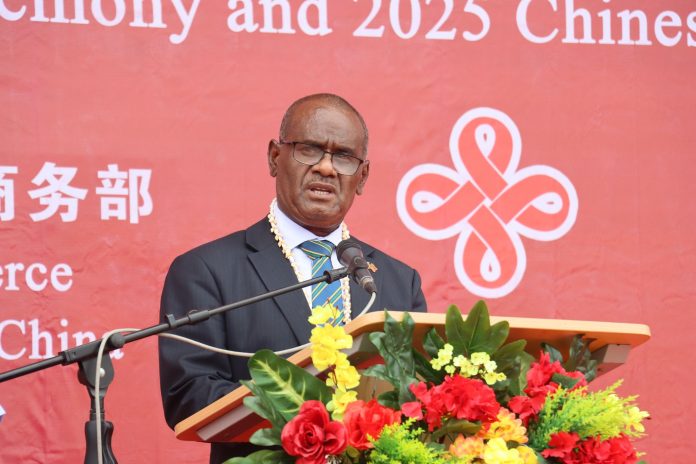
THE growing rates of Non-Communicable Diseases (NCDs) are costly, placing a heavy financial burden on the Solomon Islands healthcare system, Prime Minister Jeremiah Manele warned.
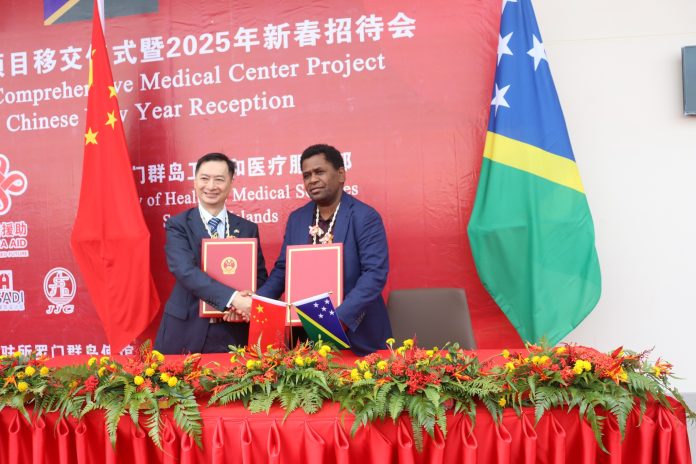
“The healthcare costs of NCDs are substantial,” Manele said during the recent opening of the Comprehensive Medical Center (CMC).
He pointed out that diabetes, a major NCD, alone accounts for 20% of the Ministry of Health and Medical Services (MHMS) budget.
Manele revealed that the average cost for one NCD admission ranges between $18,238 and $26,465.
“The cost of cardiovascular disease, heart disease, per patient is estimated to be $82,000. The cost of amputation per patient is $58,300, while the cost for treating foot ulcers is $20,000,” Manele added.
Meanwhile, Minister of Health Paul Bosawai stated that seven out of ten patients at the National Referral Hospital (NRH) are suffering from some form of NCD-related condition, including diabetes, stroke, and heart and kidney diseases.
According to the minister, since 2018, diabetes has accounted for around 60% of the NCD cases admitted to the NRH, with hypertension making up the remaining 40%.
There has also been a notable rise in essential hypertension cases, which have no known causes.
Bosawai said that the majority of diabetes cases admitted are linked to non-insulin-dependent diabetes, which is largely lifestyle-related.
He cited health statistics showing a growing concern about heart disease in the community.
“The number of admissions reflects an increasing trend in cardiac or heart disease between 2018 and 2020. There was an 11% increase, from 525 cases in 2018 to 583 cases in 2020, recorded at the National Referral Hospital. These cases are affecting more men than women,” Bosawai added.
The health minister alluded that the increase in NCD cases is “tied closely” to unhealthy habits in the population, as highlighted in the STEP Survey of 2015-2023.
Despite these challenges, the SBD $90 million Comprehensive Medical Center (CMC) is seen as a vital milestone in the country’s fight against NCDs.
“The clinical challenge today is the proper management of diagnosed NCD cases. I am indeed grateful that this new comprehensive health center has come at the right time, although long overdue. It is a facility that will assist our doctors in treating NCD complications, particularly those related to the kidney and heart,” Bosawai stated.
Meanwhile, Manele said the government has increased the 2025 MHMS budget to ensure the CMC operates effectively.
“To provide increased capacity for this new facility to operate effectively, my government has increased the 2025 budget allocation for the procurement of drugs and supplies by SBD $70,375,000, bringing the total budget to SBD $127,346,573 for 2025,” he said.
“This budget will ensure we no longer run out of medicines in the Solomon Islands once all the procurements are made this year,” he added.
Manele noted that the center will provide additional space, modern medical devices and technology, and new specialist knowledge and skills for the secondary prevention of NCDs.
PRIME Minister Jeremiah Manele has announced a series of new measures aimed at reducing tobacco consumption nationwide, marking a decisive effort to address the growing health risks associated with smoking.
The government’s actions would be guided under the existing Solomon Islands Tobacco Control Act 2010.
According to the Prime Minister, key measures include ramping up restrictions on smoking in indoor spaces and public transport, as well as strengthening guidelines for tobacco advertising, promotions, packaging, and labeling.
Additionally, the government plans to revisit the licensing requirements for tobacco manufacturing and distribution companies, as well as wholesale and retail outlets.
“We will increase the charges, if necessary, as the cost and health impacts of tobacco smoking far outweigh the benefits gained from the current license fees collected under the Tobacco Act,” Manele noted.
The announcement comes amidst the country’s ongoing Non-Communicable Disease (NCD) crisis, and the recent opening of the Comprehensive Medical Center (CMC), which is expected to play a key role in addressing the crisis.
“In addition to lifting the level of care in our clinical services, the comprehensive health center will also help the Ministry mount programs to address the six key drivers of NCDs.”
Smoking is one of the six key drivers of NCDs, alongside alcohol, sugar, salt, fats, and a lack of physical activity.
THE successful completion of the long-awaited Comprehensive Medical Center (CMC) has marked the fulfillment of major vision set out by the Ministry of Health and Medical Services (MHMS).
Minister Paul Bosawai expressed his satisfaction with the completion of the center, which has been a significant milestone in the country’s healthcare development.
“The new comprehensive health center…was that vision, which has now been all fulfilled today and I am very happy,” Minister Bosawai said.
The idea for the CMC was first developed in 2020, spearheaded by the MHMS Permanent Secretary and the senior executive management team.
The center was designed with three core visions in mind, which align with the broader National Health Strategy 2022-2031.
According to Minister Bosawai, these visions were:
Building a Facility for Specialized Care: To create a health center that offers highly specialized clinical services, is disability-friendly, and incorporates high standards for infection control and prevention.
Reducing Healthcare Costs: To provide specialized services domestically, thus reducing the need for patients to travel abroad for treatment, which in turn saves the government millions of dollars annually.
Creating a State-of-the-Art Work Environment: To develop a modern, clean, and safe facility that supports the well-being of doctors, nurses, and other healthcare professionals, fostering a productive and positive work environment.
Bosawai emphasized that the CMC plays a crucial role in strengthening the National Referral Hospital (NRH), boosting its capacity to serve as a leading healthcare provider and supporting the country’s ongoing efforts to achieve universal health coverage
“This is to ensure the best quality health services are accessible by our people,” he added.
The retrial of a teacher accused of embezzling $1.3 million from the Solomon Islands Government (SIG) in 2017 and 2018 is set to begin on April 14 and run through April 18, 2025.
During an interim mention last week, the prosecutor and defense counsel informed the court that they had no issues regarding the trial.
The matter has been adjourned to February 21 for the next interim mention. The accused, Cecilia Samani Tome, was excused from attendance, and her bail has been extended.
Tome was initially charged with one count of embezzlement to which she pleaded not guilty. Her first trial was conducted before Principal Magistrate Beneteti Tearo.
In the first trial, no witnesses were called, and the case was decided based on submitted documents. After the prosecution completed its case, the defense lawyer filed a no case to answer submission.
Magistrate Tearo ruled that Tome had no case to answer for the embezzlement charge and subsequently acquitted her of allegations related to the $1.3 million overpayment mistakenly deposited into her bank account.
The prosecution appealed Magistrate Tearo’s decision to acquit Tome, taking the matter to the High Court. After reviewing the appeal, Judge Leonard Maina remitted the case back to the Magistrate’s Court for a retrial before a different magistrate.
At the start of the retrial, Tome pleaded not guilty once again.
The prosecution alleges that in December 2017, two large payments totaling over $3 million were mistakenly deposited into Tome’s bank account. The error reportedly occurred due to a payroll staff member at the Ministry of Finance and Treasury (MOFT) entering a date in the payment system instead of the amount to be sent from the Ministry of Education. This mistake resulted in an overpayment of $3,806,297.77 into Tome’s personal salary account.
The prosecution further claims that Tome embezzled $1.3 million from the mistakenly deposited funds for her personal benefit.
The Crown is represented by John Wesley Zoze from the Office of the Director of Public Prosecution, while Ben Alasia from the Public Solicitor’s Office represents the accused, Cecilia Samani Tome.
The investigation into the case of two police officers, Gravis Afuga and Allen Noni, is still ongoing.
During a court mention last week, the prosecutor informed the court that police investigators are yet to collect one outstanding statement.
The prosecutor also confirmed that disclosures have been served to the duty defense counsel. However, the two accused officers failed to appear in court. It was suggested that their absence might have been due to confusion over the mention date, which was initially set for February 21 but was unexpectedly moved forward to yesterday.
The court has adjourned the matter to February 17, 2025, for a possible plea. Directions have been issued for the defense counsels to contact Afuga and Noni and update them on the new mention date.
The police were also directed to collect the outstanding statement, and the prosecution must serve full disclosures to the defense.
Officers Gravis Afuga and Allen Noni are jointly charged with bribery, contrary to Section 122(a) of the Penal Code, read with Section 21(a) of the Penal Code.
The charges stem from an investigation into the theft of gold ashes, which began on November 8, 2024.
Stride continued to witness on the preparation for the PRC funded million-dollar tar-seal project for Auki road network in Malaita province.
This is following the arrival of a consignment of building materials in Auki last Sunday, according to Premier Elijah Asilaua.
“The CCECC has on Sunday arrived with building materials for their campsite near Aligegeo school. Upon arrival, materials were transported to the site.
“The company is currently working on the camp and soon it expects to complete. The camp will host, workers, building materials and machineries for the project.
“As long as the camp completes, the company will begin transporting of materials for the project from Honiara to Auki,” he said.
Thereafter, the premier said actual implementation of the project will begin, which expect for late February or early Match this year.
He expressed the support of his executive and the full assembly behind the project, assuring commitment to work closely with PRC and SIG on it.
Asilaua also guaranteed the support and commitment of his government behind the Japanese funded project for Kilu’ufi hospital in Auki.
He said there are other projects such as the Australian funded emergency road upgrade on South Road, Malu’u market and World Bank funded infrastructure projects in the province.
Asilaua said MPG and its people are brace to work together to see the projects eventuate that will have significant impact on the life and the economy of Malaita province.
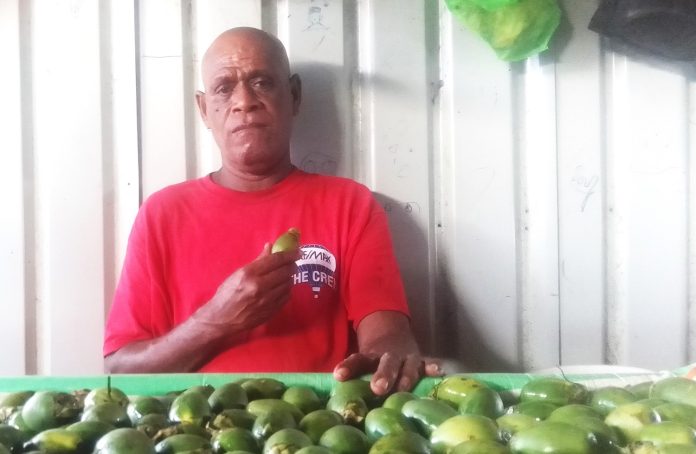
Erick Wabo terminated his employment as a police officer in 2017 and subsequently entered the informal sector by selling betel nuts, which he refers to as “green gold.”
At 58 years of age, Wabo hails from Temotu and has connections to Malaita, having spent nearly eight years in this line of work.
His venture into the informal sector as a betel vendor commenced in 2017.
Before establishing himself at the Maromaro betel nut market, Wabo operated a betel nut business in Chinatown.
Before transitioning to this trade, Wabo had a career with the Royal Solomon Islands Police Force (RSIPF), where he served from 1994 until his resignation in 2007.
“I have assigned a name to the betel nut, referring to it as green gold. I have embarked on a venture into the betel nut trade, recognizing its profit potential. Green gold represents the essence of wealth,” stated the father of four.
Mr. Wabo at his stall at Maromaro betel nut market.
The income he derives from this business is primarily allocated towards his children’s educational expenses and the sustenance of his family’s daily needs.
“In the past, financial resources were scarce. That was true during my youth. Back then, I struggled to hold onto even $10. When I attended school, my parents would provide me with just $10. However, today, I encounter money daily,” he said.
In contemporary times, individuals of all ages, including both the young and the elderly, engage in the sale of this fruit to earn an income, and many also consume it.
Wabo advised those who did not succeed in this year’s examination to consider engaging in the sale of betel nuts, often referred to as “green gold.”
“If each individual present contributes 10 bags and places them on the table, the task will be completed on the same day. Thus, one can observe daily earnings from what is referred to as green gold. “
“This is where I perceive financial opportunity,” said Wabo.
In addition to his betel nut sales, Wabo serves as a security officer for the USP Solomon Islands.
“I would like to emphasize to those who claim they do not engage in any work that selling betel nuts is a viable option. Engaging in this trade ensures that you will not face hunger. For those of us residing in urban areas, as long as you have a $50 initial investment to start your betel market, you will witness the benefits of this green gold. Even if the income generated from it appears modest, it can sustain you,” he remarked.
He highlighted a significant challenge he encounters when the price of betel nuts tends to rise.
“This is one of my major difficulties. For instance, when supply diminishes due to various factors, prices can escalate to as much as $1000,” he explained.
To mitigate this issue, Wabo has set aside capital specifically for betel nut transactions, which he does not utilize for other purposes.
“Thus, even when the price of betel nuts surges, I retain my capital reserves. After selling my inventory, I replenish the capital,” he stated.
58-year-old Wabo attended to a customer at his stall located in the Maromaro betel nut market.
He further noted, “When betel prices are elevated, I can acquire 15 20 kg bags, whereas, during periods of lower prices, I can purchase 10 bags,” said the father of four.
When the price reaches $200, it poses a significant risk for vendors like Wabo, as his sales fluctuate between 50 cents and $1.00 per betel nut.
“At that price point, you can expect a profit of around $1,000, whereas when the betel nut costs between $2 and $4, your profit can range from $1,500 to $1,800,” he explained.
Wabo typically operates his market stall, selling betel nuts daily from 7 am to 8 pm, and he usually earns over $3,000 each week.
The lowest price he has paid for betel nuts is $200 for a 20 kg batch.
“That is when you can observe prices of 50 cents to $1.00 per betel nut on display,” he noted.
Wabo indicated that when prices are elevated, the market vendors benefit more, while lower prices favour the customers.
“When the price per nut is 50 cents or $1.00, it can take a considerable amount of time to sell out, sometimes even up to three months,” he remarked.
Wabo sources his fresh betel nut from Guadalcanal, where harvesting occurs today, allowing for immediate sales, unlike the provinces where the process can take two to three days.
He appreciates his role as a betel vendor in the informal sector, finding it more fulfilling than his previous position with the RSIPF.
“In the formal sector, I only received my earnings on payday and I often relied on credit for daily necessities. If food was scarce at home, I had to borrow money to purchase it. However, this situation changed once I began selling this valuable product.”
Wabo allocates $60 daily for stall fees at Maromaro.
“Initially, it was challenging, but I have since adapted to the routine of paying my fees.”
He has also acquired a plot of land in Tuvaruhu, Honiara, with plans to construct a house.
Before his involvement in the betel nut trade, Wabo sold cigarettes and tobacco in Auki, Malaita province.