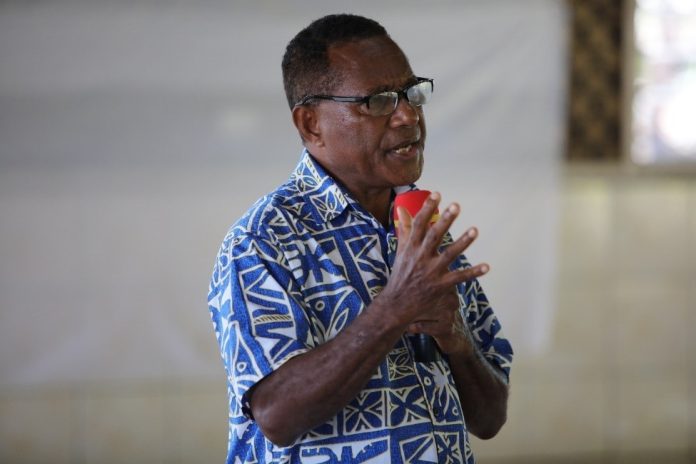
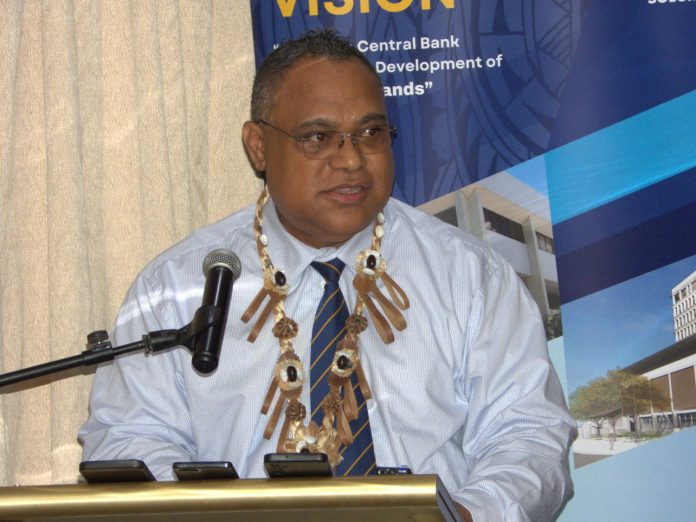
Excerpts of the speech by CBSI Governor Dr Luke Forau at the launch of the 2024 CBSI Annual Report yesterday, April 28 at the Honiara Hotel
My remarks will focus on an assessment of the country’s economic performance, and provide you with some food for thought as to how we can move forward in terms of developing our economy.
And please note, this assessment does not prescribe specific policies that should be undertaken, as some of you may have thought, rather it points out direction as to where we should focus our effort and resources to ensure optimal results are achieved in terms of improved economic wellbeing.
That said, I want to use this opportunity not simply to present statistics, but to peek beyond the numbers to the families behind every figure, the farmers behind every forecast, and the future behind every policy. Let these figures serve as a mirror, to help us reflect on our strengths and weaknesses, and as a compass to help us chart our path forward with firm commitment.
Setting the Scene: Harnessing the Spirit of the Pacific Games
Before delving further, let us pause and reflect briefly on one of our proudest moments as a nation in recent years – i.e., the 2023 Pacific Games. Remember that? For two golden weeks, our nation came alive. We cheered, we celebrated, we stood as one. Every athlete had a goal, every coach had a plan, and every volunteer had a role. And we, as a nation from all the corners of the nine Provinces and from all walks of life united to deliver one of the most (if not the most) successful Pacific Games ever.
What fueled this event to be successful?
You may have your own views on this, but for me, the 2023 Pacific Games was a success due to four key critical and inter-related factors:
(i) Very clear goal: – it was clear that the ultimate goal is to build a state-of-the-art stadium facility that will accommodate all athletes to compete.
(ii) Shared ownership: – having known what the goal is, and given that it is a national pride, everybody wants to own it, everyone feels the sense of belonging.
(iii) Dedication and determination: – knowing that we own the facility, we own the games, we dedicate all our efforts with determination to ensure the Pacific Games is successful.
(iv) A collective urgency to deliver excellence: – knowing that we are running out of time, there is a call for urgency to collectively ensure the facilities are completed on time.
Ladies and gentlemen, we did not just make it, but we also achieved and fulfilled our goal of hosting the Pacific Games, despite the challenges. Today, we gather at a time of profound geopolitical and geo-economic fragmentation and uncertainty: Trade tensions are intensifying, seemingly rock-solid geopolitical ties are fracturing, and the post-war era of trade-driven globalization seems to be visibly losing steam. Meanwhile, even as the world scrambles to respond to all these challenges, climate-related shocks continue to intensify in both frequency and severity. So, yes: just as we came together, cooperated and strategized to deliver on our ambition to host the 2023 Pacific Games, so too are we called upon to unite in response to the challenges we face. Our theme today entails, “Building the future we want through determination with clear goals and a shared ownership that calls for urgent action to deliver excellence.”
Let that theme simmer in your mind, as I will return to it later. For now, let me briefly reflect on last year’s economic conditions.
2. Brief Economic Update
Global economy
In 2024, the global economy demonstrated resilience even in the midst of continued uncertainty. The International Monetary Fund estimates global growth to have grown by 3.3% last year. This slow-down was largely driven by anaemic growth in Emerging Market and Developing Economies, not least due to the conflicts in the Middle East and Ukraine, and the enduring malaise in China’s property market. Closer to home, Australia and New Zealand, too, experienced a moderation in growth as Central Banks continued to combat inflation in these economies. More generally, global inflation continued to ease throughout 2024, supported by falling energy prices and stable food prices, and a slight cooling in labour markets worldwide.
Domestic Economic growth
On the domestic front, economic growth slowed down to 2.8% in 2024, down from the Pacific Games-boosted 4% expansion in 2023. Growth in 2024 was driven mainly by fishing, forestry, mining, construction, and manufacturing, while copra and palm oil weakened further.
Labour conditions
For the labour market conditions, it remained stable, with proxy employment indicators such as SINPF member contributions and PAYE tax revenue showing increasing trends, with the former rising by 4% and 8% respectively.
Inflation Dynamics
In terms of inflation, the headline inflation rose to 4.6% at the end of 2024, compared to 3.5% at the end of 2023. This was driven primarily by domestic inflation, which surged by 6.1% in December 2024, reflecting a 20% increase in betel nut prices. In contrast, imported inflation eased to 1.2% from 4.6% in 2023, on the back of falling global fuel prices.
Core inflation fell to 1.9%, after peaking at 3.2% in June. Importantly, both headline and core inflation remain within the CBSI´s desired range.
External conditions
On the external sector, the overall balance of payments (BOP) surplus increased by 60% to $350 million. As a result, the country’s gross foreign reserves grew by 1% to $5.8 billion, sufficient to cover 11.3 months of imports. This is well above the CBSI’s precautionary import cover threshold of 6 months.
In case you are interested to know how much do we earn from remittances through seasonal workers, total remittances from the labour mobility scheme, seasonal workers, and RSE rose by 68% to $475.5 million in 2024, thank you to Australia and New Zealand for offering the opportunity. Remittances have become the third foreign exchange earner for the country after logging and cocoa exports.
Monetary Sector
Developments in the monetary sector also point to sustained growth, with broad money rising by 4 percent to $6.4 billion. Private sector credit grew by 5 percent to $2.9 billion during the year.
Fiscal
With respect to the government’s finances, the fiscal deficit narrowed to 2% of GDP (i.e., $282 million) last year, compared to 7% of GDP ($950 million) in 2023. This improvement was due to improved tax revenue and development spending. Government debt increased to 22% of GDP, reflecting additional external borrowings for infrastructure projects.
3. Economic Outlook
Looking ahead, the Central Bank projects that Solomon Islands economy will grow by 2.7 percent in 2025, on the assumption that the forestry sector will slowdown. Nevertheless, growth is expected to be driven by the agriculture, fishing, manufacturing, construction, mining, retail trade and tourism sectors.
Over the medium term, the economy is expected to return to the pre-pandemic levels and stabilize at 2.5 percent, assuming there are no new sources of growth.
Sustaining medium-to-long-term growth requires targeted policy adjustments including diversifying growth drivers, rebuilding fiscal buffers and strategically reallocating resources to where they are best utilized to improve socioeconomic well-being of our people.
Challenges, risks and opportunities
In spite of the positive growth outlook, risks remain tilted to the downside. These include a slowdown in the forestry sector, the negative impact of climate change and pests on agriculture cash crops, coupled with a limited fiscal space and a narrow economic base would limit the economy’s future growth potential and leave it susceptible to a range of shocks. Furthermore, the country continued to face challenges such as rising costs of doing business, insecure access to land and inefficient inter-island transportation system. The escalation of the US trade tariff tension, the ongoing geopolitical tensions, and a potential global economic slowdown could weigh on the growth prospects.
In case you are interested, the current Trump’s tariffs policy imposes a 10% tariff on Solomon Islands exports. However, the direct impact of this tariff on Solomon Islands is minimal, as the share of exports to the US market accounts only 0.04%, on average, between 2020 and 2023. However, the indirect impact could be higher as we import largely from China and Australia.
On the upside risk, the economy would stand to benefit from the ongoing donor support for infrastructure development, and the expansion of the Pacific Australia Labour Mobility (PALM) scheme. Digital technology also presents new opportunities to leapfrog traditional development barrier and promote e-commerce and digital financing.
4. Economic Recovery: Five Years After COVID-19
Before we return to our theme, let’s take a look at where we stand, five years after the pandemic, we’ve made progress. But we still have a long way to go. Between 2014 and 2019, our economy grew at an average of 2.7%. In 2020, it fell by 3.4%. A modest recovery followed in 2021 with 2.6% growth.
Now, growth hovers around 2.9%, on average better than our worst moments, but still far from our full potential. However, much of that growth came from a single event — the Pacific Games. Strip that away, and it becomes clear: we are not growing fast enough, and not broadly enough. We are actually growing at a pace with a one-step forward, and a two-step backward. And if you look carefully at our current state of play, we are actually reversing in development.
Let me now return to today’s theme: “Building the future we want through determination with a clear goal and a shared ownership that calls for collective urgent action to deliver excellence.”
To realize the future, we envision for our country, we need more than predictions, we need a clear plan and commitment.
Let’s reflect on two possible growth paths ahead of us: the Baseline Scenario and an Ambitious Scenario or, more precisely, the Baseline Scenario (1) and an Alternative Scenario (2).
Let me be clear: the Alternative Scenario the ambitious scenario is not a wishful thinking. It is bold, yes but it is achievable. We have achieved even higher growth rates before. Now, it calls for a clear goal and ownership, dedication, coordination, and strong commitment to urgently deliver – just as what the Pacific Games demanded of us.
Let’s briefly examine each scenario. These inferences will impact on our well-being.
Scenario 1: The Baseline – More of the Same (or status quo)
Under this scenario, the economy remains on its current path, with growth hovering at around 2.5% annually through to 2030. Agriculture sees production level growing at the same current pace, with some gains in palm oil output but with continued underutilisation of resources in the cocoa and copra sectors. Manufacturing and trade expand slightly, but not fast enough to lift families out of poverty or meet the rising demand for employment opportunities for our growing youth population.
This path does not spell failure for our country, but it lies far below our potential, and it is not transformative in the manner our current economic and historical junctures require. This growth model has also historically been centred around a minute number of core commodities, and it has thus been far from inclusive, often locking people in the rural areas out of the positive spill-overs of development. We must also address, and indeed capitalise on, our high population growth in our economic thinking and planning – and I am afraid we will not be able to do so under this ‘business-as-usual’ scenario.
Scenario 2: Ambitious – A Bold, Coordinated, National Push
Now, let us focus on Scenario 2, the scenario we must all aim for. Under this scenario, we target the economy a sustained growth of at least 5% each year. This would triple Agricultural output, with
• Cocoa production increasing from 5,000 tons to 15,000 tons,
• Copra output increase from 10,000 tons to 30,000 tons;
• Coconut oil production expand from 5,000 tons to 15,000 tons;
• Palm oil output tripling to 72,000 tons each year.
Picture a shift towards value-added processing and the processing of raw exports to finished products. Let’s turn copra into coconut oil, cocoa into chocolate, and let’s lift manufacturing beyond the one-billion-dollar mark. When Solomon Islands becomes a renowned processing hub, where the raw products with which nature bountifully bestows us are transformed by our hands and our machines into beautifully crafted manufacturing goods, then trade opportunities will also expand, introducing our unique products to new markets across the Pacific and beyond.
However, this won’t happen by chance. It will take deliberate, sustained, and united action.
Here are a few possible policy directions that could, and should, be taken in the next couple of years to build the future economy we want:
(a) Investing in Agriculture for an inclusive and broad-based economy: From Goals to Results
Let’s take agriculture.
We often hear time and again, that agriculture is the backbone of our economy. Yet, the outcomes we observed do not always reflect this reality. Agriculture remains the most inclusive growth sector because our rural villagers participate and benefit from its positive spill overs.
However, to grow the agriculture sector to reach its full potential, we must move from goals/aspirations to deliverables that can be measured. This means translating policy objectives into concrete, measurable targets, by commodity and province, aligned with the local comparative advantages. For instance, in the next three to four years,
• we can aim to replant 10,000 hectares of aging coconut trees and expand palm oil cultivation by an additional 2,000 hectares beyond the current 6,700 hectares.
• We can strengthen cocoa production by planting 1,000 additional hectares in Makira, Guadalcanal, and Malaita.
• We can double or even triple copra production in Central, Guadalcanal, and Western Provinces by 2027.
• We must also broaden our agricultural base by scaling up new cash crops, including kava, cassava, taro, and others.
These targets must be measurable, time-bound, and monitored transparently.
(b) Investing in What Matters: Building Physical and Human Capital
Equally important is how we invest. Every dollar spent, be it private or public, must be spent where it yields the maximum impact. Investment should prioritize areas that unlock productivity growth, nurture innovation, enhance livelihoods, and build long-term resilience. This includes:
• Building rural-urban infrastructure to connect farmers to markets;
• Expanding access to affordable finance and introducing incentives to small businesses, and local farmers;
• Adequately resourcing the Ministry of Agriculture and associate agencies such as CEMA to partner effectively with farmers, the private sector, development partners and programs such as PHARMA+;
• Investing in technology and digital infrastructure to boost efficiency and productivity, as well as improve tax collection. This is where we can make a real difference in people’s everyday lives.
Moreover, our legislations must be strengthened to ensure a conducive business environment to flourish.
Having said that, I wish to highlight that one of our milestones last year was the implementation of the Payment System called the Solomon Automatic Transfer System (SOLATS), which went live in April 2024.
This milestone lays the foundation towards an inclusive payment infrastructure, as well as embracing digitalization in our economy. Going forward, I would like to see the interoperability of the payments systems with other digital financial services such as the M-Selen, Iumi-Cash, Ezipei, Accountplan, Aelan digital to ensure financial services are extended to the last mile, enabling the ordinary person (rural people) to make payments fast, safer, efficient and cost effective.
Imagine: Teachers and nurses getting paid or accessing their salaries on time through mobile services such as M-Selen, rather than travelling long distances to Honiara or provincial centres to withdraw cash. Farmers accessing information on farming techniques, prices and payments through their phones.
And a faster, and fairer tax systems that work for everyone. When we expand access to digital financial services, we don’t just make things easier we bring more people into the formal economy, thereby expanding and deepening financial inclusion for all. Just as important is that we invest in our youth. We must equip them with an education that nurtures them, transforming them into both thriving and respectful citizens and self-aware economic players.
We must also together build a healthcare system that strengthens them and protects them. But we cannot succeed if we do not also create ample and meaningful employment opportunities for them. This is not just about finding a productive way for our youths to spend their time – it is about building a more inclusive economy, one to which we all contribute, and whose rising tides can in turn lift all our boats. Let’s ensure our investment in both infrastructure and people is inclusive, climate resilient, and geared toward lasting transformation.
(c) Shared goal and collective resolve
To unlock growth, we must accelerate reforms that matter – streamline land access and administrative processes, modernize outdated laws that no longer serve today’s economy.
We need to triple our efforts, with shared leadership, shared responsibility, and shared success.
Empowering the Real Drivers of Growth: Producers and Entrepreneurs
Our growth aspirations must be inclusive. It’s not just about raising numbers — it’s about uplifting the people behind those numbers. The real drivers of our economy are our farmers, our young people, our women entrepreneurs, and our small business owners. We can achieve this by upgrading agricultural support services, ensuring our farmers have access to and adopt innovative farming methods to increase their production and trade.
We also need to expand access to affordable rural credit to help farmers and small businesses invest and expand. No one should be left out of this story of growth. Every person, in every province, must have the chance to grow, to succeed, and to contribute.
d) Monitoring, Feedback, and Accountability
Just as the Games Organizing Committee successfully used timelines and scorecards, we need to strengthen how we monitor and track our economic performance, to enhance monitoring, encourage feedback, and accountability.
We must build effective systems that track each target, whether it’s agricultural output, or infrastructure development, using timely, accurate data to inform decisions at all levels of government. Collective efforts are required from both data providers and data users to ensure the consistent flow of economic data to track our investments and monitor our progress as we chart our development aspirations forward. I must acknowledge the Ministry of National Planning and Development Coordination, for the role they play in assessing and monitoring the country’s progress towards achieving the National Development Strategy 2016 – 2035. If practical, these policy and quantifiable targets should be embedded in the National Development Strategy document.
We take the agriculture sector as an illustrative example but the same focused, results-based approach can be applied to tourism, fisheries, manufacturing, and services. Doing so will accelerate growth and open broader opportunities to shape the future we want.
Harnessing the Spirit of the Pacific Games to building the Economy we want
Ladies and gentlemen, fragmentation slows us down. If we are serious about delivering meaningful economic change, we must act with a unified purpose, across all levels of society. We all must rally around a national, unified economic agenda.
Just as we stepped up to the task by building a world class facility and successfully hosted the games (of course with the collaboration of our development partners). The Pacific Games reaffirmed to us and the world that we are a capable nation. Yes, you hear me right we are a capable nation, and we can do it.
Now, imagine for a moment what we could have and would achieve if we channeled that same spirit all those resources and all that drive, teamwork, and urgency into shaping our economic future.
Indeed, the Pacific Games taught us what’s possible when we unite behind a clear and ambitious goal. Let us apply that same spirit that same determination, urgency, commitment, and collaboration to build our economy.
If we could unite to host the Games, why not unite to build and transform our economy? If we could deliver excellence in two weeks, imagine what we can achieve in the next decade.
Ladies and gentlemen, let’s not settle for 2.5% growth when 5% and above is within our reach.
Let’s commit. Let’s act decisively. And together let’s build our country and the future we all desire.
DR LUKE FORAU
CBSI GOVERNOR