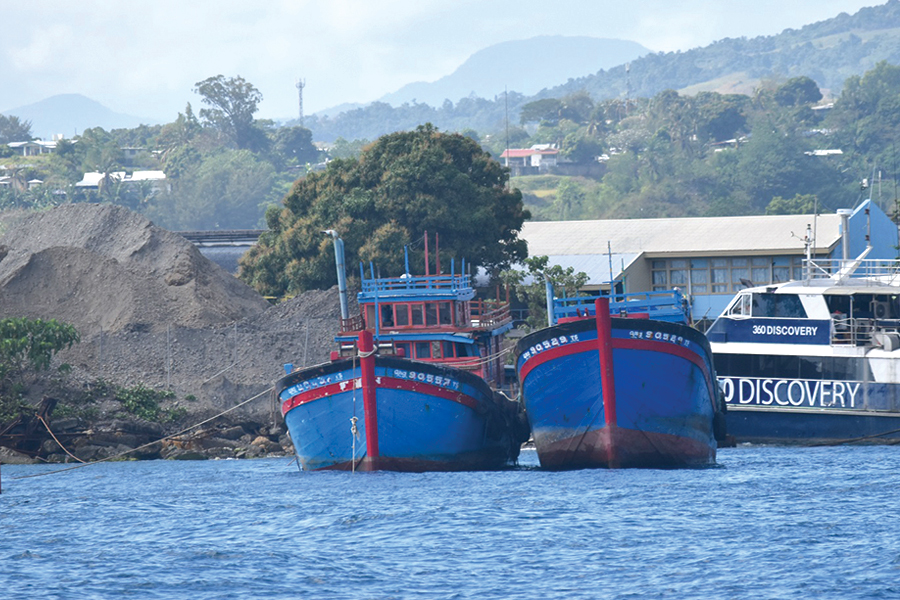
Two of the Vietnamese blue boats anchored off Pt Cruz, next to the RSIPF Maritime port, two weeks ago. ISUN File
photo
BY BARNABAS MANEBONA
Two of the Vietnamese blue boats anchored off Pt Cruz, next to the RSIPF Maritime port, two weeks ago. ISUN File photo
THE presence of one of the Vietnamese blue boats at the Hakama Agriculture station, in Ngella Mboli passage, is causing concerns for people in the area.
It is reported that onboard, a foreign rodent species has been sighted, raising concerns over what threat it might pose on the environment there.
Operations Manager for Tulaghi Police Station confirms the reports, saying the rat species is believed to be from Asia and had accompanied the boat here.
“We have already visited the boat along with government members of the province after concerns were raised by locals on which we have witnessed that there is surely a need for it to be removed.”
The three Vietnamese blue boats had earlier this year made headlines after their crew and captains were arrested for poaching in Solomon waters.
The court had decided that they be destroyed in June this year. A bid was tendered out and the winner had proposed to have them destroyed in Langlanga, Malaita province.
One of the reasons for the destruction of the boats was quarantine and insecurity.
THE Ministry of Agriculture (MAL) and the Guadalcanal planes plantation company (GPPOL) are uniting resources against the Coconut Rhinoceros Beetle, Guam strain or CRB-G, the most destructive coconut pest that has arrived in the country.
This was revealed by the Permanent Secretary for the Ministry of Agriculture and Livestock (MAL), Mr Jimi Saelea at the Coconut Day event on Sept 25, 2017.
He said that CRB-G as a destructive pest and huge threat to coconut and palm oil industries has driven GPPOL and MAL to closely work together on developing a programme that will reduce the beetle population to a manageable level.
Mr Saelea added that the programme includes an active sanitation plan of action and biological control methods using virus and fungal diseases to kill the beetles.
“The Declaration of a CRB-G Emergency Area for North Guadalcanal by the Honorable Minister for Agriculture has activated sections within the Biosecurity Act to enable resources to be sought and bodies appointed to deal with the disaster.
“A Response Oversight Committee (ROC) has been appointed and a Coordination Office created to monitor and coordinate the activities by stakeholders.”
Mr Saelea pointed out that GPPOL, MAL, KPSI (Kokonut Pacific Solomon Islands) and SICCI (Solomon Islands Chamber of Commerce and Industry) have been involved in awareness activities and so other stakeholders must also contribute their time and resources in helping to eradicate or contain CRB-G.
“At the end of the day, it is the people that will be affected in the unlikely event.
“Kill a beetle a day and burn those rotting coconut logs to reduce the breeding sites and effectively reduce the beetle population”, he said.
Dr Priyantha Wijewardane right and Mr Lasantha Wickramasekara.
BY BEN BILUA
Dr Priyantha Wijewardane right and Mr Lasantha Wickramasekara.
TWO coconut experts from Sri Lanka have left the country after a successful week of awareness to farmers.
Procurement and logistics expert Mr Lasantha Wickramasekara and Dr Priyantha Wijewardane, a leading scientist with specialisation in the coconut sector, were both in the country for the past week holding meetings with farmers as well as leaders.
In an interview with Island Sun before their departure yesterday, Mr Wickramasekara and Dr Priyantha said they have met numbers of coconut farmers in Guadalcanal province, Central province and also paid a visit to Noro Port.
They also said that they have paid a visit to the Guadalcanal plane palm oil plantation.
Mr Wickramasekara and Dr Priyantha said fruitful discussions have been held with the premier of Western Province Wayne Maepio, the Permanent Secretary of the Ministry of Agriculture and Livestock as well as some members of Parliament.
They acknowledge officials and also farmers who took time to discuss and share ideas during their trip in the Solomon Islands.
Mr Wickramasekara and Dr Priyantha said they will compile and submit a proposal to their government for further assistance towards the country’s coconut industry.
Mr Kutila Pinto from the Sri Lanka Consulate in Honiara said Mr Wickramasekara and Dr Wijewardane’s visit is part of the Consulate’s help towards the country’s coconut industry.
He explained that the purpose of the visit is to assist the country in reviewing the current framework, strengths, weaknesses, opportunities and treats of local coconut industry.
Mr Pinto said the experts will develop a platform to promote and provide awareness on methods that would expand the current usage of the coconut tree to resources owners and also develop a positive micro economic conditions for entrepreneurship and employment.
He said Honorary Consul of Sri Lanka to Solomon Islands is looking at bringing in resourceful experts to help grew the coconut industry in the country.
“I’m strongly committed to continuously explore ways in which I could assist Solomon Islands better its current economic situations with the assistance of sustainable natural resource utilisation,” Mr Pinto said.
Chairperson Kolombangara Development Advisory Committee (KDAC), Hon. Jimson
Fiau Tanagada MP, during discussions held this week.
Chairperson Kolombangara Development Advisory Committee (KDAC), Hon. Jimson Fiau Tanagada MP, during discussions held this week.
THE Government’s productive sector of the Cabinet sub-committee has seen one of its projects narrowing down on its strategic goals.
This was the outcome of the Kolombangara Development Advisory Committee during their meeting held this week at the Office of the Prime Minister and Cabinet.
Known as the Kolombangara Development Advisory Committee (KDAC), it was specifically set up under the Government’s Cabinet sub-committee’s productive sector specifically to liaise with the Kolombangara Landowners Trust Foundation (KLTF) to enter into a partnership with the Kolombangara Forestry Plantation Limited (KFPL).
In the coming weeks, consultations will begin with the KLTF which should prepare the way forward for the KFPL investment partnership.
This means KDAC will go down to the community and discuss with the people of Kolombangara, through the KLTF on partnership issues with the KFPL and later with ICSI.
In an interview with the Chairperson of KDAC, Hon Jimson Fiau Tanagada, he said the Kolombangara Forestry Plantation Limited investment is a great investment in relation to the benefits of engaging in Private- Public Partnerships.
He said that the purpose of the KDAC is to “get the stakeholders onboard by discussing with the administrative bodies of KLTF and KFPL and to get their thoughts and look at their specific objectives and to see how the government can empower them to achieve their objectives”.
The Chairperson encourages the people of Kolombangara to take ownership of their land by entering into this partnership with the KFPL and the Government.
He further stated that currently the two shareholders to the KFPL investment is the KFPL executives and the Government through ICSI.
The Chairperson also stated that this investment can be achieved within the remaining period of the current Government if the people of Kolombangara appreciate the benefits of working together as one people through KLTF with the government in this Private-Public partnership model of investment.
He stated that once this model is eventually realised for its benefits, other Provinces can follow through in adapting this model of Private- Public Partnership.
A leading Sri Lankan coconut specialist says there is still hope in the fight against the invasive Rhino Beetles.
In an inclusive interview with Island Sun Dr Priyantha Wijewardane, he said the issue of Rhino Beetle is still in a manageable stage with immediate action required.
He said one possible intervention is to remove all affected plants and burn them.
“We have experienced similar situation in our country back in 1980s and we manage to overthrow the threat using this strategy.
“The only way your country can win the battle against this Rhino Beetle is removing affected plants and burn them,” Dr Priyantha said.
He stressed there is a private company in the country who can provide alternative expertise and technology help address the incoming threat by Rhino Beetle.
However, Dr Priyantha said it is important for the government to take the lead – then stakeholders can support the implementation of any programme related to Rhino Beetles.
“Why I recommend the government to take lead is so that the government can provide financial support or seek assistance from donor partners to financially support such activities,” he said.
Dr Priyantha high recommend the government through responsible authorities mobilise programmes and activities now – before the Rhino beetles are out of control.
CIVIL society organisations (CSO) is reviewing the anti-corruption bill to make recommendations for the bills and legislations committee (BLC).
CSO Chairman Dr Huddie Namo said, “We are not waiting for the government on now doing our own review in noting what to recommend.
“Though the Petition has already been given, we will not stop in keeping up the momentum for the government to know that they are under our watch.
“We will be having strategic outlined meetings continuing until the 9th of next month.
“There were already two meetings, one on Friday and the other this week Monday in which others will be today and coming Friday rotating till next week.”
According to the Chairman, the meeting is open to all civil society members and interested parties who wish to share their points of view with the committee in regards to issues that will be discussed.
“Other’s who wish to join the meetings will have to contact the CSO and DSE General Secretary Ms Jennifer Wate on landline 23760 for approval,” said Dr Namo.
“We are planning to continue on talking about the Anti-corruption Bill through Broadcast on SIBC and on Barava FM this coming weekend including giving media statements.
“Time is not in our hands so we need to prepare, the Bill might be postponed again that will cause a big problem.”
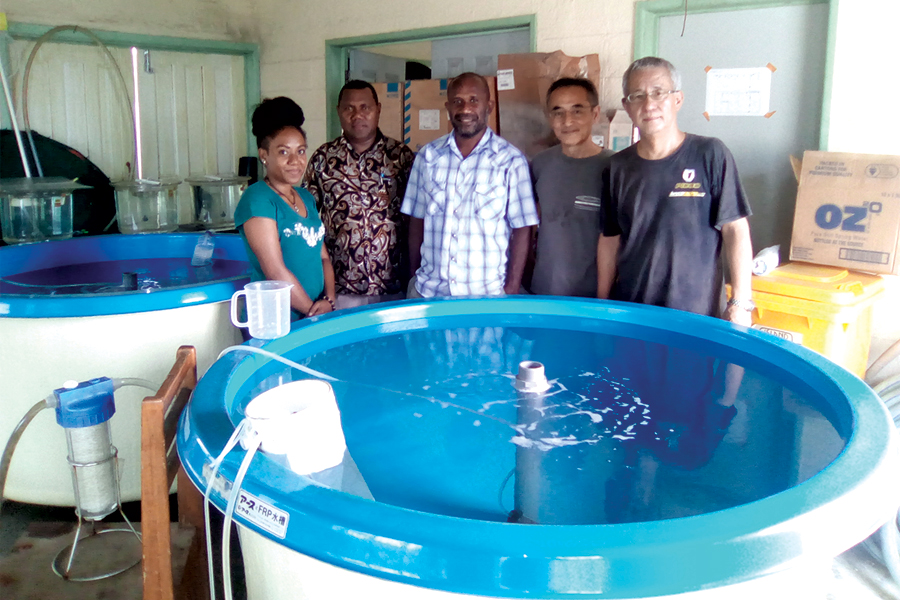
HOW TO DO IT…OFCF Beche-de-mer expert Dr Toru Komatsu, right, Director of Fisheries Mr Edward Honiwala, second left, Mr Kazuhiro Toyama of
OFCF and Aquaculture officers James and Catherine at the Ministry of Fisheries and Marine Resources (MFMR) beche-de-mer hatchery project. This year the
project is supporting a community in Marau in east Guadalcanal and San Fly in Ngella. Director Honiwala strongly emphasized that such hatchery is what
MFMR expects, and rejects farming method operated by Dr Reginald Aipia which is done in open waters and has lack of control over eggs and larvae.
More than half Beche-de-mer applicants only after money, Ministry not interested
BY JARED KOLI
MORE than half of applicants for Beche-de-mer export licence are ‘purely after the chance to draw income’, it is revealed.
As the assessment committee screens applications, Director of Fisheries Edward Honiwala confirms this, saying more than half fall under this category and will not meet all requirements.
The Ministry of Fisheries and Marine Resources (MFMR) has issued four criteria for applicants.
“We know a lot of them will not meet the four or any of the four criteria,” says the MFMR Permanent Secretary Dr Christian Ramofafia, during an exclusive interview with the two incumbents at the MFMR Headquarter yesterday.
The four criteria are:
Companies holding valid licence or permit to export Marine Product in 2017, and evidence of doing business in the fisheries sector in the last 3 years.
Companies with valid Inland Revenue Division TIN;
Companies with documentary evidence of export returns from Central Bank of Solomon Islands
Companies with good standing records of compliance with fisheries regulations in the last 3 years
Dr Christian could not reveal the exact number of applicants, but said there are many to be assessed by the assessment committee.
When asked on whether the granting of export licence will be done equally among locals and foreigners, Dr Christian said the ministry will treat all applications the same, and everyone has to fulfil the same criteria.
“If you continue with your business operations, either for locals or outsiders, but if you have licence here that means you are local company, whether the owner is an Asian or foreigner but do things in the country.
“There are many applications but unfortunately only four will be selected on the condition of the criteria set by MFMR.
“If there are many applicants meet the criteria set, we will have to look at them carefully, but according to cabinet we will have only four.
“I think we will look at commitment with the ministry and support on the development of the country, in terms of employment because all these things is based on the development of fisheries.”
The two reiterated that if someone applies just for the sake of a chance to draw money, then that application will be turned down.
Dr Christian said the ministry will put in place a strong guide to support villagers in terms of pricing because the lifting is aimed at supporting them.
“We will provide the price range to buyers and exporters, because the complexity of the trade, many of the buyers didn’t link with exporters,” he said.
The two highlighted that the ministry will put a price range for exporters.
“When we issue export permit we will also be giving them the price guide as condition for their licence. The licence will be issued with conditions, one of the conditions is not to buy undersized beche-de-mer.”
The criteria have been established to identify whether an applicant has been involved in the development of the fisheries sector.
“Others will argue to grant export licence to locals but many locals are backed by Foreigners. From our experience, licence fee is high and even locals do not afford, and we have seen that many locals are backed by outside people.
“In terms of number 1 criteria, we see this as they are genuine companies, and bank transaction is important and tax, locals may complain because some of these criteria some of the local companies cannot meet,” he said.
MFMR plans to carry out a beche-de-mer nationwide survey to determine the stock of beche-de-mer starting early next year.
“We plan to do a nationwide stock assessment of beche-de-mer before we open, but this opening is a decision which demand quick response, but we put in place how we can take information.
“We have funding available to do the exercise, in fact the plan for the nationwide survey has been reschedule for next year.
“But a team will be leaving next week to a place of interest to record information on the ground. This is important for us to take every data to assist in the trend of the beche-de-mer fisheries.
“We have a research team from the fisheries, and also officers from the province will join in, and other NGOs engaged with the fisheries,” Dr Christian said.
HOW TO DO IT…OFCF Beche-de-mer expert Dr Toru Komatsu, right, Director of Fisheries Mr Edward Honiwala, second left, Mr Kazuhiro Toyama of OFCF and Aquaculture officers James and Catherine at the Ministry of Fisheries and Marine Resources (MFMR) beche-de-mer hatchery project. This year the project is supporting a community in Marau in east Guadalcanal and San Fly in Ngella. Director Honiwala strongly emphasized that such hatchery is what MFMR expects, and rejects farming method operated by Dr Reginald Aipia which is done in open waters and has lack of control over eggs and larvae.
Pacific Farm displaying their new products on the market.
Pacific Farm displaying their new products on the market.
STAKEHOLDERS in the coconut and palm oil industry marked and celebrated the Solomon Islands Coconut Day on Monday, September 25, with a theme aimed to tackle the increasing spread of the Coconut Rhinoceros Beetle pest.
The Coconut Day was held at the National Auditorium in Honiara.
The event was organised by the Coconut Industry Working Group with support of the Rural Development Program (RDP), Pacific Horticulture Agriculture Marketing Access (PHAMA), Ministry of Agriculture, Commodities Export Marketing Authority (CEMA) and the Solomon Islands Chamber of Commerce & Industry (SICCI).
The them for the Coconut Day is “Managing the Coconut Rhinoceros Beetle to Protect our Industries and Rural Livelihoods”.
Among speakers at the occasion included Permanent of Secretary for Ministry of Agriculture, SICCI CEO Dennis Meone and representatives from the Coconut Industry Working Group (IWG), Ministry of Commerce and the Australian High Commission.
Key highlights from the speakers focused on the importance of the coconut crop for basic survival and its economic contribution, however more importantly noting the increasing threat of the Coconut Rhinoceros Beetle.
A young man cutting open a coconut at the Solomon Islands Coconut Day held at the National Auditorium in Honiara.
SICCI Export Industry and Development Officer (EIDO), John Paul Alasia says the alarming spread of the Rhinoceros Beetle is a national threat and a worthy cause for working groups or stakeholders in the private sector and the government to come together and support the efforts to contain the spread of the foreign pest.
“Coconut as we all know is known as the ‘Tree of Life’ in the Pacific and is an important commodity that has been the basic survival of our people, especially for those in the rural areas, and a great contributor to our economy.
“The Coconut Rhinoceros Beetle continues to threaten the coconut and oil palm industry at a fast-growing pace.
“SICCI as the representative body of the private sector joins the call on all stakeholders to unite in the fight against this beetle.”
Coconut industry stakeholders were invited to come together at the Coconut Day to recognise the significance of coconuts to our culture, our livelihoods and future sustainability.
Activities included displays of coconut products and value adding processes.
An open forum was held on measures to manage the Coconut Rhinoceros Beetle which threatens our Coconut, Palm Oil and other palm industries.
The Solomon Islands Coconut Day is an annual event and is open to all Coconut Industry Stakeholders including farmers, traders, processors, exporters, government ministries, non-government organisations and donor partners.
PS Ministry of Agriculture and Livestock Jimmy Saelea
BY LORETTA BRIGIDIA MANELE
PS Ministry of Agriculture and Livestock Jimmy Saelea
STAKEHOLDERS, government representatives and business houses from the coconut industry gathered together yesterday at the Auditorium Building, Museum area to celebrate Coconut Day.
Under the theme “Managing the Coconut Rhinoceros Beetle to Protect our Industries and Rural Livelihoods”, they engaged in discussions regarding the industry’s status, challenges and prospects for future success.
Among the speakers at the event was Ministry of Agriculture and Livestock’s (MAL) Permanent Secretary, Mr Jimmy Saelea.
He said that an approximate 40,000 households rely on coconuts for their livelihoods of which 80 percent of coconut producers are smallholders.
In addition, Mr Saelea stated that the estimated nut production on a yearly basis is around $370million with a gross value of $300million or more thus out of this figure only about $130million is made from the exports of copra and coconut oil.
Moreover, he stressed that challenges the industry is facing relate to land, transport reliability, freight costs, price fluctuations, quality issues, market access and productivity.
Mr Saelea said that one of these challenges is the industry’s stagnant annual production where copra accounts for only 20,000 to 30,000 metric tonnes per year most likely due to the fact that most coconut palms are senile and no longer productive.
In relation, he referred to the coconut rhinoceros beetle scientifically termed “Guam strain or CRB-G as the most challenging concern at the moment posing as a huge threat to the coconut and palm oil industries of which contribute to about 20 percent of the country’s GDP.
Furthermore, Mr Saelea said that destructive coconut pest since being discovered in Honiara back in 2014 has now spread throughout the capital, west to Aruligo and east to Aola with confirmation of its presence in North Malaita and Savo.
He emphasised that the situation is in dire need of collaboration and coordination from all stakeholders including the government, private sector, civil society and communities to plan and execute measures that should curtail the spread of the deadly pest, reduce its population and where possible eradicate it.
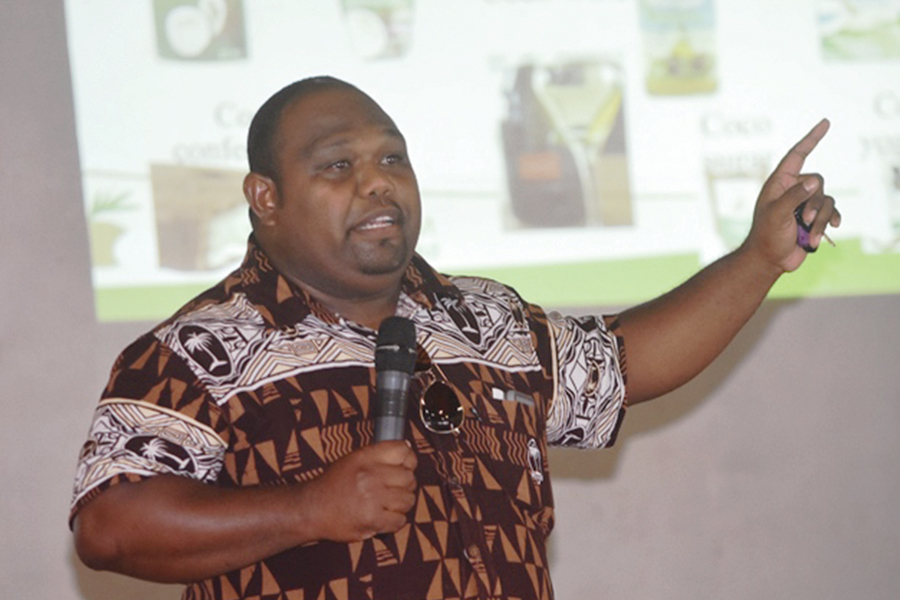
Coconut Industry Rep. Mr Rudolf H. Dora speaking on coconut research.
BY LORETTA BRIGIDIA MANELE
Coconut Industry Rep. Mr Rudolf H. Dora speaking on coconut research.
IF we can increase research and target research on specific products, we can engage companies.
This is according to Coconut Industry representative, Mr Rudolph H Dora who was speaking under the topic “Coconut Research” while contributing to discussions at the Coconut Day event at the Museum Auditorium yesterday.
Giving an example of one country’s business tactic in the coconut international market, he said in the Philippines they yield 1m nuts into their coconut factory on a daily basis.
Mr Dora added that as a small country, Solomon Islands cannot compete with that and so, what the Solomon Islands should do is carry out research on what works well for the country’s coconut industry and use this medium to tap into the global coconut market.
He labelled branding and packaging as essential components in marketing, stating that in order for a product to attract customers and stand out, its brand and packaging must be appealing.
In this case, Mr Dora continued to stress that even though you may have a good product, if you are working with a boring brand, your product won’t sell.