Home Blog Page 1631

How the strata bill will boost development in SI

0

BY CAROL-ANNE SULEGA

THE strata titles bill 2017 poses to boost development and many other industries in the Solomon Islands, it is reported.

Technical Advisor Allan McNeil reveals this when queried by the Leader of the Independent Group, Dr Derek Sikua, on the similarities of strata developments in Vanuatu and Australia in the proposed legislation to do the same in Solomon Islands.

Dr Derek made the query during the Bills and Legislation Committee (BLC) hearing to the sponsoring ministry of the strata titles bill 2017 this week after the two countries were given as a similar scheme example to what Solomon Islands is moving towards.

The Ministry of Lands, Housing and Survey is the sponsoring ministry of the Strata Titles Bill 2017.

“Explain to the Committee what is really happening in Vanuatu and in Australia jurisdiction in terms of the strata titles – what is in practice? What types of developments do you see instead of simple straight forward construction?” said Hon Sikua.

McNeil told the committee that Vanuatu and Australia have had strata development schemes for some years now but their situations are different as there are many expats and retirees that are interested in purchasing strata developments.

He gave Vanuatu as a more similar example being another Melanesian country itself.

He added that in Vanuatu their tourism industry is much stronger than Solomon Islands’ and many expats choose to retire there and many are interested in purchasing strata developments, whether it be land or building units.

McNeil added that Vanuatu’s legislation was abused through subdivision of land but in the proposed Bill currently before the BLC, it’s more on buildings.

“We have learnt lessons from Vanuatu.

“Most it has been about land, now it has been amended and is for subdividing buildings,” he added.

The BLC was told that there will be more interest from Solomon Islands to buy strata units in Solomon Islands than Vanuatu.

“Lots of strata developments in Australia, form of subdivision of land and buildings, and have different names but are essentially the same thing but where there is common property is for all the unit owners,” McNeil further added.

The BLC was also informed that consultations on the Strata Titles Bill 2017 were also done in Australia with legislative drafters and stakeholders who have dealt with strata development schemes.

The combined value of strata development value in Australia amounts to over 1 trillion Australian dollars and can be seen in cities in Australia dotted in their skylines.

All of which are dominated by strata development.

He then added that Solomon Islands will not turn out like that just yet through this scheme as it will be on a much smaller scale.

Strata Titles Bill to control urban sprawl

0

BY CAROL-ANNE SULEGA

THE Strata Titles Bill 2017 that is currently before the Bills and Legislation Committee (BLC) for consideration is an answer to controlling urban squatters.

This was confirmed to the BLC by the sponsoring Ministry of the new Bill, the Ministry of Lands, Housing and Survey.

According to the witnesses from the Ministry that appeared before the BLC, the principle reason for the Bill is the need to address acute shortage of affordable residential accommodation in Honiara.

The objective of the Bill is to facilitate high density development in Solomon Islands while at the same time protecting the interest of persons who buy units in such developments.

The Bill is also expected to result in additional housing in Solomon Islands who cannot afford to buy whole parcels in Honiara and this cannot be achieved but through strata titles.

The Bill is similar in nature to schemes in Vanuatu and Australia.

Their legislative schemes are designed to be simple and as flexible as possible to avoid areas that have rights to abuse by developers.

The Strata Titles Bill 2017 went to Cabinet in the form of a white paper and was approved in concept having the Government agreeing to adopt it as a priority form of economic development.

Since the concept was deliberated on by Cabinet with the assistance of DFAT and SPC, a contract was signed with the Drafter of the Bill, Ms. Christine Swift, finalised by the Attorney General’s Chambers and is therefore now before the BLC.

According to the Ministry of Lands officials, the concept had wide consultations prepared in 2015 along with the draft Bill before Cabinet consideration.

This included the Honiara City Council Executive, Association of Valuers, Solomon Islands Chamber of Commerce and Industry (SICCI), National Provident Fund, SI Bar Association, the Law Reform Commission and commercial banks.

The Ministry told members of the BLC that there have been wide spread support on this proposed legislation in the country and there are hopes to have it also be used outside of Honiara to control urban sprawl.

In terms of implementation of the proposed legislation, the Ministry has confirmed that they have resources and ongoing expenses will be minimal and easy to handle.

They added that for a start, they do not expect a big turnout of applicants but its innovative progress will encourage construction diversity.

The Bill has achieved lots of merit and is designed for both oversea and local investors.

SIMSA desperate for modern equipment

0
Director of SIMSA Mr Tim Harris

BY SAMIE WAIKORI

THE Solomon Islands Maritime Administration (SIMSA) is in need of modern technological equipment.

Director of SIMSA, Mr Tim Harris says the organisation and the government need to embrace modern technology more closely, and do away with misconceptions that technical and electronic systems are unreliable.

“The real situation is that time and time again technological solutions have been found more reliable and cost effective than human systems.

“In the maritime industry incidents and accidents have been analysed and show that more than 70 [percent] have been caused by human failings and less than 30 [percent] by technical failures.”

He said SIMSA needs automatic identification systems (AIS) and long-range identification and tracking (LRIT) to monitor shipping activity in the Solomon Islands EEZ.

Mr Harris said other needed technical instruments include radar sets, gyro-compasses, echo sounders, global positioning system (GPS) receivers, electronic navigational charts (ENC) and electronic chart display (ECDIS) systems, etc.

He adds training for staff to man these equipment is also vital.

Will strata developments be culturally adaptive?

0

BY CAROL-ANNE SULEGA

QUESTIONS have been raised by the Bills and Legislation Committee (BLC) on how culturally adaptive strata developments will be in the proposed strata titles bill 2017.

The questioned was raised by the Leader of the Independent Group Hon Dr Derek Sikua, a member of the BLC.

The BLC has been conducting inquiries into the strata titles bills 2017 this week straight after Parliament was adjourned on Monday this week.

Technical Advisor Allan McNeil then responded to the committee that Solomon Islanders are attuned to the cultural aspect of living.

This is being accustomed to having outdoor time in their kitchens, gathering outside together and rarely always indoors.

“Right now it will be more of a planning and building question rather than a strata development question and the way the buildings are built to suit this type of living,” McNeil said.

He then added that many people around the world who have been directed into strata developments who too are outdoor social people have all well adapted to strata developments.

The Ministry then said the strata development scheme is voluntary in terms of design and will be up to fixed termed owners to have culturally aspects maintained in a modern context or not.

Trade boost

CEO of SIPA Mr Eranda Kotelawala.

SIPA unveils infrastructure development plan for Noro and Honiara, engages world’s largest shipping line


By Alfred Sasako

SOLOMON Islands Ports Authority (SIPA) has embarked on a multi-million dollar infrastructure development plan, which will lay the foundation for economic growth at the nation’s seaports for the next 50 years, its Chief Executive Officer, Eranda Kotelawala has revealed.

Part of the plan, which will see the expansion of Noro wharf in Western Province, involves a tripartite partnership arrangement with MAERSK, the world’s largest shipping line and Tri-Marine.

A Memorandum of Understanding (MOU) cementing the relations is expected to be signed in Honiara on October 18, Mr Kotelawala told Island Sun in an exclusive interview yesterday.

“This is going to be the beginning of massive changes for the way we do things at our ports. Extensive training would be provided particularly to the stevedoring staff as much of the operation would be mechanised,” Mr Kotelawala said.

Under the arrangement, MAERSK will call into Noro Ports twice a month to pick-up reefer containers and carry them to several international destinations.

MAERSK’s regular visits would also be an opportunity for all Solomon Islands products, including sawn timber, cocoa and coconut virgin oil to be sent to markets around the world.

“To help us prepare for this project, MAESK will provide two fish off loaders and two generators for emergency use in the event there are power cuts in Noro,” he said.

“Solomon Islands is in a geo-strategic position, which unfortunately was not taken advantage of in the past. Now, large shipping companies are coming to us and saying they are willing to partner with us in building our ports in order to handle the volume of cargoes envisaged to pass through our seaports.

“They are giving us an opportunity to prove that we can do it,” Mr Kotelawala said.

He said he wanted to “set the foundation for this growth, which will result in Noro and Honiara becoming the hubs for handling regional cargo.

The potential is here, but we’ve got to prepare for it”.

In Noro, there are plans to extend the 60-metre berth by another 90 metres.

At the same time SIPA has begun paving the container area as part of the new development.

As well, work has begun on the International Shipping Ports Security (ISPS) area in line with international requirements.

In Honiara, there are plans to upgrade part of the old international wharf as well as the local jetties to withstand earthquakes and tsunami.

This is to build a life-line section for both international and domestic shipping in Solomon Islands.

Mr Kotelawala said these important infrastructures have been neglected for far too long and he is pleased the SIPA Board is being supportive of the overall development plans for both Noro and Point Cruz.

Meanwhile SIPA has signed an International Sister Port Agreement with Kaohsiung Port in southern Taiwan.

The MOU is intended to promote and develop “greater understanding, friendship and trade opportunities” between the two ports.

Kaohsiung is one of the busiest seaports in the world, handling an estimated 100 container ships at any one time, compared with Point Cruz which can handle only two.

Wait, more waiting

Parliament

Government requests more time to sort ‘more bills’, promise of ACB-return still stands


BY CAROL-ANNE SULEGA

THE Office of the Prime Minister and Cabinet (OPMC) has been allocated time during Parliament’s period of special adjournment to sort out more Bills to bring before the current sitting.

This was confirmed by the National Parliament of Solomon Islands’ media unit.

“The reason for further adjourning Parliament at its resumption on Monday 9th October was to give time for the Bills and Legislation Committee to hear the Strata Titles Bill 2017 as well as for the Prime Minister’s office to sort out Bills it will bring before this sitting,” Parliament’s statement says.

One of those Bills is the popular Anti-Corruption Bill (ACB) 2016 that has received much backfire for its withdrawal in the last sitting.

Prime Minister Manasseh Sogavare also mentioned yesterday that the Government also needs to finalise the budget, for which is believed to be the 2018 Appropriation Bill 2017.

PM Sogavare when moving the motion for special adjournment said that the bills and legislation committee requested that they need at least one week to look at the Bills currently before the house, especially the Strata Titles Bill 2017.

“One is the Anti-Corruption Bill which the Deputy Prime Minister and I have given our assurance to the nation,” Sogavare stated.

Parliament withdrew the anti–corruption bill 2016 from the Business Paper on the floor of Parliament on Monday, August 28, 2017.

PM Sogavare sought leave under Standing Order 31(1) to move the motion without notice under Standing Order 26(1) due to the following reasons:

“The Bills and Legislation Committee made some very good recommendations to improve this Bill, therefore, government needs to improve the Bill by including recommendations from the Bills and Legislations Committee.

“The Bill will be reintroduced in Parliament as a new Bill,” Sogavare said in the last sitting.

The Prime Minister said his government is standing up to improve this Bill by drawing those recommendations from the Bills and Legislations Committee.

He promised at that time that the Bill will return with much improved provisions to tackle corruption in this country.

Yesterday, the following Bills were put to first reading and were set for second reading:

The ‘Legal Profession Bill 2017’, the ‘Prescription of Ministers (Amendment) Bill 2017’ and the ‘Strata Titles Bill 2017’.

As usual, every year Parliament is expected to pass the annual Budget for the next financial year before the Christmas Festive season

On that note, the Parliament Media Unit, in its statement said they believe the Budget the Prime Minister was referring to is the 2018 Budget.

New ideas on plastic in the environment

0

PLASTIC in our oceans is an increasing problem to marine life and our environment and I was interested to learn this past week of two new ideas to help reduce our plastic bag usage and to make use of waste plastic recovered from the sea in a practical way.

Radio New Zealand International (RNZI) first presented a news bulletin in which it was said Cassava offers a Pacific alternative to the use of traditional plastic bags.

This is what was reported (quote)

“Plastic bags made from cassava starch are being considered as an alternative to traditional plastic bags in the Pacific.

“A number of Pacific Island states have banned plastic bags, amidst a wider regional effort to reduce ocean waste.

“Indonesia recently offered Pacific countries help with technology to produce bio-degradable plastic made from cassava, a crop grown throughout the region.

“Indonesian officials say the bags can easily dissolve in warm water.

“A New Zealand-based scientist specialising in biopolymers said depending on how they are used, cassava bags could have merit.

“Dr Florian Graichen said international standards would first have to be met.

“If it’s certified and accepted, then you would fulfil either the bio-degradability or compostability standards. And I think then you can look at it as a credible alternative. Having said that, you wouldn’t want to encourage just plastic bags being thrown away in any shape, form or whatsoever,” he said.

“Regional leaders at last month’s Pacific Islands Forum summit in Apia pledged efforts to reduce plastic waste in the ocean, and appear to be showing interest in the biopolmer products coming online globally.

“Dr Graichen, who is with the New Zealand crown research institute Scion, was hesitant to attribute the cassava bags as an answer to the massive problems with plastic waste, but suggested it could be better option to a plastic bag that never degrades.

“But again you wouldn’t want to have that simply just lying around and flying around. The first thing you want to look at is how can you avoid it, regardless of what the bag is,” he said.

A second innovation I read about on Linkedin on 25 September 2017 in an article by Roy Rimmer mentioned that a well know shoe manufacturer had launched making new training shoes from ocean plastic waste.

 This is what the article said :

“It is well known that plastic waste causes huge pollution problems throughout the world’s oceans. Plastics are estimated to account for nearly 80 per cent of the world’s marine debris, and a study in 2015 found that about 8 million metric tons of it pollute the seas every year.

“Naturally, any steps that can be taken to reduce this level of pollution will help reduce damage to wildlife and the wider environment and are to be welcomed.

“There is a large area of ocean known as the Great Pacific Garbage Patch, which is contaminated by masses of chemical sludge, pelagic plastics and other forms of marine debris that has been caught by currents. In the USA alone, around 500 million plastic straws are used every day. This fact inspired the National Parks Service to launch the Be Straw Free campaign, to reduce the amount of plastic waste ending up in the oceans. The new initiative from Adidas also aims to reduce marine plastic pollution.

“Adidas, in conjunction with Parley for the Ocean, an environmental initiative, has launched a new range of products manufactured from plastic debris that is found in the ocean. The popular Ultra Boost shoe is to be produced in three editions; Ultra Boost, Ultra Boost X and Ultra Boost Uncaged. The plastic waste recycling for each pair of these shoes will use the equivalent of eleven plastic bottles and the laces, sock liner covers and heel lining will also be made of recycled materials.

“Adidas aims to produce one million pairs of the shoes using plastic from the oceans this year, making a small initial impact on the problem of marine pollution. The company claims to integrate sustainability into its business model, making it an opportunity to gain a competitive advantage in addition to the environmental benefits it provides.

By 2020, Adidas hopes that all the shoes it manufactures will be made from recycled plastic.

This would make a significant difference to waste plastic in the oceans, as well as leading the way for other major companies to examine their environmental impact.

“The new Ultra Boost X shoes from Adidas are not only brilliant from an environmental point of view, but they are also great shoes, incorporating the Boost technology that provides high energy and comfort. They also look good, and are available in two different colours: white and pale blues or navy with light blues, both representing the ocean in its different moods. Because they are so lightweight, the shoes are excellent for running and the Boost technology helps to make it feel more impactful. Because the uppers are knitted, they keep the feet cool and add to the overall light feeling of the shoes.

“The company has previously demonstrated its commitment to reducing plastic waste pollution in the oceans in other ways. In addition to helping the environment by using recycled plastic for these new shoes, last year, Adidas replaced the plastic bags in its stores with paper ones, thus eliminating nearly seventy million plastic bags. Leading brands such as Adidas have an important role to play in reducing marine pollution.”


Yours sincerely

Frank Short

Disturbing disability figures in the Solomon Islands

0

THE Acting general secretary for the Solomon Islands National Council of Women and vice president of People with Disabilities Solomon Islands Casper Fa’asala announced last week that there are more than 60,000 people in the Solomon Islands suffering from disabilities.

Mr. Fa’asala made his statement during the launching of the Public Solicitor’s clinic for people with disabilities.

The SIBC carried a bulletin of Mr. Fa’asala’s announcement from which I quote:

“The number of people with disabilities in Solomon Islands is estimated to be more than 60,000, with many caused by preventable situations.

“Mr. Fa’asala said the number was high, and the number of the population living with disabilities in the country was increasing.

“Traffic accidents, chronic health conditions, disease, poor working conditions and a lack of safety equipment have been identified as the main causes.

“And these people are often in poverty because of their disability,” he said.

“Mr. Fa’asala said it is saddening to note that some cases involving people with disabilities have not been attended to by the responsible authorities.

“Mr. Fa’asala commended the Public Solicitor’s Office for establishing the country’s first legal clinic for people with disabilities.”

I would also like to express my own appreciation to the Public Solicitor’s Office in creating a legal clinic to address the concerns, needs and rights of people living in the community with disabilities.

The Solomon Islands must seek to reduce all barriers and to increase opportunities for its people with disabilities, to ensure their full participation in society.

If the Solomon Islands Constitution does not yet provide a strong legislative framework that guarantees the equal rights of people with disabilities then urgent steps should be taken to bring the Constitution in line with other countries that have such guarantees.

I would go further to suggest, if not already provided for in Solomon Islands statutes, that there should be an Employment Equity Act and a Policy on the Duty to Accommodate Persons with Disabilities in the Solomon Islands Public Service.

The Solomon Islands, to the best of my knowledge, is yet to support the protection and promotion of the rights for people with disabilities through the ratification of the UN Convention on the Rights of Persons with Disabilities.

The Convention if ratified

protects the rights to equality and non-discrimination of persons with disabilities;

explains the types of actions countries should take to ensure that rights are enjoyed by persons with disabilities on an equal basis with others;

calls on States Parties to ensure non-discrimination for persons with disabilities in a variety of areas, including freedom of expression and opinion, respect for home and the family, education, health, employment and access to services.

I have written to a representative of the MOHMS to request information on the type and nature of diseases referred to by Mr. Fa’asala impacting on disabilities in the hope that working through the New Zealand based Charitable Trust, ‘Take My Hands,’ I might be able to offer assistance with equipment to aid the recovery of persons with diseases or illnesses that could eventuate in disability or acquire mobility aids to help those with walking difficulties.


Yours sincerely

Frank Short

Veke on CITREC’s Fruition

Hon. Patrick Savusi embrases CITREC candidate from Moli Ward.

AS Guadalcanal Provincial government farewells five GP-CITREC candidates heading for Canada in the coming days, two are already in Canada and another 10 are being processed for December bringing a total of 17 candidates to be in Canada by the end of 2017.

With the high demand for workers in Canada, the prospect for next year should be around hundred (100) plus GP-CITREC candidates living and working in Canada by 2018.

An obvious happy man speaking during a farewell luncheon last Friday was Guadalcanal Premier Hon Anthony Veke. He thanked CITREC office in Canada and GP-Education authority for their work in making CITREC coming to progressive fruition.

“Despite this CITREC programme being a government undertaking, many have closely associated with me. Yes I initiated it during my previous tenure as Premier and continue to do so. I have faced so much, criticism and outright name calling by people and even some of my Assembly colleagues” Premier Veke said.

“In all these wrangling and petty politicking, I remained firm, committed and believed in CITREC as a way forward for my people of Guadalcanal. My firm position stems from an ambitious dream I always held for Guadalcanal people. That is I want to see my people everywhere around the world, like the Chinese and the Indians” Veke said.

He furthered that his recent trip to China convinced him that he is pursuing a worthy dream. He learned that Chinese people living abroad pumped in alot into Chinese economy bringing change, development and progress since the 1800s. The same can happen with Guadalcanal people living abroad. They will return with practical knowledge and new ideas in our economy.

“Therefore, for GP to change, for our people’s live’s to change, there is no time for business as usual. We have to approach GP development differently, from different dimensions. We have to take risk, take the roads less traveled. And I have been taking that risk. Today it gives me so much satisfaction and happiness personally” Premier Veke expressed.

“As we speak, an account for Guadalcanal Province has been created in Canada where remittances for the province will be deposited and channeled” Veke said.

“Remittance is a lucrative source of revenue for a country, in our case for Guadalcanal province. A rough estimate has it that should there be around 200 plus Guadalcanal workers working in Canada, our province can earn up to 35 to 40million dollars annually from remittance alone”. Premier Veke highlighted.

In substantiating Premier Veke’s arguments, GP’s External Affairs Officer Mr Mcfaddean Aoraunisaka noted that according to World Bank, officially recorded global remittances to developing countries amounted to $429 billion in 2016. And in keeping with an improved global economic outlook, remittances to developing countries are expected grow by an estimated 3.3 percent to $444 billion in 2017.

“This is GP directly participating in global economy. The global flow and exchange of human resources, human capital, trade, finance, technology, knowledge and ideas is a must participation for Guadalcanal Province.” Mr Aoraunisaka said.

G-Province is looking forward in sending over more CITREC graduates.

—GP PRESS RELEASE

Five set to work in Canada

GP Executive Farewell GP-CITREC Candidates

FIVE Guadalcanal – CITREC graduates are set to work in Canada for 24 months in the coming days.

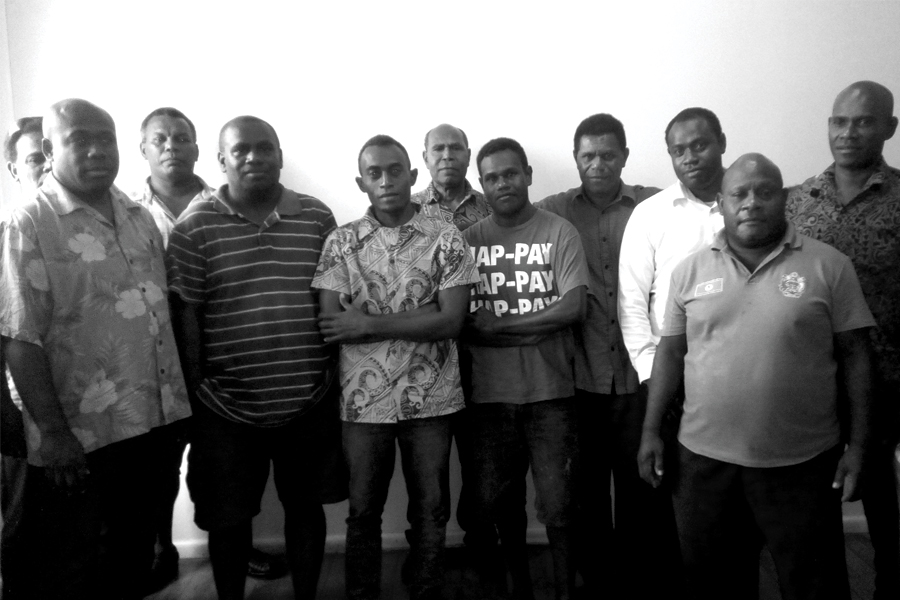
Guadalcanal provincial executive and staff from GP-Education authority held a farewell luncheon with Guadalcanal-CITREC students Friday last week at GP-headquarter Rita-eleven.

Two will take up supervisory role in their respect workplace within the Tourism and Hospitality industry whilst the other three will pilot a new programme working in dairy farms.

Their immigration nomination documents for Canada came with an employment confirmation that provides them the opportunity to remain in Canada on permanent basis as residents, a process they will apply for when arriving in Canada under the immigrant nominee programme.

They will be joining Mr Careka Volley and Ms Amelia Muse who are already in Canada on immigrant nominee programme.

Speaking during the luncheon, Premier Veke reminded the candidates to be good ambassadors for Guadalcanal Province as many more students will be following their footsteps in the coming months and years.

“This CITREC program is a huge investment for our province, and you are our human resources and capital the province invests in. Take pride and responsibility seriously as you take on this new challenge in your life. Display our worthy culture and custom in Canada” Premier Veke told them.

Also speaking during the event was Guadalcanal Provincial Minister for Education Hon Lazarus Rina who reminded the candidates and others that selection criteria was done in Canada.

“GP-Education authority does not select candidate. Therefore you are the lucky ones out of the rest for now. Be on your best, behave properly and pave the way for others” Hon Rina emphasized.

On-behalf on the students, Mr Johnathan Benozi thanked the Premier and his executive, GP-Education authority and CITREC office in Canada for their efforts and persistence in making everything possible for them to travel, work and live in Canada.

“I thank you and assure you Mr Premier, your good executive and the people of Guadalcanal that we will be good ambassadors for our Province and the country. We understand this opportunity is for many more candidates after us, hence we will not mess it up” Mr Jonathan said.

The five traveling to Canada in the coming days are, Markly Tiaro, Jonathan Benozi, Buddley Sopo, Thomas Mike and Delite Grace.

—GP PRESS RELEASE