Home Blog Page 1595

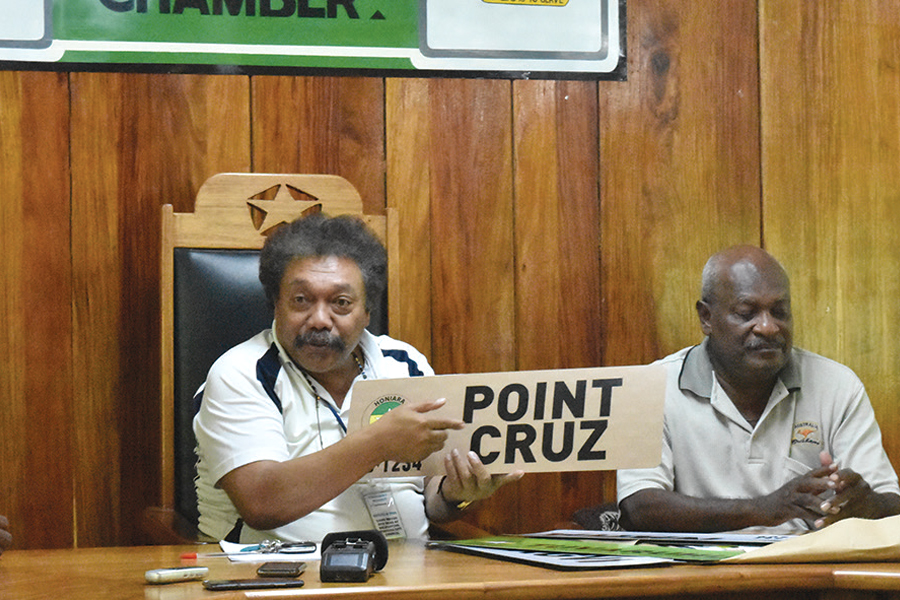
Bus conditions must meet requirements: Mua

HCC Mayor Andrew Mua left

BY BARNABAS MANEBONA

IF a bus planning to operate transportation is passed at the Ministry of Infrastructure Development (MID), HCC will do its inspection at their Depo Works Division as well.

This is according to the Honiara City Council (HCC) Mayor Hon Andrew Mua.

“If chairs and air conditions are good without sitting in a bus and seeing the road tar then we will finally be issuing a business license,” said the HCC Mayor.

“Buses without proper conditions will not be issued licenses as we will seriously be taking this into account for restriction.”

Chairman of the Taskforce responsible for the bus routes Hon Eddie Ngava said HCC’s move to enforce new bus routes in the capital is to help other rules or Acts of the National Government being enforced.

“We also want to help the health sector, tourism industry and other sectors,” said the Chairman.

“So we are not only sorting and enforcing the destination routes but we are also assisting other laws in the country.”

HCC is appealing for the public to report any bus that operates in the city with poor conditions.

Constitution to be amended to set Ombudsman eligibility standard

0

BY CAROL-ANNE SULEGA

THE Bills and Legislation Committee (BLC) has suggested that the Government consider amending the Constitution to set qualification, disqualification and eligibility standards for the appointment of an Ombudsman.

This is according to recommendations of the Committee’s report on the passed legislation.

The Office of the Ombudsman in Solomon Islands is established by the Constitution and is a public office governed by the Ombudsman (Further Provision) Act 1980.

The Ombudsman is appointed by the Governor General (GG) upon the advice of the Chairman of the Public Service Commission, the Chairman of the Judicial and Legal Service Commission and the Speaker of Parliament.

The report states that the Committee acknowledges that the Constitution does not set minimum requirements as qualifications for appointment as Ombudsman.

However, the Committee is of the view that the Constitution be amended to allow for such qualifications to be set either in the Constitution itself or in an Act (law) of Parliament.

Any such qualifications are to state the exclusion of persons with prior convictions.

Bus owners warned

0

BY MAVIS NISHIMURA PODOKOLO

HONIARA City Council has warned bus owners that increasing bus fares without any legal proceeding is illegal and that HCC will interrogate buses that charged $5 yesterday.

Mayor of Honiara City Hon Andrew Mua said his office has received a number of reports about the buses charging $5 to passengers yesterday and now they are compiling reports to identify and penalise the buses.

He said those buses who charge $5 bus fare have breached certain HHC laws and HCC will deal with the issue accordingly.

Mua said strategy to catch and interrogate the buses are in place and there will be no escape for buses who try to play foul.

He said that one strategy is to arrest and question the buses when they (buses) go to HCC to buy their business licence.

“Some of the buses who charged five dollars bus fare are yet to buy their license at HCC and this give us a higher chance to identify the buses base on the reports we received so far.

“They will be summoned when they turned up to pay their licences,” he said.

Mua said his office has never announced that there will be an increase of bus fare when endorsing the Honiara new bus route.

He stressed those buses who charge $5 fare are confused or treat the Honiara new bus route transition period as an opportunity to get more income.

This paper understands that an interim Honiara city bus owners association clearly stated during their meeting on Sunday that bus fares will remain the same.

Spokesperson for the association Mr Walter Maesugea said there is no point to increase the bus fare as decision made was to diminish short route issues and not to increase the busfare.

He said the interim bus association will talk with HCC about the issue and decision made during their discussion will be final.

This paper is yet to receive any information or the outcome of the interim bus association and HCC’s meeting.

They were supposed to have met yesterday.

Ombudsman needs provincial focal points

0

BY CAROL-ANNE SULEGA

SINCE the Office of the Ombudsman experiences and receives an average of 300 complaints a year, the Bills and Legislation Committee (BLC) suggests that the Ombudsman has at least one of his own officers in each of the country’s nine provinces.

This was a recommendation by the Committee on the passed legislation, the Ombudsman Bill (Act).

In evidence, the Committee was informed that the Office receives an increasing demand for its services and has reported an accumulated backlog.

The BLC noted that this is an overwhelming number of complaints which is managed by a very lean staff.

The Committee noted that the legislation will enable the Office to address capacity issues by expanding its current staff establishment and to recruit accordingly.

This would also take into account the recruitment of qualified personnel suited for various technical and specific tasks.

The Office anticipates these increased to be introduced this year according to the report.

The BLC was informed that previously, the Office engaged public servants who are posted in the provincial headquarters to perform investigations in the provinces on behalf of the Ombudsman.

These officers are referred to as the ‘Focal Point Personnel’ who provide assistance on an ad hoc and voluntary basis.

The report states that the Committee is concerned that in a situation where there is conflict of interest, proper investigation of complaints may be compromised under such arrangements.

The BLC then added that it supports the need for the Ombudsman to have strong presence and reach in all provinces.

“However, the Committee is of the view that the time has come for the Ombudsman to have its own staff in the provinces.

“Where focal point personnel are used, these should be remunerated for their work and clear guidelines are set to avoid conflict of interest situations,” the report states.

The BLC also recommends that the Ministry of Public Service and the Ministry of Finance and Treasury work collaboratively with the Office of the Ombudsman t0o urgently pursue recruitment within the next 12 months.

This was stated last year, therefore work on this is expected this year.

SIMSA explains connection with SAR

0
Director of SIMSA Mr Tim Harris

BY BARNABAS MANEBONA

THERE seems to be great confusion in Solomon Islands about SIMSA’s role in connection with Search and Rescue (SAR).

Solomon Islands Maritime and Safety Administration (SIMSA) Acting Director Captain Tim Harris explained that SIMSA is not the Marine Division.

“SIMSA does not physically go looking for people lost at sea. SIMSA co-ordinates other people who are already at sea to look for people or ships in distress by using electronic means to assess the weather, currents, tides and their effect on different sized ‘targets’ in the water,” said the Captain.

“This has been shown throughout the world to provide a more cost effective and speedier recovery.”

He further explained that there is no difference between the ways that Solomon Islands co-ordinate SAR when compared to PNG, Australia, New Caledonia or anywhere else in the world for that matter.

“Every maritime nation has a Maritime Rescue Co-ordination Centre (MRCC).

“It is part of the mandatory requirements for Member States of the International Maritime Organisation (IMO) that are signatories to the United Nations Convention on the Law of the Sea (UNCLOS) and the Global Maritime Distress and Safety System (GMDSS).

“The difference is that wealthy nations such as Australia, New Zealand and the United Kingdom also have dedicated Search and Rescue assets in nearly all their main ports, or a Coastguard (United States of America) that can be mobilised for SAR at short notice.

“They also have helicopters strategically located around their shores that can be mobilised for emergencies at short notice.

“The ‘assets’ for MRCC in nations such as Solomon Islands are nearly all electronic and to do with communications such as radio, Digital Selective Calling, GMDSS [automatic radio alarm]and SARMAP, etc.”

New bus association for Honiara city

0

BY BEN BILUA

A new body aimed at looking after the welfare of bus owners and operators in Honiara has been established on Sunday.

The new association is called Honiara city bus owners association, and replace the previous bus association which has remained inactive since establishment.

An interim committee including two females and five men have been appointed to drive the association while formalities such as registration of the association and drawing up of the association’s constitution are made.

All the committee members are volunteers with aims to revitalise the bus industry in Honiara.

Spokesperson of the interim association, Mr Walter Maesugea, said the association was established as the previous bus association failed to perform during this time where a new bus route is enforced.

He adds that the old bus association had never held any annual general meeting and that indicates that the association no longer exists.

“We are caught in this new bus route transition but we have no association to get our views and ideas to the rightful authorities for discussion, as such some of us call for this voluntary meeting to elect new people who can help us.

“Today (yesterday) we elect this committee as the task force to carry out discussions and also negotiation with HCC about the new Honiara City Bus route,” Maesugea said.

He explained that the urgency to establish the committee is critical as the transition of the new bus route begins today.

Maesugea adds that all the members in the committee are volunteers trying to mediate the situation now and also way forward for the association to legally register with a constitution.

He said there will be a proper meeting to appoint the association’s officer bearers when the constitution and registration of the association are made.

Police ‘wak-out’

Renbel PPC and officers abandon Tingoa station, Rove HQ seek answers

BY BARNABAS MANEBONA

RSIPF officers posted at the Tingoa police station have evacuated the station, it is reported.

The provincial police commander (PPC) and six police officers from other provinces boarded a flight to Honiara on January 1, leaving behind only one probationer officer to man the station.

Community leaders are questioning the evacuation, labelling it as non-procedural and utterly irresponsible of the RSIPF to ‘simply walk out’.

Questions furbished to police media have received the mere response: “The Office of the RSIPF Assistant Commissioner (Provincial) is aware of the matter and is dealing with it administratively.”

Island Sun has also learnt that the executive of the RSIPF were not even made aware prior to the ‘walk out’ nor are privy to any reasons behind it.

Sources familiar with the issue say even the Deputy Commissioner Admin had rang officers enquiring any possible reason behind PPC Manegaua’s walk out with his officers.

While reasons behind the move are unclear, sources say the officers had been recalled by the Acting Commissioner Provincial (ACP) following widespread complaints over their low performance leading up to and during the Christmas festivities.

Other reports say the new PPC, Inspector Aloysio Manegaua, and his officers had also received continuous threats and abuse, hence had fled for their safety.

“But this does not warrant a walk out,” says one source. “Police should never back down because of some verbal abuse and threats from a rowdy public. They have back-up like the PRT to help them curb anti-social issues, plus it is their job to maintain law and order.

“If the police can’t do that then I’m afraid our police is heading in the wrong direction,” a community elder tells Island Sun.

This paper understands that Tingoa had begun facing law and order problems since late November last year after the former acting-PPC was recalled to Rove HQ.

Community elders had taken to the media to voice their complaints over the deteriorating state of law and order, demanding that police step up in their policing roles and apprehend individuals who were carrying out anti-social activities.

They had called for PPC Manegaua to carry out high visibility foot and vehicle patrols and to visit communities. In more recent media calls they had condemned the inactivity of police and the seeming reluctance by officers to respond to reports of criminal activities.

Browsing through the Facebook forums, many commentators can be seen voicing out concerns over the implications of the ‘walk out’ and what RSIPF management plans to do to address the situation.

Some are calling for the PPC and his officers to be replaced with competent officers, others are scolding Tingoa’s public for unwanted behaviour which led to the police running away, and others just want the police and authorities to resolve the problem amicably.

While the ‘walk out’ has received mixed reactions, it is clear that it was a move that has caught many unawares and dumbfounded.

THE SOLOMON ISLANDS BROADCASTING CORPORATION (SIBC) MUST HAVE A SECURE FUNDING FRAMEWORK

0

Dear Editor,

THE Solomon Islands National Broadcasting Corporation (SIBC) is struggling to maintain its services to the communities settled on the 350 inhabited islands across the length and breadth of the nation.

The Solomon Islands being an island nation made up of over 992 tropical islands lies east of Papua New Guinea and the distance between the westernmost part and easternmost islands is about 1,500 kilometres.

The Santa Cruz islands are situated north of Vanuatu and are especially isolated at more than 200 kilometers from the other islands.

The total land area of the country is approximately 28,442 sq. Km and the total sea area is over 1,600.000 sq km.

Population estimates indicate a population in excess of 600,000

 It does not need much imagination to understand that the SIBC in its mission of public service has a vital role to play in providing information, contributing to national identity and sense of community, but also in giving attention to minorities across the vast outreaches of the country.

 Lying the Pacific Ocean, the SIBC is the first to give notice of Cyclones to enable communities to take precautions and such services are increasingly important now that the Solomon Islands is being impacted so seriously by the affects of climate change.

 It seems to me to be inconceivable that the SIBC should be short of government funding at a time when the national broadcaster is more important than ever in carrying out is primary mission of public service.

Looking into the history of national broadcasting in the Solomon Islands one learns that radio broadcasting was established by US military forces in the British Solomon Islands Protectorate (BSIP) during World War Two.

“In 1944, the Armed Forces Radio Service (AFRS) developed small, medium wave stations at Lunga on Guadalcanal and Munda, New Georgia. These were designed to provide information and entertainment to the hundreds of thousands of US service personnel then based in the BSIP. The stations were part of the Mosquito Network, a loose network of similar AFRS stations stretching through the South-West Pacific, from Bougainville in the north to Auckland in the south, and including outlets in Espiritu Santo and Noumea.

“As the Pacific war moved northwards, the AFRS stations closed and BSIP listeners returned to tuning to broadcast programmes from Australia or further afield for entertainment and information.

“In 1946, a rudimentary weekly half hour of news and service bulletins was established by the BSIP Administration. The service was transmitted from Honiara on regular inter-island radio frequencies using Government transmission equipment and soon developed a regular following.

“By 1952, the broadcasts were on a much stronger footing and the Solomon Islands Broadcasting Service (SIBS), an arm of the Government, was established.”

“In 1976, new legislation converted the SIBS into the Solomon Islands Broadcasting Corporation (SIBC), a totally independent public service broadcaster charged with providing national radio coverage and a full range of news, educational and entertainment services.”

Source: SIBC Website.

A recent article in the Solomon Star newspaper gave details of the current plight of the SIBC to stay on air and to fulfill it essential mandate. This is what the article related (quote).

“The national broadcaster, SIBC, is taking drastic and desperate measures to stay on air.

“This comes after Solomon Power’s recent disconnection of SIBC’s power supply due to a $65,000 outstanding bill.

“The national broadcaster, which has the furthest reach and relied on by the rural populace, currently runs on generators, which are expensive to maintain.

“Chief Executive Officer Ashley Wickham told the Sunday Star they are taking every possible measure available to keep the station on air.

“We’ve already shutdown the medium wave (MW) transmitter because of the situation,” Wickham said.

“Only the Short Wave (SW) transmitter is still being maintained because it reaches the whole country,” he added.

“Our streamed overnight service listened to internationally had to be switched off at 11pm so the generators could rest.”

“Wickham said their poor financial situation came about as a result of the government’s critical cash flow problem.

“The government is SIBC’s main source of revenue.

“Wickham said they will review the situation in the New Year.

“But our outlook is not so clear.

“We have not been told when Parliament is likely to sit to look at the budget.

“If our finances don’t improve, we will reduce the transmission hours of the shortwave transmitter so that they are only heard in the early mornings and evenings to close down at 11pm.

“Then we start a process of lay-off of staff.”

The situation is also affecting SIBC’s proposed television service.

Wickham said earlier, due to the government’s cash flow problems, they cancelled a contract payment of $2.5 million which SIBC were to use to set up the early part of the TV service.

“We have submissions for capitalisation of the TV Project and for equipment upgrades for radio equipment, studios, administration, provincial studios, provincial FM stations etc.

“These total $23 million.

“Since the government changed we have not heard how the new administration views our SIBC prospects,” Wickham stated.

“He said SIBC had also complained to the Prime Minister’s Office and Ministry of Finance that Solomon Power did not seem to know the essential services act and did not seem to know or care about the cash-flow situation everyone reliant on government is affected by.

“Solomon Power earlier insisted their action applies to every customer that has outstanding bills with them.”

 In a previous article I posted on Linkedin on 8 December 2017, I highlighted the Solomon Island’s trade deficit of S$170.5 million in the second quarters of 2017 and, undoubtedly, the shortage of essential government funding for the SIBC is a result of the SIG’s loss of earnings.

Here, again, is the article I posted.

“Precis of Solomon Islands Government Press Release – 8 December 2017 Solomon Islands has recorded a trade deficiency of $170.5 million in the second quarter (June) of 2017. This is according to the Solomon Islands National Statistics Office (SINSO) latest figures on the International Merchandise Trade Statistics (IMTS) released on Friday 1st December 2017. The data (IMTS) shows the movement of different types of goods between the Solomon Islands and a range of countries in Oceania, Asia, Europe, Africa, America and other regions. Releasing the statistical bulletin, Government Statistician Douglas Kimi said the deficit is a decrease of $228.0m (396%) over the surplus of $57.5m recorded in the preceding quarter. He said that in terms of the corresponding quarter a year ago, this represented a decline of $224.1m (418%) over the surplus of $53.6m in 2016.”

 I very much hope that the Solomon Islands Government will soon address the financial needs of the public service broadcaster and recognise that it is fundamental that the SIBC needs to have an appropriate, secure funding framework and see to it that government funding is an integral part of the nation’s public broadcasting service – a service that has consistently serves the country exceedingly well in times of war and in peace from its early beginnings in 1944 to the present day.

Yours sincerely

Frank Short

SOLOMON ISLANDS WESTERN PROVINCE GOVERNMENT PLANS SOME BOLD POLICY PROJECTS  

0

Dear Editor,

Reserved seats and a plastic ban among Western Province’s 2018 priorities.

Quoting from a news bulletin released by the Solomon Islands Broadcasting Corporation (SIBC) on 27 December 2017, the Western Provincial Government is looking ahead to the New Year with determination to complete several major projects.

“Among the policies the government wants to advance in 2018 is a temporary special measure for women to have three reserved seats in the provincial assembly.

“The provincial election is expected to be held next year.

“The government approved the Temporary Special Measure (TSM) policy for the reserved seats in August. Since then, it has made some specific arrangements for the three seats, including dividing the 26 wards of Western Province into three zones.

“The Women’s Rights Action Movement and the Ministry of Women, Youth, Children and Family Affairs recently facilitated a training session in Gizo that taught women how to inform other women throughout the province about the TSM policy.

“Western Provincial Premier, Wayne Maepio, said it is important for the people of Western Province to understand the TSM concept before it is implemented.

“I am happy to see that the committee and technical team are really aggressively taking note of that and are doing it,” Mr. Maepio said. “We expect them to consult with people and come back with reports about the difficulties and challenges of making up the policy’s approach in terms of ordinance.”

“Mr. Maepio said his government is committed to the TSM policy. If it is implemented, Western Province will become the first province in Solomon Islands to adopt such a measure.

The province could also set a precedent if it takes action to enforce a much-talked-about plastic ban.

“Mr. Maepio’s government announced in June that all plastics will be banned from Western Province, saying plastic bag pollution is an epidemic in the province that damages both the marine environment and people’s health.

The government expected the policy to take effect this year, but Mr. Maepio said progress has been slow.

“I would like to inform the public that we will restart it back in the New Year,” he said. “We will have a clearer time frame for its implementation then.”

“Mr. Maepio said a lot of work has to be done in terms of public awareness.”

Yours sincerely

Frank Short

LAND REFORM IN THE SOLOMON ISLANDS – WHERE NOW?

0

Dear Editor,

I recall reading a very comprehensive document on land reform in the Solomon Islands some years ago which was entitled “Building a Pathway for Successful Land Reform in the Solomon Islands.”  The author of the Report was Siobhan McDonnell with substantial contributions from Joseph Foukona and Dr.Alice Pollard.

The Report contained some sound advice for the Solomon Islands Government to consider when considering land reform and ‘unlocking’ or ‘opening up’ land for development.

The author, in one paragraph, wrote – “What is more important when we discuss land reform is making sure that all landowners receive equitable returns from development on their land.”

The Report went on to say (quote)

“Solomon Islands is dominated by logging and now by the gradual shift to mineral extraction.

“Landowners have high rental expectations from these sectors. However, the history of logging, mining and land dealings shows how corruption and conflict of interest have contributed to the increase in land contestations in recent years.

“ Middlemen involved in brokering these economic activities as ‘trustees’, ‘logging licensees’, ‘land consultants’ or government agents lack capacity and some of them act dishonestly when representing different landowner interests.

“Often when landowner groups are not happy, they dispute these deals or refuse consent for development activity on their land.

“Government agencies have too often played a role in promoting investor interests rather than looking after landowners. The experience of legal processes for land acquisition, logging licensing, natural resource extraction agreements, land dealings either on customary or state land in urban areas shows that the current trustee model, embedded in these legal processes, can easily be manipulated by mainly powerful male actors. These experiences point to the need to review legal processes and engage in land reform that is based on the needs of landowners and investors.

“This should be led by the Solomon Islands government, pulling together talented Solomon Islanders to drive land reform. In my mind, such an approach would help to create not only a space for developing ‘thought leadership’ but also inter-generation capacity building of Solomon Islanders to better manage and deal with land issues.

 “This Report highlights the need for a step by step development process for land reform efforts. Based on land reform experience in other Melanesian countries, it shows that a successful land reform process requires clear policy direction. The amending or writing of new land laws should be the final step of this land reform process, rather than the beginning. This report is a useful discussion document that we can draw on as we constructively engage in dialogue to create our own unique pathway for a successful land reform in Solomon Islands.”

I have often wondered whether the Report was considered in detail by the government following its publication and I confess, as one now distant from the Solomon Islands, that I truly do not know the answer but continue to read, as in two instances this past week, of land disputes on Customary land that have impeded developments or hampered air services by grievances raised by landowners.

In the first incident, it was reported by the Solomon Islands Broadcasting Corporation (SIBC) that a Small Malaita road construction project was being halted as a result of a dispute with landowners.

The road survey from Rorongo to Tawaro is ready to begin, pending the tribal landowners’ decision.

In the second incident, the outcome proved to be more successful following the personal intervention of the Solomon Islands Prime Minister.

The provincial airport at Parasi has been closed for seven years due to a long running land dispute involving landowner groups.  The airport is now said to re-open in March 2018.

Prime Minister, Rick Hou, discussed with landowners other projects that have long been affected by land disputes, including the construction of a regional hospital, a new police station, new court house and new power and water supply plants for Afio Substation.

Last October Moody’s Investor Service in a report evaluating the Solomon Islands local and foreign currency rating commented on the SI economic growth prospects (quote)

“On the downside, the economy’s growth potential could weaken materially in particular if the structural decline in the logging industry, weak competitiveness and low quality infrastructure hinder investment more significantly than we currently assume. In turn, a prolonged economic slowdown or sudden negative economic shock, combined with lower donor funding and depleting government’s cash reserves, would undermine fiscal strength.”

It is not too difficult to realize that the nation’s economy will suffer if land disputes continue to hamper development and raises the question in my mind, once again, to what extent has land reform taken place in the Solomon Islands since the Report and recommendations I have referred to by Siobhan McDonnell?

Yours sincerely

Frank Short