Home Blog Page 1590

Provincial school libraries go empty

0
Japanese volunteer, Mr Hirofuni Masui

By Mike Puia

SCHOOL libraries in the provinces are becoming boring these days. Most children don’t go there and read up books.

This is an observation made by a Japanese volunteer, Mr Hirofuni Masui.

Hirofuni said people in the provinces, especially school children, are not used to libraries saying this is “a problem”.

“Libraries are less attractive to students. I found out in some libraries, some books are never been looked up for years,” Masui said.

Hirofuni, who arrived in the country in 2016 under the Japanese International Cooperation Agency (JICA) volunteer programme, has left to his home country yesterday.

Hirofuni spends most of his time in Buala, the provincial center of Isabel Province, supporting the Isabel Provincial Education Authority.

Since arrival, he has been visiting schools in Isabel, Malaita, Choiseul, Guadalcanal, Makira, Western and Honiara introducing the reading promotion on literacy programme.

Hirofuni uses a game call ‘bibliobattle’ to get school children visit libraries to read up books and understand the story in preparation for presentation and voting. The one who answer most question from colleagues and get more votes is the winner and is named a ‘bibliobattle champion’. In some schools, teachers offer prizes to bibliobattle champions.

He said the program he delivered is showing good results in participating schools.

“I have taught the game in most schools in the country like a hundred times,” Hirofuni, a bibliobattle champion back in Japan, said.

As part of his programme, he also sourced reading books for schools that lacks reading books.

Hirofuni said he is happy that some schools children have picked up the game and are now spending time in the library.

A mobile wallet that faciliates Domestic and International Services

0
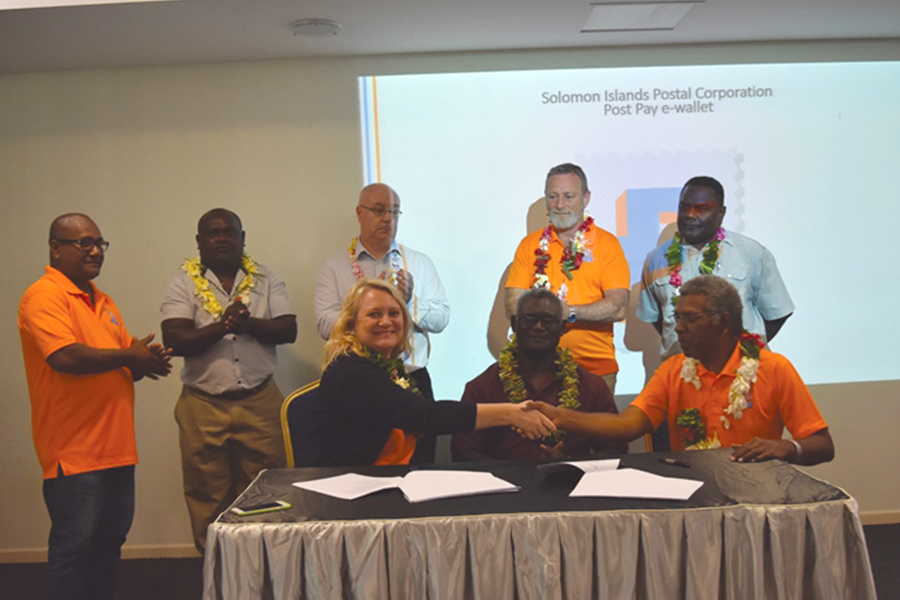
Bibimoney Chief Financial Officer, Ms Debbie shake hands with SI Postal Corporation’s chairman, Mr Robert Bokelema to mark signing as DPM and Finance Minister, Hon Sogavare looks on.

BY LORETTA BRIGIDIA MANELE

THE growing problem for financial institutions is finding strategies to tackle issues like capturing the unbanked market, leveraging technology and providing new services to existing customers.

This is according to Bibimoney’s 2017 report that highlights the stressing issues behind banking services and how Bibimoney solves these barriers.

Bibimoney states that since billions of people are either unbanked or underbanked, this gives banks a huge opportunity to utilize new technology that will attract customers cost effectively while creating financial inclusion.

In relation, the second factor, “leverage technology”, the report mentions that in order to in order to increase market share, profits and shareholder value, existing banks need to tap into emerging technology.

The last problem for financial institutions expressed by Bibimoney is the provision of new services to cater to existing customers of which noted is the statement that in emerging markets customers are often young and dissatisfied with existing services.

Henceforth, in response to the above issues, the report expressed that Bibimoney resolves these issues by providing a 24 hour convenient low cost access to financial services, providing access to bill and salary payments, airtime top ups, domestic money transfers, micro-finance and insurance services, providing basic banking services to the unbanked and providing access to fast low cost remittance corridors.

Additional issues pose by the report include the lack of interoperability, apps only work effectively on smart phones, does not link from one country to the next and it often requires senders and recipients to have a bank account.

In regards to the above, Bibimoney has removed these barriers by being a fully patented SIM-Skin solution and mobile wallet that is simple to install, suitable for any type of phone, fast and secure using 256 bit encryption, scalable to partner’s needs, compatible with any mobile phone network without requiring a partnership with any mobile operator, and facilitates viral customer growth domestically and internationally.

Furthermore, in terms of remittances, Bibimoney’s service is interoperable hence, allowing both sender and receiver use the service without having to use the same mobile network, it works on any type of phone, internet or data connectivity is not required, it is inclusive to the unbanked and underbanked, reduces the cost of remitting funds internationally, efficient in cashing out funds through an agent network and is an instant transfer, descriptively, Western Union in seconds.

“The SIM-Skin is simple to use, advanced, patented technology. You do not need the skin to receive the money, but you do to use it so the recipient becomes as wallet customer locally,” said the 2017 bibimoney report.

Contractors affected by cash-flow syndrome

0

BY ALICE NANTARA

THE working relationship between contractors and the Ministry of Infrastructure Development (MID) is again under strain due to the cash-flow problem of the country.

Few contractors who plead anonymity said that this dilemma that the government keeps facing approaching the final months of any given year is starting to get on their nerves.

“We rallied up all our effort and resources to get the contract and meet our end of the bargain only to be told that the government is currently going through a difficult financial crisis right now so the cheque will be delayed.

“All the requirements and the time frame allocated for each project we manage to comply with, get the job done and what did we receive in return?

“Talk of cash-flow issue is what we get in return and then payments are delayed and got carried forward into another year.”

Another individual hinted that the government should really look into the all too common cash-flow issue and settle it once and for all.

According to this person’s understanding, the lack of businesses investing here in our country is the sure cause of the ongoing ‘cash-flow crisis’.

“We deal with the lack of investment in Solomon Islands first and everything else will fall into place straight after.

“Personally I think that one way of strengthening our currency and ensuring this country does not get caught in the habit of having money troubles is to encourage operating businesses to invest here in the country.”

This continuing cash-flow issue has put contractors and MID personnel at an uncomfortable space.

One contractor sadly voiced that the waiting game has seriously taken a toll on his family and construction team and he just hopes that the government pays up ASAP.

Meanwhile an MID worker said that they understand the frustration contractors are going through but at the moment there is not much that can be done except wait for the government.

Young men arrested for unlawful wounding in Malaita

0

POLICE in Malu’u, in North Malaita have arrested two male suspects following a fight at Adau Village, East Mbaelelea, in Malaita Province on January 8, 2018.

The two accused, aged 22 and 24, were arrested on January 9, 2018 and were both charged for unlawful wounding.

“It is being alleged that a fight broke out and the two accused allegedly wounded the victim with a bush knife during which he sustained serious injuries,” says Provincial Police Commander, Malaita Province, Superintendent Timothy Apaesi.

“The victim is still admitted at the Malu’u Health Clinic and still receiving medical treatment.

“This is a serious matter and I call on both parties not to take the law into their hands but let the police do their duty. I also call on anyone with information about the incident to come forward and assist police in our investigations.”

The two accused have been charged for unlawful wounding and were released on principal bail to appear in court on January 29, 2018.

–POLICE MEDIA

Gap in govt payment affects road project: Bartlett

0
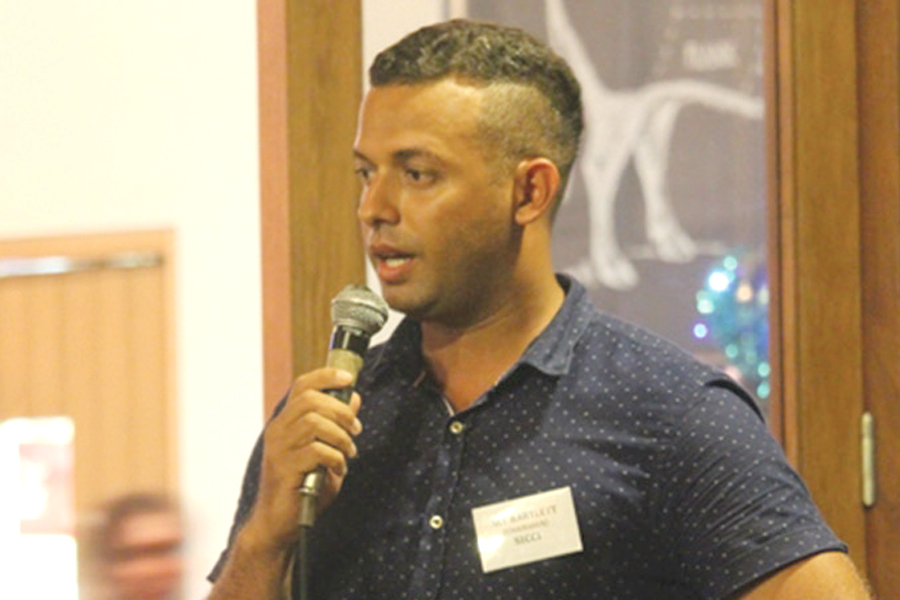
Hatanga Managing Director Mr Jay Bartlett

BY ALICE NANTARA

Hatanga Managing Director Mr Jay Bartlett

HATANGA Ltd has confirmed to the paper that government still owes the company a sizeable amount of SBD currency.

According to the information shared by Hatanga Managing Director, it’s extremely difficult to work and keep continuing while not getting paid.

Mr Jay Bartlett said that his company has offered the Ministry of Infrastructure Development (MID) all the relevant notices to inform them of the company’s intention to terminate and demobilise.

Hatanga Ltd has given the government ample time and opportunity to rectify the unfortunate situation to a point whereby the businessman realised the only wise decision is to halt the North Malaita Road Project (NMRP) and terminate the existing legal contract they have with MID.

The contract was terminated due to Government defaulting on the payment terms within the contract, says Bartlett.

The last time that the company received any form of down payment from the government was in December 2016 and the latter months between March 2017 to November 2017 has been confirmed SIG’s due.

Acting Permanent Secretary of MID also reaffirmed that it is the right of the contractor to terminate a contract under provisions of the contract if the employer does not fulfil part of its obligation.

Mr Jimmy Nuake also added that the employer did put in an effort to settle outstanding payments on time but unfortunately it did not workout has planned so now a new contract will have to be procured in order to ensure continuation of the NMRP.

According to the PS (Ag) the North Malaita Road Project is definitely part of 2018’s work plan.

USP offers degree courses for form 6 and 7 students

0

BY BEN BILUA

THE Acting Director of University of the South Pacific, Solomon Islands Campus says the university is now offering degree courses for forms six and seven.

Speaking to the media on Tuesday Mrs Patricia Rodie said staffs at the University are available to assist students who are interested to sign up for the courses.

“We are currently offering pre-degree as well as undergraduate courses and postgraduate courses for form 6 and 7 students.

“My team of staff who are currently engaging on the road show will be giving out more information about the courses,” she said.

Rodie also said that the College of Foundation Studies are now teaming up with USP Pacific TAFE and the partnership provides an avenue for students to climb the levels to degree levels.

She said USP will continue to strive for excellence in its courses on offer throughout the region.

Rodie adds that the University continues to showcase the quality and relevance of its programmes through its efforts to accredit all its courses and programmes to be recognised internationally.

She stressed that USP has achieved 18 international accreditations and four recognised programmes.

“This means USP graduates obtain qualification that are not recognised only in the region but internationally,” Rodie said.

She highlights that accreditation of USP’s accreditations are comparable to other universities in the world and this will gives students the confident to appreciate their achievements.

Rodie said USP has produced lots of achievements since its establishment with more to offer in the present and future generations.

HCC refute making bus license profit

0

BY BARNABAS MANEBONA

Honiara City Council (HCC) Mayor Hon Andrew Mua refutes accusation from the public saying that HCC is only raising profit from bus licences following the new routes enforced.

The HCC Mayor expressed that he is shocked to hear of such.

What are we raising business profit for? I know nothing of such doing,” said Hon Mua.

“Our business license fee is $1000 and there is nothing else being added on top in terms of costs charged.”

He explained that the current bus business licence fee is regulated in accordance to ordinance being carried forward from previous years.

Meanwhile, HCC has now enforced the new bus routes for Honiara Town since Monday this week.

Campus to celebrate USP’s half century

0

BY BEN BILUA

THE University of South Pacific, Solomon Islands Campus will host the University’s 50th anniversary celebration this year.

Acting Director of USP, SI Campus, Mrs Patricia Rodie said preparation to host the important event is underway.

She said the weeklong event with lots of interesting activities will take place in April.

Rodie said USP is owned by 12 countries; Cook Islands, Kiribati, Marshall Islands, Nauru, Samoa, Solomon Islands, Tokelau, Tonga, Tuvalu and Vanuatu.

She explained that these countries have contributed to fund the university on an annual basis.

Rodie adds that other countries in the region including our neighbouring country Papua New Guinea are showing their interests to become a member of the University.

She said USP has 14 campuses, three in Fiji and another 11 are distributed to 11 member countries including Solomon Islands.

“USP has three Faculties; the Faculty of Arts, Law and Education (FALE), the Faculty of Business and Economic (FBE) and the Faculty of Science, Technology and Environment (FSTE).

“These faculties are all offered here at the Solomon Islands Campus,” Rodie said.

She said USP Solomon Islands Campus was established in 1971 and now has established its centres in Gizo-Western Province, Lata – Temotu Province and Kirakira – Makira/Ulawa province.

Rodie stressed that USP SI campus is planning to establish its centres in each of the provinces in the next three to five years as students enrolment continues to increase.

She said more than 30,000 plus students have signed up to study at the university with the number expecting to increase every year.

RAMSI’s cruiser assistance makes MRCC watch keepers work easier

0

BY BARNABAS MANEBONA

DEPARTING RAMSI Maritime Advisers assistance to Solomon Islands Maritime and Safety Administration’s (SIMSA) MRCC with an old Land Cruiser before Christmas 2017 makes work easier.

This is for the Maritime Rescue Co-ordination Centre (MRCC) watch keeper to get transport to and from their duty roster.

It also means SIMSA now has a vehicle that is capable of launching and retrieving the “Lady Jane”, one of their floating asset in Honiara that can be used for “Search and Rescue” (SAR) purposes.

According to SIMSA’s Acting Director Captain Tim Harris, “Lady Jane” which is powered by two 150 HP Outboard motors will only be launched in extreme circumstances.

“The boat is kept on a trailer in SIMSA’s Compound and should be launched if there is an emergency situation in the inshore area around Honiara,” said Captain Harris.

However, Captain Harris said that the boat is a gift from a donor project (nothing to do with SAR) that finished in 2012, and SIMSA has no established position for a dedicated boat skipper to look after it, or fuel allowance specifically for the SAR boat.

“Until very recently SIMSA did not have a vehicle strong enough to launch it or trailer it out of the water,” said Harris.

“We requested from the Ministry of Infrastructure Development (MID) a Toyota Hilux Double Cabin utility vehicle with a tow bar to launch the boat and pull it out of the water but we were only given a single cabin Hilux.

“The first time we tried to retrieve the “Lady Jane” from water, the clutch on the vehicle burned out. That was two years ago.”

Airlines allegations

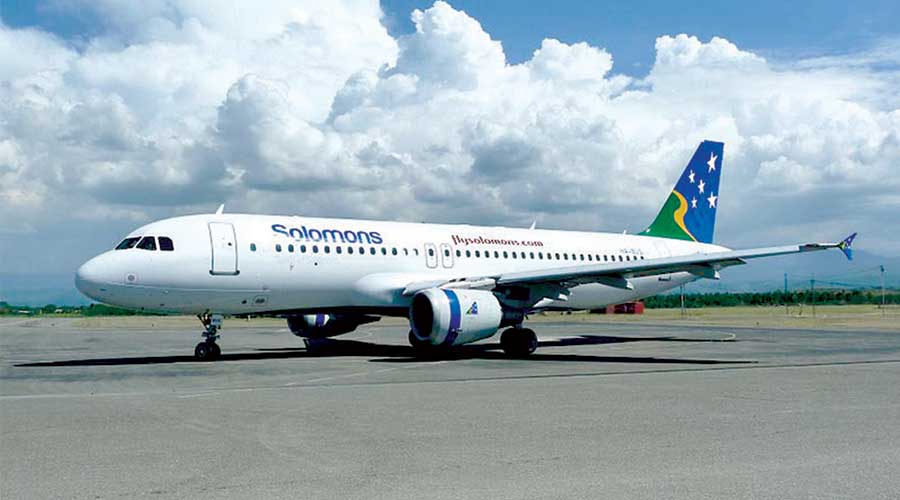
Solomon-airlines-airbus

Local pilots feel denied from joining SolAir international service, CEO Gebers dismisses claims

BY BARNABAS MANEBONA

SOLOMON Islander pilots working in the Solomon Airlines are reportedly being intentionally blocked from taking up roles in the international service, an allegation CEO Brett Gebers has strongly denied.

Island Sun is told there is an ongoing practice, entrenched in SolAir for many years, which is designed to prevent local pilots from entering the international branch of the country’s carrier. Thus only expats have been recruited from outside.

And, it is observed this system is being continued by the current chief executive officer (CEO) Brett Gebers and his administration.

Sources familiar with the issue say this discriminatory practice has resulted in more than 20 years of zero Solomon Islander pilot upgraded to the international service although a few were experienced and qualified enough.

This is said to be the reason which had driven our local experienced pilots out of the Solomon Airlines, in search of green pastures.

“Solomon Islander pilots are domineered to work only in the Islander aircraft, Twin Otters and the Dash-8. They just can’t upgrade beyond dash-8 no matter how qualified or experienced you are.

“Over the years, despite many attempts by Solomon Islanders vying for a post as First Officer in the airbus [international service], none have been allowed to make it through.

“If a vacancy is advertised for a post as First Officer in the airbus, Solomon Islander applicants would either be disregarded in the first round of screening, or would be made to fail in the final flying tests by the international service’s check n training pilot,” sources say.

Solomon Airlines is a State Owned Enterprise (SOE), however, in light of these allegations, SolAir’s management just might be breaching the SOE Act which demands that employers must provide suitable selection of suitably qualified persons for appointment, equal opportunities employment programmes, opportunities for the enhancement of the abilities of individual employees, and good working conditions.

More so, SolAir’s own policy dictates that recruitment must first be sourced internally, and if no one is capable or qualified then the airline can look outside for recruitment.

SolAir’s management have always maintained that their reason for recruiting outside is that it is costly to upgrade national pilots than to recruit experienced [or type-rated] pilots from overseas.

However, Island Sun understands that early 2017 two expats were recruited whom were without rating and experience, Solomon Airlines had had to send them to New Zealand to be trained for six months before they could work in the A320 airbus. Solomon Airlines met the hefty extra costs.

It is also understood that a highly experienced Solomon Islander pilot had applied for the post at that time but was turned down.

In mid-November last year, a vacancy was advertised in the News Corps Australia for the airbus’s captain and first officer posts , and the criteria was set to disadvantage local pilots from applying. Island Sun is told that two expats have been recruited.

In the midst of all this seeming discrimination against local pilots, an expat had jumped from being a Twin Otter pilot straight to the A320 airbus in 2015.

Insiders say, “The recent upgrade of Captain Walding to the A320 in 2015 has raised questions among local pilots why some of them who have the necessary licences such as the ATPL are not considered to upgrade to the airbus. Captain Walding only holds a Solomon Island ATPL and not Australian as the recent criteria boldly highlighted.

“No matter how hard the management tries to defend its decision, local pilots and employees of other department feel that they are being discriminated against.”

Meanwhile, CEO for Solomon Airlines Mr Brett Gebers explains to Island Sun that the company is ensuring that ‘its activities are cost effective and structured to provide a cost neutral or positive return on investment’.

“Solomon Airlines whilst being 100 percent owned by the Government, unlike some SOEs, does not receive cash handouts and grants so it has to fund all its activities from cashflow. The Company has to therefore ensure that its activities are cost effective and structured to provide a cost neutral or positive return on investment.

“One of our pilots resigned from our A320 operation based in Brisbane and another one retires shortly. The only sensible cost effective fix was to employ two A320 type rated and current pilots. This action has minimised the cost to the Company for the following reasons.

“Firstly, we do not have sufficient local pilots with Airline Transport Pilot Licences (ATPL) to be able to release two of them to fly the A320. Taking pilots off our Domestic Service would have resulted in numerous cancelled flights.

“Secondly, the cost of training two non-type rated pilots is more than we can afford at present, particularly as we have a costly check due on the A320 in February and a large expensive check due on the Dash 8 at the end of the year.

“The A320 operation is currently based in Australia for many reasons. To have crew who do not have the right to work and live in Australia would make managing the operation very difficult at present. Furthermore … international airlines often fly through the night and on all 7 days of the week. Pilots wishing to join the small A320 fleet have to commit to being able to fly when rostered or when called upon to do so.”

Gebers attributes the problem facing local pilots to past administrations who had not considered the company’s future in their management of SolAir’s affairs, promising that under his watch plans are being rolled to ensure locals are eligible come next available opportunity for the airbus.

“The decision to employ the two pilots in early 2017 was done prior to me joining the airline however it was based on sound reasoning as there were not enough Solomon Island pilots with Airline Transport Pilot licences (ATPL) to allow anyone to be released without having a significant impact on the Domestic Network.

“The two pilots you referred to, have a significant amount of experience operating in high density airspace, did not spend 6 months to acquire experience in New Zealand as alleged, but more like the standard 6 weeks to obtain the A320 type rating. As soon as they had the type rating they were out productively flying our normal routes with a Training Captain.

“The shortage of suitably qualified pilots has several causes. The first is that the prior management was all but consumed in managing the day to day affairs of the airline and did not have enough time to focus on the future. The second issue is that in many instances the pilots have not made the effort to do the required studies to obtain the ATPL. Thirdly some of the pilots with the ATPL exams have not been able to acquire sufficient night flying hours to obtain the ATPL because of the shortage of suitable night flying facilities in the Solomon Islands. The fourth issue is that despite our best efforts to train some of the new pilots who graduated through a government sponsored plan, we were unable to get them to the required standard. The safety of our passengers and crew always comes first.

“Whilst there is still a large amount of work to do, we have put a plan in place to train sufficient local pilots so that when future opportunities on the A320 become available, we will be in a position to consider them. This plan includes flying between Munda and Honiara at night once the Munda lights have been installed in March 2018.”