Home Blog Page 1373

Shipment of hospital beds from New Zealand

0

DEAR EDITOR, a 40 foot container with 48 hospital beds and some other hospital furniture, such a side tables, will be shipped from Wellington in New Zealand in June.

The 48 hospital beds will be the first consignment of 100 hospital beds destined for the National Referral Hospital (NRH) and two provincial hospitals, one in Malaita and the other Isabel Province.

The Solomon Islands Forest Association (SFA) kindly responded to an appeal for funds to acquire and transport the beds to the Solomon Islands.

Take My Hands Charity Trust (TMH) has acquired the first 48 beds and the remaining ones are in the process of being collected from New Zealand hospitals where the type of beds, although in extremely good condition, are surplus to the hospitals requirements.

I express my sincere thanks to the SFA and to TMH for continuing to help the MOHMS in the Solomon Islands and local NGO organisations

A MOU was signed more than a year ago between the NRH and TMH for the annual supply of medical equipment and medical supplies but currently the arrangements for the shipment of up to 10 twenty foot containers per year is suspended as the second phase payment in terms of the MOU is outstanding.

The SFA stepped up to get the urgently needed hospital beds because of the current state of the MOU.

I will give notice of the shipment of the second 40 foot container with the additional hospital beds when I get more information from TMH.


Yours sincerely

FRANK SHORT

Peoples budget vs political budget

0

DEAR EDITOR, I am a true Solomon Islander and I am writing in the name of all the tarungas in Solomon Islands on the above subject as oppose to national security.

My subjects on security is paramount, for without security all shall be void.

Back to subject; I am making reference to an article by AATAI John Laungi in Sunday Star Issue last Sunday.

He was making reference to the real peoples felt needs and the only funding that was felt and seen by populace in Solomon Islands.

The PCDF through the Ministry of Provincial Governments to provincial assemblies.

Indeed the 2018/19 budget is not the ‘peoples budget’, it is ‘politicians budget’.

It was crafted with hard decision on politically motivated election targeted.

People are very cynical about it. Luck vision, brutal to honesty, while electorates are crying for honest leadership, parliamentarians are looking at policies on short-terminism as oppose to long-terminism.

People in the country wake-up from sleep.

Monies generated from your sweat and donated funds are only swallowed by your National MPs.

You have 172 wards in the entire country, more than the constituencies that are reaping you without your notice.

Leaders of this country are denying the real life of Solomon Islanders.

You know as I know, whatever we may raise either formal or through media targeted at those in the round house, will never end up in the mature brains up there.

Never. Instead, they will walk against it.

But, mind you, the trend of how RCDF and other discretionary funding are dishing from the hands of our leaders, is a national security threat.

The greatest fear is that arms are in one sector of our Force and who can counter.

It has happened it will happen. Leaders know your people and slow down.

Clyde Bosawani’o

National security sector governance

0

DEAR EDITOR, the Solomon Islands recognizes that security is fundamental for effective and sustainable development. There is a shift in the Solomon Islands to an emphasis on Human Security with governments’ emphasis on people centered development. Importantly, the Solomon Islands Government has implemented an integrated approach to security reform that includes government and the people.

I have sighted the below script from a Pacific Security Meeting that is of interest for public comments that I am quoting, for public in-put. Security is every bodies concern. The quotes;

Role of Key Stakeholders in Security Sector Oversight

The key stakeholders in the oversight of the security sector include the government, Parliament, Ombudsmen, media, civil society and the security sector itself through internal accountability mechanisms. Further illumination of the type of roles these institutions play is detailed below.

Executive – Government

Government is responsible for strategic security policy development. Strategic security policies should identify national priorities, the values underpinning the policy, the legal basis of the policy and the role of key actors. Government can ensure that this policy development process is participatory through engaging the public, Parliament, accountability institutions, civil society and the security sector in a process of dialogue and debate during its development. Further, to ensure the development and implementation of effective strategic security policy, national governments should ensure that they have adequate institutional capacity in terms of staff size, expertise and skill level. Government agencies can significantly influence the policy and practices of the security sector by virtue of their policy development, management, budgeting and auditing functions.

Parliament

Parliamentarians, via debates and the activities of their committees, are well placed to monitor the security sector. Overall, parliamentarians and their committees can ensure that the legal framework for security sector oversight is in place. Budget committees can scrutinise security sector budgets, auditor generals (if located within the parliament) can monitor expenditure, defence and security committees can scrutinise security policy and practices. In the monitoring process, parliamentarians and their committees can interact with other stakeholders to maximise the information available to them on security policies and practices. Such stakeholders include the ombudsman institution, auditor generals, civil society organisations and the media.

Ombudsman and or Leadership Code Commission (LCC)

In many countries, Ombudsman / LCC institutions are able to monitor the security sector by virtue of their role in investigating public complaints about human rights violations and corruption issues. Documenting and investigating complaints against the security sector can be a crucial function in transition and developing states as aggregated data and the results of investigations can be presented to parliament – as well as released to the media – to help ensure transparency and accountability in public security sector policies and practices.

Judiciary

Independent judiciaries have a crucial role to play in ensuring security sector accountability. Security sector institutions are bound by civil and criminal law codes and prosecution of personnel who break the law is vital to ensuring transparency and accountability across the security sector. Many nations whose security sector remained – or remain – either as a whole or in part beyond the reach of judicial process have experienced problems in political management of the security sector. Fundamentally, security sector personnel should be governed by the same laws as fellow citizens to ensure that their actions in daily life as well as emergency situations are consistent with domestic law and the legal framework governing the investigative activities of law enforcement organisations.

Civil Society

Civil Society Organisations, via various feedback loops – campaigning, media, institutional and other official platforms – can guarantee that agencies providing security operate according to their mandate, do not abuse coercive force and become more effective through the consistent scrutiny of their policy and actions. Civil society’s role in oversight of the security sector expands citizen political participation and makes security policies more responsive as they are well placed to bring problems related to the provision of security by state agencies to their communities, to the attention of parliamentarians and the media. CSOs can also provide inputs on policies and practices directly to the security sector, not least through platforms such as community policing boards, and to government agencies.

The Media

Print and electronic media can facilitate security oversight by documenting key issues at local, regional and national levels. Moreover, the ability of the media to investigate and publicise potentially controversial issues is a key index of freedom of speech in any society. By highlighting security issues affecting citizens, the media helps ensure that government, Parliament, accountability institutions, civil society and the security sector have access to information that can ultimately help ensure the transparency and accountability of security policies and practices.

Security Sector Agencies

The security sector’s components – principally, the police, law enforcement agencies (including border guards) and intelligence agencies – can all ensure that their policy and practices are consistent with the need to provide public security and are consistent with the legal framework governing their activities. Principally, each agency can ensure that its own internal accountability mechanisms are strong enough to enforce regulations governing day-to-day conduct of personnel. Each agency can also work closely with its line ministry to ensure the consistency of policy and practices with the prioritised needs of citizens. Moreover, the security sector can also cooperate with Parliament and civil society to ensure that its priorities, policies and practices are clearly understood and are responsive to the needs of citizens.”end quotes.


Clyde Bosawani’o

Job creation to counter a 32.4 percent unemployment rate

0

DEAR EDITOR, a news bulletin broadcast on Radio New Zealand on May 14, 2018, quotes the Chief Executive of the Solomon Islands Chamber of Commerce, Dennis Meone, has having said Solomon Islands needs to focus on creating jobs to engage its youth population.

Mr Meone gave details of Solomon Islands unemployment rate last year, of 32.4 percent and also gave details of national statistics which showed that 70 percent of the population is under the age of 30.

Mr Meone was quoted as having said:

“You know the basic question is can we, as a country, be able to provide jobs for these young growing population?

“The answer is not really.

“And that is why the policy conversation that we are having with government to look at opportunities. I think it is important that if government creates the conducive environment so that businesses can grow and hence create the jobs or provide the jobs.”

I have pondered the very questions raised by Dennis for more than 20 years and been concerned about the steady rise in youth unemployment and the lack of job opportunities facing so many young people and actually likened the situation to a potential ticking time bomb.

I still lack the solutions to the unemployment situation and truly hope the Solomon Islands government can create the conducive environment to enable businesses to grow and facilitate jobs that will accommodate the youth.

I venture to suggest that Dennis, and the SIG, might find some encouragement and possible answers by reading an excellent article by Aneel Karnani, an Associate Professor of Strategy at the Stephen M Ross School of Business at the US University of Michigan.

The article Reducing Poverty through Employment is available to view on line.

It is rather a lengthy piece, but I have quoted here the first few paragraphs which could prove an invitation to read more of his responses to the subject matter.

“Give a man a fish, you feed him for a day; teach him how to fish, and he will be able to feed himself for the rest of his life. This is an old cliché, and like all clichés it has an element of wisdom. But, it does not go far enough. A fisherman with a simple rod and a canoe will not go hungry, but he will still be poor. For him to rise above poverty, he needs steady employment at reasonable wages in a commercial fishing company. Now his daughter might move up the development ladder and go on to become an engineer.

“Widespread poverty is an urgent challenge for the world. The starting point for addressing this challenge is the simple and obvious observation that the primary problem of the poor is that they have a low income. As the above parable indicates, the best way to alleviate poverty is to increase the income of the poor by providing productive employment. It is necessary to view the poor as producers and emphasize buying from them.

“Many of the current approaches to poverty alleviation miss this simple point. Advocates of foreign aid believe that poor countries are caught in a “poverty trap” and need major injections of aid to trigger economic development.

“Foreign aid is accused of emphasizing big objectives, big projects, top-down planning, and a one-size-fits-all approach rather than, as Easterly advocates, bottom-up solutions tailored to the local context.

“Another criticism is that very little aid actually goes to stimulate enterprise development, even though private enterprise is well established as the best path out of poverty.

“Foreign aid is also accused of creating continuing dependency and fostering corruption.”


Yours sincerely

Frank Short

Gulatatae shipping company

0

DEAR EDITOR, the dealings in which several individuals they themselves become directors and the shareholders at the same time within the Gulataetae shipping company as stated by Alfred Sasako in the public media on Thursday May 10, 2018 is a great concern to us the people of East Kwaio and so the issue deserve some clarifications from the MP for East Kwaio Mr Standley Sofu.

The truth is that Gulatatae ship was purchased from the transport public fund within the MID that channelled through the MP for East Kwaio and so the priority of ownership should be given to the people of East Kwaio.

Any abnormal dealings with the ownership through shareholding within the Gulatatae shipping company is a questionable and suspicious matters.

The both existing sea and land transportation investments formed under the name of Gulatatae company need clarification or else it does not speak well about good leadership under the current MP for East Kwaio Stanley Sofu that show no compassion to the poor struggling people of East Kwaio.

The people of East Kwaio need transparency and accountability key pillars of good leadership and management to be prevailed in any form of investments establish from the public funds donated from national government through their MPs.

Because those are the golden privileges the government has given to the people to make some differences in their livelihood when it comes to socio economic development.

God bless the people of East Kwaio.


Jacob Ofasia

Talise Market

Guadalcanal province’s partnership with Canada through CITREC

0

DEAR EDITOR, what is CITREC? It is the abbreviation for the Canadian International Training & Education Corp and is a leader in providing Canadian standard education and training beyond Canadian borders in collaboration with its partner institutions.

Quoting from CITREC’s website:

“CITREC specializes in bringing Canadian institutions and certification programmes to the world and making Canadian education more accessible globally. CITREC introduces and promotes knowledge solutions aimed at preparing youth to become leaders and succeed in the global workforce. CITREC is committed to quality, not quantity.”

The Guadalcanal Premier and his administration have been pursuing opportunities for local people for many months, particularly young members of the community, to gain training in Canada aided by CITREC’s Chairman and Honorary Consular General, Mr. Aswant Dwivedi.

In February this year, the Guadalcanal Provincial Premier, Anthony Veke, his Executive and officials received a visit from H.E Paul Maddison, the High Commissioner of Canada to Solomon Islands at the provincial headquarters in Honiara.

On that occasion, Premier Veke briefed the visiting High Commissioner on the progress of GP’s partnership with Canada through the CITREC program.

Premier Veke also expressed his vision to explore other opportunities for Guadalcanal province to see Canada as a market destination for agricultural products.

The High Commissioner expressed him view that there were great opportunities for the partnership between Canada and the Guadalcanal province.

On the CITREC programme, the High Commissioner said he was glad to see the programme had evolved with opportunities for participants to get permanent residency in Canada.

Last week it was announced that Solomon Islands nationals travelling to Canada as part of the foreign worker programme, or migrating under a Permanent Residence nomination programme from Guadalcanal Province, would benefit from a new partnership arrangement with Air Canada for their travel to Canada.

The announcement also said the partnership benefit would also be extended to any Solomon Islands province that would be joining the education and training programme offered by CITREC.

The route would be from Brisbane, Australia and into Vancouver.

CITREC Chairman, Mr. Ashwant Dwivedi, welcomed the partnership saying the Air Canada partnership would help further propel Solomon Islands partnership with Canadian’s.

The Guadalcanal Province is congratulated on the CITREC partnership programme and CITREC’s Chairman and the Government of Canada heartily thanked for assisting the Solomon Islands and the people of Guadalcanal in particular.

Yours sincerely

FRANK SHORT

An observation – every picture tells a story

0

DEAR EDITOR, the saying, ‘Every picture tells a story,’ is a common saying in English and is often said when what really happened in a situation is clear because of the way someone or something looks.

In the context of the front page photographs displayed in the Solomon Star and in the Island Sun newspapers last week which displayed the work being done by an instructor at the Taiwan Technical School Mission in teaching Malaitan farmers cultivation farming methods the message couldn’t have been clearer

Giving practical ‘hands on help’ to people in the Solomon Islands rural communities is much needed, and I believe appreciated, and what better way to demonstrate tangible aid.

Surprisingly, the reporting and illustrations of the farming training carried more coverage in the local media than Taiwan’s latest payment of SBD 44.7 million to the Solomon Islands Government for various constituencies on 8 May 2018.

Yours sincerely

FRANK SHORT

West’s executive meeting date set

0
Acting Premier Hon Maloney Lopoto

BY ALFRED PAGEPITU
GIZO

Acting Premier Hon Maloney Lopoto

THE Western Provincial government executive meeting has been scheduled for May 14-18 in Gizo.

Deputy Premier Maloney Lopoto confirmed to Island Sun Gizo yesterday the 11 executive members under Premier Wayne Maepioh will meet before the provincial election on June 13.

Lopoto said the meeting will be held at the provincial government conference room.

“This is part of the executive’s objective is for meeting the people and to visit people living in rural and urban centres from Gatokae to Marovo Lagoon.

“Executive members have done this recently reaching the people at Viru, Saeragi, Simbo, Ranonga, Noro and now they are now moving the executive at the provincial head quarter in Gizo.

“This plan is for people will have the opportunity to meet their government and at the same time for the government to deal with their government businesses as well to discuss and develop the Province,” said Lopoto.

Meanwhile, the Western provincial assembly sitting has been scheduled for May 22-29, 2018 in Gizo.

The main business of the coming Assembly meeting will be to deliberate on the Division’s Annual Report for the 2017/2018 financial year.

Meneniaru requests SPC for more FADs

0
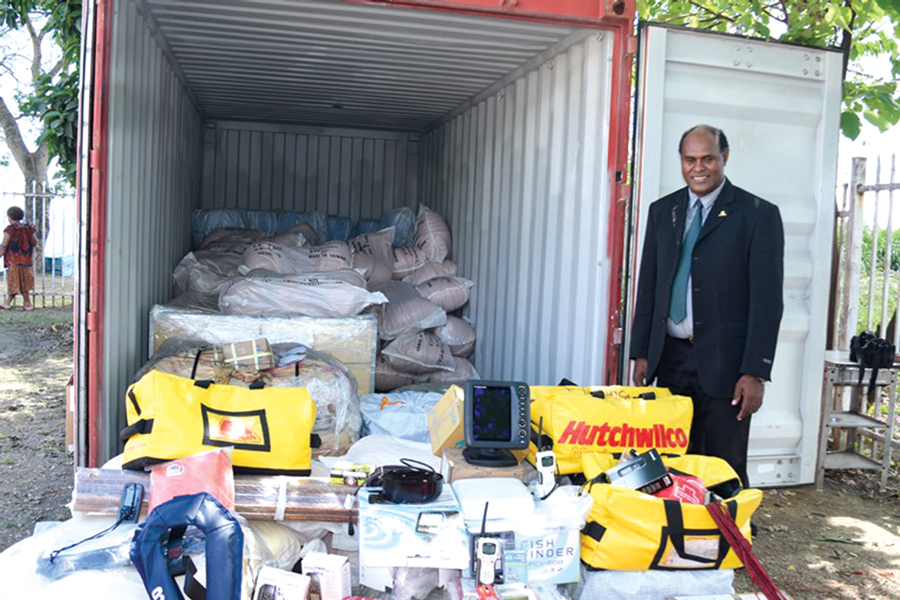
Minister John Maneniaru with the equipment donated by the SPC

BY LYNTON AARON FILIA

Minister John Maneniaru with the equipment donated by the SPC

MINISTER for Fisheries and Marine Resources has asked the Secretariat Pacific Community (SPC) to donate more Fish Aggregating Devices (FAD) to Solomon Islands communities.

In a handover ceremony of 20 FADs to 16 constituencies, Minister John Maneniaru asked for more FADs in the presence of the SPC Country Director, Mrs Monica Longanimala Ilala.

He said such development is important for communities’ daily livelihood for minor economic and social development.

“Let me ask Monika, SPC Country coordinator, we want more FADs, and that is your function, you represent the region, and Solomon Islands has that need,” Maneniaru said.

“It is an area of need that you need to address, and 20 FADs is not enough, you need to ask more for Solomon Islands, more rafters tailored down to our communities.”

Maneniaru said he asked for more rafters because even his constituency has very few and people have been waiting to see and have access to this workable device.

He adds, if SPC through the country director deals with the needs of these communities then they are covering the whole of Solomon Islands.

He encourages stakeholders to continue ensuring that fishing communities including women, youths and children get economic benefits out of the FAD programme funded under SPC.

Maneniaru said that villagers need to participate in this programme so that it adds to their daily life an economic benefit.

“Let’s make that a timely impact on our communities as we have these responsibilities of ensuring that policy touches their lives,” Maneniaru said.

SPC Country Director, Monica said they are considering the Minister’s request for more FADS.

In their discussions, Monica suggested that the Ministry of Fisheries and Marine Resources develops a report and highlight the specific needs related to its request.

She adds, SPC understands that there is a need to increase the number of FADs reaching the community level.

Current donation of the 20 rafters will definitely benefit communities in the area of food security, accessible to canoe fishermen and increase catch rate.

Communities will also benefit through transfer of fishing effort from reef to the ocean, increase food security and resilience of coral reef ecosystem and smart fishing with sustainable environmental friendly approach.

Locals appreciate police awareness talk for students at Tulagi  

0

BY BARNABAS MANEBONA

CENTRAL Province (CIP) citizens have commended the Royal Solomon Islands Police Force (RSIPF) at Tulagi for conducting awareness talk on illegal brewery (kwaso) and marijuana for students.

The awareness talk according to Solomon Business Magazine (SBM) online was conducted at McMahon Community High School last week following a request from the school.

CIP’s Provincial Police Commander (PPC) Superintendent Patricia Leta said that they were very happy to respond to the request.

“We believe it is important that our youth are given the information about the effects of drugs such as kwaso and marijuana. Our youth are exposed to these substances so they must know the effects of these things on their mental and physical health. They must learn to say no to these substances,” said PPC Superintendent Leta on SBM online.

A Senior Secondary School Teacher at McMahon was quoted thanking the PPC and her officers for taking the time to visit their school and talk about the important issues for their students as it is part of the learning process for them.

Recently, it is understood that a student of the school was arrested by police after being found in possession of a drug (Marijuana).

With the recent report having being very serious going out national forced the Deputy Premier and Provincial Minister of Education for CIP Hon Selwyn Luga to Chair a Forum recently at the school.

Despite of critics’ to the school and its administration for this year, McMahon School is striving at its top best to maintain and improve further the school standard and its reputation to produce good results. So far, all is good.

On Ngella’s famous social media forum (Ngella Forum), the RSIPF at Tulaghi have been highly commended as well.