Home Blog Page 1362

NGO for clean city

0

BY GEORGINA KEKEA

 A NON-Profitable Organisation (NGO) called Friends of the City (FTC) is taking initiatives to discuss the development and social challenges facing Honiara City and to fashion the best way forward to a clean, safe and beautiful Honiara City. Last Saturday volunteers and members of FTC came out into the streets of Honiara to do a massive cleanup along the city’s Central Business District (CBD) and roads.

With the vision to build a clean, green and prosperous Honiara City, FTC’s mission is to enhance people participation through volunteerism to build a clean, healthy, pleasant and sustainable Honiara city. FTC believes that to collaborate is better than to compete.

During the recent ‘Business after Five’ (BA5) event of the Solomon Islands Chamber of Commerce and Industry (SICCI) FTC was also given the chance to highlight their work and to make known their entity.

Soon to be launched, FTC hopes to bring together volunteers from all works of life that have the heart for the city.

The initiative by FTC come in light of recent government talks on the ban of plastics and the depressingly formidable challenge the country is faced with in terms of waste management.

Climate change, country’s biggest challenge

One of the artificial Islands in the Lau lagoon facing impacts of sea level rise.

BY LYNTON AARON FILIA


CLIMATE change is still the biggest challenge in the Solomon Islands with impacts of sea level rise and intense weather events posing a serious threat to islands and coastline dwellers.

Solomon Islands is surrounded by islands, and is a nation of hundreds of volcanic islands, coral atolls and reefs in the South Pacific and is a part of the coral triangle – hub for marine biodiversity.

However, the country’s natural beauty has been exposed to many hazards like floods, cyclones, tsunamis and volcanic eruptions with the impacts of rising sea levels and more intense weather events multiplying the risks and posing serious threats to the people of Solomon Islands.

Currently, the government of Solomon Islands and the United Nations Development Programme (UNDP) are working with communities who are on the frontline of negative impacts of climate change to find ways to adapt to the changing environment.

SIG and UNDP specialists under the Solomon Islands Water Sector Adaptation Project (SIWSAP) — Gud Wata Fo Strongem Komuniti Lo Evritaem, have worked with six far-flung communities across the country.

These locations have become innovation hubs to test and refine methods to cope with issues such as drought, salination of wells and the loss of crops to the encroaching sea.

According to SIWSAP, the project was set with a goal to equip people with resilience to meet the challenges of the future and serve as a replicable model of adaptation around the Pacific and the world.

With regards to weather, the SIWSAP project installed five hydro-meteorological stations in Gizo (Western province), Taro (Choiseul province), three in Tigoa (Rennell Bellona province), Ferafalu community (Malaita province), and Tuwo community (Temotu province).

The new hydro-meteorological stations are built upon existing Climate Early Warning Systems (CLEWS) that are monitored and operated by the Solomon Islands Meteorological Services (SIMS).

According to Solomon Islands Climate Change and Disaster Risk Finance Assessment report, SIG commitment with climate change and disaster risk management are issues of high priority.

The report also contained interest from outside partners as new climate financing mechanisms to drive actions.

The international community also works towards the commitment to jointly mobilise USD$100 billion annually in climate finance to 2020.

More broadly, strengthening country systems will improve donor confidence to engage with Solomon Islands and catalyse the achievement of the sustainable development goals, which are linked to the national priorities of Solomon Islands as outlined in the National Development Strategy 2016–2035 (NDS).

Meanwhile, SIG and UNDP through the SIWSAP project worked with communities towards addressing the Sustainable Development Goal 13 on climate change adaptation by building resilience of communities in the water sector.

Beat plastic pollution for World Environment Day

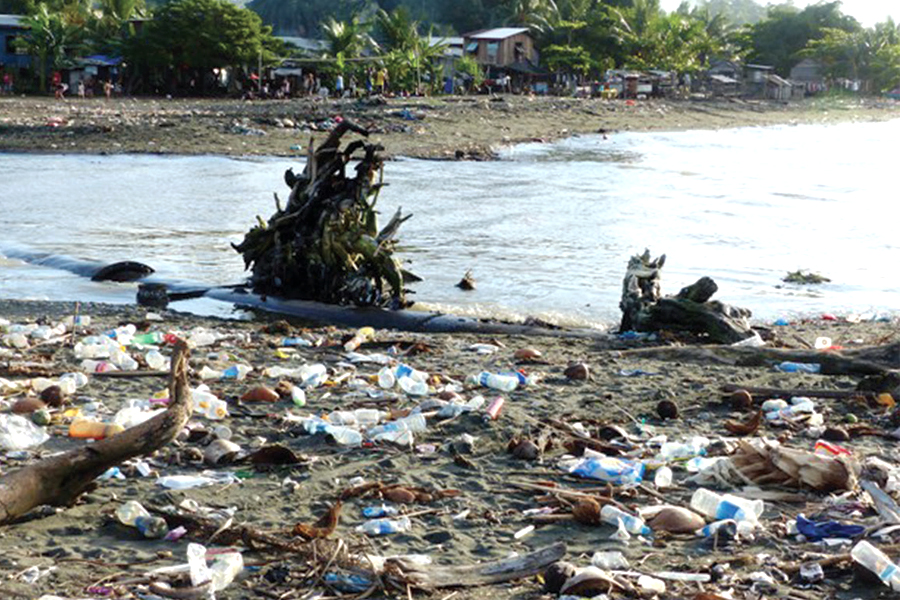
Rubbish collect at Mataniko river mouth (Photo by SPREP)

BY GEORGINA KEKEA

BEAT Plastic Pollution”, the theme for World Environment Day (WED) 2018, is a call to action for all of us to come together to combat one of the great environmental challenges of our time.

As countries plan their events for this year’s WED, the United Nations Environment Program (UNEP) hopes people do not have to wait till June 5 to act.

“This year’s WED provides an opportunity for each of us to embrace the many ways that we can help to combat plastic pollution around the world.”

In Solomon Islands, Deputy Prime Minister Manasseh Sogavare has said that there are small ways to demonstrate participation, commitment and contribution towards tackling the problem of plastic rubbish, environmental and marine waste and pollution. Sogavare made these remarks during a beach cleanup last month to commemorate Commonwealth day.

Meanwhile Friends of the City (FTC) a new Non-Governmental Organisation (NGO) established to discuss issues surrounding the city says education is the key to tackle plastic pollution.

“Correct disposal of rubbish starts from the home thus our children must be educated at an early age on how to dispose rubbish correctly.”

While plastic has many valuable uses, studies show that we have become over reliant on single-use or disposable plastic – with severe environmental consequences. UNEP reports that around the world, 1 million plastic drinking bottles are purchased every minute.

“500 billion disposable plastic bags are used worldwide every year. In total, 50 percent of the plastic we use is single use.”

Nearly one third of the plastic packaging we use escapes collection systems, which means that it ends up clogging our city streets and polluting our natural environment. Every year, up to 13 million tons of plastic leak into our oceans, where it smothers coral reefs and threatens vulnerable marine wildlife. The plastic that ends up in the oceans can circle the Earth four times in a single year, and it can persist for up to 1,000 years before it fully disintegrates.

The issue of plastic waste is a serious one and should not be taken lightly. Recently Premier Maepioh of Western province had been commended for his government’s initiative to ban plastic in the Western Solomon Islands.

Now the country’s Prime Minister is considering the ban of plastics after the recent Commonwealth Heads of Government Meeting (CHOGM) where tackling plastic waste is an outcome of the meeting.

The government of UK announced £61 million to tackle plastic waste, including matching public donations through UK Aid Match up to £5 million.

UNEP on the other hand says if you can’t reuse it, refuse it.

A simple man’s tale of success

0
Dr. Tarcisius Kabutaulaka in one of his recent visits to his beloved ‘Tasimauri’ region.

BY GEORGINA KEKEA

A SOLOMON Islander, is set to be the next director of the Center for Pacific Islands Studies (CPIS) in Hawaii.

Dr Tarcisius Kabutaulaka started his journey from Haimatua village in the Tasimauri area of Guadalcanal on the southern side of the island. Tasimauri simply means ‘alive sea’.

Educated in a Catholic Primary school in Avuavu called St Michael, Kabutaulaka recalled those days through an article he wrote called Kabutaulaka Tuhu-Vera.

In this article he spoke of how he used to walk two miles each day, to and from school in the morning and back at the end of the day with cooked sweet potato, taro or yam for lunch.

“When it rained, we used banana leaves as umbrellas folded our clothes and wrapped them in leaves and ran naked in the rain.”

One of Dr. Kabutaulaka’s daughters and her uncle in Guadalcanal.

Kabutaulaka recalled that life was difficult and he was constantly homesick when he left his parents and became a boarding student prior to the grade six exams.

“It was the first time I had left my parents and village to live elsewhere but I soon grew used to it because I knew everybody and was related to most of the other kids at school and some of the teachers.”

Thereon he furthered his studies to St Joseph Tenaru where he was one of two students that was accepted to do secondary education there.

He did forms one to five at St Josephs and did form six at King George Six School before going on to the University of the South Pacific (USP) in Fiji.

Kabutaulaka received his undergraduate and MA degrees from the University of the South Pacific and a PhD in political science and international relations from the Australian National University.

Making his way up has not been easy as Kabutaulaka told Island Sun.

“Dedication and hard work are the keys to achieving our goals,” he said.

When announcing the news of Kabutaulaka’s appointment, CPIS described Kabutaulaka as well known and widely respected throughout the region.

The statement said Kabutaulaka has established a distinguished record of teaching, research, and service in academic institutions, as well as a reputation for his work as a consultant for regional governments and nongovernmental organisations across Oceania and beyond.

“I think that Solomon Islanders can compete for and get jobs internationally. We can serve and represent our country through those jobs. I encourage other Solomon Islanders to set goals and work for it,” Kabutaulaka told Island Sun.

Dr. Tarcisius Kabutaulaka in one of his recent visits to his beloved ‘Tasimauri’ region.

Kabutaulaka joined CPIS core faculty in 2009, teaching Pacific Islands studies courses at both the undergraduate and graduate levels. This is with particular emphasis on issues related to land and economic development, conflicts, post-conflict rehabilitation/peace-building, natural resources, governance, regionalism, and China in Oceania. In addition to his teaching, Kabutaulaka is currently the Editor of the Pacific Islands Monograph Series and member of the editorial board of The Contemporary Pacific.

Prior to joining the Center, Kabutaulaka was a Research Fellow for the Pacific Islands Development Program of the East-West Center. He has also taught at the University of the South Pacific and the Solomon Islands College of Higher Education.

In the book he wrote, Kabutaulaka muses about his cultural identity as a Solomon Islander and his connection to Guadalcanal where he originated from.

“While I might be mobile, home is not. For me, a Tasimauri man of a particular generation, mobility is not about disconnections. Rather, it is about creating new connections while at the same time maintaining one’s roots in vera; that is what directs and defines one’s mobility”.

Kabutaulaka revealed that family is what brought him home every now and then including work.

“Despite the travels and working overseas most of my life, Solomon Islands is home for me. I am thankful to Solomon Islands for the early years of my education and proud to be a Solomon Islander taking on this job.”

A far cry from his home village of Haimatua. The view from Dr. Kabutaulaka’s apartment in Hawaii.

The Center for Pacific Islands Studies, in the University of Hawai‘i at Mānoa School of Pacific and Asian Studies, is both an academic department and a larger home for initiatives that bring together people and resources to promote an understanding of the Pacific Islands and issues of concern to Pacific Islanders.

Working with scholars at institutions in the region and elsewhere, faculty at the center are seeking new ways to encompass a deeper understanding of a region whose boundaries are constantly expanding.

Kabutaulaka is one of the few Solomon Islanders holding such positions in education institutions overseas.

His wife is also a Solomon Islander from Malaita and they have three daughters.

Project to help deaf people in Pacific gets US funding

0

DEAR EDITOR, a news bulletin on Radio New Zealand on Monday this week said a youth-led project to empower deaf communities in the Pacific region had been granted US funding to further their need for equality.

The particular capacity building project is aimed at assisting deaf communities in both Fiji and Papua New Guinea.

One of the project leaders, Krishneer Sen, said their research project would help ensure people with disabilities could exercise their rights, so no one would be left behind in society.

The pair received US funding from the Pacific Youth Leadership grant.

Having the needs of deaf persons in the Solomon Islands in mind, I was interested to learn more about the US sponsored Young Pacific Grant scheme and this is what I discovered by some internet searching.

I quote.

“WASHINGTON – Twelve winners have been announced for the U. S. Department of State’s 2018 Young Pacific Leaders (YPL) Small Grants Program. The selected teams, representing 11 different Pacific countries, will receive up to $13,750 in grant-funding to implement projects in the region related to the program’s core themes of education, environment and resource management, civic leadership, and economic and social development.

“In addition to funding, YPL grantees attended a kick-off workshop in Auckland, New Zealand on May 10-11, where they refined their project ideas and learned more about successful grant management. The teams will receive mentorship throughout the year to help ensure their project’s success.”

“The 2018 YPL Small Grants Program launched in January and was open to alumni from previous conferences. Alumni include young leaders, aged 20 to 35, from Australia, the Cook Islands, Fiji, the Federated States of Micronesia, Kiribati, the Marshall Islands, Nauru, New Zealand, Niue, Palau, Papua New Guinea, Samoa, Solomon Islands, Tonga, Tuvalu, Vanuatu, and the American-affiliated Pacific (Guam, Commonwealth of the Northern Mariana Islands, American Samoa).”

“2018 Young Pacific Leaders Small Grants Program Awardees:

Kaitiaki Generation

New Zealand and Hawaii

A collaborative exchange between Māori and Kanaka ʻŌiwi communities on traditional knowledge and western science.

Documenting Traditional Knowledge through Digital Media

The Cook Islands

Webseries documenting Cook Islands Māori traditional knowledge and importance of indigenous culture for future generations.

Youth-4-Change Mentoring Program

The Federated States of Micronesia

Youth leadership and mentorship training program to help young peer leaders provide for at-risk youths in Micronesian communities.

Project Sechelik

Palau

To promote literacy and indigenous language in Palau by publishing and distributing an original colorful children’s book written in Palauan.

Training in Jolly Phonics

Papua New Guinea

Providing skills-based training to elementary school teachers in the Kerowagi District of Chimbu Province, Papua New Guinea.

Community Building and Engagement for Deaf Persons

Fiji and Papua New Guinea

Enhancing deaf peoples’ opportunity to be an equal citizen in their society through community empowerment, civic leadership, and training.

Sustainable Livelihood Project

Fiji

Training farmers in Wairuarua Village to develop, implement, and further sustainable livelihoods through permaculture and traditional farming methods.

Removal of Sargassum Seaweed

Tuvalu

Community engagement and environmental clean-up initiative to remove invasive seaweed species and improve coral reef health.

LE VĀ TALANOA

Samoa

A cultural heritage workshop focusing on Samoan architecture and working to bridge the gaps in generational knowledge.

Malasitabu Project

Vanuatu

Supporting Malasitabu Primary School through classroom infrastructure development, promoting healthy lifestyles and education on waste management.

Language Roots the Tree of Culture

Niue

A cultural bridge between Niuean youth in-country and those living overseas to promote and preserve cultural heritage.

Early Literacy- Let’s Read

Vanuatu

Early literacy initiative targeting children under the age of three.”

The Solomon Islands has many young, talented leaders already involved in the kind of projects for which US Embassy grants have been awarded this year and in past years, so I would strongly encourage those young leaders to prepare their own projects and to bid for grants the next time around.

The contact details are: US Embassy, US Embassy Majuro, Mejen WEto, Ocean Side, Majuro, Marshall Islands. Phone +692-247-4011. Fax     +692-247-4012


Yours sincerely

Frank Short

Japan-SI airport deal

0

DEAR EDITOR, the SI Government signed a milestone agreement with the Japanese Government for the improvement of the Honiara International Airport Project last Wednesday in Tokyo, Japan.

Quoting the Solomon Star newspaper of May 17, 2018

“The Minister of Foreign Affairs & External Trade the Honourable, Milner Tozaka, and the Japanese Foreign Minister Taro Kono officially signed the agreement at the Japanese Foreign Affairs Office.

“During the signing ceremony, Minister Tozaka acknowledged the Government of Japan for its unwavering support in infrastructure development.

“The four billion three hundred and sixty-four million Japanese Yen (4,364,000,000), is directed towards the upgrading the Honiara International Airport.

“I would like to express through you, our gratitude towards your Government for the continuous support rendered to us through the volunteers, Grassroots projects and more importantly the country’s infrastructure development ambitions,” he said.

“Minister Tozaka said Japan remains the leading infrastructure development partner in Solomon Islands.

Therefore, he said the Solomon Islands Government welcomes the continuous cooperation and support by the Japanese Government.

“I want to thank you on behalf of the Government of this milestone achievement,’’ Minister Tozaka said.

“Japan’s Foreign Minister Kono in response said the improvement of the Honiara International Airport is Japan’s desire to see sustainable development through infrastructure programs in the Solomon Islands.

“He said this project will also supplement the current Kukum Highway Infrastructure program.

“Meanwhile, the Japanese Foreign Minister has also congratulated Solomon Islands for opening a tourism office in Japan.

“Mr Kono said his office together with other relevant agencies will make sure Solomon Islands tourism is promoted in Japan.”


Thank you, Japan!

Yours sincerely

Frank Short

Australia has boosted its aid to the Pacific

0

DEAR EDITOR, the Australian government has increased aid to the Pacific, with the region set to receive US$979 million over the next two years.

“The funding was announced in the federal government’s budget, which was delivered in Canberra on May 8, 2018.

“Although the commitment to the Pacific has risen, the size of Australia’s entire overseas aid budget remains frozen at $3.1 billion dollars after deep cuts in recent years.

“The Pacific contribution now represents 30 per cent of Australia’s total aid budget.

“The foreign minister, Julie Bishop, said Australia would strengthen relations with its Pacific partners and “work together” for the region’s stability, security and economic opportunities.

“The money will include funding for undersea communications cables to Papua New Guinea and Solomon Islands.

“Australia will also open a High Commission in Tuvalu.” Copyright@2018 Radio New Zealand

Meanwhile in the Solomon Islands, Australia is funding an evacuation and youth centre in Malawai Community, in Central Kwara’ae, under Direct Aid Program funding for 2017-2018.

“Second Secretary, Alexandra Little and Justin Iduto’o of the Australian High Commission were delighted to visit the project at the end of March.

“We are so pleased to see the excellent progress made by Malawai community on this project,” said Australian High Commission Second Secretary, Alexandra Little.

“The community has displayed great team work, commitment and organisation in bringing this project together.”

“The centre will also be used to engage youths of our community with productive activities.

“Mothers can use this centre to market their produce, children can be taught in this centre, to be brought up under our norms and beliefs, our way of life, and the community can utilise this centre as a hub”, said Philip Kwato’o, project coordinator of the centre.

“The Direct Aid Program is a small grants program administered by the Australian High Commission. The program is designed to assist community groups improve their livelihoods.” Copyright: Solomon Star.


Thank you Australia!

Yours sincerely

Frank Short


Recent Ministerial visit to mine operation in Rennell welcomed with a different perspective

0
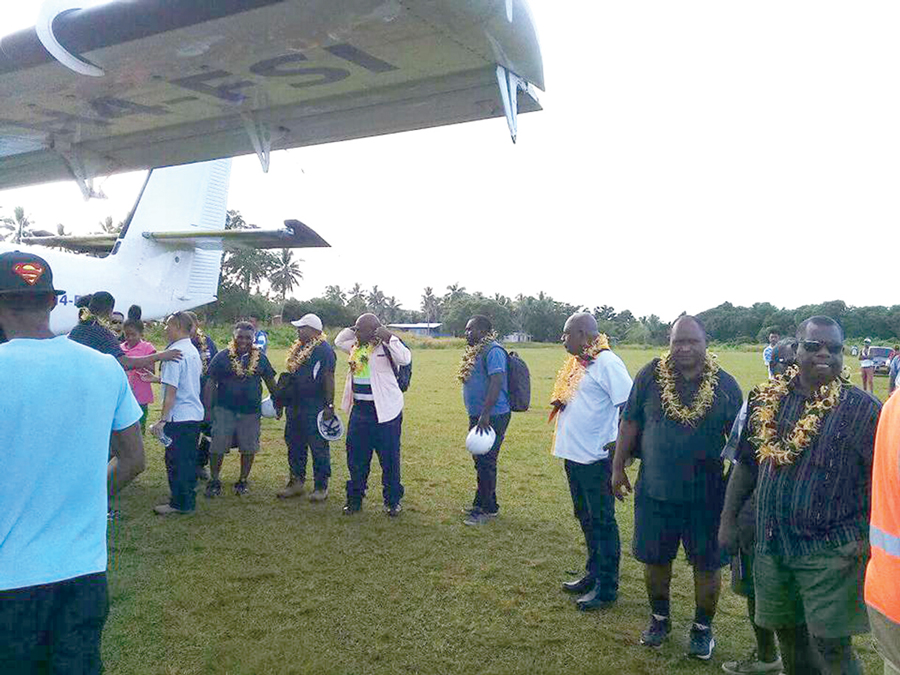
The Government delegation arrives in Tigoa airport. Photo supplied.

By Gary Hatigeva

DESPITE all the negativities and criticisms raised on the recent government led trip to the mining operation on Rennell Island in Rennell and Bellona Province, a lot on the island have termed the visit as positive and timely one.

Although the visit was said to be very short, many thought it has met the objective, which is said to have given an opportunity for cabinet ministers to witness first-hand the mining operations on the ground and its effects on the environment and the people.

Following the visit, Island Sun received calls from many people on the island regarding the trip, which includes Jimmy Festus, who described the visit as very encouraging and a move in a right direction.

“Much has been said on social media and print papers on mining, but unless one pay a visit and set foot on the ground before he could understand the real impact and situation on the ground,” the Tigoa Elder said.

Festus then pointed out that the Government ministers and officers have the responsibility to visit the people and talk to them about their work and responsibilities including issues relating to mining operations, especially in the case of the current operation.

He added that with the wide representation of various but relevant ministries, it is good that the picture on the issue is seen from all aspects through these different ministers under their banners.

However, on a balance, many have also taken their frustrations and concerns to both the local media and online, who expressed fears over possibilities in a compromised report, if it is to be put together on the visit.

Some have expressed concerns over claims that the mining company had paid for all expenses including chartered flights and other expenses incurred.

A local commenting in from Rennell on one of the local forums online, (name with-held), suggested that with Bintan Mining Solomon Islands Limited (BMSIL) meeting all expenses, whatever reports obtained would be subjected to biasness.

This was an issue the government has been very silent about despite follow ups for clarifications on regarding the claims.

The government lead trip to Rennell according to officials was for the observation of the Miner’s Rehabilitation programmes, which came under heavy criticism from the general populace.

Some have suggested that the issue of rehabilitation is irrelevant as it should normally be done at the end of the mining project, and therefore the government should have sent technical people to carry out a proper study and not politicians.

“It would be interesting to know more about the rehabilitation management plan. I believe the management plan should outline the goals of the rehabilitation and the implementation (activities).

“Are they going to use native plants/trees to restore the degraded sites? Are they introducing fast-growing exotic species to accelerate the succession? Vegetation cover is important at the early stage to avoid further degradation by erosion.

“What are they trying to achieve with the rehabilitation? Certainly restoring native biodiversity should be one of the long-term goals. Not forgetting the ecosystem services that were lost as a result of this mining. Invasive species and pest will be a challenge in any rehabilitation project.

“Again how are they going to measure the success? At the end of the day, we are creating a novel ecosystem hoping it will sustain itself in the future,” others questioned in the Forum Solomon Islands International page on Facebook.

Meanwhile, the Tigoa elder thanked Bintan Mining SI Ltd for what he thought, was an opportunity given to the ministers and officials, to pay a day visit to not only observe the status of the mine operation, but so as seeing the status of the Province.

He said the visit also gives an opportunity for the Ministers to have a glimpse on the Provincial Headquarters which has run down tremendously.

The recent visit was led by the Minister for Mines, Energy and Rural Electrification, Bradley Tovosia, who was accompanied by the Minister for Environment, the Minister for Culture and Tourism, the Minister for Public Service, including other top government officials.

Western polling officials ready for tomorrow

By Mike Puia

Gizo


THIRTY-FOUR people from the Western Province are now ready to man the 12 polling stations within the Gizo/Kolombangara constituency.

Eligible voters in the constituency will go to the polls tomorrow to elect their new Member of Parliament.

The constituency has been without a MP since last November after the high court disqualified their MP.

Five people, including the wife of the former MP and the former Prime Minister, are contesting the seat.

22 polling officials and 12 presiding officers completed a one-day intensive training in Gizo yesterday.

The training covered voting aspects including procedures and processes and responsibilities as managers of polling stations.

These officials will head out to their assigned polling stations today in preparation for tomorrow’s polling day.

The training was conducted by the Returning Officer and Assistant Returning Officers who were briefed, on Sunday, by staff of the Solomon Islands Electoral Commission (SIEC).

A separate briefing was also conducted for police officers in Gizo.

Eligible voters in the constituency have been reminded of the importance of their participation in the process of electing a Member of Parliament.

The by-election is the same as the 2014 National General Election, except, not all constituencies go to poll.

The 12 polling stations will open at 7am and closes 5pm. Voters are being urged to get to the polling station within this time.

Voters are required to tick only one box against the candidate of their choice.

Security will be tightened as police presence will be boosted with the deployment of additional police officers to the Western province.

Supporters of the contending candidates have been urged to maintain respect and peace and continue to observe election laws.

Russell islands tribal landowner questions authorities over RIPEL dealings

0

By Alfred Sasako


INQUISITIVE Russell Islands’ tribal landowner, Silas Selo, has questioned why authorities have accepted questionable dealings by foreign businessman, Patrick Wong, on RIPEL and related matters.

“Mr Wong is using a constitution that never exists to manipulate the system,” Mr Selo told Island Sun yesterday, referring to the constitution of the Lavukal Trust Board.

“The situation is this. Mr Reginald Kokili was the President of the Lavukal Trust Board and Simon Gatuven was the Vice President. But when Mr Kokili died a few years ago, Mr Gatuven automatically became of the President – that is in the original Lavukal Trust Board constitution,” Selo said.

He said it was unfortunate that while the Board was recovering and reorganising after Mr Kokili’s death, Mr Patrick Wong and his right hand man, John Whiteside “hijacked” the appointment process, which was never endorsed by the people of Russell Islands.

“Subsequently, they appointed their own cronies to the Lavukal Trust Board based on a new constitution which was never explained to nor endorsed by the landowners.

“The people of Russell Islands do not know anything about the new constitution or the process that Mr Wong and his people used to get through authorities.

“Those who signed as Board members did so without the people’s knowledge or their mandate. So how could authorities accept such as valid documents?” Selo said.

He said one other thing authorities overlooked was the fact that Mr Wong disposed of all his shares in RIPEL in 2010.

“As such, Mr Wong should never be dealing with any matters relating to RIPEL. He has offloaded all his shares. So I ask again, why are the authorities not doing anything about this, but instead, support him all the time?

“There’s something wrong with our system,” Selo said.