Home Blog Page 1141

‘Economic interest puts health at risk’

0
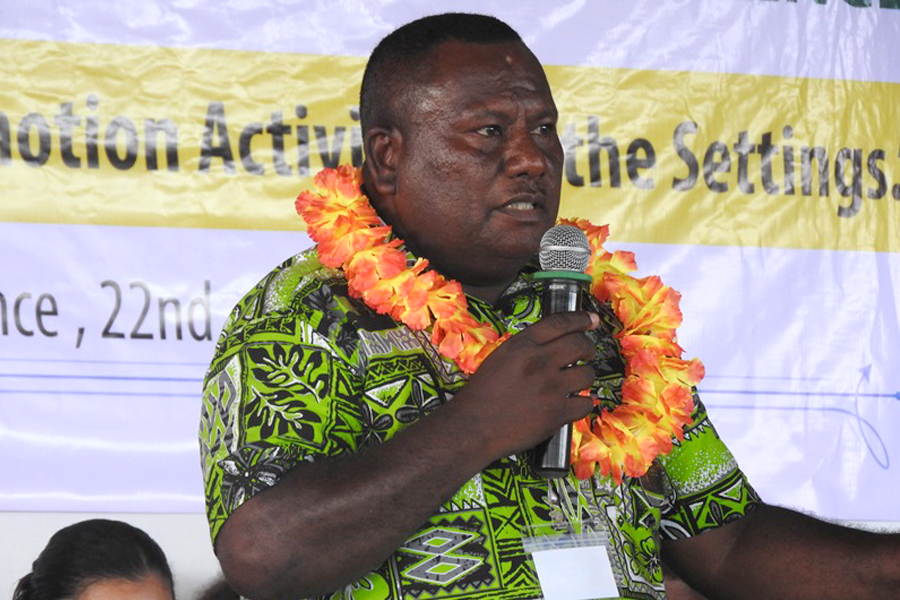
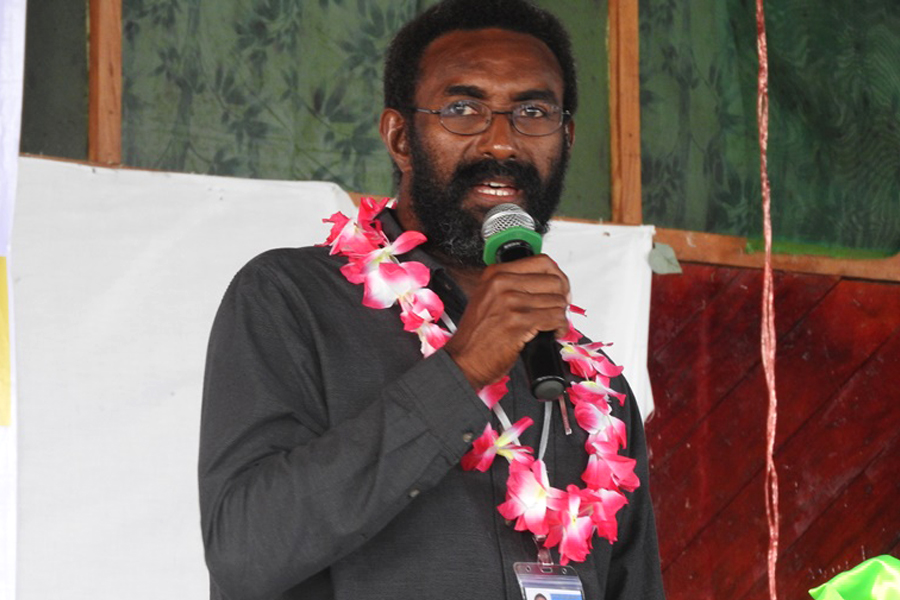
Director of Malaita Health Authority, Dr Henry Kako delivering the keynote address during official opening of the four days National Health Setting Conference which currently in Auki.

BY SAMIE WAIKORI

AUKI

COMMERCIAL and economic interest of a country is a risk to its people and environment.

Director of Malaita Health Authority, Dr Henry Kako raised the alarm in the keynote address during official opening of the National Healthy Setting Conference in Malaita on Monday.

He said while progress has been significant and inspiring, it has not sufficient to cope with the speed of change the region especially Solomon Islands is facing.

Kako said at no point in human existence has there a rate of environmental change that so profoundly threatens the health of people and the planet.

“Destruction of our habitat and destabilization of our climate compromises our access to the most fundamental requisites for human existence, safe water, clean air, food security and shelter,” he said.

Kako said climate change in particular continue to threatens many Pacific island countries and health promotion intervention are relevant to the process of adaptation and mitigation.

He said a distinct feature of life in the 21st century is the speed, power and reach of marketing of commercial products.

“People are tunes in and exposed to information at unprecedented rates.

“This can be empowering as knowledge is readily accessible to the public, but this would also require discernment to filter credible from illegitimate sources.

“At no other point in history has it possible to rapidly alter or create ‘social norms’ and influence behaviour in favour of specific products, especially those that may be harmful to our health,” Kako said.

He said that increasingly, health messages from Ministries of Health were drowned by sectors protects the commercial and economic interests of a country.

He said often times, decisions were made to support or stimulate economic growth with little or no thought on both the immediate and long term health effects of these decisions.

“There is no doubt that commercial and economic determinants create opportunities to improve quality of life.

“At the same time risk to health can no longer be ignored, especially where there is strong evidence of long-term consequences on critical health requisites.

“Increasingly, ministries of health will need to call out situations where commercial and economic decisions may result in short-term gains (e.g. job creation) and long-term adverse impacts (eg forest denudation, flash floods and loss of life and property),” Kako said.

Human behaviours important in healthy setting

0
Director of Health Promotion Division of MHMS, Mr Ben Rickie speaking during the official opening of the National Health Setting Conference at Motel Malaita in Auki on Monday..

BY SAMIE WAIKORI

AUKI

Director of Health Promotion Division of MHMS, Mr Ben Rickie speaking during the official opening of the National Health Setting Conference at Motel Malaita in Auki on Monday..

HUMAN behaviour is very important in health setting as it affects health and quality of life.

Director of Health Promotion Division of MHMS, Mr Ben Rickie said yesterday that behaviour is the result of a complex interplay of internal and external drivers.

He said individuals and groups will consider their values beliefs, perceptions and knowledge as they make decision.

Rickie said people’s decisions are also influence by contexts, social norms and group expectations.

“As people interact with their environments where they work, live and play, they decisions and the setting will affect their health outcomes for better or worse.

“Collectively, human behaviours result in human activity that can create or destroy health.

“It is only in the 21st century that the world has reached consensus on the urgent need to address human activity that has plunged the planet into a state of crisis, from relentless use of fossil fuels to destruction of the physical environment,” he said.

Rickie said efforts to mobilise support for sustainable development started in the 1990s with the Unite Nations Conference on Environment and Development or Agenda 21, the Kyoto Protocol, Rio+20, the Sendai declaration and COP21 among others.

He said WHO has long recognised the importance of behaviour and settings in achieving better health and quality of life.

Rickie said health promotion was defined as the process of enabling people to increase control over and to improve their health in 1986 through the Ottawa Charter.

He said health promotion challenged the dominant biomedical approach in public health and pave the way for uptake of a broader socio-ecological model for population health.

Rickie said this would articulate a different role of the health sector include, creating supportive environments, developing personal skills, strengthen community action, building healthy public policy and reorienting health systems.

National Health Setting Conference 2018 in Malaita

0
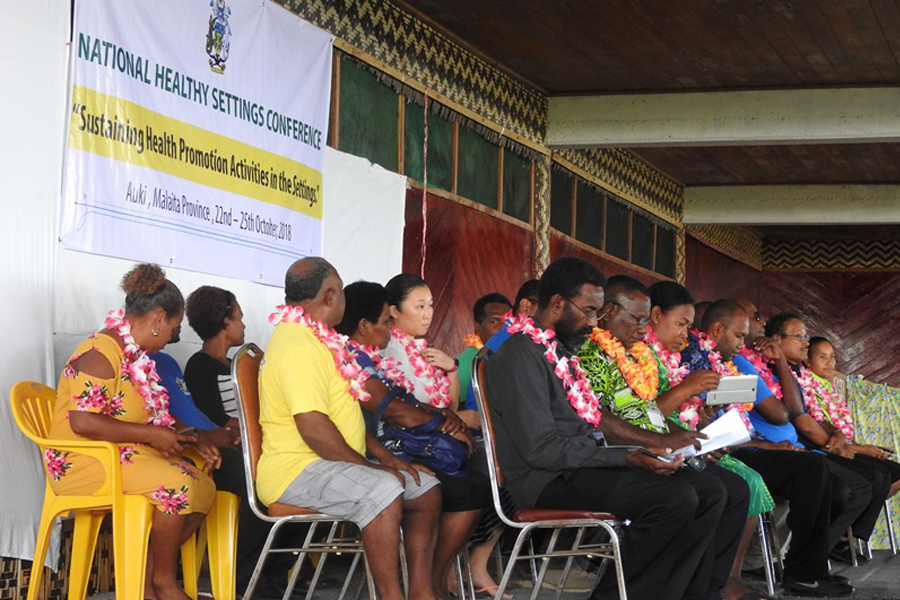
Officialls attending the National Health Settings Conference currently in Auki, Malaita province.

BY SAMIE WAIKORI

AUKI

Officialls attending the National Health Settings Conference currently in Auki, Malaita province.

MALAITA Provincial Health Authority is hosting the first-ever National Health Setting Conference, underway in Auki.

The four-day meeting started on Monday this week with the theme “Sustaining health promotion activities in the setting”.

Speaking during the official opening of the programme yesterday, Director of Health Promotion Division of MHMS, Mr Ben Rickie said since health promotion embarked on healthy setting, they learned a lot from establishing the programme in the country.

“All the health promotion officers may present their experience for the past years.

“We all must acknowledge those pioneering experiences, through them we can have some insights that direct us to a position for future aspiration on all healthy setting,” he said.

Thus, Rickie challenged the participants to move beyond participation and engagement at hand and to interact with people.

Saying, this is by mobilising it to a higher order of inclusion, self-determination – defining the agenda and initiating action.

He said the missing step may be in providing people with sufficient information and capacity to understand discern and decided what is in their best interest.

“Making informed decision is a necessary step that individuals, families, groups, societies and nation must take in order to be active players who are not just engaging or participating in the development process, but are determine their own destiny,” Rickie said.

He said health promotion offers solutions and methods to go beyond the rhetoric of inclusion, participation and engagement to enable people to increase control and improve their health.

Rickie added that health promotion focused on providing supportive environments for people to develop their individual and collective skills in making decisions from the choices present to them.

He said in the western pacific region, health setting is one of the most important mechanisms that organise people’s participation in health matters.

Rickie said this might constitute a rhythm that has the potential to permeate health actions across all SDGs.

“Whether is healthy islands, healthy cities, health-promotion schools, healthy hospitals, healthy communities, or others, these settings are natural sites for integrated action and excellent platforms for local ownership of any combination of the SDGs,” he said.

He emphasised that healthy settings in turn cannot be achieved unless it equips or supports people tom modify their behaviour.

Rickie continued that healthy behaviours are triggered by health literacy, better choices and informed decisions.

“This provides the ‘beat’ – the punctuation of sound through silence of individuals contributing in their own ways at their own pace to collective achievement of health, until each and every one is reaching for better health, and no one left behind,” he said.

The conference gathered health promotional staffs from the nine provinces across the country including HCC.

Youth unemployment associated with exploitation: UNDP report

0

BY LYNTON AARON FILIA 

A United Nation Development Programme (UNDP) report highlighted youth unemployment in Solomon Islands is associated with the risk of exploitation.

UNDP’s Solomon Islands Youth Status Report 2018 said youth unemployment is associated with the risk of exploitation – particularly sexual exploitation of young girls around logging and mining camps and foreign fishing vessels.

The findings were compiled from a research carried out in eight provinces across Solomon Islands.

According to the report, Honiara’s street prostitution often involves young women who have experienced abuse at home, while prostitution at hotels and bars involves both local and Asian migrant women.

In the meantime, the report said it is unclear if these trades also include young boys but investigation and prosecution of the sex trade is rare in the country.

However, first case of human trafficking involving a young girl married to a foreign logger was brought before court in September 2017.

Regarding the issues, Government and group of NGOs in the country has been working on the UN Convention on the Rights of the Child with aim to address the risk of exploitation.

Now, only Save the Children and UNICEF are actively working on prevention through awareness and child protection programme locally, while the ILO builds capacity through its Pacific Sub Regional Child Labor and Trafficking Program

At the government level, the Advisory Committee on Children informs Cabinet and coordinates the implementation of the UN Convention on the Rights of the Child.

The Committee on the Rights of the Child has pointed to several inconsistencies on minimum ages that could be changed to reflect international standards—the minimum age of criminal responsibility is just 8 years old, employment 12 and marriage 15.

Furthermore with the report it stated lack of adequate opportunities for young people to participate in the informal and formal economy makes lasting peace harder to sustain.

This includes young men who lack direction more prone to recruitment by militant or criminal groups – as happened during the tensions, it said.

Besides, the report also highlighted that Solomon Islands Family Health and Safety Study found a correlation between male unemployment and violence against women.

Lack of employment and livelihood opportunities affects many young people’s sense of self-worth and their ability to participate in social, community and political life.

In Honiara, while there are regulations that set aside certain sectors such as transport for indigenous small businesses, the entry of Asian migrants and their subsequent scapegoating for broader governance failures is also creating a potential security risk.

PM congratulates first recipient of Skills Passport Programme

0
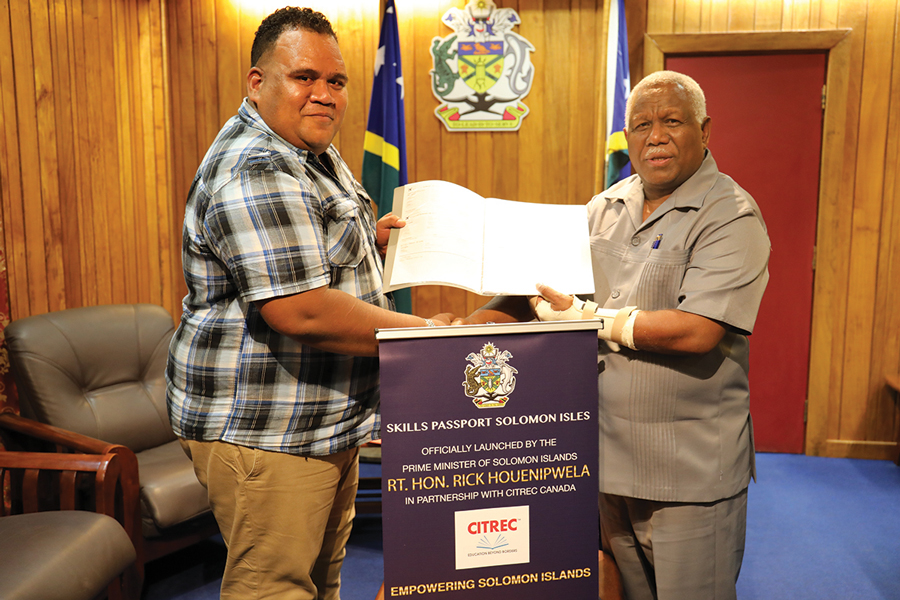
PM Hou handing over the PR and work permits to Mr Leve this afternoon.

PRIME Minister Rick Houenipwela has congratulated the first recipient of the Skills Passport Solomon Isles program in Canada.

Mr Ofati Leve will be the first recipient of the programme following the launching of the new initiative with Canadian International Training & Education Corp of Canada [CITREC] by the Prime Minister at the margins of the UNGA in New York last month.

The Prime Minister encouraged Leve to be a good ambassador for the Solomon Islands whilst in Canada.

“You are the pioneer under this new programme and therefore you have a very important responsibility to give a good impression to your employers and the Government of Canada of the value of Solomon Islanders,” he said.

The Prime Minister said Leve’s success will open more doors and opportunities for more Solomon Islanders.

Leve in response said he is a proud Solomon Islander and he will be flying the flag of his country in Canada.

“I am excited for this new journey to a new country to work. I am so happy to be the first recipient and I thank the Prime Minister for launching the new programme with CITREC which will definitely be opening new opportunities for people like me,” he said.

Under this programme, Leve will be employed as a chef with a permanent full time employee in a Canadian restaurant with permanent residence and work permit.

He will depart to Canada this Saturday.

This new initiative will introduce eligible Solomon Islands nationals to an expedited stream for Canadian Permanent Residency which comes with permanent jobs into Canada’s Hospitality and Tourism Sector.

It will also introduce new efforts in empowering women in Solomon Islands with seven out of 15 Permanent Residency nominations under the pilot project.

This programme will allow Solomon Islands nationals under a special pilot project to apply for Permanent Residence nomination for Canada that will be supported under Canada’s Provincial Nomination programme.
–OPMC PRESS

Many support women participation in politics

0

BY LYNTON AARON FILIA

 THERE have been positive attitudes towards women participating in politics in Solomon Islands.

In the lead up to the Solomon Island’s National General Election (NGE) in 2014, the Solomon Island Electoral Commission (SIEC) conducted a range of Voter Awareness Programmes (VAPs).

These were designed to enhance voter engagement with the electoral system and improve voter awareness of key electoral issues.

With that, a survey shows there have high number of people in the country supporting the participation of women into politics.

From the People’s Survey, the report indicates positive attitudes towards women as leaders in the Solomon Islands; however this has not lead to significant representation of women in politics.

For example, the 2013 People’s Survey reported that 91 percent of respondents considered woman would be a good leader, while the results of the 2014 NGE showed only 2.7 percent of the population voted for women candidates.

In return, only one female Member of Parliament in a 50 member chamber, the report said.

In this survey, SIEC further explore such gap through investigating attitudes of respondents in relation to the capability of women to be politicians, as compared to men.

The findings resulted with 81 percent of respondents considered women to be as skilled as men at being politicians.

82 percent women respondents reported a similar response rate, and while this is a high proportion, it is not quite as high as results from the 2013 People’s Survey.

The positive response rate to women’s level of skill as being a politician when compared to men was relatively consistent across all provinces.

In identifying what women candidates needed to win in their constituency, respondents most frequently noted that having a reputation for helping accounts to 34 percent and demonstrating good personal attributes is 34 percent were critical.

Of the respondents who said women were not as skilled at being a politician as men, 40 percent said that it was not a woman’s role to be a politician or a leader (this was less than 8 percent of overall respondents).

This was similar among both women (35 percent) and men (45 percent).

Overall, 19 percent of respondents (14 percent of women respondents) felt women were not as capable at being politicians as men simply because of their gender.

This suggests that there are further gender-based issues, particularly in promoting women’s representation in politics, to be addressed within the Solomon Islands.

SINCW congratulate Tanagada over new appointment

0

BY BARNABAS MANEBONA

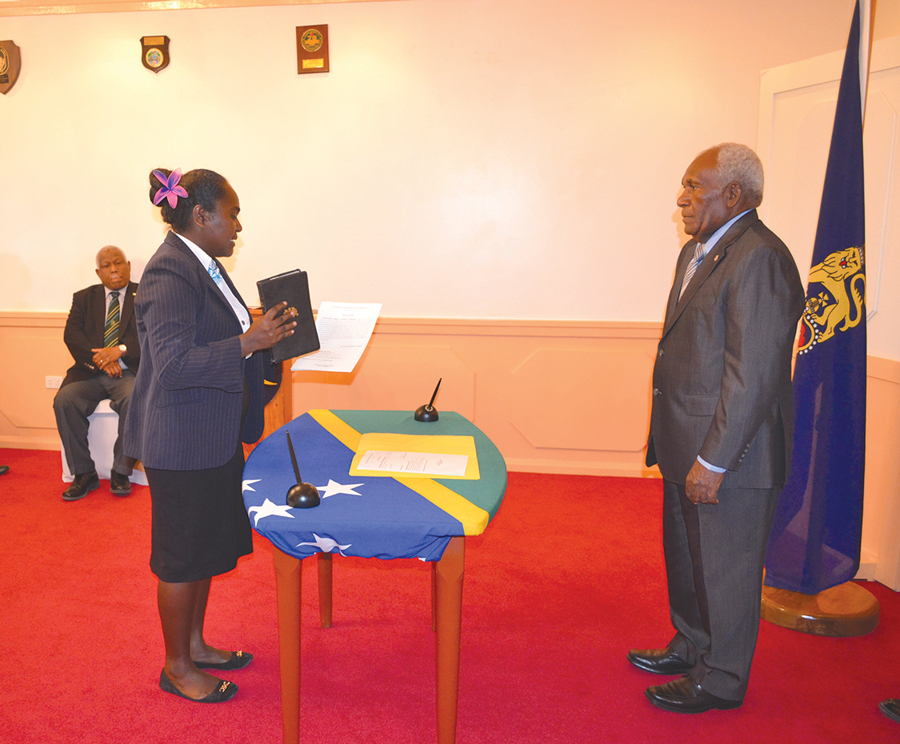
THE Executive and management of the Solomon Islands National Council of Women (SINCW) congratulate Hon Lanelle Tanagada of her appointment as the new Minister for the Ministry of Women, Youth and Children Affairs (MWYCFA).

In a Press Release yesterday, SINCW as the umbrella NGO of women’s organisation mandated to provide the complementary and support role to the MWYCFA in implementing its policies for women look forward to continue and give that support to the Hon. Minister and her team in the MWYCFA.

“We also look forward to working closely with you and your staff to continue as well as further strengthen our special relationship in striving to better the lives of our women, youths and children in Solomon Islands.

“We wish the Hon. Minister all success in her role as the Minister for MWYCFA as we are looking forward for a new and longer political turn around in the 2019 National General Election,” stated SINCW in their Press Release.

Hon Lanelle Tanagada is the Member of Parliament (MP) for Gizo/Kolombangara Constituency in Western Province.

CPG question past Executive on shopping complex project

0

BY BARNABAS MANEBONA

THE current Central Islands Province (CIP) Provincial Government are questioning why the previous Executive of the province had come up with a Shopping Complex project for Tulaghi.

Comparing to the small scale yet in terms of business houses development in Tulaghi, the current Executive see the project as too early to develop such having already spent part of the province past Provincial Capacity Development Fund (PCDF) of around $5 Million.

“We should currently be focusing more on other areas to start off with that are beneficial with the level of scale development that CIP is in at this stage,” said a disappointing Premier for CIP Hon Patrick Vasuni with the understanding that his provincial government is criticized by the people of the province over the incomplete Shopping Complex project.

Nevertheless CIP’s Premier has assured that despite of such, his current provincial Executive will still yet be looking back into this project but will have to wait for the next PCDF funding before they can see how things work out from planning.

CIP this year after being disqualified from the 2015 and 2016 PCDF funding has topped first position in the assessment of PCDFs in the country.

NSO staff honoured with certificates

0

STAFF of the National Statistics Office (NSO) were honoured on Friday last week for their participation during the two weeks of in-depth training on Census Management and CSPro.

Commenced on October 8, the training concluded with certificate presentation on Friday.

“The training is a massive leap for the NSO staff,” Government Statistician, Douglas Kimi said.

It was envisioned to prepare and equip staff with crucial proficiency regarding staff involvement in different levels of census management and operational activities and also impart officers with procedures into editing census data.

Mr Kimi said equipping staff with essential expertise ahead of the 2019 population census is vital.

“Since the census project involves huge operations and the information to be collected will be used and useful in the next ten years, it is important that proper management of census activities, processes together with monitoring/evaluation are being implemented to control and guarantee management of data quality and to complete the Census count,” Kimi emphasised.

Kimi thanked his staff for their patience and cooperation throughout the course of the training and also acknowledged the training facilitator Dr Michael Jonathan Levin for his time and service.

He said the teamwork essence and serenity displayed by participants (staff) has ensued in the training success.

The training was the first of its kind for the NSO and the presentation contents are similar to the recommended UN revised Population handbook together with the approved international standards, classifications and definitions.

Meanwhile, participants thanked the NSO management for making the training accessible and pledged to put into practice what has been learned.

–SINSO MEDIA

Successful public spending to reduce poverty requires targeting benefits to right people

0

BY LORETTA BRIGIDIA MANELE

SUCCESSFUL and financially feasible public spending to reduce poverty requires targeting to prevent the benefits dripping into the hands of the non-poor.

This was expressed in the “Solomon Islands Poverty Maps Based in the 2012/13 Household Income and Expenditure Survey and the 2009 Census of Population” report.

The report emphasized that if poor households can be easily identified, transfer payments and other direct interventions can be made with the approach of giving directly advocated in the form of conditional cash transfers.

However, also stated was that there are concerns regarding the above mechanism’s applicability, particularly because of unknown interplay between new sources of social transfers and existing informal safety net with the inclusion that informational requirements for screening and the financial infrastructure for making direct payments may not be present.

On top of that, the report says distributing benefits to only a number of people in any one village or area requires institutions and personnel that can withstand temptations of corruption and reciprocal obligations that can be present in clan-based societies.

The study mentioned that if there is relatively high number of poor people in certain areas, spatial targeting may be attainable in which extra development projects and public services are provided for everyone in those areas.