Home Blog Page 1140

The Fred Hollows Foundation (NZ) is helping to end avoidable blindness in the Solomon Islands

0

DEAR EDITOR, the Solomons National Referral Hospital Medical Superintendent Dr John Hue said, recently, the country’s top causes for blindness and visual impairment is cataracts.

He said, “The top causes of blindness and visual impairment in the Solomon Islands in the age group of 40 years and above are cataracts meaning clouding of the natural lens in the eye.”

Other leading causes are refractive errors, he added.

Knowing that the Fred Hollows Foundation in New Zealand was responsible for the establishment of the Referral Eye Centre in Honiara and where much good work is being done daily to deal with patients with eye problems, I was interested to learn what the Foundation is currently doing to further aid the Solomon Islands Government and those suffering from visual impairment.

Laura McPike, the Project Officer from the Foundation, kindly responded to a query I made and referred me to the Foundation’s website from which I will quote to give readers an insight of what the New Zealand charity has done to appraise the situation of eye care needs and what is currently being done by way of training support.

Here are the relevant aspects:

“The Solomon Islands has a local eye care workforce who were trained by us at the Pacific Eye Institute in Fiji and operate from various hospitals and eye clinics across the country.

“All Foundation-trained eye doctors and the majority of the Foundation-trained nurses are based at the Regional Eye Centre in Honiara which we built in 2015.

 “With this facility providing increased surgical capacity, the team is working towards eliminating the backlog of cataracts and helping to address other eye conditions.

 “An outreach team from Honiara provides support to the other eye nurses placed across the country, helping deliver eye care services to their communities.

“The clinic is off-the-grid, producing more energy than it can use through its solar panel system.”

 “In the Solomon Islands last year:

·         “Foundation-trained Dr Claude Posala, now Head of Department for Ophthalmology at the Regional Eye Centre, completed the Asia-Pacific Academy of Ophthalmology’s Leadership Development Program in March 2017.

·         “A national survey assessing the rates of avoidable blindness was conducted in 2017. The results from this survey will provide valuable information which will help us assess the impact The Foundation has had on eye care in the country to date and inform the development of our programme going forward.

·         “Two doctors have begun training in ophthalmology at the Pacific Eye Institute. These doctors are expected to graduate in 2019 and 2021.

·         “We expect to meet our training targets for eye nurses by the end of this year. These targets are based on international standards using population size then adjusted according to the geographic spread of the population.”

The Fred Hollows Foundation’s aid is much appreciated and the Foundation thanked for the great work being done in the Solomon Islands.

 I will very much look forward to learning that the backlog of cataract cases has been cleared and the patients that have suffered for so long with cataracts are able to see again and go about their daily activities with restored vision.

Yours sincerely

Frank Short

Logging roads in Solomon Islands make up twice the length of the Yangtze River in China, according to Global Witness.

0

DEAR EDITOR, a report recently commissioned by the Solomon Islands’ ministry of finance suggested that if logging continues at its current pace, natural forests will be exhausted by 2036.

The Solomons exported more than 3 million cubic metres of logs in 2017; nearly 20 times what experts think is a sustainable annual harvest.
According to an article in the Independent newspaper today (quote)

“The hugely unsustainable rate of logging, the high risks of illegality and the fact that the industry does little to benefit local people all create a bleak picture.

“Global Witness used satellite imagery and drone photography to determine the rate at which logging is taking place in the Solomon Islands.

“These images revealed vast swathes of deforested land, as well as over 12,000 km (7456 miles) of logging roads criss-crossing the tiny nation.

“One in every 20km of logging road in the Solomon Islands is above 400m in altitude, despite specific efforts by the government to limit deforestation in these zones.

“In their report, Global Witness highlighted China as a particularly worrying player in this situation. The Solomon Islands the second biggest source of tropical logs to China, after Papua New Guinea, the large Asian nation requires no checks to ensure these imports are legal or sustainable.

“As their investigation found these was a high risk that logging companies were not seeking permission from many local landowners or avoiding prohibited places, Global Witness concluded that some of the timber leaving these islands is likely illegally sourced.”

In a separate reported released by Radio New Zealand today (Thursday)the environmental group Global Witness is calling for a moratorium on all logging operations in the Solomon Islands.

The report said logging companies are operating without the permission of local landowners, in prohibited places and without paying taxes owed.

Global Witness Campaign Leader, Beibei Yin, said both China and the Solomon Islands need to put in place better protections.

 “If the logging practice continues at its current speed, its (Solomons) forest, it will be commercially extinct, exhausted by 2036. This is a really alarming figure all of us need to be aware of it”
Source:  Radio New Zealand.
Yours sincerely
Frank Short

Community’s adaption to climate change will be dependent on the rate at which environmental changes will occur.

0

DEAR EDITOR, according to a recent article published in the Island Sun newspaper and from which I quote.

“The Office of the Auditor-General has conducted a Performance Audit on Climate Change Adaptation and Disaster Risk Reduction Strategies. This was in recognition of the impact that Climate Change has and will have on islands in the Solomon Islands.”

Arising from that report the article went on to say –

“The National Climate Change Policy needs to be updated. There needs to be a Food Security Policy developed. There needs to be sufficient budget provision from Parliament to ensure effective policies exist and to ensure that ministries have sufficient resources to implement them effectively and in full. “Solomon Islands cannot stop the rise in sea level but it can become one of the best prepared countries in the world to deal with its consequences and ensure that its people can not only survive but prosper in the post-climate change world.”

When it comes to adaption it should be understood that only when there is likely to be a slow-onset in prolonged environmental changes that communities will have time to react and possibly adapt, but should climate change bring about rapid environmental events, such as frequent cyclones, increased sea levels and inland flooding, people will rarely have any other option but to move to higher ground, if possible, or to migrate.

Already in Kiribati increasingly frequent king tides and storm surges, floods and longer droughts are new, unwelcome additions to the islander’s way of life

Sea level rise has turned freshwater resources salty, rendering the land unable to grow staple crops such as coconut and taro, and eating away the shoreline.

Islanders are being told that they may have to abandon their islands, the places where their ancestors have been buried, where their children have a home and an identity.

Small Pacific nations are increasingly under threat from climate change not of their own making and it is time that those nations, corporations and leaders accept the science and lower carbon emissions, as outlined and agreed upon at the Paris Climate Conference.

If they value the continuing betterment of all nations and an interconnected world, they must take the action that is necessary to preserve the way of life for future generations to enjoy.

Yours sincerely

Frank Short

“I help the victims because it’s my job as a police officer and I have to feed them at home.”

0

DEAR EDITOR, when Florence Teiraru of Buala Police Station spoke at a conference currently underway in Honiara, she expressed the words summarised in the heading to this article.

Florence was explaining to her audience the need for a Family Support Centre at Buala to be able to deal with issues of family violence.

In the absence of a proper FSC facility she explained that it was her duty to help the victims.

Much of a police officer’s work requires the ability to relate to those going trough incredible hardships and show compassion, while still  remaining professional.

I am pleased to acknowledge Florence’s duty of care to others in the service of the Royal Solomon Islands Police Force (RSIPF).

Yours sincerely

Frank Short

Solomon Islands:  Disturbing allegations surface over Constitutional Development Fund (CDF) grants controlled by Members of Parliament.

0

DEAR EDITOR, at a time when the Solomon Islands Government has past enabling anti-corruption legislation to curb corruption and the Prime Minister has gone out of his way to assure business and world leaders that the Solomon Islands is ensuring accountable and honest government, a rather disturbing report surfaced today in the Island Sun newspaper written by local veteran journalist Alfred Sasako.

In the article, Mr. Sasako, said, in an opening paragraph:

“When the Government introduced the ‘Preferred Supplier’ policy in 2016, no one ever thought one supplier would be raking in the lion share of the controversial Constituency Development Fund (CDF) grants controlled by Members of Parliament.”

His article went onto to make further allegations, and I will quote.

“A special investigation by Island Sun found that one company (name withheld) has picked up handsomely from government funding.

 “Figures obtained by Island Sun show the company, which sells vehicles, vehicle parts, Lucas mill and other hardware, clocked up more than $233 million between 2012 and September this year.

“In 2012 for example, payments to the company were slightly more than just $1.6 million. The following year, however, payments to the company skyrocketed to more than $10. 4 million. From then on, the increased payments simply continued skyward.

“A woman spoken to could not say whether Members of Parliament bought vehicles from the company as the boss was away overseas.

“Meanwhile it has been revealed that much of the payments to a certain Constituency have gone into a private bank account of a Member of Parliament.”
 
Source – Copyright @ 2018, Island Sun newspaper.

Whether the allegations raised by Mr. Sasako are true or not, it surely must be in the interest of the Solomon Islands Government to have such alleged ‘corruption’ actions investigated and appropriate and swift action taken if substantiated.

Yours sincerely

Frank Short

Solomon Islands is the custodian of a battle ground that is deserving of maintenance and preservation in remembrance of the deceased.

0

DEAR EDITOR, WW II sites have been said to be important to destinational marketing in the Solomon Islands.

Quoting from a recent article in the Island Sun newspaper it read:

“Battlefields from World War II form an important part of Solomon Islands history so do the heritage, which forms an important component of the Solomon Islands tourism products.

“WWII heritage though small, standalone as a special interest market, focusing on the relatives of WWII veterans and historians from USA, Australia and Japan, but also appealing to a broader market interested in recent history.

“There are many sites around Honiara and on Guadalcanal including the American War Memorial, Thin Red Line and Bloody Ridge. Iron Bottom Sound, Tulagi and Western Province also contain sign cant sites from WWII.

“Meanwhile, most sites however are poorly presented, poorly maintained and in many instances have limited information and documentation associated with them.

“Unlike PNG (Kokoda Track) or Vanuatu (SS President Coolidge) there has been no combined effort to support the development of an iconic WWII site into a major tourism attraction.”

Source:  Island Sun newspaper.

Apart from the necessity, as I see it, of better maintaining and preserving the historic battle sites, one should remember that those battle sites also contain the last remains of many deceased soldiers.

It is believed that about 300 Americans and a staggering figure of 20,000 Japanese are still listed as missing.

The battle for Guadalcanal during World War II will remain forever as a battle that changed the course of history in the Pacific.

The historical significance of this means that the Solomon Islands must do all it can to ensure that all those who lost their lives and are still unrecovered are given respect by way of maintaining the battle fields befitting how we  should care for the deceased.

I have visited the Kranji War Cemetery in Singapore and also visited the Chungkai War Graves Cemetery in Kanchanaburi in Thailand.

Both those places of final rest are beautifully maintained and living gardens of peace and rest.

Yours sincerely

Frank Short

Scientists are reported to have succeeded in wiping out mosquitoes in new laboratory experiments

0

DEAR EDITOR, quoting from an article written by Kate Kelland and published by Reuters in September this year.

 “ Scientists have succeeded in wiping out a population of caged mosquitoes in laboratory experiments using a type of genetic engineering known as a gene drive, which spread a modification blocking female reproduction.

 “The researchers, whose work was published on Monday in the journal Nature Biotechnology, managed to eliminate the population in less than 11 generations, suggesting the technique could in future be used to control the spread of malaria, a parasitic disease carried by Anopheles gambiae mosquitoes.

“It will still be at least five to 10 years before we consider testing any mosquitoes with gene drive in the wild, but now we have some encouraging proof that we’re on the right path,” said Andrea Crisanti, a professor at Imperial College London who co-led the work.

“The results mark the first time this technology has been able to completely suppress a population. The hope is that in future, mosquitoes carrying a gene drive could be released, spreading female infertility within local malaria-carrying mosquito populations and causing them to collapse.

“Gene drive technologies alter DNA and drive self-sustaining genetic changes through multiple generations by overriding normal biological processes. The technologies can be very powerful, but they are also controversial, since such genetically engineered organisms released into the environment could have an unknown and irreversible impact on the ecosystem.

“The technique used in this study was designed to target the specific mosquito species Anopheles gambiae that is responsible for malaria transmission in sub-Saharan Africa.

“The World Health Organization has warned that global progress against malaria is stalling and could be reversed if momentum in the fight to wipe it out was lost.

“The disease infected around 216 million people worldwide in 2016 and killed 445,000 of them. The vast majority of malaria deaths are in babies and young children in sub-Saharan Africa.

“Crisanti’s team designed their gene drive to selectively alter a region of a so-called “doublesex gene” in the mosquitoes, which is responsible for female development.

“Males who carried this modified gene showed no changes, and neither did females with only one copy of it, he explained in the study. But females with two copies of the modified gene showed both male and female characteristics – they failed to bite and did not lay eggs.

“The experiments found the gene drive transmitted the genetic modification nearly 100 percent of the time, and after 7-11 generations the populations collapsed due to lack of offspring.

“Crisanti said the results showed that gene drive solutions can work, offering “hope in the fight against a disease that has plagued mankind for centuries”.

“He added, however, that “there is still more work to be done, both in terms of testing the technology in larger lab-based studies and working with affected countries to assess the feasibility of such an intervention”.

“But Mariann Bassey, a campaigner with the environmental group Friends of the Earth Africa, said the technique was risky.

“To solve the malaria crisis, we should focus on the least risky and most effective solutions, not experiment with ecosystems with little regard for the potentially new environmental and health consequences,” she said in a statement.”

Copyright @ 2018 Reuters.

In the Solomon Islands malaria remains a health hazard and the cause of much sickness, especially in the rural areas of the country.

Yours sincerely

Frank Short

Maitaki commends young Kurukurus

0

BY ROMULUS HUTA

THE head of the Solomon Islands delegation to the recent Youth Olympic Games held in Argentina this month says he is more convinced that the national under-18 futsal side is one of the world’s best in the sport.

Chef De Mission Morris Maitaki shared his conviction after watching how the boys performed during the games in Buenos Aires taking on the likes of Brazil, Russia and Iran in Pool B of the futsal competition.

Maitaki, who watched all their four pool matches by cheering from the sideline, said the young futsal side was exceptional. “The outstanding performance of our Futsal team was extremely exceptional despite not winning a medal.

“We have proven to the world of futsal that we are among the best teams in the world.

“Attending to all matches of our futsal team at Technolopolise and Cenard arenas it’s the best feeling to witness our boys displaying their skills with an overwhelming support from the crowd of Argentina.

“This has proved to me our common saying that we are a little Brazil or Argentina in the Oceania,” Maitaki stressed.

The Chef De Mission believes that futsal has a very bright future ahead of them in Solomon Islands.

“I strongly believe our futsal can be a real threat in the World of futsal in the next 10 years if given the right home and proper training and adequate preparation.

“We came to the youth Olympic Games to compete knowing very well that we have nothing to compare to other nations with no proper facilities, competitions and adequate preparation unlike other countries who prepare well for this youth Olympic Games.

“However, despite all these difficulties yet our team performance have impressed and surprises many participating teams, officials, spectators and I do believe it has also impacted our young players back at home who also aspire to come this far,” Maitaki expressed.

The young kurukurus and the rest of One Team Solomon members will arrive in Honiara this afternoon.

Futsal challenge looms

0
Marist Futsal Club was crowned the champions of the SIPA Futsal League. The second part of the 2018 futsal season which is the Futsal Challenge will kick off on November 5.

THE Solomon Islands Ports Authority (SIPA) Futsal Challenge 2018 will commence on November 5, Solomon Islands Football federation (SIFF) confirms yesterday.

The challenge is part of the SIPA-sponsored national futsal league which concluded in June and won by Marist.

Clubs entering the challenge are ones who have took part in the national league. They are Marist, Kooline, Mataks, Koloale, Vania, Solympics, Gantimak, Indo-Solo, Real kakamora and Henderson Eels.

The clubs have been drawn into two pools, A and B. Draws are based on team ranking at the completion of the league competition.

Champions Marist leads Pool A and is joined by Kooline, Mataks, Koloale, KOSSA and Vania. Pool B comprises Solympics, Guntimark, G-Camp, Indoor-Solo, Real Kakamora and Henderson Eels.

SIFF Futsal Development Officer Jerry Sam said registration will close on October 31 and forms can be collected at the SIFF Office.

Sam said teams will play according to pools. The top two teams emerging from each group will qualify into the semi-finals. Sam explained that the presentation for both the league proper and the challenge competition will be held after the SIPA Futsal Challenge.

He added that clubs need to get organized to successfully compete in the final competition for this year.

GROUP A: Marist, Kooline, Mataks, Koloale, KOSSA and Vania.

GROUP B: Solympics, Guntimark, G-Camp, Indoor- Solo, Real Kakamora and Henderson Eels

Matangiki triumph

HRUA action is set to kick off with SOLRICE again major sponsors
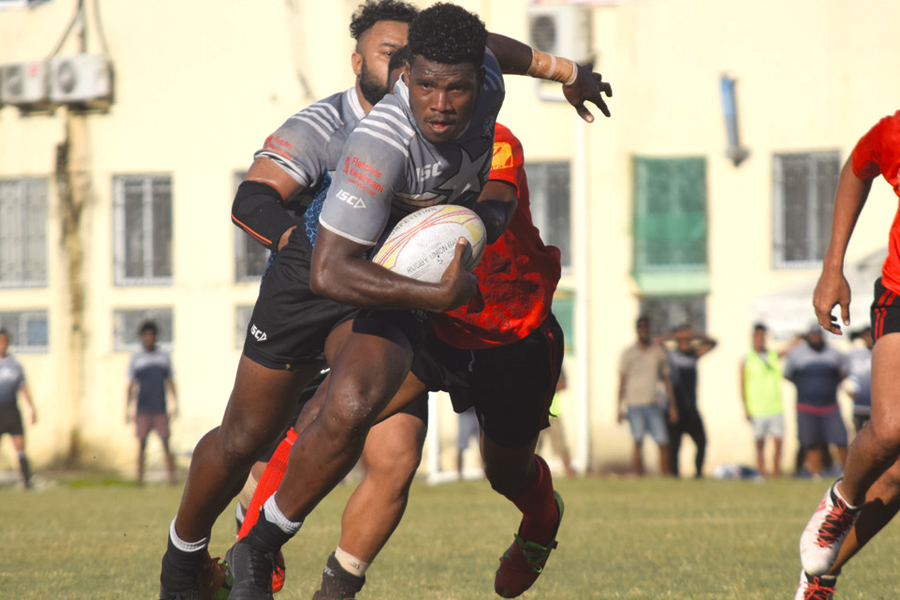
Hammerheads Chris Saru breaks away from a tackle during the grand final of the HRUA 2018 top 4 play offs on Tuesday.
Matangiki won 16-12. Picture Taromane Martin.

MATANGIKI rugby club is the new champion for the 2018 Honiara Rugby Union Association (HRUA) top four play-off.

This came after defeating league proper winner, Henderson Hammerhead Sharks 16-12 in yesterday’s close-contested grand final showdown at the Town Ground Rugby stadium.

Matangiki led 7-0 after 20 minutes in the first half via a Moana Tepuke converted try but saw the score margin reduced 7-5 ten minutes later, Bobby Sade crossing the line for Sharks’ first try.

It remained 7-5 in favor of Matangiki when second half resumed. Hammerheads were struggling to get out their own half, Matangiki forcing a number of turnovers and mistakes out of the Sharks forwards.

“It’s a big achievement for the club.

Our club once won 10 titles in a row and to win again today is definitely a cause to celebrate,” Matangiki team captain Owen Teika said.

“I really appreciate the support from the fans, our church.

The old players we always try to show good rugby for our young boys.

“On this note I want to thank Hammerheads for a tough but very clean game today (on Tuesday).

“Definitely they have a lot of big forwards. But we know they are tall, bulky and strong so we had to play smart.

“We stuck to our game pattern or 1-3-3-1 and spread their forwards wide so they can run and eventually puff themselves out.

“In the semi final his kicking was spot on so we all decided Simon will continue with the penalty conversion duties.

“I don’t look at who the player is to give the responsibility too but I give it to who will get the win for our team,” Teika said.

Three more Simon Tepuke penalty conversions in the second half were enough to secure Matangiki the win beating HHH 16-12 in the grand final match yesterday.

“Obviously Matangiki was the better team today. We created one or two mistakes which led to the penalties and their first try.

“Playing catch up rugby is a bit tough but then again we only had ourselves to blame for not keeping our discipline and letting that one go,” HHH Head Coach Philip Campbell said.

Prize presentation for the winners will take place on a later date to be confirmed by HRUA executive.

Final HRUA top four play-offs standing:

1st place: Matangiki, 2nd place: HHH Sharks, 3rd place: TIA Warriors, 4th place: Avaiki rugby club.