Home Blog Page 1139

Police arrest 32-yr man for bashing wife and tying up son

0

POLICE at Tulagi in Central province have arrested a 32-year-old man for allegedly assaulting his wife and tying up his 13-year-old elder son at Ha’a village on Big Ngella recently.

The suspect was charged with domestic violence under Section 57 subsection 1 of the new Family Protection Act.

Supervising Provincial Police Commander (PPC) Central Province, Inspector John Sara says, “The incident happened recently and was reported to police only on October 19, 2018.

“Police arrested the suspect on the same date from the care of Crime Prevention Committee Members (CPC) at Ha’a Village.

“It is alleged that the incident happened at the family house when the husband came and get hold of their first born son, tied him up with a rope and slapped him twice on his face.

“Then he turned to his wife and punched her. She became unconscious and fell to the ground.

“The suspect then escaped for fear of retaliation from his wife’s relatives.

“The suspect was arrested with the assistance of CPC members and detained at the Tulagi police custody as investigations continue into the incident.

“This is a very sad incident especially with the father who is supposed to be responsible for his wife and son mistreating them in such a manner. This is not acceptable in any society.

“I would like to remind our chiefs, church leaders, and members of our communities that beating of women and children is a serious offence.

“We cannot tolerate such behaviour. The full force of the law will be enforced.”

PPC Sara also thanked members of the CPC at Ha’a Village for assisting to bring the suspect to the police to be arrested and brought to justice.

–POLICE MEDIA


SI could lose millions in tax revenue under PACER-Plus

By Gary Hatigeva

SOLOMON ISLANDS is amongst three Pacific Island nations that are highlighted to be in great risks of losing millions in import tax revenue due to pressure from the PACER-Plus Agreement.

This is according to the full analysis and accompanying briefs of the Pacific Islands Network on Globalisation (PANG), which examines and reveals the impacts of PACER-Plus in relation to the Trade in Goods as well as the Services and Investment components of the agreement.

In a statement, PANG says the analysis also comes as a realisation of the concerns that is said to be held by Pacific communities and some Pacific island governments about the regional free trade agreement under the PACER-Plus, which are well founded according to the new analysis that was released yesterday.

The analysis states that the Trade in Goods chapter requires Pacific Island Countries to make extensive cuts in their import taxes, with Solomon Islands, Samoa, and Vanuatu expected to lose USD$13million, USD$12.5million and USD$7.5million respectively.

Referring to the reports, PANG’s Trade Justice Campaigner Adam Wolfenden, said the PACER-Plus package confirms their fears about PACER-Plus and how it undermines the ability of Pacific Island Countries to determine for themselves what they want development to be and having the tools to make that a reality.

“PACER-Plus does little to help boost the exports of Pacific Island Countries yet it is burdening them with a whole raft of legally binding commitments with meaningless safeguards. This is not development by any definition,” Mr Wolfenden said.

In addition to this the safeguard mechanisms and infant industry, the campaigner stressed that the provisions are too weak to be of any practical use to Pacific Island Countries who need to protect their industries that are being hurt by increased imports under PACER-Plus.

Meanwhile, the PANG official also pointed out that the Trade in Services and Investment chapters represent a serious restriction on the ability of Pacific Island Countries to regulate and ensure that investment that comes in has its benefits maximised.

“Over the years we have seen many experts detail the problematic nature of PACER-Plus and how it was being constructed to Australia and New Zealand’s benefit.

“These warnings, including from an Australian Parliamentary inquiry have been ignored and now we have a binding agreement that won’t address the real economic issues the Pacific Islands have and instead will burden them further with cuts in government revenue and the reduced ability to regulate,” the Organisation’s Trade Justice Campaigner explained.

He further pointed out that under PACER-Plus, Pacific Island governments will have a reduced ability to regulate their service industries and investments, and instead the investors will be given greater rights to challenge any policies or regulations that they may deem to be unfair.

“Pacific Island countries are signing up to a framework that many nations are walking away from in favour of something that better balances the rights of governments and investors,” Mr Wolfenden added.

He said there are very real and serious implications of this agreement that countries need to factor in to their ratification processes.

Fiji, Papua New Guinea, Palau, Republic of Marshall Islands and the Federated States of Micronesia all have not signed on, and the access to Australia’s recently launched Pacific Labour Scheme is linked to progress on PACER-Plus.

PACER-Plus was signed by Australia, New Zealand, and 9 other Pacific Island Countries in 2017, which included Cook Islands, Kiribati, Nauru, Niue, Samoa, Tonga, Tuvalu and Solomon Islands.

Vanuatu signed the Agreement three months later in another summit in Samoa.

The Ministry of Foreign Affairs and External Trade is responsible for the facilitation and implementation of the Agreement, together with its relevant stakeholders and ministries here in Solomon Islands.

A detailed respond is expected when responsible officials return to the country on the issues highlighted in PANG’s reports.

But in a brief statement, the Ministry’s Trade Commissioner, Joseph Ma’ahanua explained from Brussels that the ministry will be undertaking its own process of awareness for PACER-Plus for the country, including their stakeholders and the public soon.

The Pacific Agreement on Closer Economic Relations or PACER-Plus is an umbrella agreement between members of the Pacific Islands Forum, which included the Forum Island Countries plus Australia and New Zealand that seeks to provide a framework for the future development of trade cooperation.

According to its initial establishment plans, the PACER-Plus was created to foster economic growth, investment and employment, at the same time promoting trade and structural reforms in the Pacific Region.

However, the PANG statement disagrees, claiming that PACER-Plus has always been about the interests of Canberra and Wellington, and Australia’s cynical move in connecting the labour scheme to their market access into Pacific economies, is further proof to the matters highlighted.

NCDs remain a threat in Solomon Islands

0

BY JENNIFER KUSAPA

A female officer within the Non-Communicable Disease (NCD) department of the Ministry of Health and Medical Services reiterates that NCDs remain a major threat to health in Solomon Islands.

The officer revealed to this paper yesterday that diabetes, heart attack, stroke and other NCD have been on the rise in this country and continue to be an increasing problem in the society.

“Eating styles of people lead to such disease, in the past you hardly see NCD cases increasing every month but currently if you are going to the National Referral Hospital there are not enough beds to accommodate patients and it is a serious problem,” the officer said.

“People nowadays eat too much than the exercise they do, families or household should eat more during the day and eat less during the evenings.”

The officer said though local foods are hard to get especially people in Honiara try as much to reduce eating rice and oily foods.

She said eating much of local foods and vegetables will avoid being caught up in NCDs and people must be reminded to care about their own health.

Status of citizenship bill questioned ahead of parliament resumption

0
Parliament

By Gary Hatigeva

WITH less than two months before the 10th Parliament House is dissolved, Solomon Islands Nationals living abroad are questioning whether the much anticipated ‘Constitution (Amendment) (Dual Citizenship) Bill 2017’ will be tabled when parliament resumes.

This comes as a follow up on an assurance the Prime Minister had made during his recent international visits abroad.

In his visits to Solomon Islanders residing outside the country, the Prime Minister shared his government’s keen intention to have the Dual Citizenship Bill become realised before this tenure ends.

In that time, he acknowledged that for years, many Solomon Islanders of mixed ethnicity and those living abroad have been seeking such a law.

If adopted, the legislation looks to enable those that have given up the Solomon Islands passport, to regain their Solomon Islands status.

The proposed law was intended to facilitate the return and reintegration of Solomon Islands citizens by birth or ancestry who lost their citizenship through marriage, forced labour or naturalisation in another country, a policy that is said to be based on an exponentially growing trend in the 21st Century.

It also aims to open up opportunities for the benefit of social, economic, family, employment and study, with ease of movement for those eligible, between country of origin and country of residence.

“That is what many of the communities I have met in Port Moresby, in the United Kingdom, our communities overseas… they have told us they want us to see to this,” the Prime Minister was quoted in an earlier report.

Following its first introduction in Parliament in March this year, the Prime Minister was forced to withdraw the bill withdrew both the ‘Constitution (Amendment) (Dual Citizenship) Bill 2017’ and the ‘Citizenship Bill 2017’.

This was to sort out issues raised by the Bills and Legislation Committee, based on its report, which suggested that the Constitution (Amendment) (Dual Citizenship) Bill 2017 be differed and the Citizenship Bill 2017 be withdrawn.

The Bills Committee made these recommendations so to give Government time to look at the broader policy issues that the committee had raised regarding the Citizenship Bill 2017.

According to the PM, both bills were withdrawn, because the Constitution (Amendment) (Dual Citizenship) Bill is an enabling legislation for the citizenship bill.

There were other matters highlighted as contributing factors to the withdrawal, which included the shortage in numbers, but despite all these challenges, the PM said he is hoping when parliament resumes, they would have the numbers to move the dual citizenship forward.

This means both Bills will have to be reintroduced to Parliament, however, parliament is set to resume on Wednesday next week, and the BLC has also confirmed not receiving the whole package.

A follow up with the Chairman of the BLC and Aoke Langalanga MP Matthew Wale yesterday, revealed that since its withdrawal, the Dual Citizenship bill has never made up agenda of its committee (BLC) enquiries and hearings, but confirmed receiving only one of the two.

“There are 2 bills on this matter. The ‘Constitution amendment bill’ is already resubmitted. We are still waiting for the amended ‘Citizenship Bill’ to be resubmitted,” the BLC Chairman explained.

He said if the second bill is ready the Bills Committee can deal with it, but however pointed out that time is running out.

Meanwhile, Parliamentary officials suggested that the Government might bring it later, as it can still do that, but reiterated the questioned of whether the time at hand is enough, and given parliament is less than two months away from its dissolution.

Parliament is expected to go through the Bills that were covered by the BLC in the first part of the last session, and the government according to insiders, will put more emphasis and priority on getting the 2019 National Budget deliberated on.

Questions were also raised as to whether parliament can still carry on with its businesses (voting on any matter that would affect the constitution), as it is now left with 49 members after the former MP for Temotu Vatud was disqualified by the courts through a successful petition against her.

But Legal people spoken to said it is fine as it is also allowed for under section 68 of the constitution, which does not disqualify parliament to proceed with any of its businesses even in the absence or vacancy of a seat.

They however stressed that to make any changes to any sections of the constitution, the house will need a two-third majority of the total number of members, including those from the other side of the house, but added that with the current situation, parliament can use the two-thirds of a new total of 49 MPs.

However, with one MP short, the government is also one number short to fulfil the two-thirds majority highlighted in the constitution to pass a constitutional amendment, and will therefore rely on numbers from the opposition and independent groups.

“But will we they support it, or will we expect to see a repetition of what had happened to the Constitutional Amendment for the Electoral Act 2018, as a lot of them have raised concerns over the issue of timing?”

Count one against former MP withdrawn

0

BY JENNIFER KUSAPA

THE case against the former MP for Central Makira Constituency has adjourned to October 31 to allow counsels to amend the pre-trial conference documents.

On Wednesday the prosecution withdraw the other count of conversation against the accused Hypolite Taremae under section 190 (ii) b(2) of the Criminal Procedure Code.

Prosecution have withdrawn the other charge as currently there is insufficient evidence to proceed; but once prosecution has enough evidence in the future they can again proceed with the charge.

Therefore after the withdrawal of count-one, counsels have to amend the PTC documents.

This is the case against the former MP who has pleaded not guilty to the charges against him and a PTC has been set he was arrested for allegation of misappropriation of fund in 2011 and 2013.

The allegation said Mr Taremae has misappropriated more than $200,000 for reafforestation project for Central Makira Constituency.

He was arrested and charged with conversion late in May this year.

Office of the Director Public Prosecution appears for crown while Anderson Kesaka is representing the accused.

First voters list

Data compilation done, provisional voters list to be exhibited next week: SIEC

BY BARNABAS MANEBONA

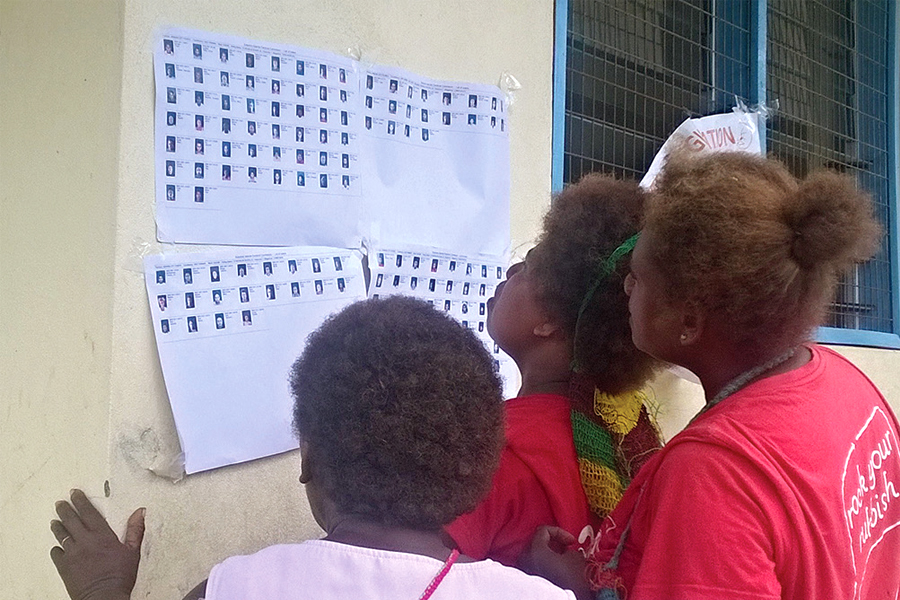
THE first Provisional voters List will be released on Monday next week, according to the Solomon Islands Electoral Commission (SIEC).

In a media statement yesterday, SIEC said voter registrants throughout the country will now have the opportunity to check and correct the first voters list.

SIEC for the past few weeks have been busy with data compilation immediately after the close of registration early this month.

It is stated that around 30 data officers have been engaged for the data compilation process in which they worked around the clock over to match and adjudicate registration details.

“This is when those who were found to be highly resembled are manually verified to establish a decision on whether the same person registered twice or are different registrants.

“During this process, double registrants were identified and their previous registrations removed altogether leaving only the registrants latest registration,” a statement from the office said.

SIEC says printing of the provisional voters list should commence today and be packaged and dispersed right away to all constituencies for publication as of next week.

This provisional voters list should contain names of all who have registered recently and in 2014.

The list is expected to be pinned up in all Voter Registration Centres for registrants to check and identify problems.

During this time, the public is encouraged to view the list and make appropriate changes to the list.

Any registered person can challenge the Provisional List or a person on the Provisional List on the following grounds:

  • Is not a citizen of SI
  • Has not attained 18 years
  • Is not an ordinary resident in the constituency
  • Is not of sound mind
  • Registered more than once
  • Is not the person he or she claims to be
  • Is not qualified by the law
  • Has applied to register but his/her name does not appear on the list or name not spelt correctly.


“If your name appears in yellow on the Provisional Voters List, it means that you have attempted to register more than once. Only your latest registration will remain on the final voters list.”

The Provisional List will be exhibited as of October 29 to November 4, after which the Omission and Objection period commences from November 7 to 20.

SIEC encourages registrants to check the list and make corrections (if any) by filling in Omission and Objection forms which can be issued by Revising Officers upon requests.

“Take note of the important dates above so that you can participate in the legal processes.”

Rapid action needed to limit global warming but allegedly climate aid money is not reaching the most vulnerable in the Pacific.

0

DEAR EDITOR, on a day when an international report says rapid, far reaching and unprecedented changes are needed in all aspects of society to limit global warming, we are told that climate aid money is not reaching the most vulnerable in the Pacific.

Quoting from today’s Radio New Zealand’s news bulletin, 8 October 2018.

“The Intergovernmental Panel on Climate Change (IPCC) said limiting warming to 1.5 degrees compared to 2 degrees is necessary to ensure a more sustainable and equitable society.

“The report provides key scientific evidence ahead of the December climate change conference in Poland, when governments review the Paris Agreement to tackle climate change.

“It said every extra bit of warming matters, especially since warming of 1.5 degrees or higher increases the risks of long-lasting or irreversible changes, such as the loss of some ecosystems.

“The lower limit would reduce sea level rise by 10 centimetres by the end of the century, the Arctic Ocean would be free of sea ice in summer just once a century instead of once a decade, and coral reefs would decline by around 70 percent rather than be completely lost.

“It says “rapid and far-reaching” transitions are required and CO2 emissions will need to fall by 45 percent from 2010 levels by 2030.

“The report is clear that avoiding a warmer future above 1.5 degrees will bring significant benefits for millions of people who will face significantly reduced risks of flooding, food insecurity and climate stress, including Pacific communities,” said Associate Professor Bronwyn Hayward from Canterbury University, one of the report’s authors.

“The world is already seeing the consequences of 1 degrees of global warming through more extreme weather, rising sea levels and diminishing Arctic sea ice, the report said.

“The IPCC noted good news in that some of the kinds of actions needed to limit global warming to 1.5ºC were already underway, but they did need to accelerate, with current decisions vital to ensuring a safe and sustainable world.”

Copyright @ 2018, Radio New Zealand.

Meanwhile, also quoting from Radio New Zealand, we learn that around the world money is being poured into helping vulnerable countries fight climate change.

But Caritas New Zealand director Julianne Hickey said finance was not getting beyond large institutions and government structures.

“We’ve heard time and time again from the Solomon Islands through to Tonga, to Papua New Guinea, that it is not reaching those who need it most and those who’ve done the least to cause the issues of climate change.”

Caritas Australia Pacific manager Stephanie Lalor said preparedness was where money was best spent.

“We know for every one dollar invested in mitigation, preparation activities at community level, we save ten dollars in the cost of actually then responding to the impact of a disaster.”

Sad to think, as many in the Pacific countries are saying, the people have become the victims of a problem others had caused.

Yours sincerely

Frank Short

RENEWING FRIENDSHIPS AND EXTENDING THANKS FOR PAST SUPPORT FOR THE SOLOMON ISLANDS POLICE

0
SINGAPORE:  28 September 2018
DEAR EDITOR, today, I had the pleasure with catching up with an old friend and one who rendered considerable help to the Royal Solomon Islands Police Force during the early years following my appointment as the Commissioner of Police in the Solomon Islands from 1997.
Mr Khoo Boon Hui was the Commissioner of Police in Singapore from 1997 to 2010 and in more recent times till 2016 was the President of INTERPOL.
I took the opportunity at lunch to thank Mr Khoo for having made it possible for several senior officers of the RSIPF to go to Singapore in the period 1997-1998 to undergo training in Community Policing and to tell him how that training experience was put to good practice in the initiation of community policing policy and practice in the period leading up to the onset of civil disturbance in the Solomon Islands, a time when, very unfortunately, the community policing concept and operations were radically disrupted.
Mr Khoo also helped the RSIPF in those early years by giving surplus police uniforms when, on my arrival, I had found the members of the local police service had no change of uniform and there was no funds available to acquire uniforms and other accoutrements.
My Khoo retains a strong interest in the Solomon Islands and several times asked how community policing was now progressing.   I was happy to tell him that community policing was continuing and progress was being achieved.
Yours sincerely
Frank Short

Do not overlook Pacific Islanders own views when tackling the threat imposed by climate change to the Pacific Island Nations.

0

DEAR EDITOR, quoting Radio New Zealand – 5 October 2018

“Climate change experts and Pacific Islands leaders say indigenous views must be included when it comes to creating regional policies on the issue.

“The importance of western and indigenous perspectives uniting when it comes to tackling climate change in the region was highlighted at a recent conference in Auckland.

“For all the lengthiness of its title, the “Climate Change and Conflict in the Pacific: Prevention, Management and the Enhancement of Community Resilience” workshop had a simple message: don’t forget about the Pacific.

“Despite being on the frontline of climate change impacts, Pacific Islanders’ own views on the issue are often absent from the current policy-making process.”

“Those claims are echoed by people like Reverend Dr Upolu Vaai from the Theological College in Fiji, who experiences the impact of climate change effects on the ground every day.

“The narrative, the climate change narrative has been dominated by either the scientific world view or perspective or the economic perspective where the indigenous perspective and indigenous world views are often excluded.”

“Building on the traditional wisdom and Pacific people’s understanding of their own environment is a challenge that Professor Kevin Clements, the Director of the Toda Peace Institute, said couldn’t be ignored.”

Copyright @ 2018, Radio New Zealand.

Yours sincerely

Frank Short

Relaying stark predictions on the growing threat of climate change

0

DEAR EDITOR, in contributing this piece I feel rather like one of Joab’s comforters but the threat we face from climate change, and especially in the Pacific, is a story that has to be told.

 My reference to Joab is because in the bible it is said three of Joab’s friends tried to make him feel better but only made things worse.

Joab answered his friends and said, “I have heard many such things: miserable comforters are ye all.” Job 16: 1-2 KJV.

Just a few days ago, Anoti Tong, the former President of Kiribati spoke about the growing threat of climate change to his nation.

He is widely reported to have said:

“Increasingly frequent king tides and storm surges, floods and longer droughts are new, unwelcome additions to our way of life on Kiribati.

“Sea level rise is turning our freshwater resources salty, rendering the land unable to grow staple crops such as coconut and taro, and eating away our shoreline.

“We are being told that we may have to abandon our islands, the places where our ancestors have been buried, where our children have a home and an identity.

“If this disastrous outcome comes to pass, my people will need a place of safety to move to. Rather than be regarded as “climate refugees” – a term that has no definition or status in the international legal system – I seek migration with dignity for my people.”

Quoting from an article in the US Miami Herald, Leonard Pitts Jr is quoted to have made a spectacular claim in a story he entitled, ‘We only have 10 years to save ourselves from climate change.”

In his lengthy piece, I will quote just one or two extracts.

“What if the end of the world came and nobody noticed?
 
“It’s not quite an idle question.

“You see, something remarkable happened last week. The Intergovernmental Panel on Climate Change, a group of scientists working under the aegis of the United Nations, issued a report on our planet’s health. Turns out its worse than we thought. Barring prompt — and politically unlikely — measures to drastically cut carbon output within the next decade, they say we’ll begin to see worsening droughts, wildfires, coral reef decimation, coastal flooding, food shortages and poverty beginning as soon as 2040.

“You can expect mass evacuations from the most heavily impacted areas. As one of the report’s authors, Aromar Revi, director of the Indian Institute for Human Settlements, told The New York Times, “In some parts of the world, national borders will become irrelevant. You can set up a wall to try to contain 10,000 and 20,000 and 1 million people, but not 10 million.”

The commentary is necessarily subjective analysis, but Mr. Pitts seems to stand by it

 What is clear is the world is still lacking environmental leadership despite the forthright and best efforts of several Pacific Islands leaders in highlighting the very real dangers already evidenced by climate change.

Yours sincerely

Frank Short