An interesting increase within just 4 years, but is expected to drop says SIEC
By Gary Hatigeva
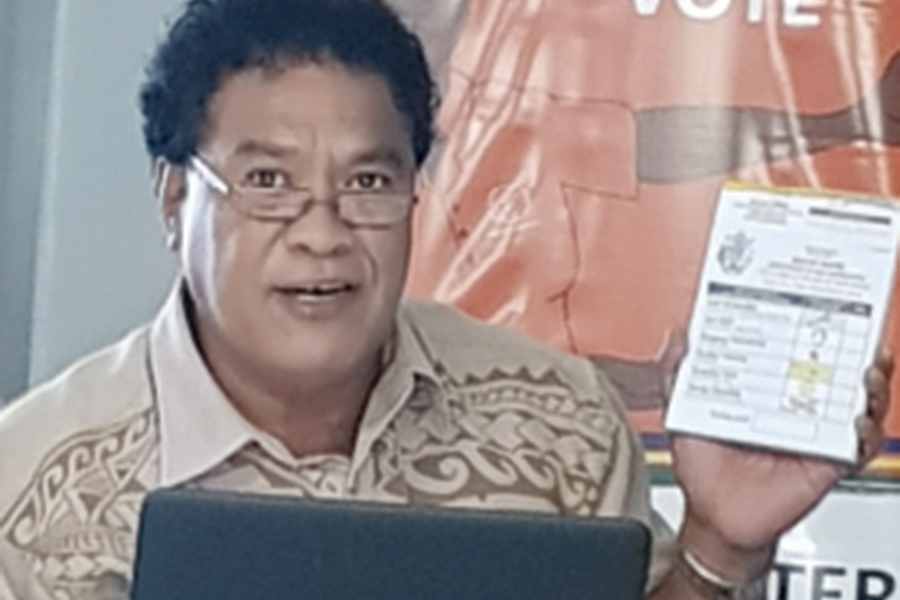
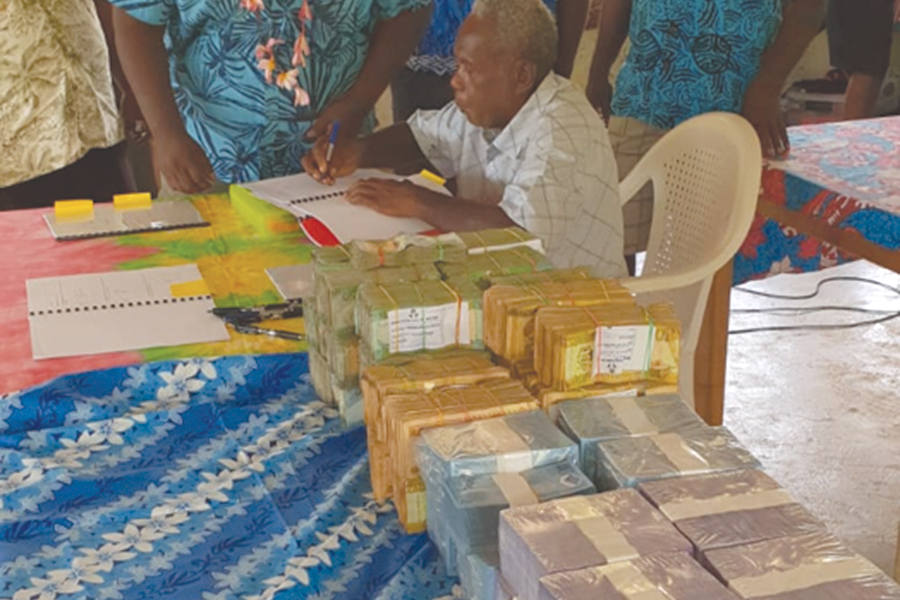
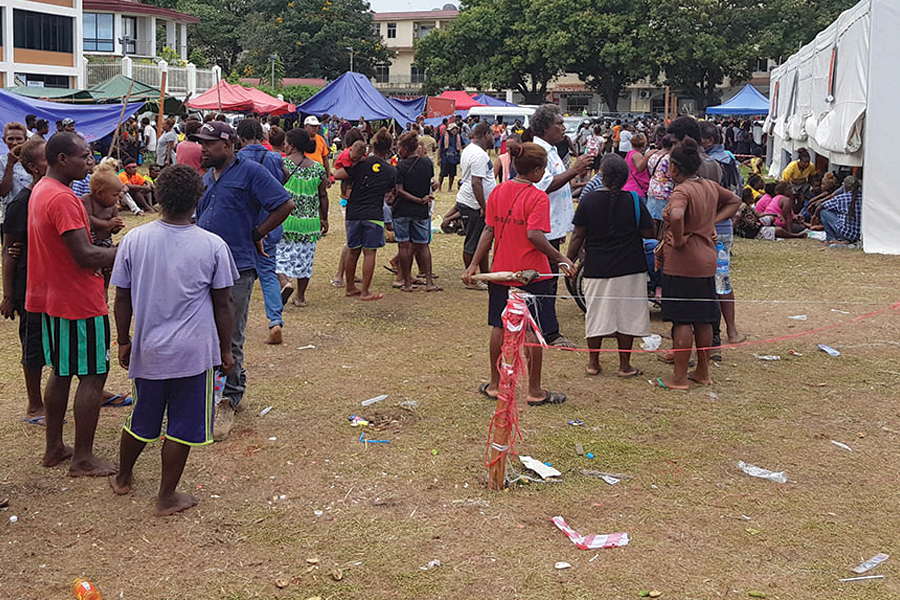
FOLLOWING last month’s voter registration programmes held nationwide, the Solomon Islands Electoral Commission (SIEC) through its Biometric Voter Registration (BVR) system, has confirmed recording around 372,850 voters, an increase of around 150,000.
This increase had jumped past the Commission’s estimates in the expected number, which the Commission’s Chief Electoral Officer, Mose Saitala suggested it to be an interesting increase from just over 200,000 from the last registration exercise, just about four years ago.
In this increase, the Commission has recorded close to 81,000 of newly registered including those who had just fallen into the eligible voting age, which was around the figures that were estimated.
However, around 54,900 were those who re-registered under the transfer status, a figure that is said to have gone beyond the Commission’s estimates, and this according to Saitala, had sparked the high increase, within a period of just four years.
He said it is also under these transfer activities where a lot of people used to register more than once, and confirmed that the commission through the sufficiency of the BVR system was able to remove a good number of names.
Others whose names appeared more than once, was due to the fact they were involved in the mass cross-border registration but have not fulfilled the requirements of the Act, have returned to re-do their registration in their constituency of origin, and this cases have been noted, with some already being removed.
He added that the current total number of names is also expected to drop after the crucial phase of the process, which is the objection and omission, including the public inquiry, where a good number of names are expected to be objected and removed.
The CEO stressed that to see a more accurate and realistic figure, more is needed to be done on the screening, but suggested that this can happen effectively through the help of the people, whom he encouraged to use the Objection and Omission period, to point out people whose names are highly questionable.
He explained that this important process will be done two weeks after the provisional list is put out, and the commission is now working tirelessly to finalise all its preparations and trainings for its Revising Officers, who will be tasked with the responsibility to look after the objection phase.
He then revealed that a good number of names were also highlighted by their registration officials to be underage, but pointed out that there are a good number of them that might still be in the provisional list, but can only hope they are spotted and removed.
Saitala however called again on the genuine electors in all constituencies to assist the commission on this, stressing that SIEC will also rely heavily on them to point out those who are not qualified to register, let alone voting.
Island Sun understands that the Commission was due to start its roll out programme yesterday, pinning up its provisional list of voters for viewing, ahead of the Objection and Omission phase in two weeks’ time.
Chief Nutrition Officer from MHMS, Ms Salome Diatalau who is facilitating a
training on breast feeding programme currently in Auki
BY SAMIE WAIKORI
AUKI
Chief Nutrition Officer from MHMS, Ms Salome Diatalau who is facilitating a training on breast feeding programme currently in Auki
FATHERS are said to also play an important role in breast feeding.
Although breast feeding is carried out by mothers, fathers also need to understand their responsibility under the breast feeding programme.
Chief Nutrition Officer from MHMS who is facilitating a training on breast feeding programme in Auki, Ms Salome Diatalau, made the statement in an interview with this paper yesterday.
She said this breast feeding programme encourages fathers to play an integral role in the breast feeding and nurturing of the child.
“It is common that when mothers go for their antenatal clinic checks (mark), fathers usually do not accompany mothers to clinics.
“But now, as this baby friendly programme in placed we want care fathers give for babies must also share with mothers,” Diatalau said.
She said first care must be shown to mothers so that when babies come out, mothers are healthy to take care of them.
Diatalau said they encourage companionship among couples because they are the reason the babies are there.
She said during the period of pregnancy mothers go through lots of changes in their body, thus, support from fathers are very important to give confidence to mothers.
Diatalau continued that during antenatal, mothers will be educated on the baby friendly initiatives that look at breast feeding for mothers.
“So it’s good for both to be educated on the programme, so that when mothers are doubt on what to do during breast feeding period fathers can assist by recalling the breast feeding educational talk,” she said.
Diatalau said this programme cannot succeed without help from fathers and they encourage them to be the main driver behind the programme.
BUSINESSMAN Patrick Wong and his Board of Directors have done it again – this time paying in full the remaining dividends to the Lavukal people of Russell Islands.
The quiet but rich ceremony took place at Marulaon Village in West Russell last Friday. Some $1.455 million (about AUD249, 000) in dividends were paid out, fulfilling an undertaking Mr Wong made just three months earlier.
“The $1.50m is tied up and is directly linked to the court cases. Once these were completed, it would immediately be paid out,” the businessman reportedly told the crowd last August.
Since then a stunning Court of Appeal victory on October 1 has given Wong and his directors the cue to proceed full steam ahead: and they did; after their promise to pay out within two to three weeks.
True to his word, Wong and his Directors travelled down to Russell Islands by boat early on Friday morning and paid the dividend in full – all $1.455 million of it and more.
Some questioned why the payment was made so close to the National General Election. They wondered if there was another reason for this massive payment,
“As a matter of fact this particular dividend of $1.5m was declared back in September last year. If not for those very few who supported and filed the 344/2017 High Court Case in August – September last year, this money would have been paid last year,” Wong explained.
“This matter was further delayed when this same group, who was misled by John Whiteside, a former employee, filed an appeal to the Solomon Islands highest court; the Court of Appeal,” he said.
“During the 1st of October judgement hearing, it was revealed in a Sworn Statement that this same Whiteside was right in the middle of this issue. Mr Wilson Rano, lawyers for Lavukal told the three Court of Appeal Judges that, when the Court ordered Lavukal to pay security for cost, Mr Rano did not send this notice to his clients; the Lavukal entities, but instead sent the letter to John Whiteside,” Wong said.
“This has now prompted some Lavukal people, to ask why Mr Whiteside is allowed to continue to stay in the country, when he was terminated by the company in October – November last year. He is unemployed, yet he is allowed to cause such bitter division between the Lavukal tribes,” Wong said.
Some Lavukal people are reportedly asking where Mr Whiteside is now, after leaving Chief Samuel Kubu with a $ 500,000 bill he must pay.
“This is what Chief Kubu gets for supporting Whiteside and Van Vlymen, another former business associated. Chief Kubu is thrown to the curb side and on his own,” they said.
Wong also explained that the $1.50million payment is not a bonus, it is Lavukal 24.90 percent share, which Lavukal is rightfully entitled to. He urged them to work together.
“This is the time to come together. This is the time to work together for the betterment of the Lavukal people,” Mr Wong, the main architect of the settlement, reportedly told the crowd.
“The important thing is that the Lavukal people must make a decision. Any internal fight between me and any of my former business associates should not be allowed to stand in the way of any development the Lavukal people want to see on their land,” reportedly said.
The ceremony was attended by many dignitaries from Central Islands province, including its Premier Patrick Vasuni. Honourable Dickson Mua was also invited to attend, but had to send his apologies.
In Friday’s ceremony, a deed of settlement was formally signed between the Lavukal Company Investment Ltd (LCIL) on behalf of its people on one hand and the Russell Islands Plantation Estates Ltd (RIPEL), International Comtrade, Shipping Limited (ICSL) and Levers Solomons Ltd (LSL) on the other. The Deed formalised the acceptance of the return of their three million shares and in turn their entitlement to dividends.
“That deed of settlement simply nullifies past undertakings by Lavukal. In essence, Lavukal has now accepted that the purported MoU made in October 2015 is now null and void,” a source who attended the ceremony told Island Sun at the weekend.
“The deed of settlement has now set RIPEL on a new pedestal for investment and development. In other words, RIPEL, once described as the “jewel of the crown” in Solomon Islands’ economy, is finally free for development.
“The difference is that any new development will be on the terms of the owner, not anyone else’s.”
In August this year Mr Wong and his directors paid the first dividends of $498,000, which was shared equally amongst some 3, 768 Lavukal people including children from two years up.
“Each member of the tribe received $130 each. We did not stop sharing the money until Sunday,” Chairman Lavukal Trust Board, Oliver Salopuka said at the time.
Mr Wong flew out of the country yesterday.
When approached for a comment, he simply said he had none except “I am simply doing what the people of Lavukal want to see.” When Island Sun pressed one last question and asked if this is the last one, Wong said – “No, there’s more to come.”
SIX people die every day due to non-communicable diseases (NCD), according to the country’s health ministry.
A report from the Ministry of Health and Medical Services (MHMS) on the NCD programme says cancer kills one person every day, type-two diabetes kills one person every 2nd day and stroke kills one every day.
It reads that heart problems kills one to two people every day and smoking kills one person every 2nd day.
According to the report [source: NRH], for 2018 – two to three people were amputated every week for NCD related diseases.
It stated that NCD is on the rise and the impact it has on the human resources and economy of the country is great.
National government has spent lots of money to treat patients with NCD in hospitals around the country. It records about $35,883 to treat a diabetes per admission
The report said in 2017, about 400 cases of diabetes were admitted at the (Medical Ward) NRH and it costed about $2million for their treatment.
It is projected that if caution is not taken, in the years to come, people will see more and more NCD cases in young people in their 20s.
The report, on the other hand, gives roadmaps in which people can abide by to avoid NCDs.
It stated that in order to manage NCD, it needs to reverse NCD risk behaviour, not to smoke, eat healthy diet, control weight, no alcohol, no betel nut, and adopt healthy settings.
Sustainability to reduce NCD involves preventions of NCDs risk factors. This is to strengthen public health policies, like the “No Tobacco Act 2010”.
The report stated that it requires partnership with communities, churches and stakeholders to implement package of essential NCDs interventions in the primary settings.
A major discovery was that inadequate consumption of fruits and vegetables was a major risk factor for lifestyle disease and early death.
In the government level, multi-sectoral approach was paramount toward the implementation of the NCD strategic plan 2017- 2020.
The four years NCD strategic plan looked at healthy settings in preventing NCDs. That will be in workplace settings, schools settings and community settings.
The plan also to encourage healthy lifestyles which required providing practical support that creates environment to help people to change or make healthier choice.
These areas were on agriculture (farming), healthy settings, village settings (environment), price control (cheaper local garden foods), attention on supsup gardens and healthy cooking demonstrations.
The plan also advocated against smoking, alcohol, betel-nut and to support communal groups like churches to integrate with the settings.
The plan went to the extend of providing technical advice on NCD-PEN screenings in the settings.
SIEC starts crack-down on people selling and buying voter ID cards
By Gary Hatigeva
THE Solomon Islands Electoral Commission (SIEC) has confirmed activating its major crackdown programme to follow up on people alleged to have collected and bought Voter ID cards since the close of the Registration period.
This comes as a follow-up from the data revealed by the Biometric Voter Registration (BVR) system from the recent registration programme and reliable information obtained.
In confirming this, SIEC Manager Operation Fred Bosaboe told Island Sun that the Commission is working closely with police to execute its mass crackdown exercise, which is expected to be happening soon.
He said the follow-up also comes as part of some complaints and claims raised by concerned voters of people who are allegedly collecting thousands of cards from voters in exchange for financial and personal benefits.
Bosaboe further revealed that around 1000 cases have so far been spotted under the system and information in hand, of people believed to have deliberately defrauded a programme that is guided by an Act of Solomon Islands.
It is believed that a lot of those who are involved in the multiple registration activity, have done so with intention to sell their cards to intending candidates, while candidates on the other hand, are said to be buying cards for the purpose of making estimates to the data of their potential voters for next year’s election.
And it is also said that this is the very reason why a good number of voters who registered in the 2014 registration programme, have appeared in numbers in the recent registration phase asking for replacement of their cards.
However, a lot of section within the new Electoral Act prohibits such activities, highlighting that is an offence for candidates to buy vote or voters soliciting the sale of their votes for any kind of benefit from a candidate, and those caught can face a penalty of $150,000 or 15 years imprisonment or both.
Vote buying or card trading according to officials, is also another form of campaigning, and to be engaged in campaign activity outside campaign period, also commits an offence and can face a penalty of $20,000 fine or two years imprisonment, or both.
Meanwhile, Mr Bosaboe explained that a good number of those to be called in for questioning through collaboration with police, also includes people who have ignorantly defrauded the registration system by engaging in multiple registrations or registering more than once.
Interestingly, the Biometric Voter Registration (BVR) system was also able to pick out one person who managed to register the highest up to 10 times in the recent registration period under different constituencies, using different names.
Unfortunately, he was caught in almost all aspects of the system, as the system according to SIEC, is so sophisticated that it was able to scan for both facial recognition and thumbprint matches, and in this person’s case, the system picked it out clearly, matching all details around 10 times, with a funny name in his last registration.
“And so yes, we are expecting a mass arrest of people attempting and evidently involved in card collecting, including those who are also involved in multiple registration,” Mr Bosaboe confirmed when asked.
Meanwhile, the SIEC Manager Operation stressed that they do acknowledge the fact that many are raising genuine concerns all over social media and mainstream media, but pointed out that it is unfortunate the commission has not received anything in formal.
He therefore, urges complainants to make formal submission of complaints to the commission for thorough follow ups if they have information of those currently involved in card collecting, and revealed that if caught, arrests and prosecution can take place.
He however warned that people involved in this practice have to stop, “because once the authority catches up on you, like the ones that have been noted for arrests, they too will get called up and if guilty, they will receive heavy punishments.
The New act speaks out clearly on such activities, placing an illegal status on them and people can be pay up to 150,000 units or imprisonments of up to 15 years max.
But of the 1000 cases revealed, the commission is of the view some of those spotted might later get released off the hook, and if it does, the commission anticipates the actual to be around 800 cases.
Senior government minister blocking MRD’s new lease agreement
By Alfred Sasako
A senior Government Minister is reportedly blocking the Ministry of Rural Development (MRD) from moving out of a converted motel building which the Government is leasing at $245,000-a-month.
The building at Ranadi in East Honiara also houses the offices of the 50 constituencies.
Insiders told Island Sun on Friday 26th October the Minister has been arguing for the renewal of the lease agreement, which is due to lapse at the end of the month.
“He has argued consistently both in Caucus and in Cabinet for the renewal of the existing lease, which is contrary to cost-saving measures the government is promoting,” one insider told Island Sun on last Friday.
“Everyone in Cabinet and Caucus knows the Minister’s position is influenced by politics – he assumes the new Landlord is supporting a candidate who will be contesting his seat at the National General Election next year,” the insider said.
Two months ago the MRD signed a two-year lease with a new Landlord, whose building is located in Honiara’s Central Business District (CBD). The new premises will cost $150,000 a month ($95,000 a month less than the current lease).
As a result of the Minister’s position, the first payment for the new premises believed to be around $600,000, which includes the bond, has been held up at the Treasury.
“The Minister’s position has placed the MRD in a very awkward position. On one hand it has already entered into a new and binding lease agreement with a new Landlord, while on the other hand the Minister wants to renew the current agreement,” one insider said.
“The MRD is now faced with a huge problem on its hands. Unless there is political intervention at the highest level, there doesn’t seem to be an end in sight,” the insider said.
It is understood the owner of the Ranadi premises is now offering the lease at $190,000 a month.
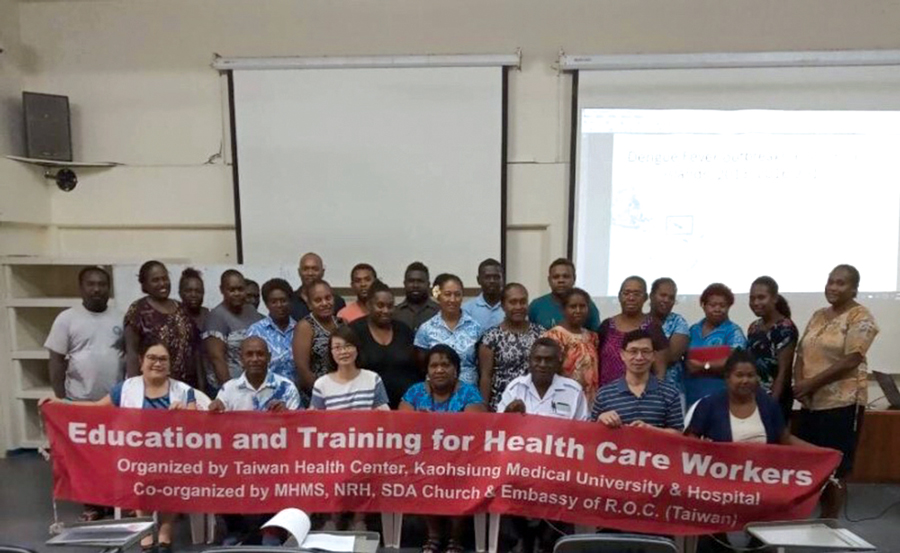
THIRTY-THREE local health workers from NRH, HCC, Guadalcanal province, and nursing school of SINU attended an Infection Prevention and Control workshop at the Taiwan Health Center (THC) from October 30 to November 1.
THC Leader, Alice Hsu said the workshop was conducted by THC and two visiting experts from Kaohsiung Medical University Hospital (KMUH) in Taiwan.
They are Infectious Disease doctor Wei-Ru Lin and Infection Control nurse, Ching-Tzu Hung.
Dr Lin is the Director of Infection Control Center and Hung is the leader of the Infection Control Center.
During the opening ceremony, National Referral Hospital’s (NRH) Director of Nursing Department, Selwyn Hou said in recent years, healthcare-associated infection has become an important issue in the hospitals in Solomon Islands.
He stressed that implementation of the infection prevention and control program is not just the government’s responsibility as it also needs the cooperation of all staff members of the hospital, especially to comply with the policy and procedure of infection control.
At the workshop, Dr Lin provided lectures about infection control including how to break the transmission of infectious disease, tuberculosis and the catheter-associated urinary tract infection care bundle.
He also took time to visit the hospital where he led the participants to inspect the wards and suggested the building of a model ward.
Lin says a model ward of standard of infection control would include a clean environment with standard operating procedures for the patient care with an evidence-based guideline and care bundle with checklists.
Participants at the workshop were taught how to correctly use the N95 respirator and tested the use of a fluorescent lotion to demonstrate correct hand hygiene.
This is involved learning the importance of the correct hand hygiene method.
Leader of the Infection Control Unit at NRH, John Saohu also spoke about the current policy and guideline of infection prevention and control in Solomon Islands.
National Health Surveillance Unit leader, Alison Ripiapu spoke about emergency preparedness and response of emerging diseases including Dengue fever in Solomon Islands.
THC Leader, Hsu, expressed that the Infection Prevention and Infection Control had been held annually since 2015.
“We all sincerely hope that all these Solomon participants will be able to implement the programme of prevention and control of infection to improve patient safety in Solomon Islands,” she said.
A Taiwanese businessman Mr Chiang Wen-hao introduces his business products and services offer such as coconut
fiber, peat, charcoal, frozen copra and PET flakes.
BY LYNTON AARON FILIA
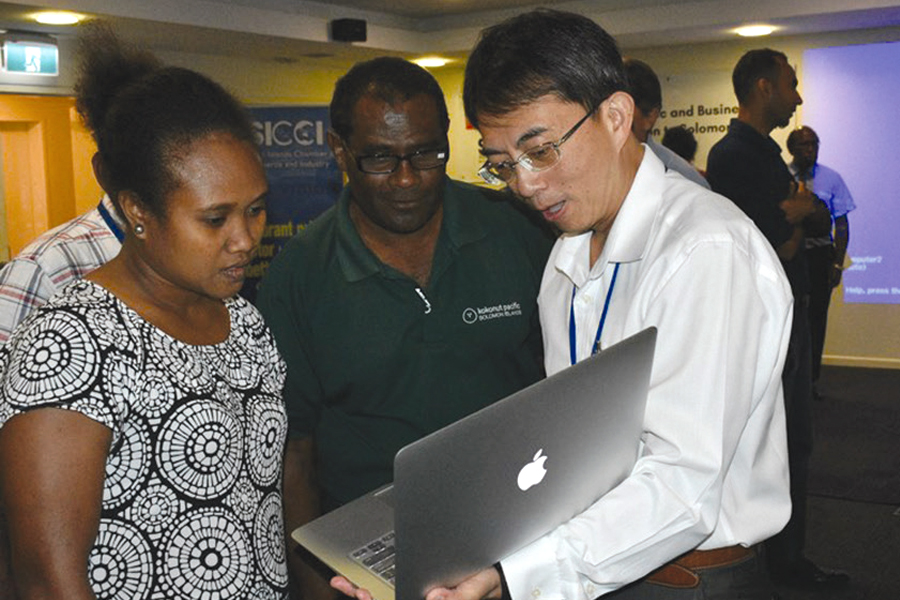
A Taiwanese businessman Mr Chiang Wen-hao introduces his business products and services offer such as coconut fiber, peat, charcoal, frozen copra and PET flakes.
SIX companies in Taiwan are eyeing Solomon Islands as a place to do business.
This was reported during a workshop on Taiwan Economic and Business Cooperation held at Heritage Park Hotel yesterday.
The six companies in Taiwan were given the chance to interact, network and share business opportunities with the members of Solomon Islands Chamber of Commerce and Industry’s members (SICCI).
Following that, the visiting companies also presented their business ideas and shared their interest to invest in Solomon Islands.
Prime Minister Rick Houenipwela said the business forum marks a new beginning for trade agreement between Solomon Islands and Taiwan.
He said over the past three decade, the investment and trade between Solomon Islands and ROC (Taiwan) did not really feature high on the partnership agenda.
However, the one-day forum symbolises both governments’ acceptance as it is now time they address this important sector directly and with serious and focused attention, PM Hou said.
He said they came up with the concept to minimise the country’s continuous reliance on external donors’ generosity into the foreseeable future.
With this, Hou said SIG is strategically positioning itself to increase its focus on trade to supplement aid with the view to replace much of their development aid with trade in the coming decades.
He said the Ministry of Foreign Affairs and Trade and Ministry of Commerce, Industry, Labour and Immigration have been part of the workshop which will further explore opportunities for stronger technical cooperation.
Not only that but mutual partnership in commercial business development partnership and through trade and investment exchange, Hou said.
At the same time, Taiwan’s Ambassador to Solomon Islands Mr Roger Luo said Taiwan’s six companies hope their presence will provide a platform to connect with the right people that they want to meet in Honiara.
He said the one-day business forum has availed opportunities for both countries to explore business opportunities with the aim to achieve tangible results.
His Excellency Luo said the visit of six companies here is a result from SIG’s earnest hope to cooperate with Taiwan to achieve more of Solomon Islands’ development aspirations.
HE Luo said during PM Hou’s visit to Taiwan he met several Taiwanese entrepreneurs and tirelessly advocated this meaningful cause.
“The visit by this Trade Mission is indeed a follow-up and response on our part to PM Houenipwela’s call for more business cooperation between Taiwan and Solomon Islands,” he said.
From the archipelagic islands of Solomon Islands to the highest mountain on earth, the Solomon Islands flag was flown high amongst flags of the different nations on earth. Talita Mazini Henderson is part Solomon Islands. She
left the SI flag on Mount Everest Base camp with pride
BY GEORGINA KEKEA
TWENTY-TWO year-old Talita Mazini Henderson is said to be the first Solomon Islander to fly the country’s flag high at the Mount Everest Base Camp.
A British citizen, and a Solomon Islander by blood, Talita’s mother comes from Nusa Simbo in the Western Province. All her life Talita had been living abroad, but comes home occasionally to connect with her mother’s side of the family.
It was only recently, Talita made the trek to Mount Everest Base Camp as part of a group from the University that she went to in the United Kingdom. This was for a charity fundraising project.
While the focus of her expedition was for the fundraising project, the pride in carrying the flag that bore her roots also made a significant impact in the hearts of many that saw her picture via social media at the Everest Base Camp. More gratified was her mother, Nagarita Mazini.
“I am very proud because this one will put Solomon Islands on the map as she had been to a place where no Solomon Islander have been to yet,” said Talita’s mum, Nagarita.
Mount Everest is in the Himalayan mountain range in a small country in Asia called Nepal. Talita said her trek was for 15 days. It started with an early morning flight to a mountain town called Lukla. Lukla is approximately 2500 metres above sea level. A little higher than the highest mountain in Solomon Islands.
Talita with the Solomon Islands flag. At her back is Mount Everest, the highest mountain on earth.
The flight to Lukla is said to be one of the most dangerous in the world because it depends so much on the weather. Sometimes the flight can be delayed or cancelled for days.
“Aside from the mountain and danger element, it reminded me of the Solomon Airlines flight to Gizo – small plane and small runway,” Talita said.
Everest Base Camp is the starting point for those preparing to climb to the top of Mount Everest.
From the archipelagic islands of Solomon Islands to the highest mountain on earth, the Solomon Islands flag was flown high amongst flags of the different nations on earth. Talita Mazini Henderson is part Solomon Islands. She left the SI flag on Mount Everest Base camp with pride
Thousands of trekkers visit the place every year, some with the intention to conquer the highest mountain on earth. For Talita, the breathtaking view of the sunrise on Mount Everest was worth the trip.
“We woke up at 3am to do the sunrise climb to Kala Patthar, the famous viewpoint of Mount Everest at 5500 metres above sea level.
“At this altitude, it would only take a few steps before my heart felt like it would burst out of my chest.
“It slowly started to get light and the silhouette of Mount Everest began to show. That was all the motivation I needed to push myself to the top. We made it there before sunrise.
“The panoramic view of the snowcapped mountains that surround it is breathtaking. It was worth the numb cold fingers, something a bit difficult to imagine in the Solomon Islands.”
The highest spot that Talita trekked to in Solomon Islands, Nusa Simbo. Here she is pictured with her mother Nagarita (R) and extended family in Simbo
In the Solomon Islands, the highest that Talita had reached in her trekking was to the highest hill in Nusa Simbo. The highest elevation in Nusa Simbo is 111 metres.
So for Talita, the two-week trek in the Himalayas was one of the most difficult, yet enjoyable experience.
“I noticed similarities between Nepal and Solomon Islands. I saw women washing clothes from a shared water supply, there was no electricity in some of the remote villages and there was a strong religious foundation (in their case Buddhism),” Talita muses.
She said they even played cards every night, just like she does with her family in Simbo.
However she was amazed by the dramatic landscapes of the mountains in Nepal just like she was amazed by the dramatic landscapes of the sea, islands and forests of Solomon Islands.
The island life. Talita enjoying her time in Simbo.
“Both countries are hidden gems where mankind is only just scratching the surface. From the mountains to the sea, one boasts beauty at a height, the other at sea level. Nepal has the highest mountain in the world and Solomon Islands has one of the largest lagoons in the world,” Talita said.
She said she was proud to have represented Solomon Islands at Everest Base Camp.
“We all supported her. My sons, her brothers. We all supported her in her fundraising efforts to trek the Himalayas. So we are all proud of her achievements,” her mother said.
At the same time, Talita’s dad, Christopher Henderson said he is happy for her daughter wanting to see the world.
He said the travel bug in Talita might have come from them (Talita’s parents) from the way they travel the world especially in their work life.
Talita’s father works in the Agriculture sector and met her mother in Solomon Islands when he worked here many years ago. As a child, Talita grew up in the Philippines, Nambia as well as Jamaica.
Since Solomon Islands is yet to pass the dual citizenship law, Talita currently holds a British citizenship passport.
However she holds Solomon Islands dear to her heart as this is also her place of origin.
“When my mum asked me to carry the Solomon Islands flag with me, I thought, why not? Solomon Islands is unique and it is a part of me and I think it is important. Two contrasting places Solomon Islands and Everest and I think it will be nice to represent Solomon Islands by carrying its flag to the highest place on earth,” she said.
Talita loves travelling and charity work. The charity fundraising project that she participated in was for Meningitis Research Foundation.
How the women in Nepal do their laundry. Quite similar to Solomon Islands
She raised a total of £3243.22 ($32,000) in that project. The charity does work from medical research to raising awareness with the ultimate goal of eradicating meningitis altogether.
“The groups most affected are babies and students so I felt it was important to help spread awareness as a student myself.”
Talita just completed her university studies and is currently in the country with her parents. She will be going back to the UK soon but promised to be a true ambassador of Solomon Islands wherever she goes and wherever she works.
She says she will also be happy to work or help out in the country’s newest office in London should she be given a chance.
Talita also speaks Spanish and French as well as Solomon Islands pijin, despite not growing up in Solomon Islands.
“My mum used to say a few words in her language in Simbo. I don’t speak her native language but can follow through with a few words,” Talita laughingly say.
Mount Everest is known as Sagarmatha which translates ‘Goddess of the sky’. Locals have long respected the Himalayas Mountains as home to the gods. Until the 1900s, local people did not climb these sacred peaks.
The temperature at the top of Everest can reach -60 degrees Celsius at the most. The warmest it can get is -7 degrees Celsius.
Climbers can lose 4 to 10 kg during an expedition to Mount Everest.
“I am proud to have represented Solomon Islands at Everest Base Camp. Hopefully someone is inspired by this and decides to take it all the way to the top,” Talita challenges.
The three new Japanese Volunteer, from left Tsuyoshi Suzuki, Yoshiaki Uto and Masae Ito
BY MAVIS NISHIMURA PODOKOLO
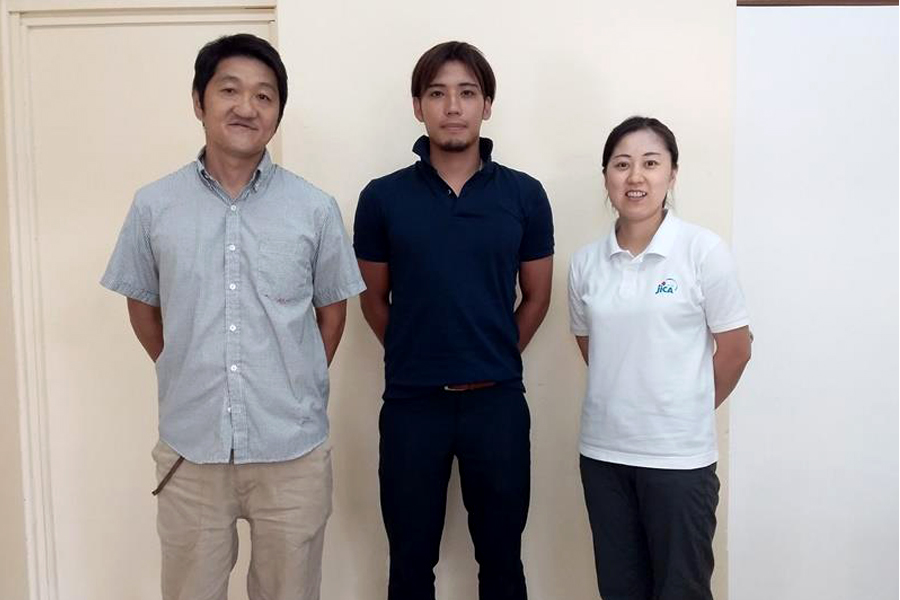
The three new Japanese Volunteer, from left Tsuyoshi Suzuki, Yoshiaki Uto and Masae Ito
THE Japanese Ambassador to Solomon Islands Toyama Shigeru has urged three new Japanese volunteers to Solomon Islands to work hard with local counterparts with passion for contributing something to a better life of local people.
Mr Shigeru revealed this yesterday in an exclusive interview with this paper over the matter.
“I urged three new volunteers to work hard with local counterparts with passion for contributing something to better life of local people,” said Shigeru.
He said solid friendship between two counties is not only brought about by official-level contact but also through the people-to-people contact among Japanese and Solomon Islanders.
Shigeru said this connection has been enhanced by the JICA volunteers with local communities in Solomon Islands.
“In fact, we have many such volunteers who dedicated themselves to further promoting the grass-root friendship between the two peoples.
“I hope that three new volunteers will also be loved by local communities.”
These three volunteers are Tsuyoshi Suzuki who is 47 years old, 34-year-old Yoshiaki Uto and Masae Ito who is 31 years of age.
They will be helping out in three different arenas according to their different skills and abilities.
Suzuki is specialised on information communication technology hence he will be working for the institute of Public Administration and Management (IPAM), Uto on Physical education and will be working at the Solomon Islands National University institute of education and humanities, and Ito is a Nurse and will be serving Buala Hospital in Isabel.
They will be serving Solomon Islands for two years and will leave for Japan in 2020.
In relation to the Japanese voluntarily programme, the Japanese Government has provided a various types of assistance to Solomon Islands since the establishment of the diplomatic relations in 1978. Over the past four decades, Japan has dispatched more than 400 volunteers to Solomon Islands.